
How Much Does a Gallon of Exterior Paint Cost in 2025?
In 2025, you’ll typically pay about $35–$75 per gallon for exterior paint. Premium acrylics and long-lasting coatings usually cost more, while basic formulas cost less. Your total price can jump with surface prep, primer, caulk, and supplies, plus how efficiently the paint covers your siding. Sheen and quality also affect durability and washability. If you want to estimate gallons and true cost per square foot accurately, keep going—there’s more that can change your budget.
How Much Is Exterior Paint Per Gallon in 2025?
How much should you expect to pay for exterior paint per gallon in 2025?
You’ll typically see ranges from about $35 to $75 per gallon, depending on quality and finish. Premium acrylics and long-lasting coatings often sit nearer the higher end, while basic formulations usually cost less.
Your budget should also account for cost fluctuations caused by shifting material prices and shipping charges. Keep an eye on market trends, because sales cycles, contractor demand, and regional supply can quickly move prices.
If you compare brands, price per gallon matters most alongside coverage rate and durability.
What Impacts Exterior Paint Cost Per Gallon?
Paint brand and line can swing the price fast, since premium finishes often include better durability and additives.
You’ll also pay more when surface prep and repairs are needed, because smoothing, patching, and cleaning take time and materials.
Finally, your coverage rate and chosen paint thickness affect how many gallons you use, so small changes can raise or lower your total cost per gallon.
Paint Brand And Line
Even if two buckets cover the same square footage, the brand and product line you choose can swing the price per gallon.
You often pay more for premium lines backed by strong brand reputation, because you’re buying proven color stability and protection.
You’ll also notice higher costs when the line emphasizes product durability, like resistance to fading, cracking, and mildew.
Budget brands may cover well at first, but you might spend more later on extra coats or earlier repainting.
Surface Prep And Repairs
Before you buy a gallon, surface prep and repairs largely determine what you’ll actually pay for exterior paint.
Start with surface cleaning: you remove mildew, chalking, dirt, and loose grime so the coating bonds well.
Then inspect for cracks, peeling, blistering, rot, and failing caulk. If you patch holes and sand rough edges, you reduce rework later.
You may need priming over stained spots, bare wood, or metal to prevent bleed-through.
Complex repair techniques—like replacing damaged siding or filling deep cracks—raise labor time and material costs, increasing your overall cost per gallon.
Coverage Rate And Thickness
Once your surface prep is done, the next factor that sets your real paint cost per gallon is how much area you can cover at the thickness you need.
You’ll get better value when your coverage thickness matches the label, because too thin coverage can force extra coats. Too thick, and you’ll burn more paint per square foot than expected.
Your application techniques also drive results: spraying, rolling, and brushing each spread paint differently, affecting waste and actual coverage.
Weather and drying time matter too, since fast-dry conditions can reduce leveling and increase film buildup.
Measure carefully and plan coats.
How Does Acrylic vs Elastomeric Change Pricing?
When you choose acrylic exterior paint, you often pay less upfront, but you may need more gallons to hit the coverage you want.
Elastomeric paint costs more per gallon because it adds flexible binders that help it stretch over cracks and resist peeling.
You’ll get better value when you match the acrylic coverage and cost to your surface needs or pick elastomeric flexibility pricing for problem areas.
Acrylic Coverage And Cost
Acrylic paint can cost less per gallon than elastomeric options, but you usually pay for coverage in a different way—how it spreads and how well it hides varies by the product.
You’ll often get solid coverage with acrylic advantages like strong adhesion and good hide on properly prepped surfaces.
Still, acrylic disadvantages show up when you’re painting rough, stained, or chalky exteriors; you may need thicker coats or primer to avoid showing through.
Check the label’s spread rate and plan for number of coats to estimate real per-square-foot cost.
Elastomeric Flexibility Pricing Impact
Elastomeric paint typically costs more per gallon than acrylic, but its flexibility can reduce waste and labor on problematic surfaces. If your siding has hairline cracks or stucco that moves, you’ll pay extra upfront but benefit from elastomeric benefits that stretch and resist peeling. That can lower repaint frequency and fewer touch-ups, which offsets higher per-gallon pricing. Use this quick comparison to forecast:
| Finish | Best for | Cost impact |
|---|---|---|
| Acrylic | Smooth, stable walls | Lower |
| Elastomeric | Cracks, movement | Higher |
Flexibility advantages also help you skip extra caulking and prep.
Why Brand, Sheen, and Quality Raise Exterior Paint Cost?
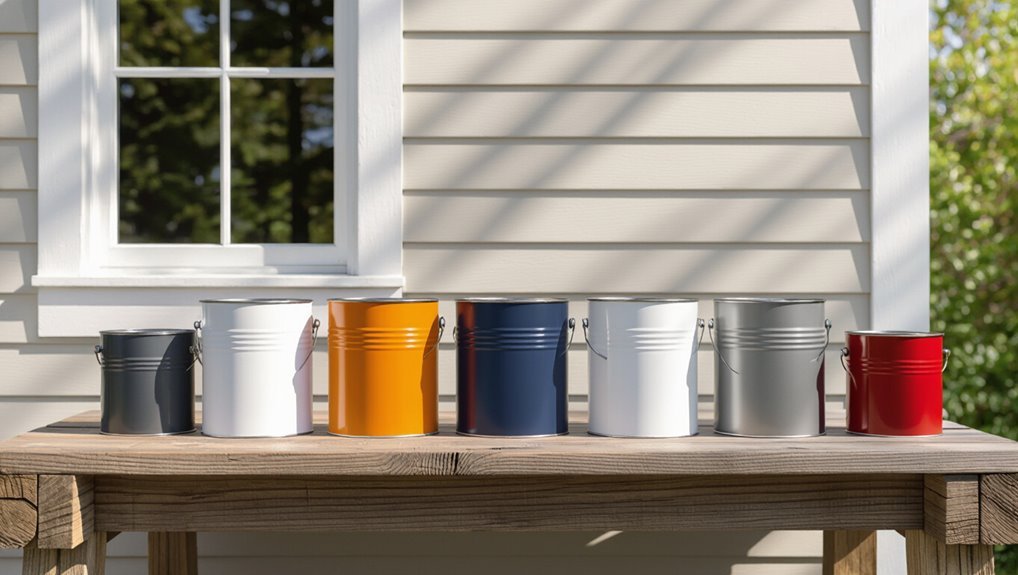
Because you pay for performance, the brand, sheen level, and overall quality of exterior paint can meaningfully raise the per-gallon cost.
You’re paying for proven brand reputation, better binders, and more consistent pigment loads that resist fading and cracking. Higher sheen levels can cost more because they often use specialized resins to create stronger sheen effects and tougher cleanable surfaces.
Premium quality also improves adhesion, washability, and color retention, so you buy fewer “touch-up” gallons later. If you choose cheaper paint, you may spend more time prepping, repainting, and patching failed areas.
What Coverage Rate Means for Your Cost Per Sq Ft?
Coverage rate tells you how many square feet one gallon of exterior paint will actually cover, so it has a direct impact on your cost per sq ft. If the label says 350 sq ft per gallon, you can estimate material needs before you buy.
Higher coverage efficiency usually means you apply fewer gallons per project, which improves cost effectiveness.
- Check coverage for your surface type and texture
- Compare paint formulas by sq ft per gallon, not price alone
- Factor in coats: coverage per coat affects total gallons
- Plan for waste and trim details to avoid underbuying
How Climate and Siding Condition Affect Paint Needs?
Your regional climate changes how fast paint breaks down, so you may need extra coats in harsh sun, freeze-thaw cycles, or humid coastal areas.
If your siding’s in rough shape—peeling, chalky, or uneven—you’ll spend more effort on scraping, sanding, and priming before you can paint.
When you factor both conditions into your plan, you avoid underestimating the total paint you’ll need.
Regional Climate Impacts Coverage
Even if you pick the right paint, regional climate and siding condition can change how many coats you actually need. You’ll face different climate variations: humid coasts may require extra film thickness to resist mildew, while dry, sunny zones fade faster and can burn through topcoats.
In cold regions, freeze-thaw cycles stress bonds, so you often apply an additional coat to maintain coverage uniformity. Track regional trends by local temperature swings, wind exposure, and rainfall frequency, then plan coats that match how your area absorbs and weathers paint.
- Use humidity and mildew risk maps to estimate coverage loss
- Adjust coats for UV intensity and reflectivity
- Factor wind-driven rain penetration depth
- Compare local rainfall totals with historical averages
Siding Condition Drives Prep Needs
Before you buy the paint, you need to judge the siding’s condition, because it determines how much prep work—and how many coats—you’ll need.
Check for peeling, chalking, cracks, or loose boards, since failing surfaces won’t hold properly. In wet or freeze-thaw climates, damaged edges soak water, then expand, so you must scrape, dry, and spot-prime early.
Different siding materials—wood, vinyl, fiber cement, brick veneer—require distinct primers to strengthen paint adhesion.
If the surface is sound, you’ll prep lightly and often apply fewer coats. If it’s failing, expect more labor and extra coverage.
Labor vs Materials: Where Exterior Job Costs Rise?
Exterior painting costs climb when you shift from thinking about gallon prices to tracking how labor and materials each add pressure on the project.
You’ll feel labor costs rise when crews spend extra time masking, scraping, patching, and managing weather windows. Meanwhile, material expenses climb as you buy primer, caulk, patch compounds, specialty coatings, and thicker coverage for textured siding.
Decide what you can control before you sign, because estimates swing based on schedule intensity and prep complexity.
- Prep hours vs crew rates
- Number of coats and dry time
- Surface waste and material overage
- Access issues like ladders and scaffolding
How Many Gallons Do You Need for Common Homes?
To estimate how many gallons of exterior paint you need, you start by calculating your home’s paintable square footage and then dividing by the coverage rating on your paint can.
This gallon estimation depends on your home size, window count, and surface complexity, so measure carefully.
For a typical small house (1,000–1,500 sq. ft.), plan on about 2–4 gallons per coat.
For a mid-size home (1,500–2,500 sq. ft.), expect roughly 4–7 gallons per coat.
For larger homes (2,500–3,500 sq. ft.), you may need 7–11 gallons.
Always add extra for weathered areas.
Do Primer, Caulk, and Supplies Add to Paint Cost?
Yes—primer, caulk, and supplies can add to your exterior paint cost, especially when your siding has gaps, peeling paint, or bare spots.
Before you buy gallons, budget for Primer costs, Caulk expenses, and Supply considerations that protect adhesion and prevent moisture intrusion.
Before you buy gallons, budget for primer costs, caulk expenses, and supply needs that boost adhesion and prevent moisture intrusion.
You’ll likely need additional brushes, rollers, painter’s tape, scrapers, sandpaper, patching compounds, and drop cloths.
- Estimate primer for repairs and bare wood spots
- Plan caulk for seams, cracks, and joints
- Factor tools and prep consumables into additional materials
- Account for waste from cuts, touch-ups, and thicker coverage
When Specialty Coatings Cost More (and When They Pay)?
Specialty coatings often cost more because they’re engineered for specific problems—like elastomeric flexibility, rust-resistant metal protection, anti-mold and mildew additives, or higher-build systems for heavily weathered surfaces.
You’ll pay extra when you face specialty applications such as breathable stucco repairs, industrial-grade rust control, or long-lasting marine exposure.
You should also expect higher pricing if the coating system includes multiple layers, primers, and longer cure times.
Still, you can justify the cost when it prevents peeling, stops corrosion, and extends repaint intervals—your cost justification comes from fewer callbacks and longer durability.
How to Compare Quotes and Cut Exterior Paint Costs?
Before you buy, compare quotes by breaking down the total cost per square foot and confirming exactly what’s included.
Before you buy, compare quotes by breaking down total cost per square foot and confirming exactly what’s included.
Ask each contractor to list prep work, caulking, primer type, number of coats, paint brand/grade, labor hours, and cleanup.
Then run simple cost saving strategies: match scope before negotiating, request a written breakdown, and check warranty terms.
Use paint selection tips by choosing the correct sheen and durability for your climate to avoid rework.
Also confirm materials include tax, disposal, and scaffolding or lift fees.
- Verify surface prep requirements
- Compare primer and coat counts
- Check warranty and licensing
- Request line-item pricing and timelines
Frequently Asked Questions
How Long Does Exterior Paint Typically Last in 2025?
Typically, exterior paint lasts 5–10 years, depending on surface prep and application quality. You improve paint durability with priming, caulking, and proper coats. Good weather resistance protects against fading, peeling, and cracking.
Can I Paint Over Old Exterior Paint Without Sanding or Priming?
You can sometimes, but don’t count on it. For solid paint adhesion, you need surface preparation: clean loose paint, scrape blisters, and sand glossy spots; spot-prime stains or bare wood. Otherwise, peeling will “come back like a ghost.”
What’s the Best Temperature Range for Applying Exterior Paint?
Aim for 50–85°F (10–29°C) for best weather conditions; avoid freezing nights or scorching sun. You’ll get better paint application when surfaces are dry, not windy, and humidity stays low, so the coating cures evenly.
Does Darker Paint Cost More or Require Different Coverage?
Darker paint can cost a bit more, because color absorption often demands richer pigments. You usually need similar coverage, though shadier tones may look best with two coats. Better color absorption can boost paint longevity.
Are Zero-Voc Exterior Paints More Expensive in 2025?
Yes—zero-VOC exterior paints often cost more in 2025, but you can offset that with better durability and fewer health-related headaches. Do a price comparison, and explore paint alternatives like low-VOC options for similar performance.
Conclusion
As you plan your exterior refresh in 2025, remember: price isn’t just a number per gallon—it’s the promise of coverage, durability, and the right finish. Think of each coat like a shield, with primer as your armor and caulk as the seam that keeps the storm out. Compare brands, sheen, and coverage rate, then price your job by square foot, not guesswork. You’ll stretch your budget—and your curb appeal—farther.
