
What Is a Wall Painting Called? Art Terms and Styles Explained
When you see art painted directly onto a surface, you’re looking at a wall painting—an umbrella term for murals and plaster or surface paintings. A fresco is painted on wet plaster so the pigments bond to the wall, while a mural usually means large public artwork. You might also spot trompe-l’oeil for 3D illusions, sgraffito for scraped layered effects, or relief painting for raised texture. You can identify materials, condition, and repairs, then keep going to learn more.
What Is a Wall Painting Called?
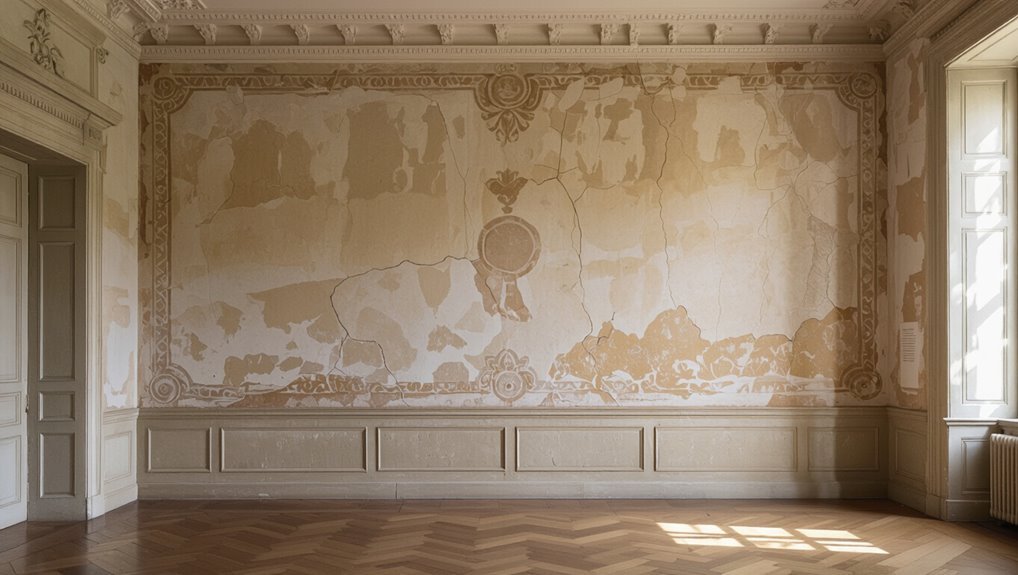
When you look at a building’s interior or exterior and see imagery painted directly onto a surface, you’re probably looking at a wall painting.
You can call it that in everyday use, but you’ll also hear specific labels tied to the setting and historic techniques. You might describe ancient works as plaster or surface painting, especially when pigments settle into prepared layers.
You may also reference “decorative mural” when the design covers large sections, yet the key idea stays the same: paint becomes part of the wall.
Treat it as more than decoration—wall paintings often carry cultural significance.
Fresco vs Mural vs Wall Painting: What’s Different?
You’ll see that fresco is made when pigments are applied directly onto wet plaster, so the image becomes part of the wall surface.
You’ll also notice a mural is simply large-scale public wall art, often created for a broader audience.
When you hear wall painting, it’s the general interior term that covers many kinds of painted walls.
Fresco: Pigments Applied On Plaster
Fresco applies pigment directly onto freshly laid plaster, so the colors bond as the wall sets. You work quickly, using fresco techniques where water in the plaster helps pigments become part of the surface rather than sitting on top.
You can layer tones and adjust details while the plaster is still receptive, which rewards practiced brushwork. Because this process becomes integral to the wall, it can remain surprisingly durable for centuries.
You see fresco’s historical significance in churches and civic buildings, where artists trusted the medium to carry symbolism and daily life in lasting color.
Murals: Large-Scale Public Art
Murals are large-scale public artworks that transform architecture into a shared visual story. You’ll see them as public art that invites community engagement through vivid visual storytelling.
Unlike fresco, you don’t need plaster; artists apply paint or mixed media directly on walls using artistic techniques suited to streets, plazas, and transit spaces. Murals often carry cultural expression and historical significance, honoring local events, people, and landmarks.
When you support urban revitalization, you’re backing collaborative projects that turn neglected surfaces into landmarks. Look closely, and you’ll notice the planning, scale, and materials that make murals endure and resonate.
Wall Painting: General Interior Terms
Wall painting covers many interior surface treatments, but the big differences come down to materials, process, and context.
You’ll hear “fresco” when pigment bonds to wet plaster, giving durable color that feels integrated.
You’ll hear “mural” for large-scale planned imagery, often tied to a broader site vision.
You’ll hear “wall painting” for the general act—applied to plaster, drywall, or panels—more flexible for interior design and color psychology.
- Pigment-to-surface bonding (fresco)
- Scale and site intent (mural)
- Broad technique and medium (wall painting)
Graffiti and Street Art: Wall Painting Names
When you see a graffiti tag, you’re usually spotting a quick signature meant to claim space.
In contrast, murals and street art pieces build scenes with color, characters, and bigger themes.
As you compare tags to murals, you’ll notice distinct styles and names that help you tell what you’re looking at fast.
Graffiti Tags Vs. Murals
Graffiti tags and murals both claim public space, but you can tell them apart by their goals and execution. Tags focus on quick identity marks, using tagging techniques to leave a name fast, often in tight scripts.
Murals aim for visual storytelling, so you see larger compositions, careful color planning, and sometimes paint-by-number planning influenced by mural history.
Look closely:
- Taggers repeat their name to build recognition
- Muralists develop scenes, characters, or messages
- Artists choose surfaces to maximize impact and readability
When you compare speed, scale, and detail, the difference becomes obvious.
Street Art Styles And Names
Street art styles don’t just decorate walls—they follow distinct names, rules of scale, and signature looks. You’ll spot tags from graffiti evolution, fast and personal, then move into throw-ups with bold outlines.
Street murals expand into larger compositions, building urban aesthetics through visual storytelling and careful lettering. Stenciling and wheatpaste add texture, while wheatpaste posters push public expression with readable imagery.
Styles like mural realism or abstract pieces often signal cultural identity. You may also witness artistic collaboration when crews trade techniques and roles.
Finally, community engagement keeps the work grounded, turning each wall into shared conversation.
Trompe-l’oeil: When Walls Look 3D
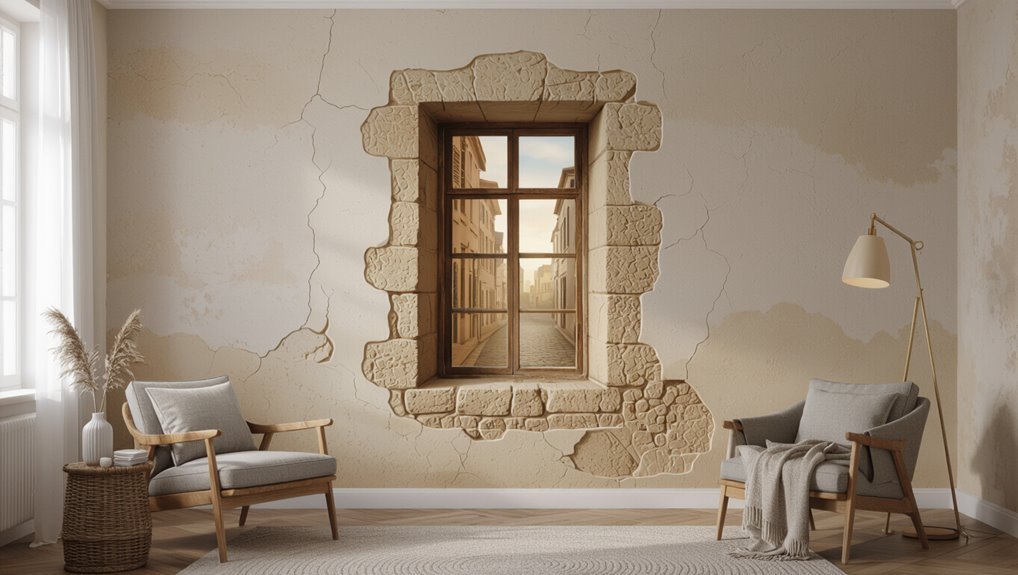
Trompe-l’oeil uses painted illusion to trick your eye into seeing depth where there isn’t any. You stand close, and suddenly flat plaster looks like carved stone, framed doors, or receding shadows.
You use trompe l’oeil techniques to stage realistic highlights, gradients, and precise perspective, turning optical illusions into convincing space.
Use trompe l’oeil techniques to craft lifelike highlights and gradients, with precise perspective that transforms illusion into convincing depth.
- Match light and shadow so corners “move” forward
- Paint edges with sharp focus and soft falloff
- Keep linear perspective consistent across the wall
When you master the illusion, your brain accepts what the surface can’t truly deliver.
Sgraffito and Relief Painting: Surface Variations
You create sgraffito by scraping through a top layer to reveal what’s beneath, so the surface turns into a built-up image through contrast.
You make relief painting by adding raised material to the support, which gives depth you can almost feel with your eyes.
Compare them side by side and you’ll see how one subtracts to show layers, while the other builds layers outward.
Sgraffito: Scrape To Reveal
Sgraffito is a subtractive technique that lets you carve or scrape through a surface layer to expose what lies beneath. You scratch a prepared coat—often wet plaster or tinted ground—then reveal an underlying layer in sharp lines, textures, and patterns.
This approach carries historical significance because makers used it for durable, weather-tough decoration on walls and facades. To get clean results, you control depth and angle, and you follow technique variations like using combs, needles, or hooked tools.
- Plan your design before scraping
- Work from light to dark layers
- Clean tools to prevent smearing
Relief Painting: Raised Surface Depth
Relief painting builds on the idea of manipulating the surface, but instead of scraping down, you shape areas to rise above the ground so the image gains depth and tactility. You work in layers, carving or adding paste, gel, or plaster to create relief rather than flat color. As you press, build, and smooth, you exploit textured surfaces—so light rakes across raised edges.
| Method | Effect | Look |
|---|---|---|
| Layering paste | Height | Soft peaks |
| Stacked lines | Shadow | Crisp ridges |
| Casting forms | Volume | Bold relief |
| Brushed gel | Texture | Subtle grain |
These artistic techniques let you control surface variations.
How Clay, Lime, Plaster Change the Name
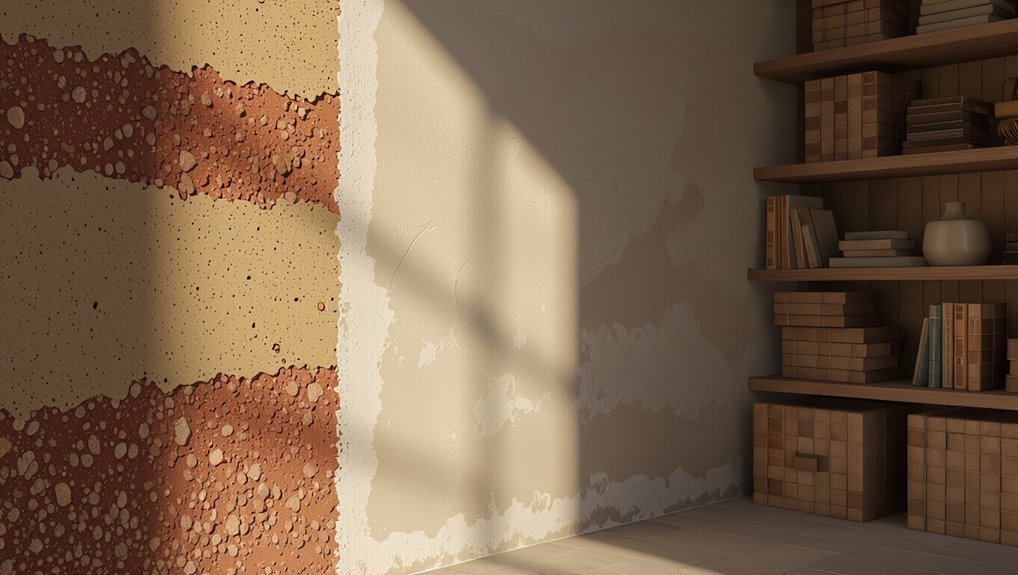
Clay, lime, and plaster can all transform a surface, but they also change what people call the result. When you choose different materials, you shape the vocabulary around it.
You might start from clay properties that let you form sculpted relief, then switch to lime benefits for breathable, light finishes. Finally, you apply plaster techniques that lock in a surface and invite texture variations.
- Clay-based work gets labeled as molded or modeled.
- Lime layers often get called limewash or fresco ground.
- Plastered surfaces are described by their coat and finish.
Paint vs Plaster: What to Call the Artwork
| Option | Layer | Likely term |
|---|---|---|
| Paint | surface | mural painting |
| Plaster | embedded color | fresco |
| Hybrid | both | painted fresco |
| Note | finish varies | name by method |
Where Wall Paintings Appear: Churches to Museums
- You’ll notice distinct artistic techniques: gilding, glazing, and fresco layering.
- You’ll see restoration methods shaped by moisture, salts, and soot.
- You’ll track regional influences in palette, figures, and iconography.
When you compare spaces, you also compare meaning.
How to Identify a Wall Painting Without Guessing
Once you’ve compared how location shapes technique and meaning, you can stop guessing and start identifying.
For art identification, begin with surface type: plaster, brick, or canvas-like mounts. Look for pigment behavior—matte mineral stains often indicate fresco; glossy layers suggest later paint over walls.
Check joins and repairs: original outlines, retouching, and cracking patterns reveal age. Use light to trace underdrawings, incisions, or sinopia.
Then connect motifs to historical context: devotional scenes, portraits, or decorative borders match specific periods.
Finally, document measurements and materials so you can verify against reliable references.
Regional Styles: Common Wall Painting Labels
Regional styles often leave consistent “labels” you can read on the wall, even when the work is weathered. You can spot regional techniques by watching how artists layer plaster, incise details, and build depth.
Cultural influences and historical contexts steer artistic traditions, so the same subject appears with different stylistic variations and thematic elements.
- Look for local materials in the binder, stone, or pigments you can’t ignore.
- Compare color palettes, brush handling, and outlines across nearby sites.
- Track symbolic meanings tied to community involvement, festivals, or patron legends.
When you connect these clues, you interpret symbolic meanings more confidently and distinguish regional labels from imitation.
Words for Restoration, Conservation, and Research
Restoration, conservation, and research share a toolbox of careful words that help you describe what happens to a painted surface over time. You’ll name interventions, document condition, and interpret causes without guessing. In your notes, use terms like “stabilization,” “cleaning,” and “retouching,” and connect them to specific restoration techniques. Apply conservation ethics by stating what you preserve and what you avoid. Describe your research methodologies—sampling, microscopy, imaging—and link findings to historical significance.
| Term | Meaning |
|---|---|
| Condition | Current state |
| Varnish | Protective layer |
| Consolidation | Strengthens paint |
| Inpainting | Fills losses |
| Provenance | Ownership history |
Frequently Asked Questions
Are Wallpaper Patterns Considered Wall Paintings?
No, wallpaper patterns aren’t wall paintings. You apply printed wallpaper techniques, like repeating motifs or murals, to cover surfaces. Wall paintings involve painting directly with pigments, brushes, or fresco processes. So wallpaper stays decorative styles, not painting.
What’s the Difference Between a Wall Painting and a Mural?
A mural covers large surfaces with detailed scenes; a wall painting can be smaller or simpler, often created for decorative wall aesthetics. Use mural techniques—like layering and scale—to shape impact. As the saying goes, “art speaks louder.”
Can a Wall Painting Be Removed or Must It Stay?
Yes, you can remove a wall painting, but it depends on its materials and installation. For safety and value, you should prioritize wall painting preservation, using trained conservators to assess, test, and decide whether removal damages the surface.
What Materials Make Wall Paintings Last for Centuries?
To make wall paintings last for centuries, you choose durable pigments, lime-based plasters, and stable binders; you use acrylic longevity–friendly coatings only when appropriate. You apply preservation techniques like controlled humidity, UV shielding, and careful sealing to prevent flaking.
How Are Wall Paintings Documented and Cataloged in Museums?
You document and catalog wall paintings by photographing, mapping, and recording condition data, then assigning accession numbers. You also log materials, provenance, and past restoration for art preservation, using exhibition methods that track location, lighting, and conservation requirements.
Conclusion
You can call a wall painting a “mural” or “fresco,” but you’ll get the label right only if you look at how it’s made—pigments on plaster, paint applied on top, or carved relief. You can spot trompe-l’oeil tricks, read graffiti styles, and notice sgraffito grooves. And when you document, restore, or research, you use the right terms—so the work stays understood, protected, and respected.
