
Should I Paint an Accent Wall? Design Tips
You should paint an accent wall if you want an easy focal point that hides flaws, ties fabrics together, and defines a zone without a full-room commitment. Pick a wall with natural interest—behind a sofa, bed, or fireplace—and test swatches in different light. Use matte or eggshell for subtlety, satin for durability, and moisture-resistant finishes in bathrooms. Avoid tiny, dark rooms or competing focal points. Keep going to learn placement, color-picking, and removal tips.
Should You Paint an Accent Wall? What This Guide Covers
Thinking about an accent wall? You’ll learn accent wall benefits and how color psychology guides mood choices so you pick hues that suit your space.
This guide covers design consistency across finishes and texture exploration to add depth without clutter. You’ll balance room harmony with bold visual impact, ensuring style integration with existing furniture and art.
Trend relevance is noted, but you’ll focus on timeless options that reflect personal expression.
Practical considerations — scale, lighting, paint type, and maintenance — get clear, actionable tips.
After this overview, you’ll know whether an accent wall fits your goals.
When an Accent Wall Actually Improves a Room
You’ll know an accent wall helps when it gives the room a clear focal point that draws the eye and anchors the layout.
It can also mask or minimize architectural flaws like uneven drywall, awkward outlets, or a bland chimney breast. Use color, texture, or pattern to make that correction feel intentional rather than a cover-up.
Defines A Focal Point
A well-placed accent wall gives your eye somewhere to land and instantly organizes the room’s visual flow. You can use color, texture, or pattern to create a clear focal point that anchors furniture and directs movement.
Pick a wall that naturally draws attention—behind a sofa, bed, or fireplace—and keep surrounding walls neutral so the accent adds visual interest without competing.
Scale the treatment to the room: bold in larger spaces, subtle in compact ones. By defining a focal point, you simplify styling choices and make the room feel intentional, cohesive, and easier to arrange.
Hides Architectural Flaws
When a wall betrays uneven plaster, cramped proportions, or awkward openings, an accent wall can turn those flaws into purposeful character instead of eyesores.
You can use color, texture, or pattern to create architectural enhancement that reframes imperfections as design features. Choose deeper hues or bold finishes to draw attention to the wall itself, not to flaws, and position furniture or artwork to reinforce the deliberate focus.
Avoid busy patterns that create a competing visual distraction; instead, opt for a careful treatment that masks irregularities while maintaining balance.
With thoughtful selection, an accent wall conceals faults and elevates the room’s style.
When to Skip an Accent Wall and Try Another Idea
Wondering if an accent wall is the right move? If your room feels small, poorly lit, or has busy architecture, skip it.
Choose accent wall alternatives like patterned wallpaper on furniture, a gallery wall, or textured textiles to add interest without narrowing space.
Consider color scheme considerations: maintain cohesive hues and contrast levels so alternatives blend, not clash.
If you plan frequent style changes, avoid permanent paint and use removable options.
Also skip an accent wall when it competes with focal elements—fireplaces, large windows, or artwork—so your room reads balanced and intentional instead of visually confusing.
Which Wall to Make the Accent Wall
Pick the wall that naturally becomes the room’s focal point, like one with built-ins, a bold painting, or an architectural detail.
If you have a fireplace or other standout feature, that’s usually the best choice.
Otherwise, choose the wall opposite the entrance so the accent greets you as you walk in.
Focal Point Wall
A focal-point wall draws the eye and anchors the room, so choose the surface that naturally commands attention—usually the wall behind the bed, sofa, or fireplace.
Pick a wall with minimal visual competition so your accent reads clearly. Consider sightlines from entryways and seating; the wall you see first should carry the impact.
Use color psychology to influence perception—deep hues recede, bright tones advance—and aim for mood enhancement that complements function: calming for bedrooms, energizing for home offices.
Keep surrounding decor restrained, balance proportions, and test samples at different times before committing.
Fireplace Or Feature
If your room already centers on a fireplace or built-in feature, use that natural anchor for your accent wall so the space reads intentional and cohesive. You’ll highlight architectural interest by painting around hearths, mantels, or shelving to unify fireplace styles with surrounding walls.
Choose colors that complement feature materials—stone, tile, wood—so texture and tone work together. If the feature is intricate, keep the color simple; if it’s minimal, you can be bolder.
Balance scale and sightlines so the accent enhances rather than overwhelms. Test samples in different light before committing to the final hue.
Opposite The Entrance
Often the best wall to make your accent is the one directly opposite the entrance, since it draws the eye as you walk in and sets the room’s tone immediately.
You’ll use entrance impact to guide choices and color psychology to influence mood. Pick a wall that frames a focal point or hides flaws.
Consider scale, lighting, and traffic flow so the accent feels intentional.
- Anchor with art or shelving
- Choose a hue that complements main furnishings
- Test swatches in daylight and evening
- Keep trim neutral to avoid visual clutter
How Room Size and Shape Affect Your Accent Choice
Because room dimensions shape how colors and patterns read, you’ll want to match your accent wall to the space’s scale and proportions. In small rooms, pick a light or subtle accent to avoid overwhelm; in tall rooms, a darker or vertical-striped wall emphasizes height. For long, narrow spaces, place the accent on the short end to balance proportions. Square rooms tolerate bolder treatments centered on a focal wall.
| Room shape | Accent idea |
|---|---|
| Small | Soft hue or single texture |
| Tall | Dark tone or vertical pattern |
| Long | Short-end focal wall |
Consider furniture layout when finalizing your choice.
How Natural Light Changes Accent Wall Color
Natural light can dramatically change how an accent wall reads, so assess the room at different times of day before committing to a color.
You’ll notice natural light dynamics shift warmth and saturation, altering color perception dramatically. Watch how shadows, reflections, and direct sun change hue intensity.
Consider these observations:
- Morning light (cooler) mutes warm tones and reveals blue undertones.
- Midday light (neutral) shows true saturation, useful for final checks.
- Evening light (warmer) enhances reds and golds, deepening contrast.
- Cloudy days soften contrasts, making colors appear lower-contrast and more muted.
Choosing an Accent Color That Matches Your Decor
Start by spotting the undertones in your current paint and furnishings so your accent color won’t clash.
Match or echo hues from textiles like rugs, pillows, and curtains to create a cohesive look.
Aim for a balanced contrast that highlights the wall without overwhelming the room.
Consider Existing Undertones
When choosing an accent color, look at the existing undertones in your room’s finishes—walls, floors, textiles, and metals—and match or complement those warm or cool cues so the new color feels intentional rather than clashing.
Assess color temperature to decide whether a warm rust, cool slate, or neutral will promote undertone harmony.
Observe natural and artificial light shifts before committing.
Consider these reference points:
- Wood floors: red or yellow undertones.
- Wall base paint: creamy, pink, or blue lean.
- Metal finishes: brass warmth or chrome coolness.
- Stone and tile: veined coolness or sunlit warmth.
Coordinate With Textiles
Textiles are an easy place to tie an accent color into your room because they’re visible, changeable, and already carry the hues you’ll live with—so look at rugs, throw pillows, curtains, and bedding first to pick a shade that echoes or balances them.
You’ll assess textile patterns to find dominant or subtle colors worth highlighting. Match or complement a key tone from stripes, florals, or geometrics, and consider scale so the wall doesn’t compete.
Factor in fabric textures—velvet, linen, wool—since sheen and depth change perceived color. Test samples on-site before committing to guarantee harmony with your decor.
Use A Balanced Contrast
Linking your accent wall to textiles is smart, but you’ll also want to think about contrast so the color complements rather than overwhelms the room. You’ll pick a hue that supports existing fabrics and creates visual balance without fighting patterns.
Use color pairing to guide intensity and temperature, testing swatches in different light. Consider these steps to refine contrast:
- Match undertones of fabrics and wall paint.
- Choose one dominant and one supporting color.
- Test small swatches near key textiles at different times.
- Adjust saturation until the wall recedes or pops as planned.
Trust the room’s mood when finalizing.
Use Color Theory to Pick Bold or Subtle Accents
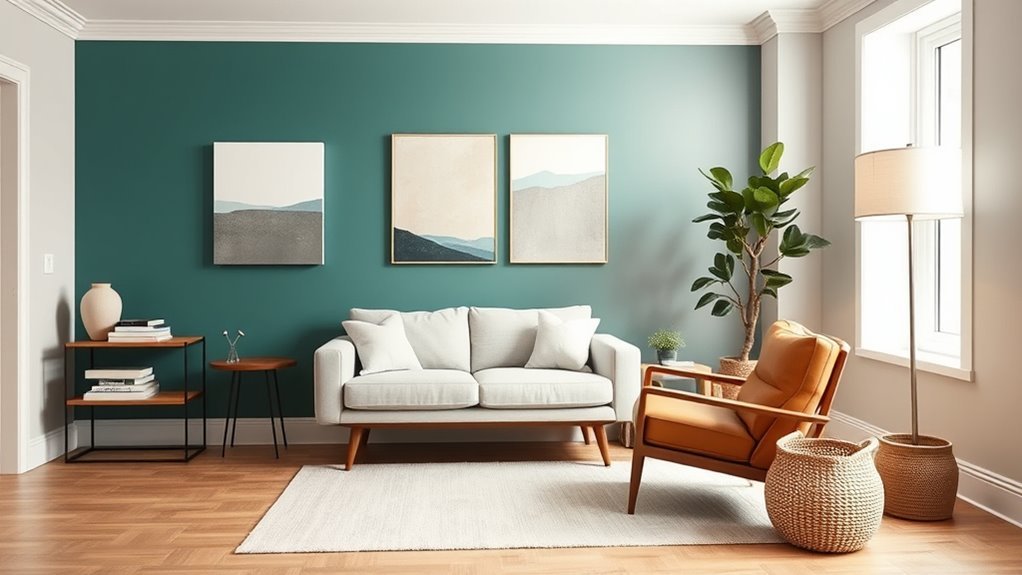
Although color choice might seem purely aesthetic, it actually shapes how a room feels and functions, so pick accents with intent.
Use color psychology to decide whether you want energy or calm: warm reds and oranges boost excitement, cool blues and greens soothe.
Let color psychology guide you: choose warm reds and oranges for energy, cool blues and greens for calm.
Think about accent harmony—tie your accent wall to textiles, artwork, or a single furniture piece so it feels deliberate, not random.
If you’re uncertain, test swatches in different light and live with them for a few days. That practice reveals how colors interact with your space and mood before you commit to painting.
Choosing the Right Contrast Level
When you pick an accent wall, decide how much contrast you want between it and the surrounding walls—high contrast makes the accent pop and define a space, while low contrast creates a subtle, cohesive look.
Use color psychology to guide mood: bold contrasts energize, muted differences soothe. Aim for contrast harmony with furniture and art.
Consider these scenarios:
- Deep navy against soft gray for drama.
- Warm terracotta beside cream for cozy balance.
- Charcoal trim with pale beige for modern subtlety.
- Muted green next to off-white for calm cohesion.
Test samples in different light before committing.
Paint Finishes: Matte, Eggshell, Satin, Gloss
Think about how each finish changes the look of your accent wall—matte hides imperfections, eggshell gives a soft sheen, satin adds subtle luster, and gloss makes colors pop.
You’ll also want to weigh durability and cleaning needs, since higher-sheen paints resist scuffs and wipe clean more easily.
Choosing the right finish lets you balance visual effect with practical maintenance.
Finish Visual Effects
Finish matters: the sheen you pick changes how colors read, hides (or shows) surface flaws, and affects light reflection across your accent wall.
You’ll use finish visual cues to shape mood and focal emphasis; the visual impact varies with sheen. Consider:
- Matte — soft, absorbs light, mutes imperfections, cozy.
- Eggshell — low sheen, subtle depth, slightly more forgiving.
- Satin — gentle sheen, highlights texture, livelier color.
- Gloss — high reflection, dramatic pop, reveals flaws.
Pick matte or eggshell for subdued depth; choose satin or gloss when you want color brilliance and a stronger focal pull.
Durability And Maintenance
Sheen doesn’t just change how a wall looks — it shapes how it stands up to everyday life, so you’ll want to weigh durability and upkeep alongside visual effects.
Matte hides imperfections but resists scrubbing poorly; use it on low-traffic accent walls.
Eggshell balances subtle sheen with decent paint durability, good for living areas.
Satin cleans easier and handles higher wear, ideal for hallways.
Gloss shines and wipes clean but highlights flaws, suited for trim or focal accents.
For maintenance tips, test cleaning methods, touch up with leftover paint, and choose finish based on traffic and your willingness to clean.
Wallpaper or Texture: When to Pick Over Paint
When should you choose wallpaper or textured finishes instead of paint? You’ll pick them when you want more tactile interest or bold wall finishes that paint can’t mimic.
Consider texture to hide imperfections and wallpaper for complex pattern choices or instant focal points. Think about room use, lighting, and installation effort.
Use texture to disguise flaws and wallpaper for intricate patterns—balance room function, lighting, and installation when deciding.
- Hide flaws: textured plaster masks dents and unevenness.
- Make a statement: wallpaper delivers intricate patterns quickly.
- Durability: vinyl and washable textures stand up to traffic.
- Removal and change: wallpaper removal needs planning; some textures are permanent.
Choose based on function, style, and long-term maintenance.
How to Test Colors Without Committing
Wondering how a color will actually look in your space? Try color samples on different walls and observe them at various times of day.
Apply small test patches where light hits and where shadows fall so you see true contrast. Use swatch boards to compare multiple hues together and hold them against furniture and flooring.
For a low-commitment visual, stick temporary decals or large adhesive swatches on the wall to mimic an accent shape and scale. Live with these for a few days before deciding.
Take photos under natural and artificial light to review tones you might otherwise miss.
Accent Walls in Open-Plan Spaces: Zoning Tips
In open-plan rooms you’ll want to define functional zones clearly so each area feels intentional and easy to use.
Use accent walls to anchor a seating area, dining spot, or workspace without building physical barriers.
Keep color cohesion across zones so the palette connects the space while still letting each zone stand out.
Define Functional Zones
Though open-plan layouts feel airy, they can leave you guessing where one activity ends and another begins; an accent wall lets you clearly define functional zones without adding physical barriers.
You can establish functional boundaries and spatial differentiation with intent: choose a wall behind the sofa to anchor the living area, paint the dining wall for a cozy eating zone, use a bold stripe to direct circulation, or pick a textured finish to mark a workspace.
Consider scale, sightlines, and furniture placement so each painted zone reads clearly. Keep contrasts simple so zones feel connected, not chaotic.
Use Color Cohesion
When you’re zoning an open-plan space, keep color choices cohesive so each accent wall reads as part of a unified scheme rather than an isolated statement. You’ll use color harmony to link areas, repeating undertones and a cohesive palette so connections feel intentional. Choose one dominant hue, echo it in softer or darker values, and add a neutral anchor. Balance mood and function: warm for social zones, cool for work. Small accents—pillows, rugs, art—bridge walls. The table below taps feeling and intention to guide choices.
| Emotion | Intent |
|---|---|
| Calm | Study |
| Warmth | Living |
| Focus | Office |
| Energy | Kitchen |
| Rest | Bedroom |
Accent Walls in Small Rooms: Avoid Overwhelm
Although a bold accent can bring personality, you’ll want to scale it carefully in a small room so the space feels energized, not crowded.
A bold accent adds personality—scale it down in small rooms so they feel energized, not crowded.
You’ll use color psychology to pick hues that expand rather than close in, and you’ll aim for room balance by keeping furniture and decor minimal.
Consider subtle contrasts and light-reflecting finishes to avoid visual heaviness.
- Choose lighter shades of your accent color.
- Paint only one short wall or a recessed niche.
- Keep trim and ceiling neutral to lift the space.
- Limit patterned accents to one or two small pieces.
Bedroom Accent Walls: Headboard Alternatives
If you don’t want a traditional headboard, an accent wall can anchor your bed while adding texture or color that reads like built-in furniture.
Choose vertical paneling, a painted mural, or a fabric-covered wall to mimic various headboard styles without extra furniture. Use color combinations that balance the room—soft neutrals with one deep accent or complementary hues for contrast.
Add narrow shelving or wall-mounted lights to increase function and frame the sleeping area.
Keep the focal zone proportional to bed size and room scale so the wall reads intentional, not overpowering.
Living Room Accents: Behind Sofa vs. TV
When you choose an accent wall behind the sofa, you’ll create a warm focal point that anchors seating and invites conversation.
Placing the accent behind the TV demands cleaner lines and glare-free finishes so the screen stays the star.
Think about how each placement changes flow, sightlines, and how you want the room to feel.
Behind-Sofa Impact
A well-chosen accent behind your sofa can change how the whole room feels, giving the seating area a defined focal point and inviting warmth without competing with the TV.
You’ll use sofa styling and color psychology to balance texture, scale, and mood. Consider how the wall anchors conversations and frames art or shelving to create layers.
Think about contrast with cushions and rug to keep harmony.
- Deep matte hue for coziness
- Lighter tone with bold art for contrast
- Textured finish to add depth
- Narrow stripe to elongate the room
Place lighting to enhance intent.
TV-Wall Considerations
Because the TV naturally draws attention, plan the wall so it supports viewing without overpowering the room: balance matte or muted finishes to reduce glare, frame the screen with built-in shelving or trim to create a focal rectangle, and use lighting and texture to separate the media zone from your behind-sofa accents.
Decide tv placement early so sightlines and cable runs are tidy. Match accent color intensity to the screen size and viewing distance to avoid visual competition. Use low-profile cabinetry, concealed wiring, and adjustable sconces.
If your sofa backs the accent wall, keep that palette calmer so neither area fights for attention.
Kitchen Accent Ideas: Painted Walls vs. Islands
If you want a bold focal point without a major remodel, painted accent walls deliver color and mood with minimal effort. Painted islands, however, double the impact by adding texture and functional contrast where you gather and prep.
A painted accent wall brings bold mood with little fuss; a painted island adds texture, function, and doubled impact.
You’ll choose between subtle backdrop changes and statement furniture that anchors the room. Consider kitchen color schemes and island contrast to balance flow and storage. Decide based on traffic, cleaning needs, and how much visual weight you want.
- Wall: easy update, large color field
- Island: furniture-like, tactile finish
- Both: layered neutrals + pop hue
- Tip: sample paint in daylight
Bathroom Accents: Moisture-Resistant Paint Tips
When you’re planning a bathroom accent wall, pick a moisture-resistant paint like semi-gloss or satin to resist mold and peeling.
Prep the surface by cleaning, repairing grout or caulk, and using a mildew-resistant primer so the finish lasts. Those steps’ll keep your accent wall looking fresh despite humidity.
Choose Moisture-Resistant Paint
Moisture can wreck a beautiful accent wall fast, so choose paint specifically formulated to resist humidity and mildew in bathrooms.
You want moisture resistance and paint durability to protect color and finish over time. Pick semi-gloss or satin for easy cleaning, and look for antimicrobial additives if mold is a concern.
Consider low-VOC formulas for ventilation-challenged spaces.
- Choose a bathroom-rated finish (satin/semi-gloss).
- Confirm mildew-resistant or antimicrobial labeling.
- Prioritize paint durability and scrubbability.
- Match primer and paint specs for humid rooms.
These choices keep your accent wall vibrant and long-lasting.
Prep For Humidity
Start by sealing and priming the wall so humidity won’t undermine your paint job.
Next, check for existing mold or peeling; clean and repair surfaces before you paint.
Use a high-quality primer formulated for bathrooms to improve adhesion and humidity control.
For paint selection, pick a semi-gloss or satin finish that resists moisture and wipes clean easily.
Ventilation matters: install or test exhaust fans and run them during and after showers.
Allow full curing time between coats, and avoid painting right before seasonal humidity spikes.
These steps guarantee your accent wall stays vibrant and durable in a humid space.
How Patterns and Murals Change Impact
Because patterns and murals change a room’s focal point, you’ll want to choose designs that match the scale and mood you’re aiming for.
Consider pattern selection and mural effects to guide energy: bold geometrics heighten drama, soft florals calm, large-scale murals expand, and small repeats add texture.
Let pattern and scale set the room’s mood: geometrics spark drama, florals soothe, murals enlarge, repeats add texture.
Think about contrast with surrounding walls, ceiling height, natural light, and how much visual attention you want.
Try samples on poster board. Don’t overcrowd the space; let the design breathe.
Use the list below to visualize possibilities:
- Bold geometric for drama
- Soft floral for calm
- Large mural to enlarge
- Small repeat for texture
Balancing Furniture With a Strong Accent Wall
When you place furniture against a strong accent wall, let the wall set the mood and arrange pieces to complement—not compete with—it; choose simpler silhouettes and neutral tones for large, busy patterns, or add a few bolder, echoed accents (a pillow, lamp, or rug) when the wall is more restrained, so the room reads as intentional rather than cluttered. Balance scale and spacing: low-profile sofas keep sightlines, slim legs reduce visual weight. Prioritize furniture arrangement and color coordination: repeat one accent hue, limit textures, and maintain breathing room. Visual guide:
| Sofa | Rug | Lamp |
|---|---|---|
| Low profile | Subtle pattern | Echo color |
| Open legs | Natural fiber | Minimalist shape |
Lighting to Highlight or Soften an Accent Wall
After you’ve balanced furniture against a bold accent wall, lighting becomes the tool that either amplifies that drama or tames it.
You’ll choose fixtures to either spotlight or soften those accent colors. Consider directional sconces to highlight texture, dimmable overheads for control, and warm bulbs to create soft lighting that soothes.
Use contrast sparingly so the wall reads intentional, not overpowering.
Picture options:
- Track lights angled for focal points.
- Picture lights to emphasize details.
- Recessed dimmers for overall mood.
- Floor lamps for gentle wash.
Adjust intensity until the wall feels integrated with the room.
Layer Textiles and Art to Tie the Accent In
Tie the wall to the rest of the room by echoing its colors in rugs, pillows, and throws so everything feels intentional.
Hang layered art—mix framed pieces, canvases, and a sculptural element—to create depth and visual interest.
You’ll make the accent wall read as part of the whole rather than an isolated feature.
Coordinate Colors With Textiles
Because textiles and art sit at eye level and on surfaces, you can use them to echo the accent wall’s color and make the whole room feel intentional.
You’ll coordinate textiles by mixing scale and hue to support color harmony without matching exactly. Focus on one dominant wall color, then introduce complementary fabrics and subtle contrasts.
- Throw pillows in varied textile patterns that pick up the wall hue.
- A rug that anchors the palette with muted repeats.
- Curtains that balance light and saturation.
- A woven bench or pouf tying in an accent tone.
Keep proportions and restraint for a polished look.
Layer Art For Depth
Start by mixing scales and heights to give your accent wall real depth; lean larger, grounded pieces against the wall and float smaller, textured textiles and framed art in front or slightly off-center to create a lived-in, intentional look.
You’ll layer textures and mix materials—wood, metal, woven fibers—to enhance depth and add dimension. Hang a primary artwork, then overlap a textile panel or lean a sculptural piece to create balance.
Vary frame sizes and finishes; choose frames that complement the wall tone and nearby fabrics. Keep compositions asymmetrical but cohesive so the layered look feels deliberate, not cluttered.
Common Mistakes That Make Accents Look Awkward
When an accent wall goes wrong, it usually stands out for the wrong reasons—clashing colors, poor placement, or overpowering scale can make a room feel unbalanced or awkward.
You can avoid common missteps by spotting issues early: a color clash with existing fabrics, choosing the wrong wall that breaks sightlines, or picking a hue that fights the room’s light.
Don’t ignore scale or furniture relationship.
Consider scale and how your furniture interacts with the accent wall before committing to color or placement.
Typical mistakes include:
- Choosing an overly bright hue that dominates.
- Painting the wrong wall opposite the focal point.
- Ignoring existing patterns and textures.
- Overlooking how natural light alters tones.
Budget-Friendly Accent Wall Options
If you’ve spotted issues with color, placement, or scale, you can still get a striking accent without spending much.
Choose budget friendly materials like peel-and-stick panels, inexpensive paint brands, or reclaimed wood. Use DIY techniques—tape stripes, reusable stencils, or sponge texture—to test color combinations and texture options.
Consider wall alternatives: leaning artwork, thrifted decor, or a fabric-draped panel for temporary solutions. Favor minimalist designs if space is small.
Mix a bold hue on one section with neutral surroundings. These approaches save money, let you experiment, and stay reversible so you can change the look anytime.
Prep & Paint Checklist for a Clean Finish
Before you pick up a brush, gather the right tools and prep the wall so paint goes on smoothly and lasts—clean the surface, repair holes and cracks, sand glossy spots, remove dust, and tape edges for sharp lines.
Use prep materials like spackle, primer, sandpaper, and drop cloths. Wear protective gear and test color samples on small areas.
Follow surface preparation steps, then apply consistent paint techniques for even coverage. Keep clean tools at hand and respect drying time between coats.
Finish with final touches: remove tape, touch up edges, and clean brushes.
- Tape edges
- Prime
- Roll/brush
- Inspect
Use Trim, Molding, or Panels to Enhance Impact
You’ve prepped and painted carefully, so now use trim, molding, or panels to give the accent wall structure and visual weight. You can choose trim styles that echo your room’s era—minimal modern, classic crown, or chunky farmhouse—to frame focal points.
Try panel designs like board-and-batten, raised rectangles, or shaker-style grids to add rhythm without clutter. Use molding techniques to create shadow lines and depth; paint them the same color for subtlety or a contrasting shade for drama.
Consider how paneling interacts with wall textures—smooth, plaster, or shiplap—to guarantee cohesive, intentional impact.
When to Hire a Pro vs. DIY
When deciding whether to tackle an accent wall yourself or hire a pro, weigh your skills, time, and the wall’s complexity: simple paint or basic trim is great for a confident DIYer, but intricate molding, structural modifications, or specialty finishes call for a contractor with experience.
You want good results without wasted time or cost. Consider:
- Time: are deadlines or daily life limiting you?
- Skill: do you have experience with straight lines, prep, and texture?
- Scope: does the job require electrical, drywall, or custom trim?
- Budget: compare pro painting estimates versus your DIY tips and materials.
Choose accordingly.
How to Update or Remove an Accent Wall Later
Planning for change makes updating or removing an accent wall much easier down the road, so think about how permanent the materials and finishes are before you start.
Plan for future updates—choose materials and finishes with removability in mind to simplify later changes.
When you want accent wall removal, prep by testing a small area to see adhesion and underlying color.
For quicker refreshes, try painting alternatives like removable wallpaper, peel-and-stick panels, or fabric hangings that follow evolving color trends.
Make design updates by layering art, trim, or lighting to mask rather than rebuild.
If you do repaint, choose a neutral undercoat to simplify future changes and protect surfaces during shifts.
3 Before-and-After Accent Wall Case Studies
Although every room and homeowner has different tastes and constraints, before-and-after case studies show practical choices you can adapt to your space.
You’ll see real Accent wall transformations that teach Color selection strategies and placement.
Study how scale, light, and furniture interact so you pick solutions that fit your lifestyle.
Examples to visualize:
- Small bedroom: deep navy behind headboard, boosts coziness.
- Living room: warm terracotta on one wall, anchors seating.
- Home office: pale sage with matte finish, reduces glare.
- Entryway: high-contrast black trim, creates dramatic focus.
Use these to guide confident, tailored choices.
Quick Decision Guide: Should You Paint an Accent Wall?
Curious if an accent wall is right for your space? Use this quick guide to decide: think about room size, focal points, and how accent wall trends and color psychology influence mood. If you want drama, pick a deep hue; for calm, choose muted tones. Consider permanence—paint’s reversible—and your furniture’s contrast.
| Question | Quick Check |
|---|---|
| Room size | Small rooms suit light accents |
| Focal point | Accent the wall behind bed or fireplace |
| Commitment | Test swatches for a week |
If most checks are positive, go ahead—an accent wall can transform your room.
Frequently Asked Questions
Will an Accent Wall Affect My Home’s Resale Value?
Yes — an accent wall can affect your home’s resale value: resale trends show tasteful, neutral accents attract buyers, while bold or polarizing colors may deter them, so use color psychology to choose calming, broadly appealing hues that add subtle interest.
Can I Use an Accent Color on Ceilings Instead of Walls?
Absolutely — you can flirt with ceiling colors to elevate a room: it’s a chic nod to design trends, so go bold or subtle, but keep balance, lighting, and adjoining walls in mind to avoid overwhelming the space.
How Do Pets and Kids Impact Paint Choice for Accent Walls?
You should pick durable, washable paints: choose pet friendly colors that hide fur and stains, and use kid proof finishes like scrubbable semi-gloss or satin. You’ll reduce touch-ups and keep accent walls looking fresh longer.
Are There Eco-Friendly or Low-Voc Accent Paint Options?
A Denver family chose zero-VOC Benjamin Moore Natura for their nursery; you’ll find eco friendly options like Natura and other low VOC paints that’ll cut fumes, resist stains, and keep your accent wall healthier for everyone.
Can Accent Walls Be Achieved With Removable Panels or Stick-On Tiles?
Yes — you can create accent walls with removable panels and stick on tiles; they’re renter-friendly, quick to install, and let you experiment with texture or pattern without permanent changes, though surface prep and quality matter for longevity.
Conclusion
Deciding on an accent wall? Trust your gut: bold contrast can energize a bland room, while subtle texture can soothe a chaotic space. You’ll bright‑spot a focal wall to anchor furniture, yet you’ll avoid a clash that shrinks the room. If you crave quick drama, paint; if you want flexibility, try wallpaper or art. Small changes can feel huge; big changes can be undone—so pick what excites you today and won’t haunt you tomorrow.
