
Is Painting a Wall a Chemical Change? Simple Explanation
You’re usually causing a physical change when you paint a wall: pigments disperse, solvents evaporate, and binders form a film without turning the wall into a new substance. Water‑based paints dry as particles coalesce; oil‑based paints can chemically react with oxygen and cure into a tougher film. Curing involves chemical bonding, but typical drying is mostly physical. If you want to know which paints truly cure chemically and how that affects safety and durability, keep going for more details.
Quick Answer: Is Painting a Wall a Chemical Change?
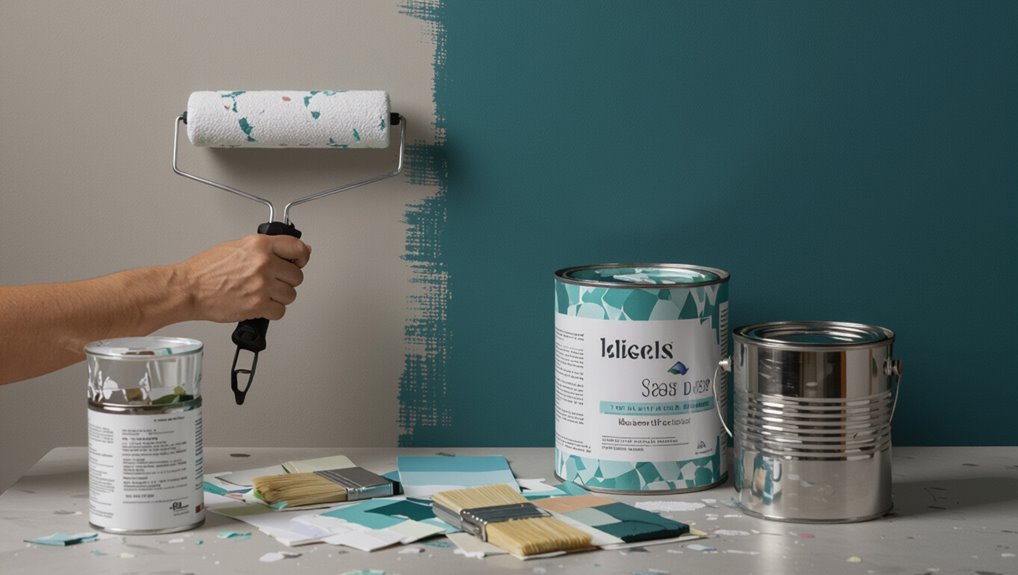
Is painting a wall a chemical change or a physical one? You’ll mostly see a physical change: paint dries as solvents evaporate and film forms, not new substances.
However, polymerization in some coatings creates chemical bonds, boosting paint durability.
Your surface preparation affects adhesion and final outcome, so treat it seriously to guarantee the coating performs as planned.
What Defines a Chemical Change Versus a Physical Change?
When you compare chemical and physical changes, focus on whether the substance’s identity itself is altered or only its form and arrangement.
Physical changes change appearance or state without making new substances, while chemical changes create new substances by rearranging atoms and forming or breaking chemical bonds.
You’ll assess chemical properties like reactivity and new bonds versus physical properties such as shape, phase, or texture.
Paint Chemistry Overview: Pigments, Binders, and Solvents
Having distinguished chemical from physical changes, you can look at paint as a mixture whose visible and functional properties come from three core ingredients: pigments provide color and opacity, binders form the film that holds pigment particles together and adheres to the surface, and solvents (or carriers) control viscosity for application and evaporation afterward.
You’ll consider pigment properties, binder types, and how each affects durability, gloss, and adhesion.
How Water‑Based Paint Dries: Evaporation and Film Formation
When you paint with a water‑based formula, the water first evaporates from the surface, concentrating the solids.
As the droplets shrink, polymer particles are forced together and coalesce into a continuous film.
Finally, the binder undergoes physical and slight chemical changes as it solidifies, locking pigments in place.
Water Evaporation Process
Although the pigments and binders stay put, the water in latex or acrylic paint leaves the film by evaporating and carrying solvent out of the wet layer, thinning the liquid phase until polymer particles come into close contact.
You’ll notice evaporation effects like cooling and faster solidification in warm, dry air; think of a tiny water cycle removing moisture so the paint sets into a coherent film.
Film Coalescence Mechanism
After evaporation concentrates the paint, the polymer binder particles jam together and start to fuse into a continuous film—a process called coalescence.
You watch film formation as particles deform and pack, relying on binder interaction to stick and smooth.
You’ll notice texture changes and gloss develop as the surface levels.
- Particles pack
- Deformation begins
- Surface smooths
Binder Solidification Steps
Because water leaves the paint film in stages, you’ll see distinct binder solidification steps that control drying and final film properties.
You observe evaporation, particle packing, and film formation as the binder properties shift from dispersed polymer to continuous matrix.
Surface tension, coalescing agents, and temperature affect this solidification process, determining hardness, adhesion, and permeability of the cured paint film.
How Oil‑Based Paint Dries: Oxidation and Polymerization
When you use oil‑based paint, it dries by reacting with oxygen so the liquid components oxidize rather than simply evaporate.
Those oxidation reactions create chemical bonds between the oil molecules, turning them into a tough polymer film.
You’ll see a durable, cross‑linked coating form that explains why oil paints take longer to cure than water‑based ones.
Oil Paint Oxidation
If you’ve ever wondered why oil-based paint feels dry yet isn’t actually evaporating, it’s because drying is a chemical process: the oil binds to oxygen from the air and undergoes polymerization, forming a solid film.
You’ll notice oxidation reactions vary by paint formulation, affecting drying process, long term effects, environmental impact, application techniques, and safety measures.
- Surface exposure
- Catalyst presence
- Temperature/humidity
Polymer Film Formation
Building on how oils oxidize, polymer film formation is the sequence of chemical steps that turns liquid paint into a bonded, solid coating.
You watch reactive oil molecules crosslink via oxidation and polymerization, creating a network that gives polymer stability and adhesion to the surface.
This curing improves film integrity, resists solvents and wear, and permanently transforms liquid binder into a durable protective layer.
Pigments: What Changes (or Not) During Drying
Paint dries, but pigments mostly don’t change chemically — they stay the same molecules that give the paint its color while the binder and solvents around them evaporate or polymerize.
You’ll notice pigment stability during the drying process: color remains, dispersion shifts, and brightness may alter due to light scattering.
Consider:
- Particle packing alters sheen.
- Pigment agglomeration affects uniformity.
- Surface adsorption changes apparent tone.
Role of Binders: Physical Film Formation Versus Chemical Curing
When you look at a freshly coated wall, binders are the invisible architects that either form a physical film as solvents evaporate or undergo chemical curing to create a cross‑linked network.
That distinction determines durability, flexibility, and how the paint responds to moisture and temperature.
You’ll identify binder types by film characteristics: acrylics give flexible films, alkyds harden by oxidation, and epoxies cure into rigid, chemical‑resistant networks.
Solvent Evaporation in Paint Explained Simply
Because solvents are the carriers that keep paint workable, they evaporate after you apply a coat, leaving the binder particles to come together and form the final film.
Solvents carry paint until they evaporate, allowing binder particles to unite and form the final film.
You’ll notice evaporation rate depends on solvent types and paint formulations, affecting drying time and film appearance.
Consider:
- Fast solvents — quick tack-free finish.
- Slow solvents — smoother leveling.
- Waterborne vs solventborne choices.
Oxidative Curing: How Air Turns Binders Into a Network
After solvents evaporate and binder particles draw together, air can finish the job by chemically linking those binders into a tough film.
You’ll see an oxidative process where oxygen reacts with unsaturated sites in the binders, causing them to form bonds and stiffen.
Over time this builds a continuous binder network, hardening the paint surface and improving durability without adding new material.
Cross‑Linking and Polymerization Explained in Plain Language
Think of cross‑linking as the glue that ties individual paint molecules into a strong web, and polymerization as the process that builds those long molecular chains.
When you apply paint, reactive sites on the binder molecules connect, creating a tougher, less soluble film.
Understanding these two steps helps you see why a painted wall becomes chemically different from wet paint.
What Is Cross‑Linking
Cross-linking happens when individual polymer chains form chemical bonds with each other, creating a network that changes how the material behaves.
You notice cross-linking benefits in tougher, water-resistant paint films and clearer finishes.
Here are cross-linking examples to picture it:
- Hardened latex paint film
- Epoxy floor resin
- Varnished wood finish
How Polymerization Works
When monomers meet and start bonding, they form long chains or networks called polymers, and that bonding process is polymerization. You see chains grow or cross‑link, changing polymer properties like flexibility and hardness. That shift determines polymer applications: coatings, adhesives, or plastics.
| Feature | Effect |
|---|---|
| Chain length | Strength |
| Cross‑linking | Rigidity |
Why Most Household Painting Is a Physical Change
Although paint undergoes noticeable changes as you apply it, most of those changes are physical rather than chemical: pigments disperse, solvents evaporate, and binder particles coalesce to form a continuous film without altering the paint’s underlying chemical identity.
You notice paint properties and the drying process change appearance and texture. Consider:
- Pigment dispersion and color spread.
- Solvent evaporation and film formation.
- Binder particle packing and adhesion.
When Paint Drying Becomes a Chemical Change
You’ll notice that some paints dry simply by solvents evaporating, which is a physical change, but others undergo surface chemical reactions that alter their chemistry.
Pay attention to terminology: “evaporation” describes solvent loss, while “curing” refers to chemical cross-linking that permanently transforms the paint film.
Understanding whether a coating cures or just dries helps you predict durability, odor, and safety during and after application.
Surface Chemical Reactions
If you look closely, paint doesn’t always just dry by evaporation—sometimes it undergoes real chemical changes at the surface where it meets air, moisture, or the substrate.
You notice surface reactions and chemical interactions that alter film properties.
Consider these examples:
- Oxidation at the paint–air interface.
- Hydrolysis from moisture exposure.
- Bonding with the substrate’s minerals.
Curing vs Evaporation
When paint goes from wet to hard, you need to know whether it’s simply evaporating solvents or undergoing a chemical cure, because the mechanisms and the resulting film properties differ. You’ll spot evaporation effects in solvent-based paints; curing processes occur with crosslinking or polymerization. Compare:
| Type | Mechanism | Result |
|---|---|---|
| Evaporation | Physical loss | Film forms |
| Curing | Chemical bonds | Durable finish |
Example: Latex Paint on Drywall – What Actually Happens
Take a paintbrush and swipe a coat of latex paint across drywall, and you’ll see mostly physical changes: the water and solvents in the paint evaporate, leaving polymer particles that coalesce into a continuous film and bind to the drywall surface, while pigments and additives remain dispersed rather than forming new chemical substances.
Swipe latex paint across drywall and you mostly get physical change: water evaporates, polymers coalesce, pigments stay dispersed.
- Clean and sand for proper wall preparation.
- Polymer film forms—latex adhesion occurs.
- Drying is evaporation, not new molecules.
Example: Oil Paints and Alkyds – True Chemical Reactions
When you use oil paints or alkyds, the drying is an actual chemical cure rather than just evaporation.
Oxygen reacts with the unsaturated oil molecules in an oxidation process that creates crosslinks between chains. Those crosslinks form a hard, continuous film that’s chemically different from the original liquid.
Oil Paints Cure Chemically
Although it might look like drying, oil paints and alkyds actually cure through chemical reactions: their unsaturated oil molecules oxidize and cross-link into a hard film, and alkyd resins undergo similar polymerization and cross-linking processes.
You’ll notice oil paint benefits in durability and flexibility from this curing process.
Visual cues:
- Surface hardens gradually.
- Sheen deepens over days.
- Brush marks settle into film.
Alkyd Oxidation Process
Having seen how oil paints harden by oxidizing and cross-linking, you can apply the same chemical logic to alkyds: their polyester backbone carries unsaturated fatty acid chains that react with atmospheric oxygen, forming peroxides that initiate radical-mediated cross-linking and build a three-dimensional polymer network.
You’ll notice alkyd properties depend on fatty acid content and catalysts, and the distinct oxidation stages control drying rate and durability.
Crosslinking Forms Film
Picture the wet paint transforming into a tough, continuous film as reactive sites on its polymer chains link together—this is crosslinking, a true chemical process that turns mobile molecules into an insoluble network.
You’ll see crosslinking benefits like improved adhesion and film durability.
Think of these stages:
- Oxygen-triggered bonding starts.
- Polymer chains weave a network.
- Surface hardens, resisting solvents.
What Additives and Hardeners Do: When They Trigger Chemical Change
When you add additives or hardeners to paint, they don’t just tweak texture or drying time — they can start real chemical reactions that change the paint’s composition and properties. You’ll notice additive effects and hardener roles: catalysts, crosslinkers, or stabilizers alter bonding and durability, sometimes forming new compounds that lock the film.
| Component | Function | Outcome |
|---|---|---|
| Additive | Modify flow | Smoother finish |
| Hardener | Crosslink | Increased hardness |
| Catalyst | Speed cure | Faster set |
| Stabilizer | Prevent degrade | Longer life |
Signs That a Chemical Change Occurred in Paint
You can tell a chemical change in paint when the color shifts noticeably as it cures.
Pay attention to changes in texture and the way a continuous film forms on the surface.
Also note any new or stronger odors or fumes, which often indicate chemical reactions are taking place.
Color Change Observed
Although a fresh coat usually just covers the surface, a true chemical change in paint often shows up as an unexpected color shift—one that goes beyond simple fading or staining.
You’ll notice altered color perception when pigment stability breaks down. Watch for:
- Sudden yellowing or darkening across the film.
- Patchy, uneven hues appearing over time.
- Metallic or iridescent sheens emerging.
Texture And Film Formation
Color shifts often come with changes you can feel and see in the paint’s surface, so pay attention to texture and film formation as further signs of chemical change. You’ll use texture analysis to detect surface hardening, cracking, or leveling. Improved film durability indicates curing reactions rather than mere drying.
| Feature | Test | Meaning |
|---|---|---|
| Smoothness | Feel | Proper film |
| Hardness | Scratch | Cured coating |
| Flexibility | Bend | Durable film |
Odor Or Fume Release
When paint gives off a distinct smell or visible fumes as it dries, you’ve likely got chemical reactions at work rather than simple evaporation; those odors come from volatile organic compounds (VOCs) and reaction byproducts being released as binders cure or solvents react.
You notice odor release and fume effects that signal new compounds forming.
- Sharp solvent smell from VOCs
- Persistent chemical odors as binders cure
- Irritation, headaches or eye watering
Why Smell Alone Doesn’t Prove a Chemical Change
Ever wonder if that strong paint smell means the wall’s chemistry has changed? You rely on smell perception, but odors alone aren’t definitive chemical indicators.
Volatile compounds can evaporate without altering the painted substrate’s chemical structure. To confirm a chemical change you’d need measurable new substances or bonds—smell hints at vapors, not proof of molecular transformation in the wall itself.
Safety Implications: VOCs, Off‑Gassing, and Curing Hazards
Although the paint on your walls might seem harmless once it looks dry, many coatings continue to emit volatile organic compounds (VOCs) and other off‑gassed chemicals during drying and curing.
These emissions can irritate eyes, throat, and lungs or cause headaches and dizziness at higher concentrations. You should manage VOCs exposure, off gassing effects, curing risks, and follow health precautions:
- Ventilate well.
- Use low‑VOC paints.
- Limit occupancy during curing.
How Temperature and Humidity Affect Drying and Reactions
You’ll notice temperature speeds or slows how fast paint solvents evaporate and films form, so warmer conditions usually dry faster while cold ones stall reactions.
Humidity controls moisture in the air and can prevent proper curing or cause sagging and blistering if it’s too high.
For reliable drying and chemical reactions you should aim for the paint maker’s recommended temperature and relative humidity ranges.
Temperature Effects On Drying
How does temperature shape the way paint dries and any chemical reactions involved? You’ll notice temperature impact on drying speed and reaction rates: warmer air speeds solvent evaporation and polymer crosslinking, while cold slows both.
- Higher temperatures: faster evaporation, quicker tack-free time.
- Lower temperatures: prolonged wet film, slower cure.
- Extreme heat: may trap defects or accelerate reactions unevenly.
Humidity’s Role In Curing
When humidity rises, you’ll notice paint takes longer to dry because moisture in the air slows solvent evaporation and can interfere with polymer crosslinking.
High humidity also raises the risk of surface defects like blushing and poor adhesion, while very low humidity can cause overly rapid skinning and trapped solvents that weaken the film.
You should monitor humidity effects during curing processes to balance drying rate and film integrity.
Optimal Conditions For Reactions
Although temperature and humidity may seem like simple weather variables, they directly control the chemical and physical steps that turn wet paint into a durable film.
You’ll manage reaction conditions and environmental factors to optimize catalyst effects and temperature influence, balancing humidity effects, substrate preparation, drying time, and paint formulation:
- Warm, moderate humidity accelerates cure.
- High humidity prolongs drying time.
- Cold slows chemical crosslinking.
How Surface Preparation Affects Drying and Reactions
Because the condition of a wall controls paint behavior, prepping the surface changes how quickly coatings dry and whether chemical interactions occur.
You’ll improve paint adhesion and substrate compatibility by cleaning, sanding, and priming. Surface preparation affects drying conditions and lets you select proper application techniques.
Environmental factors like humidity and temperature further influence curing rates and potential reactions, so always adjust prep accordingly.
When to Expect Permanent Changes Versus Reversible Changes
Proper surface prep helps determine whether the changes paint causes will be permanent or reversible, so think about what you want the finish to do before you apply it.
You’ll judge permanence by adhesion, chemical curing, and substrate interaction.
Consider examples:
- Strong adhesion to bare wood — permanent changes.
- Peelable temporary coatings — reversible changes.
- Surface stains locked in by primer — effectively permanent.
How Labs Test for Chemical Change in Paint
When you send a paint sample to a materials lab, technicians run targeted tests to tell whether the coating underwent chemical change or just physical drying.
They’ll examine curing chemistry, adhesion strength, and interactions with the substrate using instrumental methods like FTIR, DSC, and adhesion pull tests.
You’ll get reports on paint stability, identified chemical interactions, residual solvents, crosslink density, and failure modes.
Everyday Comparisons: Painting Versus True Chemical Reactions
If you’ve ever brushed on paint and watched it change from wet to dry, you’ve seen a physical transformation that can look like a chemical reaction but usually isn’t—paint mostly dries by solvent evaporation and film formation, not by atoms rearranging into new substances.
You compare visible changes to true reactions by noticing smell, heat, or new compounds.
- Surface sheen; affects paint durability.
- Faster drying techniques (heat, fans).
- Chemical reactions release gas or color change.
How to Choose Paint If You Want Minimal Chemical Reactions
Having noticed how drying usually involves evaporation rather than new substances, you’ll want paints that minimize any actual chemical reactions—especially if you care about fumes, off-gassing, or unintended curing byproducts.
Choose water-based latex over solvent-based, seek eco friendly options and low VOC choices, check ingredient lists for fewer additives, and test small areas to confirm scent and performance before full application.
Practical Tips to Speed Drying Without Causing Problems
Although you can’t force a paint to cure faster than its chemistry allows, you can speed evaporation and reduce problems by controlling temperature, humidity, and airflow.
Use safe drying techniques during paint application to avoid blisters or runs.
- Warm, dry room with fans for steady airflow.
- Thin coats; wait tack-free between layers.
- Dehumidify to prevent long tacky times.
Curing Time and When the Room Is Safe to Reoccupy
When you paint a room, the surface may feel dry in an hour or two, but full curing—when the paint reaches its designated hardness, chemical resistance, and minimal off-gassing—can take days to weeks depending on the product and conditions. You should watch curing duration, ventilation, and smell; follow manufacturer reoccupying timeline before returning.
| Emotion | Smell | Timeframe |
|---|---|---|
| Relief | Faint | Days |
| Anxiety | Strong | 24–48h |
| Calm | None | Weeks |
| Joy | Fresh | Weeks |
| Patience | Mild | Days |
Common Misconceptions: Painting Won’t Change Your Wall’s Chemistry Entirely
Because paint sits on the surface and bonds primarily through adhesion and film formation, it won’t fundamentally change the wall’s underlying chemistry— you’ll alter appearance, not core composition.
Address common paint misconceptions so you know what to expect:
- Color hides stains but doesn’t alter wall chemistry.
- Sealers block moisture but don’t convert substrate chemically.
- Primer improves adhesion; it’s physical prep, not a chemical transformation.
Bottom Line: When Painting Is Chemical and When It’s Physical
You’ve seen that most painting actions change appearance and adhesion without altering the wall’s underlying chemistry; now, let’s be clear about the exceptions.
You’ll call painting physical when pigments and binders coat the surface after proper wall preparation and dry without new substances forming.
It’s chemical only if reactions alter paint properties or the substrate—curing epoxies, reactive primers, or solvent-driven degradation create true chemical change.
Further Reading and Quick Resources on Paint Chemistry
Want to dive deeper into how paints behave and why some coatings chemically cure while others just dry?
Explore concise books, trustworthy websites, and videos that explain paint additives and environmental impact, so you’ll understand formulation and safety.
- Introductory book on coating chemistry.
- Educational university or government web pages.
- Short expert videos and product datasheets.
Frequently Asked Questions
Can Paint Remove or Damage Previous Wallpaper Adhesives Chemically?
Yes — paint itself usually won’t cause adhesive breakdown, but solvent-based primers or strippers can chemically loosen glue, helping wallpaper removal; you’ll want proper prep, testing, and ventilation to avoid damage or staining.
Can Mold or Mildew Growth Be Caused by Paint Chemistry?
Yes — paint chemistry can influence mold or mildew growth. Think of paint as a fortress: you’ll choose mold prevention and mildew resistance formulations so the walls stay dry and hostile to spores, not inviting them inside.
Does Repainting Change Indoor Air Quality Long-Term?
Yes — repainting can change indoor air quality long-term: you’ll reduce airborne pollutants if you choose low-VOC paints and guarantee ventilation, but repeated coatings or high VOC emissions without ventilation can cause persistent indoor pollutant buildup.
Can Paint React With Metal Fixtures or Pipes Behind Walls?
Potential paint pitfalls: paint interactions can promote metal corrosion if coatings trap moisture or contain corrosive solvents; you’ll want proper primers, ventilation, and barrier layers so fixtures and pipes don’t suffer slow, surface-degrading damage.
Do Anti‑Microbial Additives Create Lasting Chemical Residues?
Yes — antimicrobial additives can leave chemical residues, but their additive effectiveness and residue longevity vary by formulation, concentration, and surface; you’ll see diminishing activity over time, so maintenance or reapplication often restores protection.
Conclusion
Think of painting a wall like dressing it for a party: sometimes you just slip on a coat (physical change), other times the fabric itself transforms (chemical change). Water-based paints mostly dry by evaporation—like mist lifting—so the wall stays itself. Oil-based paints often harden through slow chemistry, changing molecules into a new skin. Know the paint type, wait for curing, and you’ll let the room breathe easy with a fresh, lasting look.
