
How to Paint Stripes on a Wall Without Bleeding (Easy Guide)
You can get crisp, bleed-free stripes by planning layout, priming porous or stained areas, and marking straight guidelines with a level. Apply the right painter’s tape, press and burnish edges, then seal the tape line with a thin coat of the base color or acrylic caulk. Use thin coats of stripe color with an angled brush and mini-roller, remove tape at a 45° angle while paint is tacky, and follow up with light touch-ups—keep going to learn pro tips and fixes.
How to Paint Crisp Stripes Without Bleeding
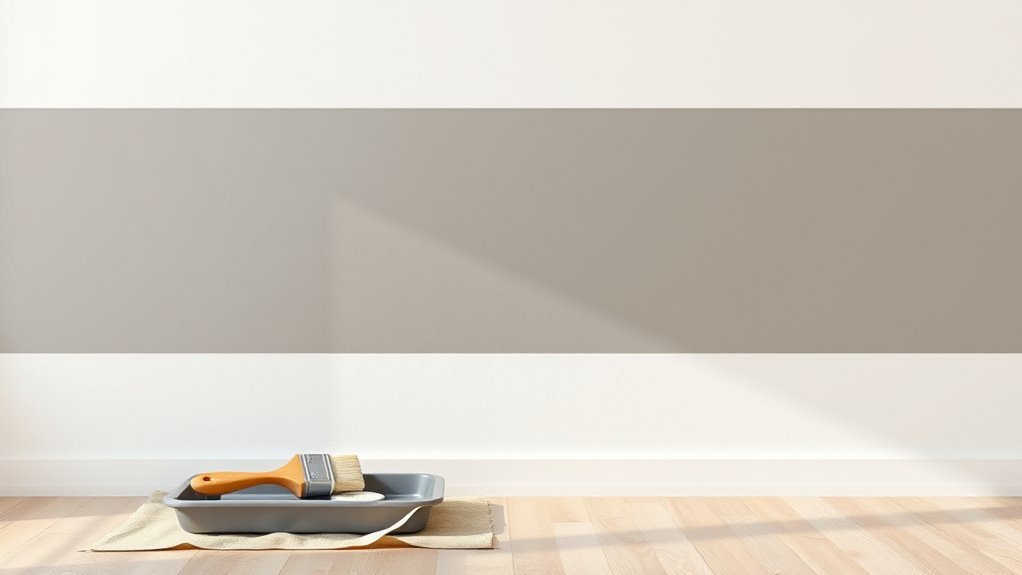
When you want crisp, clean stripes, proper prepping and the right tape make all the difference. You’ll wash and dry the wall, fill imperfections, and sand smooth so paint sits evenly.
Measure and level, mark edges, and apply high-quality painter’s tape firmly—press edges down to block bleed. Seal tape with a thin coat of the base color before applying stripe color.
Use a small roller or brush with light coats, avoiding overload. Consider color psychology when choosing hues so stripes enhance mood and use decorative accents sparingly to keep lines the focal point.
Quick: 3-Step Foolproof Method
If you want a fast, reliable way to get crisp stripes, follow this three-step method: prep the wall and tape your lines, seal the tape with the base color, then roll the stripe color on with light, even coats.
Step 1: clean, sand, and firmly press painter’s tape along measured marks.
Step 2: apply base-color sealant over tape edge—let dry—to prevent bleed-through.
Step 3: use a high-quality roller, thin coats, lift tape while paint’s tacky.
Consider color psychology when choosing stripe hues and test how stripes interact with furniture placement to ensure balance and flow.
Plan Your Stripe Pattern and Spacing
Decide how wide you want each stripe to be and stick to that width for a balanced look. Measure and mark your lines carefully with a level and pencil so your tape goes on straight.
Don’t forget to account for doorways and other interruptions so your pattern reads well across the whole wall.
Choose Stripe Widths
Because stripe width sets the room’s rhythm and scale, pick sizes that match the space and your furniture. Think visually: narrow stripes make rooms feel taller and more formal; wide stripes read bolder and more modern. Use color psychology to decide contrast — high contrast emphasizes pattern, low contrast soothes.
Consider historical styles: thin pinstripes suit traditional rooms, broader bands fit mid-century or contemporary schemes. Balance stripe width with ceiling height, furniture scale, and focal walls. Sketch options to compare impact.
Once you settle on widths, you’ll be ready to measure and mark for precise, bleed-free painting.
Measure And Mark
When you’re ready to lay out your stripes, start by measuring the wall and marking a precise guideline for every band so each stripe lines up and reads straight. Use a level and tape measure to plot top and bottom horizontal lines, then connect them with vertical plumb lines at each edge.
Consider wall texture when choosing spacing—rough surfaces can mask narrow stripes, so widen bands if needed.
Sketch the pattern on paper, accounting for trim and corners. Think about color psychology as you place darker or lighter bands to guide eye flow.
Mark with pencil and low-tack painter’s tape.
Account For Doorways
If your stripes cross a doorway, plan their placement so bands align visually across the opening and avoid awkward half-stripes at the jambs; measure from a fixed wall edge, note Doorway transitions, and shift your pattern so full bands sit centered on the doorway. Mark guidelines, mask carefully, and remove tape before paint fully cures. Remember to factor in Light switch covers—remove or mask them so stripes continue uninterrupted. Visualize choices with a simple layout:
| Doorway view | Stripe effect |
|---|---|
| Centered bands | Symmetrical |
| Offset bands | Asymmetrical |
| Half-stripes | Avoid |
| Switch nearby | Mask/reposition |
Pick a Finish: Matte, Eggshell, or Satin?
Think about how sheen affects the look and upkeep of your stripes: matte hides imperfections, eggshell gives a soft low-luster, and satin adds more sheen and durability.
You’ll prefer matte or eggshell in low-traffic rooms and satin where scuffs and cleaning are likely.
Match the finish to the room’s use so your stripes stay crisp and easy to maintain.
Finish Sheen Comparison
Because your stripe edges rely on how paint reflects light and hides imperfections, choosing the right sheen matters more than you might expect.
In a finish sheen comparison, matte hides imperfections and softens wall texture, so it forgives small tape or brush flaws but can look flat.
Eggshell offers a subtle low-luster that balances hiding flaws with slight depth—good for most rooms.
Satin adds more sheen, making edges pop and colors richer; it can reveal texture and minor irregularities, so prep matters.
Pick based on how much texture you want visible versus how crisp and vibrant you need the stripes to appear.
Durability And Maintenance
While sheen affects appearance, durability and upkeep should guide your finish choice so stripes stay crisp over time. You’ll pick matte for low-sheen, forgiving walls with subtle texture, but it resists cleaning poorly.
Eggshell balances softness and durability, handling gentle scrubs and mild cleaning solutions without dulling.
Satin offers the toughest surface, ideal if your wall texture is smoother and you expect frequent cleaning.
Test a small stripe, scrub gently with your chosen cleaning solutions, and inspect for sheen loss or edge wear.
Choose satin for high-traffic areas, eggshell for living spaces, matte for low-touch decorative zones.
Choose Colors for Crisp Contrast
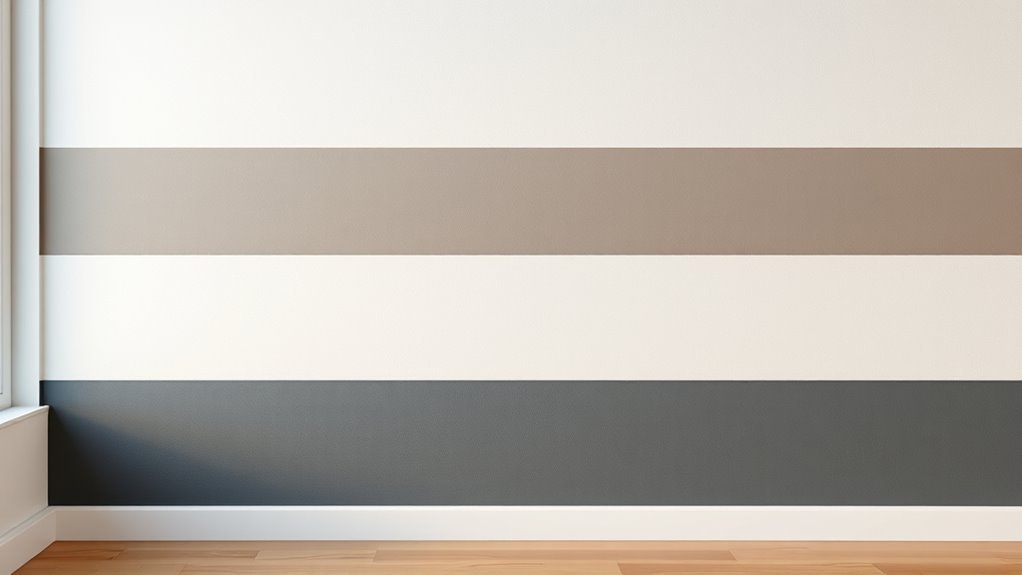
Want bold, crisp stripes that pop? You’ll pick colors that maximize contrast and suit the room’s mood. Use color psychology to decide warm vs. cool pairs, and study historical patterns for classic combos. Test samples on primer, view at different times, and consider sheen differences for edge definition.
| Use this test | Purpose |
|---|---|
| Small swatch | See true hue |
| Opposite swatch | Check contrast |
| Ambient check | Lighting effect |
Choose one dominant and one accent; stick to two main tones to keep edges clear and the look timeless.
Choose Painter’s Tape That Prevents Bleed
Pick painter’s tape with the right adhesion strength so it sticks firmly without peeling your paint.
You’ll also want to use edge-sealing techniques—like pressing the tape down firmly and running a putty knife along the edge—to stop bleed.
Together they keep your stripe lines sharp and clean.
Tape Adhesion Strength
Because the tape is your main barrier against bleed, choose a painter’s tape with the right adhesion. You want tape firm enough to stick to the wall but gentle enough to remove cleanly. Test tape adhesion on a small, hidden area after proper surface preparation—clean, dry, and dust-free—to confirm it bonds without lifting paint.
For fresh drywall or delicate finishes, use low-adhesion tape; for textured or glossy surfaces, pick medium-adhesion options. Press the tape down firmly along the stripe line, smoothing with your fingers to eliminate gaps.
Remove tape slowly at a 45-degree angle once paint is dry to the touch.
Edge Seal Techniques
When you’re sealing stripe edges, choose painter’s tape designed to create a tight barrier against paint—look for tapes labeled “no-bleed” or “edge-seal” that have a thin, rubberized adhesive and a crisp, straight edge. Press tape firmly along seams, using a plastic card to burnish into textured walls so wall texture won’t trap seepage. Use a clear acrylic seal or a thin coat of base color over the tape edge for extra protection. Remove tape at a 45° angle while paint is tacky. Consider color psychology when planning stripe contrast to hide tiny flaws.
| Tool | Purpose |
|---|---|
| Plastic card | Burnish tape |
| Acrylic seal | Prevent bleed |
| Angled peel | Clean edge |
Low‑Tack vs. High‑Tack Tape: When to Use Each
If your wall surface is delicate or freshly painted, you’ll want low‑tack painter’s tape because it sticks enough to block paint but comes off cleanly without peeling finish or leaving residue. Use low‑tack for painted trim, wallpapered areas, or surfaces where tape removal must be gentle.
Choose high‑tack when you’re masking rough or previously unpainted drywall, exterior walls, or textured surfaces that need extra grip to prevent seepage. High‑tack resists lifting during vigorous rolling, but test it first to avoid damage.
Plan tape placement to control color blending edges; remove tape at a 45° angle while paint’s slightly tacky.
Tools for Painting Stripes Without Bleeding
Before you start taping, gather the right tools so you can work quickly and keep edges crisp. You’ll need quality painter’s tape, angled brushes, a mini-roller, a putty knife for sealing, and sample swatches to test color psychology against light and wall texture. Keep a damp cloth handy for cleanups.
| Tool | Purpose | Tip |
|---|---|---|
| Painter’s tape | Clean edges | Use low-tack on fresh paint |
| Angled brush | Cut-ins | Short bristles for control |
| Mini-roller | Smooth fills | Match nap to wall texture |
| Putty knife | Seal tape | Press firmly along edge |
| Swatches | Test colors | View at different times of day |
Measure and Mark Stripe Lines Accurately
Although precise measuring takes a bit of patience, you’ll save time and avoid costly mistakes by laying out your stripe lines carefully from the start. First, decide stripe width and map them from a central reference so stripes balance across the wall.
Use a tape measure, pencil marks at ceiling and baseboard, and a straightedge to connect points. Note wall texture—rough surfaces need closer inspection for true straightness.
Consider color psychology when placing wide versus narrow bands; wider bands read calmer. Double-check measurements before taping; accurate marks cut down on touch-ups and prevent bleeding during painting.
Laser Level vs. Chalk Line: Which to Use?
You can get razor‑straight accuracy with a laser level, which is ideal if you’re working on long walls or need perfectly aligned stripes.
A chalk line is quicker and simpler for short runs or when you want a low-tech, budget-friendly option.
Think about how precise you need to be and how much setup time you’ll tolerate before choosing.
Laser Level Precision
When you need crisp, perfectly level stripes, choosing between a laser level and a chalk line comes down to precision, ease, and the surface you’re working on.
A laser level gives razor-straight reference lines you can follow without measuring marks, ideal when wall texture is minimal and you’re matching high paint sheen that highlights imperfections. You’ll place it once, adjust height, and move tape along the projected line for consistent spacing.
Battery life and visibility in bright rooms matter, so test before taping. For textured or matte finishes, lasers still help, but confirm the beam reads clearly across bumps.
Chalk Line Simplicity
If your goal is quick, straightforward lines without gadget setup, a chalk line delivers simple, reliable guides you can snap and follow immediately. You’ll mark stripe edges fast, reposition easily, and avoid fiddly batteries or calibration.
Use low-tack painter’s tape over the chalk for crisp edges, and brush excess chalk away before painting. Choose chalk color that contrasts with your wall so room lighting reveals every guide.
Remember how color psychology affects perception: wider or narrower stripes can feel different depending on hue and light. For small rooms, pair subtle stripes with brighter lighting to keep the space airy and balanced.
Prep the Wall for Tight Tape Adhesion
Before taping, make the surface clean, dry, and smooth so the tape seals tightly against the wall. Wipe grime with mild detergent, rinse, and let dry fully; oils or dust break adhesion.
Use a lighter grit sponge or cloth to remove loose paint, but don’t sand deeply—that’s for the next section.
Patch small holes with spackle, dry, and feather edges so tape sits flat.
Choose painter’s tape rated for your finish and press edges firmly with a plastic card.
Remember how color psychology affects stripe impact and consider eco-friendly paints to keep fumes low while you work.
Remove Wallpaper Residue and Sand Smooth
Once you’ve removed the bulk of the paper, tackle any remaining adhesive with a warm water and vinegar solution or a commercial wallpaper remover so the surface’s grip isn’t compromised.
After the adhesive softens, scrape carefully with a putty knife, working in small sections to avoid gouging. Rinse and let dry.
Inspect for bumps, then use medium-grit sandpaper for initial wall sanding, followed by fine-grit for a smooth finish.
Vacuum and wipe with a tack cloth to remove dust.
Proper wallpaper removal and thorough sanding give tape and paint a clean, even surface that helps prevent bleeding along stripe edges.
When to Prime to Stop Bleed
You should prime any patched or sanded areas and any surface that’s porous or stained before taping for stripes.
Pick a primer formulated for sealing (like an oil-based or high-hide acrylic) when stains or strong color show through.
Use a bonding primer on slick or glossy finishes.
Let the primer cure fully to create a crisp barrier that prevents color bleed.
When To Prime
Wondering when to prime to prevent paint bleed? Prime whenever you’re working on new drywall, repairing patches, or switching between high-contrast colors—especially if color psychology guides a bold stripe next to a neutral.
Prime after sanding and dust removal, before applying tape, and once walls are fully dry; that’ll seal porous surfaces and stop bleed.
If your furniture placement keeps you close to painted stripes, prime to avoid stains or uneven sheen from touch-ups.
Also prime when covering glossy finishes or deep stains.
Skip primer only on well-coated, similar-color walls that show no porosity or damage.
Types Of Primers
After priming needs are clear, pick the right primer to stop paint bleed—different primers handle surface porosity, stains, and glossy finishes in distinct ways. You’ll choose a bonding primer for slick surfaces, a stain-blocking primer for tannin or water marks, and a high-build primer to even porous drywall so paint texture stays consistent.
For color psychology, remember primer tone affects final hue; use tinted primer for strong colors to reduce coats. Match primer type to surface and topcoat: oil-based for stubborn stains, latex for easy cleanup.
Proper primer prevents bleed and keeps stripe edges crisp.
Primer Types That Block Bleed
Covering tannin-rich woods or old stained drywall, the right primer prevents bleed-through so your crisp stripes stay crisp. Choose shellac-based primers for severe stains; they seal tannins and water marks instantly.
Use oil-based primers on raw wood or patched areas for strong adhesion and stain blocking. For low-odor jobs or green builds, pick high-quality latex block primers labeled as stain-blocking—these often pair well with eco-friendly paints and respect color psychology by preserving true hues.
Spot-prime troubled zones, let primers cure fully, and avoid mixing primer types without manufacturer guidance to ensure stripes remain sharp.
Apply Tape So Edges Stay Sealed
Start by pressing the tape down firmly along the stripe edges so no gaps remain. Burnish the seams with a plastic card or your fingernail to create a tight seal.
Then run a thin coat of the base color over the tape edge to lock it in before you roll on the stripe color.
Prep Tape Edges
When you press the painter’s tape down, take a firm, steady swipe along each edge so the adhesive seals against the wall and prevents paint from seeping under. Next, inspect for gaps or lifted corners and press those areas again.
Run a clean, dry credit card or a plastic putty knife firmly along the tape to guarantee full contact. If you’ll pair contrasting hues, consider color psychology when planning stripe order so progressions feel intentional.
Choose compatible, eco-friendly paints to avoid extra bleeding from heavy solvents. Let the tape rest a few minutes before painting to maximize adhesion and minimize seepage.
Burnish Tape Seams
If you want crisp stripe edges, burnish the tape seams firmly so the adhesive bonds fully to the wall and keeps paint out. Take a plastic putty knife or a fingernail and run it along each tape edge with steady pressure, working from the center toward the wall to force adhesive into every pore.
Burnish tape in short, overlapping strokes; check corners and textured areas closely. Seam sealing prevents bleed under low spots, making your next steps cleaner.
Don’t skip this: properly burnished seams save time and touch-ups, giving you sharp, professional-looking stripes with minimal effort.
Seal With Basecoat
Before you paint your stripe color, seal the taped edges with a thin layer of the room’s basecoat so the tape’s adhesive and any tiny gaps are filled and paint can’t creep underneath. Apply the basecoat with a small brush along tape edges, pressing paint into any uneven wall texture so it bonds and smooths progressions.
Let it dry fully; that cured barrier blocks bleed-through when you roll your stripe color. This step preserves crisp lines and respects color psychology by keeping hues true—no unintended blends or halos that would alter mood.
Remove tape at the right time for the cleanest edge.
Seal Tape Edges With Caulk or Primer
Since crisp lines hinge on stopping paint from sneaking under the tape, seal the edges with caulk or a primer before you roll. You’ll improve sealing edges by choosing a paintable acrylic caulk for gaps or a thin primer application for smooth surfaces.
Seal tape edges with paintable acrylic caulk or a thin primer first to prevent paint bleed and ensure crisp lines.
Run a bead of caulk, smooth it into the seam, or brush a light primer coat along the tape edge to block bleed. Let it dry fully.
When you remove tape, pull slowly at a 45° angle.
- Use paintable acrylic caulk for gaps.
- Apply thin primer to slick surfaces.
- Smooth caulk with a damp finger.
- Dry completely before painting.
Paint‑On Sealant Technique for Crisp Lines
When you want razor-sharp stripes without the extra steps of caulk, try the paint‑on sealant method; you paint a thin coat of your base color over the tape edge so any seepage is the same color as the wall, and then topcoat with your stripe color once that layer’s dry.
You press tape firmly, brush a thin base coat over the tape edge, let it cure, then apply your stripe color. This minimizes bleed and keeps lines crisp.
Choose eco friendly paints to reduce odors and toxins, and think about color psychology to guarantee your stripe contrast sets the right mood.
Paint Order: Base Coat or Stripe Color First?
Deciding which paint goes down first—your base coat or the stripe color—makes a big difference in edge quality and cleanup, so pick the order that matches your chosen technique. You’ll usually lay a full base coat first for uniform coverage, then tape and apply stripes; this hides minor texture differences from varied wall textures.
Alternatively, painting stripes first can let you seal edges with base color for crisp overlap.
Work in a ventilated area to reduce paint fumes, and let coats fully cure before taping or removing guards.
- Base-first: consistency
- Stripe-first: precision
- Cure time: patience
- Ventilation: safety
Cut In Stripe Edges Like a Pro
Now that you’ve sorted whether the base or the stripe goes down first, it’s time to cut in your stripe edges like a pro. Start by taping crisp lines with high-quality painter’s tape, pressing firmly along the seam to account for wall texture.
Use a sharp angled brush and load it sparingly to maintain control; dragging excess paint causes bleed. Work from the taped edge inward, keeping steady short strokes.
Use a sharp angled brush, load sparingly, and paint from the tape inward with steady short strokes to prevent bleed.
Remove tape while paint is tacky, pulling at a 45-degree angle.
Consider color psychology when choosing stripe contrast—clean edges make bold hues read confident, subtle tones feel calm.
Roller Techniques That Prevent Bleed
Choose high-quality roller covers so nap sheds and texture won’t force paint under your tape. Load only enough paint for a thin, even coat.
Roll with steady pressure and avoid overworking an area. Then immediately feather the stripe edges with a brush to blend and stop bleed.
These small habits keep stripes crisp without extra sanding or touch-ups.
Use High-Quality Roller Covers
If you want crisp, bleed-free stripes, start with high-quality roller covers—they hold paint evenly and release it smoothly, reducing the chance of seepage under tape.
Choose nap length based on wall texture so you get consistent coverage; a smoother finish preserves color psychology choices and keeps lines sharp.
Replace worn covers between coats to avoid shedding. Clean and store covers properly for reuse.
- Choose nap for surface (smooth vs. textured)
- Pick lint-free, dense fibers
- Test on scrap to confirm release
- Replace after heavy use to prevent shedding
Apply Thin, Even Coats
When you roll stripes, apply thin, even coats so paint doesn’t puddle at the tape edges and seep underneath. Roll lightly, using multiple passes rather than one heavy load; this controls paint texture and keeps crisp lines. Let each thin coat dry before adding another; thinner layers reduce bleed and let you judge color psychology effects accurately. Use a low-nap roller for smooth surfaces and a slightly higher nap for textured walls to match sheen and texture. Track drying times and inspect edges.
| Pass | Roller Load | Dry Time |
|---|---|---|
| 1 | Light | 20–30 min |
| 2 | Light | 30–45 min |
| 3 | Touch-ups | 45–60 min |
Feather Edges With Brush
Wondering how to keep roller-applied paint from creeping under the tape? Use a brush technique to feather edges before rolling. Lightly drag a dry, angled brush along the tape edge to thin the paint, creating a subtle blending that blocks bleed and blends with the roller finish.
Work in short strokes, remove excess paint from the brush, and let the feathered edge dry slightly.
- Clean tape edge first.
- Load brush sparingly.
- Feather edges toward stripe center.
- Roll gently after tack forms.
This method gives crisp stripes without harsh ridges or seepage.
Control Paint Thickness to Avoid Bleed
Because thick paint is the main culprit behind bleed, you’ll want to control how much goes on the brush or roller from the start. Load a brush lightly and tap off excess. For rollers, use a well-filled tray and roll slowly to remove drips.
Keep paint viscosity consistent—stir thoroughly and strain lumps. Store mixed paint in airtight containers to maintain consistency; proper paint storage prevents skinning that affects flow.
Choose finish and pigment mindful of color psychology—some hues hide minor flaws better.
Work deliberately, wiping edges as you go, and avoid overloading tools to keep crisp stripe lines.
Multiple Thin Coats vs. One Thick Coat
If you want crisp, bleed-free stripes, apply multiple thin coats instead of trying to cover in one thick pass. Thin layers dry faster, let you spot bleed early, and preserve the stripe edge so color psychology stays true—no muddy tones. Eco friendly paints often need that patience; they layer better than one heavy coat. You’ll save time sanding and touching up.
Multiple thin coats give crisp, bleed-free stripes—dry faster, reveal bleeds early, and avoid muddy, dull edges.
- Let each thin coat dry fully.
- Lightly sand between coats if needed.
- Keep brush strokes parallel to stripe edges.
- Use minimal pressure to avoid pushing paint under tape.
Multiple thin coats beat one thick coat every time.
When to Remove Tape for Sharp Lines
When the paint is dry to the touch but not fully cured, peel the tape back slowly at a 45-degree angle to reveal the sharpest edge. You’ll avoid tears and lifting when you time tape removal so the paint has set but hasn’t bonded fully. Test a corner: if paint doesn’t smudge, proceed.
Pulling too soon can smudge; waiting too long can pull cured paint. Keep a steady hand and remove tape in sections near your working area to prevent accidents.
Proper tape removal preserves sharp lines and the crisp contrast between colors, giving a professional finish without extra touchups.
Best Angle and Speed to Remove Tape
As you peel the tape, hold the strip close to the wall and pull it back slowly at a 45-degree angle—this low, inward motion helps separate the tape from the paint without lifting the edge. You’ll want a steady, unhurried pace; quick jerks risk tearing or dragging fresh paint.
Consider how wall texture affects adhesion—smoother surfaces release easier than textured ones.
Think about color psychology when choosing contrasting stripe colors; cleaner removals preserve crisp transitions that impact perceived mood.
Follow these practical steps:
- Test a corner to gauge release speed.
- Maintain a consistent slow pull.
- Angle slightly inward along the length.
- Use tweezers for stubborn ends.
Temperature, Humidity, and Drying Tips
Work when the room temperature is in the paint’s recommended range—usually between 50–85°F—to get proper curing and crisp edges.
Keep humidity moderate; too much moisture slows drying and can cause bleeding, while extremely low humidity can make paint skin over.
Adjust with a dehumidifier, fan, or A/C to speed or slow drying as needed.
Ideal Temperature Range
If you want clean, crisp stripes, keep the room between about 50°F and 85°F (10°C–29°C) while you paint and during drying—temperatures outside that range can slow curing, cause bubbling, or make tape seals fail.
Aim for the ideal temperature to guarantee consistent paint drying and adhesion; colder air prolongs tackiness, hotter air can skin over paint and trap solvents.
Monitor conditions and pause if extremes occur. Use climate control or portable heaters/fans cautiously to avoid blasts that disturb tape.
- Check temperature before starting.
- Keep it steady during coats.
- Avoid direct heat on wet paint.
- Let paint reach touch-dry before taping.
Manage Humidity Levels
Because humidity directly affects how paint dries, you should monitor and control moisture in the room when painting stripes. Keep windows open or run a dehumidifier to maintain steady humidity control and speed drying. Avoid painting in high humidity; tape can peel and edges may bleed. Use fans for airflow, but not directly on fresh stripes. Check for condensation to prevent mold; quick drying reduces mold prevention concerns. If humidity spikes, pause and wait. Visualize conditions:
| Condition | Action |
|---|---|
| High humidity | Dehumidifier on |
| Mild humidity | Fans + open window |
| Condensation | Pause painting |
Fix Minor Bleed Without Repainting
When you spot a thin line of bleed along your stripe, don’t panic—most small imperfections can be fixed without repainting the whole wall. You’ll tidy edges with minimal tools, keeping color psychology in mind so contrast still complements the room.
Assess wall texture first; smooth walls need different fixes than textured ones. Use a steady hand, a small brush, and matching paint or a fine-point stain remover for latex.
- Lightly sand and wipe dust.
- Use a tiny artist’s brush to touch up.
- Feather edges so transition looks intentional.
- Seal with a clear matte coat to protect.
Repair Large Bleed and Re‑Tape Correctly
If you spot a large bleed, check the area carefully to see how far the paint traveled and whether the wall surface was damaged.
Peel away any loose tape and flaking paint, then sand or clean the edges so the new tape will stick.
Re-tape using a paintable sealant or painter’s caulk along the edge to lock out paint before you repaint.
Assess The Bleed Area
Before you start repainting, take a close look at the bleed: note its size, how far it’s spread under the tape, and whether the underlying coat is damaged. You’ll assess whether to sand, spot-prime, or fully re-tape.
Consider how the stripe color affects the room—color psychology influences whether a crisp edge matters more—and how furniture placement will hide or reveal imperfections.
Measure the bleed so your new tape overlaps enough. Check for paint build-up that could lift when you re-tape.
- Measure maximum bleed width.
- Inspect underlying coat adhesion.
- Decide sand vs. spot-prime.
- Plan tape overlap.
Remove Loose Tape
Now pull up any loose or partially adhered tape and remove it slowly so you don’t rip fresh paint or spread the bleed further. Work from one end, lifting at a low angle; if tape resists, warm it briefly with a hair dryer to soften adhesive.
As you lift, scrape away excess paint with a putty knife, mindful of wall texture to avoid gouging. If adhesive residue remains, use a mild solvent and test a hidden spot—similar caution as with wallpaper removal.
Clean the area, let it dry fully, then inspect the stripe edge before re-taping to guarantee a crisp line.
Re-Tape With Sealant
Once you’ve removed loose tape and cleaned the edge, you’ll repair any large bleed by sealing the line before re-taping. After tape removal, scrape away dried paint and sand lightly.
Apply a thin bead of paintable caulk to sealing gaps, smoothing it flush with a wet finger or tool. Let it cure fully.
Reapply high-quality painter’s tape, pressing firmly to create a crisp edge.
- Inspect for residual bleed and dust.
- Use paintable caulk for sealing gaps.
- Smooth and allow full cure time.
- Press tape edge firmly before painting.
Working on Textured Walls and Adhesion Issues
If your walls have texture, you’ll need to adapt your prep and taping so paint doesn’t seep into crevices and ruin your crisp lines.
Assess wall texture and anticipate adhesion issues; rough surfaces grab tape unevenly. Clean the wall, removing dust and oils, then lightly sand high peaks to smooth critical edges.
Use a high-quality, low-tack painter’s tape designed for textured surfaces and press it down with a plastic putty knife to seal against crevices.
Apply a thin coat of base color along the tape edge to seal pores, let it dry, then paint stripe colors for sharp lines.
Stripe Techniques for Trim, Windows, and Corners
When you tape around trim and windows, press the tape firmly to seal the edge so paint doesn’t creep underneath.
For corners, plan your stripe lines so they wrap cleanly—use a small brush to cut in where tape can’t reach.
Take your time removing tape while paint is tacky to keep edges sharp.
Taping Around Trim
Because trim, windows, and corners create tight edges where paint can easily bleed, you’ll want to prep and tape them carefully before you roll your stripes. Assess wall textures and verify ceiling alignment so stripes sit straight. Clean surfaces, sand glossy trim, and use high-quality painter’s tape.
- Press tape edge firmly along trim, following grain and texture.
- Use a flexible trim guard for irregular profiles and window casings.
- Seal tape with a thin coat of base color to lock edges.
- Remove tape while paint is tacky to avoid peeling crisp lines.
Managing Corner Transitions
How do you carry a stripe cleanly around a corner or over trim without it looking jagged? You’ll want to plan line placement so creative color combinations flow. Mark corners and trim edges with a pencil, then use low-tack tape on flat sections.
For inside corners, butt tape to meet precisely and wrap tape slightly around external corners for crisp edges. Cut tape near window and door trim for neat transitions.
Consider wall texture considerations: on orange-peel or heavy texture, seal edges with a thin coat of base color before taping. Paint thin layers and peel tape while paint’s tacky for sharp results.
Vertical vs. Horizontal Stripe Tips
If you want clean, professional-looking stripes, you’ll approach vertical and horizontal layouts differently because gravity, wall imperfections, and viewing angles change how paint behaves and how obvious any flaws will be. You’ll consider color psychology when choosing stripe orientation—vertical makes ceilings feel higher, horizontal widens a room—and factor wall texture into tape choice and paint application.
For vertical stripes, work top-down to control drips; for horizontal, use a level and step back often. Follow these practical tips:
- Use high-quality painter’s tape and press firmly.
- Seal edges with a thin basecoat.
- Paint thin layers to avoid bleeding.
- Remove tape at 45°.
Stencils and Guides for Narrow Stripes
When you need ultra-thin, crisp stripes, stencils and narrow guides give you the control tape can’t, letting you mark consistent widths and repeat patterns without freehand guessing. Use removable narrow-edge stencils or laser-cut templates to trace lines, securing edges with low-tack tape.
Apply paint with a dry brush or foam roller, dabbing lightly to prevent seepage. Test on scrap material to confirm color saturation and spacing.
Consider color psychology when choosing hues—thin stripes can calm or energize depending on contrast. Reference historical patterns for inspiration, adapting motifs’ scale to modern proportions for balanced results.
Blend Stripes Across Multiple Walls Seamlessly
Because stripes crossing corners draw the eye, you’ll want a clear plan before you paint so the pattern reads continuous from wall to wall. Measure and mark stripe lines across adjoining walls, using a long level or laser to keep lines aligned.
Plan stripes across corners carefully; measure and mark lines with a long level or laser for seamless, continuous alignment.
Prioritize wall preparation: patch, sand, and prime so texture and sheen don’t interrupt stripes.
For color matching, mix enough paint for all walls and label batches; test a small corner to confirm consistency.
When painting, wrap tape slightly around the corner and burnish edges for crisp joins. Finish by removing tape at tacky-dry stage for neat seams.
- Measure and mark
- Prep surfaces
- Mix and test color
- Tape and burnish
Time‑Saving Tips for Multiple Rooms
To save time across multiple rooms, map the whole project first so you can batch tasks—do all measuring, sanding, priming, and taping in one go rather than finishing room by room. Plan stripe widths and color psychology to keep flow between spaces, and choose eco friendly paints when possible. Work in stages: prep, paint base, tape, stripe, touch-up. Rotate tools and containers to avoid cross-room drying. Label mixes and store small batches for consistency. Communicate timing with occupants to minimize interruptions.
| Stage | Action |
|---|---|
| Prep | Measure, sand |
| Base | Prime, basecoat |
| Tape | Mark, edge-seal |
| Paint | Stripe, touch-up |
Budget Checklist: Tape, Paint, and Tools
If you want clean, bleed‑free stripes without overspending, start with a compact checklist that prioritizes quality tape, the right paints, and a few reliable tools. You’ll save time and avoid surprises by matching supplies to wall textures and using color psychology to choose finishes that read well at scale.
Stock up smartly, test samples, and plan edges.
- Painter’s tape (medium-adhesion for smooth, low-porosity; high-adhesion for textured walls)
- Semi-gloss and matte sample pots for contrast testing
- Angled sash brush and 2″ foam roller for crisp edges
- Drop cloth, level, and quality utility knife
Common Mistakes That Cause Paint Bleed
When you rush layout, choose the wrong tape, or skip surface prep, paint finds gaps and bleeds under the edges. You’ll see soft, uneven lines when tape lifts, walls aren’t cleaned, or primer’s missing.
Using low-quality tape or overloading the brush forces seepage. Ignoring wall texture—old wallpaper seams or patched drywall—creates channels for bleed.
Low-quality tape and overloaded brushes force paint to seep—old seams and patched drywall create channels for bleed.
Skipping test swatches also hides how Color psychology or Historical patterns interact with hue contrast and reveal imperfections.
Poor drying time between coats, working in high humidity, and dragging tape off too quickly all compound the problem. Fix these basics before blaming technique or paint.
Pro Shortcuts for Perfect Stripe Edges
Although pro painters rely on practice, you can mimic their shortcuts to get razor-sharp stripe edges every time. Consider color psychology when planning contrasts and let wall texture guide tape choice. Prep, patience, and a few tricks beat messy lines.
- Use high-quality painter’s tape and press seams with a plastic putty knife for tight adhesion.
- Seal tape edges with the base color before topcoating to block bleed-through.
- Cut crisp edges by scoring tape with a utility knife, then remove while paint’s tacky.
- Roll thin coats and use a small angled brush for touch-ups where texture disrupts the line.
Safety & Cleanup When Painting Stripes
Before you start rolling, protect yourself and the room: wear gloves and eye protection. Open windows for ventilation, and lay down drop cloths. Tape off trim to keep paint off floors and fixtures.
Before rolling, protect yourself and the room: wear gloves and eye protection, ventilate, lay drop cloths, and tape trim.
Keep safety gear handy—masks for fumes, knee pads for low work, and sturdy shoes.
Use painter’s tape designed for trim to prevent bleeding, and remove it while paint is tacky for crisp lines.
For cleanup, have soap, warm water, rags, a paint scraper, and cleanup supplies like mineral spirits for oil-based paints.
Dispose of used tape and rags responsibly and store leftover paint sealed and labeled.
Maintain and Touch Up Striped Walls
If you want your striped wall to keep looking sharp, inspect it regularly for scuffs, chips, and fading so you can address issues before they spread. Note how wall texture affects touch-ups; rough areas may need light sanding before you repaint. Consider color psychology when matching tones so repaired stripes read seamless and keep the room’s mood consistent. Keep supplies handy: small angled brush, sample pots, mild cleaner.
- Clean damaged area gently.
- Sand and prime uneven texture.
- Use feathered brush strokes to blend.
- Seal with a compatible topcoat once dry.
Touch up promptly to preserve crisp lines.
Quick Troubleshooting Chart: Cause and Fix
When a stripe shows bleeding, uneven coverage, or brush marks, this quick troubleshooting chart helps you pinpoint the likely cause and apply the right fix fast.
Bleeding: cause—tape not sealed or paint too thin; fix—re-seat tape, use a sealant or caulk, apply thicker coat.
Uneven coverage: cause—poor primer, wrong sheen, or strong color contrast; fix—prime, use multiple thin coats, consider color psychology when choosing contrast.
Brush marks: cause—overworking or wrong brush; fix—use quality brush/roller, follow stroke direction, sand lightly between coats.
Wall texture: adjust technique—smoother tape and light sanding.
Frequently Asked Questions
Can I Use Removable Wallpaper Strips Instead of Painter’s Tape?
Yes — you can use removable wallpaper strips instead of painter’s tape for stripes, but they’ll behave differently: removable wallpaper peels easily, while painter’s tape seals edges better to prevent bleed; test a small area first.
Will Stripes Make a Small Room Look Larger or Smaller?
Horizontal stripes generally make a room feel wider, while vertical stripes make it feel taller; you’ll use visual illusion to alter spatial perception, so choose stripe direction to emphasize width or height and achieve your desired effect.
Can I Stripe Over Existing Wallpaper Without Stripping It First?
You can, but you shouldn’t unless the wallpaper’s firmly glued and smooth; poor adhesion causes peeling. Prioritize wallpaper removal when possible, and if not, do thorough surface preparation—clean, sand seams, prime—before striping.
How Do I Match Stripe Colors Across Different Paint Brands?
You match stripe colors by using color consistency tools: get exact color codes, request custom tints, and test samples; guarantee paint compatibility by comparing sheens and bases, and make small trial panels to confirm visual match before full application.
Are There Eco-Friendly Paints That Prevent Bleed Without Primers?
Yes—you can use eco friendly paints with built‑in stain resistance that reduce bleed, but they won’t always substitute stain resistant primers; you’ll still want primers for tough stains or high-contrast stripe edges to ensure crisp lines.
Conclusion
You’ve learned the foolproof steps to paint stripes that sing instead of seep — now it’s time to dance. With careful plans, crisp taping, and patient brushstrokes, your wall becomes a ribbon of color that lifts the room. Don’t rush; treat edges like a secret handshake between colors. When you step back, those clean lines will feel like a small, proud victory—proof that careful work can turn ordinary walls into something joyful and true.
