
What Is a Painting on a Wall Called? Art Terms
If you’re naming a painting on a wall, you’ll usually call large, site-specific works murals; indoor or smaller painted surfaces are often called wall paintings, decorative panels, or frescoes if done on wet plaster. Techniques like trompe-l’œil, sgraffito, mosaics, and painted masonry each change the term and care needs. Legal, material, and viewing context also matter for accurate labeling — keep going and you’ll learn how to identify the right term for any wall work.
Who Searches “What to Call a Wall Painting” (Intent)
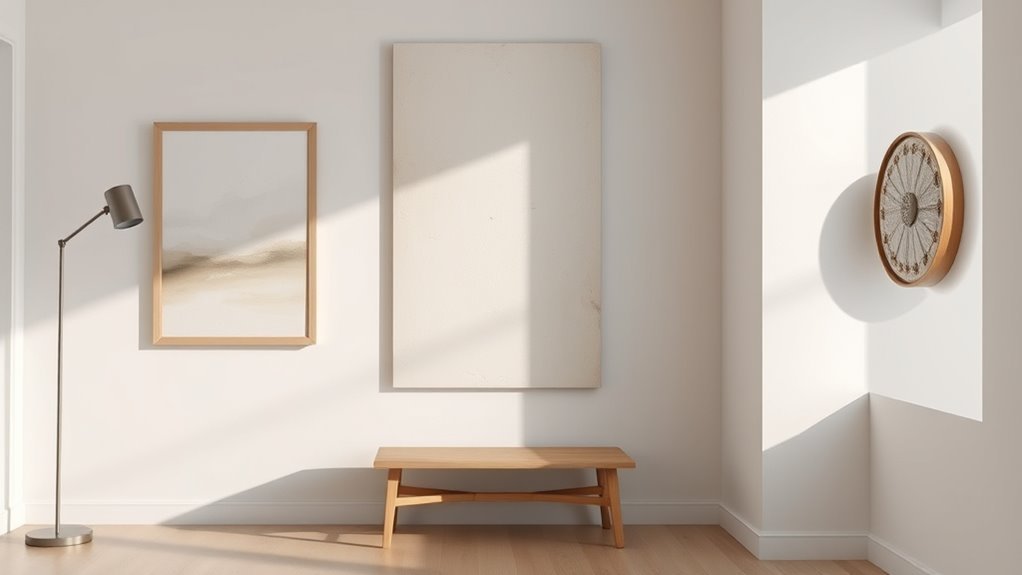
Who’s looking up “what to call a wall painting,” and why? You might be a student clarifying terminology, a curator noting artistic intent for labels, a journalist framing cultural significance, or a homeowner planning decor.
You’re checking legal or restoration records, researching street art vs. commissioned murals, or cataloging community projects. You want precise language to communicate value, provenance, or care instructions.
You’re weighing context: public vs. private, temporary vs. permanent, decorative vs. political. Your search aims to match term to purpose so stakeholders understand meaning, responsibility, and preservation needs without mislabeling creative work.
What Counts as a Wall Painting: Clear Definition
When you ask what counts as a wall painting, you’ll need to separate traditional murals from the broader concept of murality — the idea and practice of painting that engages architectural surfaces.
Consider both exterior and interior wall paintings, since location affects scale, function, and conservation needs.
Also look at how surface preparation methods like fresco, primer, or undercoat change the work’s permanence and technique.
Mural Versus Murality
Although people often call any large wall image a mural, a clear definition matters: a mural is a painted or applied artwork integrated with an architectural surface, created specifically for that site and designed as a lasting, public-facing element of the space.
You’ll weigh mural significance against “murality” — the qualities that make a work function as a mural: permanence, site-specificity, and civic intent.
Mural history traces social role and technique, helping you distinguish decorative or temporary graphics from true murals.
Use those criteria to judge wall works, focusing on context, maker intention, and material integration rather than size alone.
Interior Wall Paintings
Shifting from public façades to interiors means we’ve to rethink scale, purpose, and audience: interior wall paintings occupy rooms rather than streets, and that changes what counts as a wall painting.
You judge them by how they shape interior aesthetics, respond to wall color, and interact with furniture and light. They can be decorative, narrative, or immersive, and they often serve private or semi-private functions.
You consider placement, viewing distance, and durability, not just imagery. Think of them as integrated room elements that alter mood and use.
- Decorative panels that complement decor
- Narrative scenes for intimate viewing
- Immersive compositions tied to function
Surface Preparation Methods
Surface preparation decides whether a painted wall becomes art or just decoration: you need clean, stable, and appropriately textured substrates so pigments and binders adhere, age, and interact with light as planned.
You assess moisture, remove loose material, and repair cracks; these wall preparation essentials stop future failure. You select primers, consolidate friable plaster, and sand for desired tooth.
For lime, fresco, or acrylic work you choose compatible surface treatment techniques that respect vapor transmission and pigment behavior.
You mask and plan staging to protect edges. Proper prep makes your wall painting durable, readable, and visually integrated with its environment.
Quick Answer: Common Names for Wall Paintings
You’ll want to distinguish between murals and frescos, since frescos are painted into wet plaster while murals can use many methods.
Learn the common terminology—like fresco, secco, mural, and decorative wall art—so you can describe technique and intent accurately.
That clarity helps whether you’re cataloging, conserving, or just appreciating wall paintings.
Mural Vs. Fresco
When you hear “mural” and “fresco,” they often get used interchangeably, but they refer to different techniques and histories: a mural is any large-scale artwork painted or applied directly on a wall, while a fresco specifically means pigments applied to wet plaster so the paint becomes part of the wall as it dries.
You’ll notice mural characteristics like varied media, surface preparation, and modern themes. Fresco origins lie in ancient practices where durability and integration with architecture mattered.
Choose mural when flexibility and materials vary; choose fresco for permanence and historical technique.
- Visible surface texture and scale
- Technique dictates longevity
- Context shapes meaning
Wall Painting Terminology
Think of wall painting terminology as a handy toolbox: it groups the common names you’ll encounter—mural, fresco, trompe-l’œil, sgraffito, and mural-adjacent terms like graffiti and street art—so you can identify technique, material, and intent at a glance.
You’ll learn Wall painting techniques to spot wet plaster frescoes, painted murals, and illusionistic trompe-l’œil.
Historical wall art and Cultural wall expressions reveal context, while Decorative mural styles show aesthetic choices without delving into decorative wall art specifics.
Urban wall transformations describe streetscapes shifting with Artistic wall narratives.
You’ll also consider Wall painting preservation and Community mural initiatives supporting longevity and access.
Decorative Wall Art
Moving from techniques and public contexts to decorative wall art narrows your focus to works made primarily for ornament, ambiance, or interior design rather than public commentary or monumental narrative.
You’ll recognize decorative styles that prioritize wall aesthetics and design integration, blending artistic themes and cultural influences into interiors. Consider artistic movements that inform color palettes and texture variations, and how spatial impact shapes a visual narrative.
Decorative wall art includes murals, panels, and painted installations tailored to scale and purpose. You’ll choose pieces to complement furniture, light, and architecture, making intentional statements without overpowering a room.
- Murals for interiors
- Painted panels
- Decorative installations
Mural vs. Wall Painting: What’s the Difference?
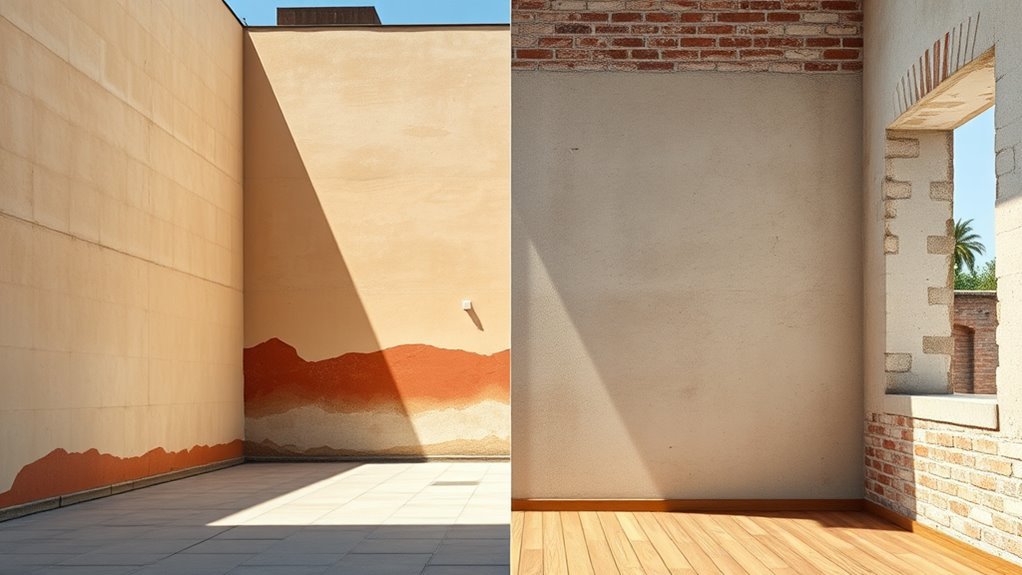
How do you tell a mural from a wall painting? You consider purpose, scale, and context: mural history ties murals to public narratives and community murals serving collective identity, while wall painting styles can be decorative or private.
Look at mural symbolism and cultural murals that carry social messages versus neutral wall art influences driven by trends.
Check mural techniques and permanence—murals often involve robust methods and mural preservation concerns; wall paintings may be temporary or decorative.
Also weigh wall painting ethics: permission, representation, and maintenance.
In short, murals aim public impact; wall paintings often prioritize aesthetics or interior function.
Fresco: Technique, Materials, and Why It’s Unique
Fresco is a wall-painting method that fuses pigment with fresh lime plaster so the color becomes part of the surface itself, creating extraordinary durability and a matte, integrated look.
Fresco: pigment fused into fresh lime plaster, yielding integrated, durable color with a matte, timeless finish
You’ll learn the technique: applying intonaco in sections, working fast while plaster’s wet, and choosing mineral pigments that carbonate into the lime.
Materials include lime putty, sand, water, and natural pigments; tools are trowels and brushes.
Study fresco history to see Renaissance masters and ancient murals.
For fresco preservation, control moisture, salt, and environmental pollutants to prevent flaking and loss.
- Technique: giornata planning
- Materials: lime-based mix
- Care: humidity control
Trompe-l’Œil and Illusionistic Wall Painting
Although it tricks the eye with convincing depth and detail, trompe-l’œil relies on precise observation and masterful handling of perspective, light, and shadow to turn flat surfaces into believable spaces. You’ll notice trompe l’œil techniques emphasize proportion, cast shadows, and seamless edges so objects seem tangible. When you approach illusionistic murals, you engage with architecture and viewer position; the effect depends on vantage point. Use these works to study foreshortening and material textures. Below is a simple guide:
| Element | Purpose | Tip |
|---|---|---|
| Perspective | Create depth | Anchor to sightline |
| Shadow | Define volume | Match light source |
| Texture | Suggest material | Layer glazes |
| Scale | Sell reality | Consider viewer distance |
Graffiti and Street Art: Urban Wall Painting
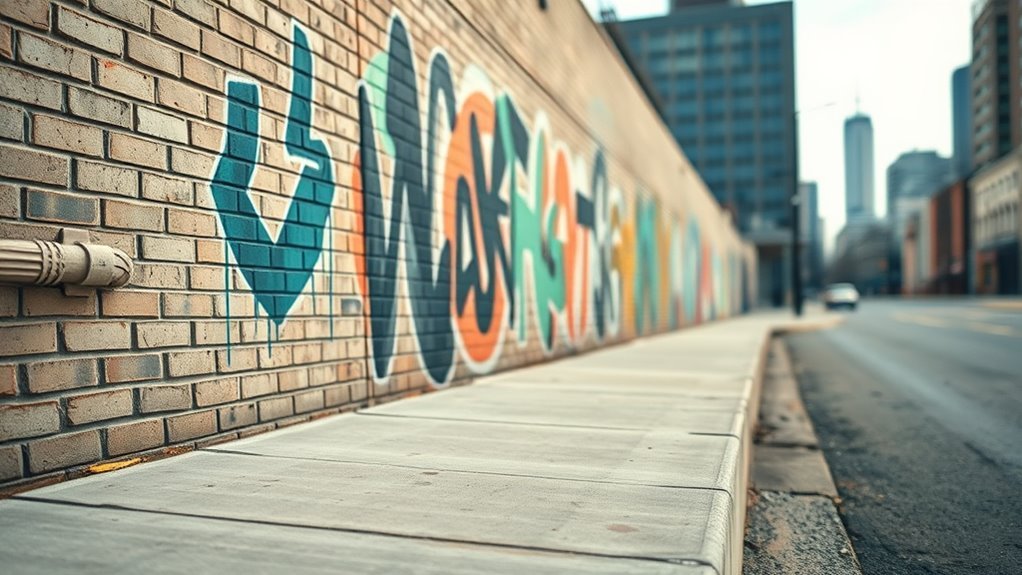
When you look at graffiti and street art, you’ll weigh legal versus illegal work and how that status shapes style and opportunity.
Notice the range of techniques—from tagging and stenciling to large-scale murals—and how each choice affects visibility and message.
Consider how these works engage communities, spark conversation, or drive change in urban spaces.
Legal Versus Illegal Art
If you’ve ever paused to admire a mural or flinched at a hastily scrawled tag, you’ve encountered the tension between legal and illegal urban wall painting.
You judge context: commissioned legal graffiti can revitalize neighborhoods, while unauthorized murals may provoke fines or removal. You consider intent, permission, and community impact.
Cities balance regulation with creative freedom, offering permits, designated walls, or public art programs to channel energy constructively.
You’ll notice debates about ownership, aesthetics, and policing.
- Ask who funded or permitted the work.
- Look for community responses and maintenance.
- Note enforcement patterns and designated zones.
Styles And Techniques
Street artists and graffiti writers use a mix of styles and techniques—from bold, letter-based pieces to figurative murals and abstract hand‑styles—and each choice shapes how a work reads in the urban landscape.
You’ll notice abstract styles and expressionist techniques offering emotion and movement, while realism approaches capture portraiture and scenes. Decorative motifs and thematic concepts tie visuals to messages, and cultural influences root works in place.
Contemporary trends update tools and color palettes, while texture variations add depth. You’ll also spot historical significance in references and methods, showing continuity between past and present urban practice.
Community Engagement Impact
Because murals and graffiti often occupy shared public spaces, they invite citizens to respond, interact, and reshape neighborhood identity. You can see that impact in both everyday conversations and organized initiatives.
When you encounter community art on a block, it prompts dialogue, local pride, and sometimes collective action. You can join workshops, document stories, or propose new pieces, turning passive observation into active public engagement.
These projects can deter vandalism, amplify marginalized voices, and stimulate small-economy foot traffic. Engage directly: participate, photograph respectfully, and support maintenance.
- Attend mural workshops
- Share stories online
- Volunteer for upkeep
Portable vs. Permanent: Panel Paintings and Canvases on Walls
When you move through galleries or churches, you’ll notice a clear difference between works meant to travel and those fixed to walls: panel paintings and canvases were made to be taken down, carried, and shown in different settings, while murals and frescoes were conceived as permanent parts of their architectural sites.
You learn about panel differences when you see wood or composite supports, joinery, and varnish darkening with age, and you compare canvas types—linen, cotton, primed or raw—each affecting texture and durability.
Conservation, display choices, and transport needs hinge on whether a work was designed to be portable or permanent.
Tapestry and Textiles That Act Like Wall Paintings
You’ll notice how woven wall hangings occupy space like large-scale paintings, using warp and weft to create imagery and texture.
Pay attention to tapestry techniques—cartooning, weft-faced weaving, and needlework—and to materials like wool, silk, and metal thread that shape color and sheen.
Consider how these choices affect scale, light response, and the work’s role as both insulation and visual narrative.
Woven Wall Hangings
A woven wall hanging turns textile into a pictorial field, letting fibers act like brushstrokes to shape color, texture, and narrative across a room.
You’ll see how woven techniques let you balance pattern and scale, and how textile art gives warmth, acoustic softness, and a tactile focal point without framing.
You can hang small panels or grand pieces to set mood, create rhythm, or anchor seating.
Care and placement matter: light, height, and backing influence how the design reads.
Consider proportion to furniture and wall, and how touchable surfaces invite closer inspection.
- Choose scale that complements the room
- Vary texture for depth
- Mind lighting and placement
Tapestry Techniques and Materials
Tapestry techniques turn threads into imagery, and you’ll find that weaving, rya knots, soumak, and warp-faced methods each shape surface, line, and depth differently.
You choose tapestry materials—wool, silk, cotton, metal thread—to control color, sheen, and durability. These tapestry techniques let you build pictorial effects in woven textiles, turning textile art into narrative or abstract composition.
As fiber art, wall hangings require consideration of loom setup, tension, and finishing so decorative textiles hang flat and read like paintings.
Learning textile techniques expands your toolkit, letting you treat fibers as paint and fabric as canvas in compelling, tactile work.
Wall Installations and Mixed-Media Works (Not Paintings)
While paintings hang flat against a wall, wall installations and mixed-media works transform that same vertical plane into immersive, tactile environments you can almost walk into. They combine found objects, fabric, light, sound, and sculptural elements to redefine how viewers interact with art.
You’ll encounter pieces that extend into space, invite touch, or activate through motion and sound. These works challenge framing, require tailored display, and often rely on site-specific responses.
You’ll consider scale, sightlines, and viewer movement when you experience them.
- Engage by moving around the piece.
- Note materials and their histories.
- Observe how light alters perception.
Bas-Relief and Mural Sculpture: Painted 3D Walls
Move from installations into walls that physically rise toward you: bas-relief and mural sculpture paint three-dimensional forms directly onto vertical surfaces, blending pictorial imagery with low-relief modeling.
You’ll see artists build shallow armatures, apply plaster or synthetic media, and sculpt subtle projection so figures catch light like freestanding work. Using bas relief techniques, painters integrate color, texture, and carved shadow to enhance depth without full sculpture.
Mural sculpture lets you experience narrative and tactility together; you can trace contour with your eyes and hand, while the wall remains structural. These works sit between painting and relief, demanding both painterly and sculptural skill.
Mosaic, Painted Masonry, and Related Wall Arts
You’ll explore mosaic wall techniques that arrange tesserae and tiles into durable, image-bearing surfaces.
You’ll also look at painted masonry methods for sealing, priming, and rendering pigment on plaster and stone.
Finally, you’ll compare how tile and tesserae uses differ in texture, scale, and setting.
Mosaic Wall Techniques
Explore how mosaic and painted masonry transform plain walls into visual narratives and textured surfaces that change a room’s mood and scale.
You’ll learn mosaic techniques that trace historical mosaics’ craft while seeing how artistic mosaics evolve now. You’ll consider material choice, grout color, and pattern scale to guide sightlines and atmosphere.
Contemporary mosaics mix glass, stone, and recycled media for shine, depth, and tactile contrast. You’ll think about light interaction and maintenance when planning installations, ensuring longevity and impact.
- Choose tesserae for color and durability
- Plan grout for contrast or cohesion
- Test layout at full scale before fixing
Painted Masonry Methods
Painted masonry lets you turn structural surfaces into expressive backdrops, whether you’re frescoing a courtyard wall, stenciling a repeating motif, or layering washes over rough stone to soften scale.
You’ll choose masonry techniques that suit substrate porosity, climate, and maintenance, selecting lime or acrylic binders and sealants.
When you prepare painted surfaces, you’ll clean, prime, and sketch compositions to integrate with architecture.
These artistic methods include buon and fresco secco, encaustic-like washes, and trompe-l’oeil to suggest depth.
As wall art, painted masonry interacts with texture and light, so you’ll test pigments and finishes to guarantee longevity and visual harmony.
Tile And Tesserae Uses
Moving from painted masonry’s surface treatments to assembled surfaces, tile and tesserae let you build images with discrete pieces rather than applied pigment. You choose materials, grout, and scale to control texture, reflectivity, and durability.
Mosaic work relies on precise tile patterns, while tesserae techniques determine color shifts and linework. You plan composition like a painter but place elements like a sculptor, adapting to architectural joints and sightlines. These methods suit public, sacred, or domestic walls and resist weather better than many paints.
- Pick contrasting tile patterns for movement
- Use tesserae techniques for gradients
- Consider substrate and sealants
Materials: Fresco, Tempera, Oil, and Acrylic on Walls
Materials matter when you’re putting pigment on a wall: fresco, tempera, oil, and acrylic each behave differently, demand different supports, and age in distinct ways. You’ll explore fresco techniques for longevity, tempera uses for matte detail, oil applications for rich glazing, and acrylic finishes for fast drying. Choose based on durability, texture, and environment.
| Medium | Character | Best for |
|---|---|---|
| Fresco | Mineral bond | Murals in damp settings |
| Tempera | Egg-based matte | Fine, detailed work |
| Oil | Slow-drying glow | Layered, luminous images |
| Acrylic | Flexible quick-dry | Contemporary murals |
Surface Preparation for True Wall Paintings
Before you start painting, check the wall for cracks, loose plaster, moisture, and structural issues so you know what repairs are needed.
Clean and decontaminate the surface thoroughly to remove dirt, efflorescence, and biological growth that can undermine adhesion.
Finally, choose and apply a primer suited to the wall material and painting method to guarantee lasting bond and protection.
Assessing Wall Integrity
Although you might be enthusiastic to paint, you should first assess the wall’s integrity to guarantee a true wall painting will last. Check for cracks, loose plaster, moisture, and previous coatings that could compromise adhesion.
You’ll perform a careful wall inspection and basic structural assessment to decide if repairs or reinforcement are needed. Tap for hollow spots, probe for dampness, and note flaking layers. Document issues and plan fixes before any paint touches the surface.
Consider consulting a pro for major defects.
- Look for cracks and hollow sounds
- Identify moisture sources
- Note previous incompatible coatings
Cleaning And Decontamination
Start by removing surface dirt, grime, and biological growths so your true wall painting will adhere and age as planned.
You’ll test small areas to pick cleaning methods—dry brushing, mild detergents, or controlled aqueous cleaning—matching technique to substrate and pigment sensitivity.
Wear gloves, use soft tools, and avoid harsh solvents that harm original material.
Biological contaminants need biocides chosen for conservation use and applied sparingly.
After cleaning, document conditions and residues.
Proper wall cleaning reduces failure risk and supports long-term paint preservation.
If uncertainty arises, consult a conservator to prevent irreversible damage to historic wall paintings.
Applying Proper Primers
Choose a primer that respects the wall’s substrate and the paint system you’ll use, because the wrong primer can trap moisture, repel adhesion, or alter color.
You’ll assess surface conditions—porosity, previous coatings, and dampness—then pick primer types matched to masonry, plaster, or painted drywall.
Apply in thin, even coats, letting each cure fully before painting. Patch cracks and remove loose material; don’t paint over active efflorescence.
Test a small area to confirm adhesion and color shift. Follow manufacturer instructions for dilution and recoat times to guarantee longevity and accurate finish.
- Match primer types to substrate
- Test adhesion on site
- Repair before priming
Scale and Placement: How Size Changes the Name
When you change an artwork’s size or where it’s placed, its name and perceived role often change too: a small study can become a miniature, a large painted panel can be called a mural, and a work designed for a column or ceiling gets labeled by its setting rather than just its subject.
You notice scale nuances affecting terms—study, panel, fresco—while placement significance shifts descriptions to ceiling painting, frieze, or trompe-l’œil.
You’ll call something a mural when it dominates a wall; a lunette when it fits an arch. Naming follows practical size and precise architectural context, not just imagery.
Public Murals vs. Private Interior Wall Paintings
When you compare public murals and private interior wall paintings, you’ll notice public works often respond to community space, scale, and visibility.
Private wall artwork usually focuses on personal taste, materials suited for indoor conditions, and long-term maintenance by the owner.
You should also consider legal and ownership issues—permits, copyright, and who controls alterations differ sharply between public and private contexts.
Public Mural Characteristics
A public mural usually faces different needs and audiences than a private interior painting, so you’ll plan for scale, durability, and visibility from the start.
You’ll choose robust materials, weatherproof finishes, and compositions readable from a distance. Public mural themes often reflect local history, activism, or celebration, and community mural projects invite collaboration and stewardship.
You’ll consider permits, maintenance plans, and audience flow to maximize impact while minimizing deterioration.
- Engage locals for concept and upkeep
- Use UV-resistant paints and graffiti-resistant coatings
- Design for sightlines, lighting, and long-term conservation
Private Wall Artwork
You choose pieces from your private collection to refine wall aesthetics and coordinate color schemes with home decor.
Consider art placement for maximum visual impact, balancing artistic themes with existing furniture and design trends.
Let personal expression guide creative inspiration while maintaining cohesion—scale, texture, and framing matter.
You’ll test lighting and sightlines, edit to avoid clutter, and refresh pieces seasonally to keep interiors vibrant and meaningful.
Legal And Ownership Issues
Because public murals sit on shared property and interior wall paintings live inside private homes, you’ll encounter very different legal questions about permission, copyright, and responsibility.
You’ll need to evaluate mural permissions, artist agreements, and wall art contracts up front. Public works often involve municipal rules and possible public domain claims; private pieces rely on clear licensing terms and homeowner consent.
To avoid ownership disputes and resolve copyright issues, get everything written. Know your legal rights, define reproduction rights, and decide who maintains the work.
- Ask for written mural permissions and licensing terms.
- Specify copyright issues in artist agreements.
- Draft wall art contracts to prevent ownership disputes.
Religious Wall Paintings: Icons, Chapels, and Sanctuaries
Stepping into a chapel, you’ll notice how wall paintings transform plain surfaces into sacred narratives that guide worship and devotion. You’ll see icons that focus prayer, frescoes that illustrate scripture, and decorative cycles that mark liturgy.
These images use religious symbolism to teach, comfort, and assert communal identity. You’ll notice scale, placement, and palette chosen to elevate space; they frame altars, define chapels, and create sanctuaries of sight.
Whether bright or subdued, they reflect artistic inspiration rooted in belief, patronage, and ritual purpose, inviting you to read theology visually as you move through the space.
Historic Wall-Painting Methods Across Cultures
You’ll notice how fresco techniques—from buon fresco in Italy to secco variants elsewhere—shape color, texture, and longevity.
Compare those methods to mural traditions across cultures, where materials and motifs respond to local climates and beliefs.
As you study examples, focus on technique, surface preparation, and cultural purpose.
Fresco Techniques Worldwide
Fresco painting—water-based pigments applied to wet or dry plaster—has been adapted across cultures to suit local materials, climates, and rituals.
You’ll trace fresco history through global techniques, noting regional styles from Mediterranean buon fresco to Mexican and South Asian adaptations.
You’ll see cultural significance in ritual scenes, civic narratives, and devotional imagery.
Contemporary frescoes revive methods while facing preservation challenges like humidity, pollution, and vandalism.
You’ll learn practical differences—lime slaking, pigment choices, and layering—that shape outcomes and conservation strategies.
- Learn materials and methods you can test.
- Compare regional styles and motifs.
- Note key preservation challenges.
Mural Traditions Explored
Across continents and centuries, mural traditions have recorded communal values, religious stories, and political power directly onto public walls you can still read today.
You explore diverse mural styles rooted in cultural significance and historical context, from temple frescoes to street murals. You’ll study artistic techniques—pigments, plaster, spray—and learn how community stories shape content and placement.
Consider environmental impact of materials and conservation choices. Mural festivals revive traditions and foster dialogue, while murals often deliver pointed social commentary.
Conservation and Restoration of Painted Walls
Conserving and restoring painted walls demands careful assessment, skilled technique, and respect for a work’s original materials and intent.
You evaluate condition, identify pigments and binders, and choose preservation techniques that stabilize surfaces without altering historical character.
You’ll document every step, test treatments in small areas, and address restoration challenges like flaking, moisture, and past inappropriate repairs.
Collaboration with historians and conservators guides ethical decisions.
- Learn basic preventive care to slow deterioration.
- Consult a professional for structural or chemical issues.
- Photograph and record interventions for future caretakers.
Legal and Ownership Terms for Wall Paintings and Murals
After stabilizing and documenting a painted wall, you’ll often face questions about who legally owns the work and what rights apply to its use, display, or alteration.
You need to know legal rights tied to physical ownership versus artistic authorship; property owners, artists, and funders can all claim interests.
You’ll navigate ownership disputes, contracts from mural commissioning, and consent or indemnity clauses.
Consider copyright issues separately: even if the wall’s owner controls the surface, the artist may retain reproduction rights.
Clear agreements before work begins prevent conflict, and documenting permissions helps enforce terms if disputes arise.
How to Label a Wall Artwork in Catalogs and Captions
Labeling a wall artwork in a catalog or caption requires you to balance concise factual information with context that honors both the physical object and the creator’s rights.
Labeling wall artworks demands concise facts and contextual respect for both the object and its creator’s rights.
You’ll state title (or description if untitled), artist, date, medium, dimensions, and location. Use clear labeling techniques that note whether the piece is a wall painting, mural, or temporary work.
Include credit line and rights holder, and mention condition or alterations when relevant. Keep captions scannable so readers grasp provenance and viewing context quickly.
- Title or descriptive label
- Artist, date, medium, dimensions
- Credit line and rights info
When to Call It a Mural vs. a Mural Commission or Project
Once you’ve settled on the factual caption details, you’ll also need to decide what to call the work itself: a mural, a mural commission, or a mural project.
You’ll call it a mural when the piece fits the mural definition: a painted or applied work integrated with an architectural surface.
Use mural commission when a client formally hired the artist, contract or payment exists, and responsibilities are documented.
Label it a mural project when multiple stakeholders, phased work, funding sources, or community involvement shape the process.
Be precise: include dates, funders, and collaborators so the label reflects mural functions and context.
Artist Intent and Style: Naming by Purpose
When you name a mural by purpose, center the artist’s intent and stylistic choices: is it a decorative backdrop, a political statement, a site-specific intervention, or an experiment in technique?
You’ll focus on artist expression and use creative labeling that reflects function, tone, and method. Ask what the creator aimed to communicate, who the audience is, and which materials or styles dominate.
Your naming should guide interpretation without overclaiming authorship. Consider hybrid forms and acknowledge collaboration.
Use concise, descriptive tags that respect context and intention.
- Purpose-driven
- Political/social commentary
- Experimental/technique-focused
Regional Terms and Translations for Wall Paintings
How do regional words shape our understanding of wall paintings? You’ll notice regional variations affect labels: mural, fresco, graffiti, pichacao, or t̓sék̓ʷel in some Indigenous tongues.
Translating terms reveals histories and materials—fresco ties to plaster techniques, pichacao to São Paulo’s alleyway tradition.
Cultural influences guide meaning: sacred mural in one place, political poster in another. When you learn local words, you grasp social context, production methods, and audience expectations.
Respecting original terminology preserves nuance and avoids flattening diverse practices into a single English term, helping you appreciate each wall painting on its own cultural terms.
How Museums and Galleries Classify Wall-Mounted Works
Classification matters because museums and galleries place wall-mounted works into categories that shape how you see, conserve, and interpret them. You’ll encounter museum classifications that separate originals, prints, installations, and conservation priorities, and gallery terminology that distinguishes framed easel paintings from murals, reliefs, and site-specific pieces.
Curators label works by medium, provenance, and display needs so you understand context and care requirements. When you visit, those labels guide interpretation and handling protocols.
Consider how classification affects display rotation, lighting, and conservation intervention; it influences scholarship, loans, and insurance.
- Medium and technique
- Provenance and attribution
- Display and conservation needs
Practical Naming Guide for Homeowners and Designers
Because the terms museums use don’t always fit domestic needs, you’ll want a practical naming system that’s clear for homeowners, designers, and tradespeople. You’ll label by function (accent, focal), format (canvas, mural, print), and placement (entry, above sofa). Use homeowner preferences and designer insights to agree on terms before ordering or installing. Keep labels short so contractors and movers understand.
| Use | Format | Placement |
|---|---|---|
| Accent | Canvas | Above sofa |
| Focal | Mural | Entryway |
| Practical | Hallway |
This simple table helps standardize communication and prevent mistakes.
How Journalists and Bloggers Should Refer to Wall Paintings
When you write about wall paintings, choose terms that guide readers without overloading them with specialist jargon; call works “murals” when they’re integral to the wall, “frescoes” for paintings done on wet plaster, and “wall-mounted paintings” or “canvases” when they’re applied or hung on the surface.
You should follow journalistic terminology and blogging standards: be precise, use accessible descriptions, and note context (public, private, conservation). Avoid speculative labels unless verified. Cite sources for attribution and technique.
Use consistent style in captions and leads to aid readers’ understanding and trust.
- Prefer clear, single-word identifiers
- Note material and location briefly
- Credit artists and sources
SEO Keywords People Use for Wall Art Terms
Want your articles on wall art to be found? Use SEO keywords that match what readers search: artistic expression, wall aesthetics, cultural significance, and design trends.
Emphasize historical context and artistic techniques to catch academic and casual queries. Blend visual storytelling with viewer engagement to appeal to social and gallery audiences.
Mention community involvement when the work serves public space, and highlight emotional impact for personal or therapeutic angles.
You’ll rank better by mixing specific and broad terms, keeping phrases natural in headings, meta descriptions, and image alt text so searchers and algorithms both recognize your relevance.
Short Checklist to Identify What to Call a Wall Painting
If you’re trying to name a wall painting, check a few key features: its size and setting (mural, fresco, or panel), whether it’s painted directly on the substrate or on a removable support, the technique used (spray, brush, encaustic, secco), the work’s purpose (decorative, commemorative, or activist), and any legal or community context (commissioned, street art, or public art).
Then use this short checklist to decide: note substrate, technique, intent, and style.
Use this quick checklist to note substrate, technique, intent, and style when naming a wall painting.
Consider artistic styles and painting techniques when labeling. Be precise and avoid assumptions about authorship or permanence.
- Ask about surface and support
- Identify main technique
- Confirm commission or public status
Common Mislabels and How to Avoid Them
Although it may seem straightforward, you’ll often encounter paintings on walls that get misnamed because observers skip checking substrate, technique, or context. You should confirm whether it’s a mural, fresco, graffiti, or painted canvas applied later; that clears up misconceptions clarified by simple observation.
Note terminology nuances: substrate (plaster, brick), technique (buon fresco, secco, spray), and permanence. Ask who commissioned it and where it’s located.
Use concise labels: mural for site-specific works, fresco for wet-plaster painting, graffiti for unsanctioned spray art. Precise identification prevents mislabeling and respects artists’ methods and intent.
Case Studies: Famous Murals, Frescoes, and Installations
Start with a look at context: you’ll see how site, patronage, and medium shape meaning as much as style.
You’ll examine famous murals, frescoes, and installations to learn how artists respond to politics, faith, and public use.
Case studies show how scale, technique, and placement alter interpretation and how preservation decisions affect cultural significance.
You’ll consider viewer access, original intent, and later reinterpretations.
Use these prompts to engage with examples:
- Compare a politically charged mural and its community response.
- Analyze a fresco’s material limits and restoration choices.
- Trace an installation’s lifecycle from conception to conservation.
Further Reading and Resources on Wall-Painting Terminology
Anyone exploring wall-painting terminology will find targeted resources that clarify technical terms, historical usages, and conservation vocabulary; use glossaries, illustrated handbooks, and journal articles to build a precise working lexicon. You’ll consult museum guides, academic surveys, and field manuals to trace wall painting history and assess cultural significance. Follow recommended reading, join specialist forums, and check conservation case studies. Use the quick reference below for starting points and pace your study.
| Resource | Type | Focus |
|---|---|---|
| Glossary | Online | Definitions |
| Handbook | Book | Techniques |
| Journal | Periodical | Research |
| Museum Guide | Pamphlet | Context |
Frequently Asked Questions
Can a Decal or Wallpaper Be Called a Wall Painting?
No — you wouldn’t call a decal or wallpaper a wall painting; they’re wall art or a decorative design, produced as applied prints or coverings rather than painted imagery, though they can mimic painted styles convincingly.
Do Temporary Pop-Up Murals Count as Official Artworks?
Yes — you’ll see temporary art bloom across public space, and it’s treated as official artwork when created with intent, skill, or approval; cities, critics, and communities often recognize pop-up murals as legitimate, meaningful works.
Are Murals Protected Intellectual Property by Default?
Yes — you generally own mural copyright automatically when you create it, but mural ownership of the physical wall can differ; you’ll still hold copyright unless you’ve signed it away or a work-for-hire contract transfers rights.
How Do I Credit Multiple Artists on a Single Wall Piece?
Don’t worry about complexity; list each contributor visibly and consistently. You’ll note artist collaboration prominently, choose crediting styles (equal billing, role-based, or timeline), use durable signage or plaque, and include social handles and year.
Can a Painted Wall Be Insured as Fine Art?
Yes — you can insure a painted wall as fine art if it meets collectors’ criteria; you’ll need professional art valuation and to confirm specific coverage details, exclusions, and limits within your insurance policies before proceeding.
Conclusion
You stand before a house of words where each room bears a picture on its wall: some are murals—bold family portraits that shout community—others are frescoes, fresco-like ghosts painted into wet plaster, breathing with the wall’s skin. Call them murals, frescoes, wall paintings, or installations, but remember: names are maps, not the territory. Choose the map that fits your journey, and you’ll find the painting’s true address in history and technique.
