
How to Price Exterior Painting Jobs: Easy Estimate Guide
You’ll price exterior painting jobs by measuring paintable surfaces, subtracting openings, and separating siding, trim, and soffits so you can apply the right coverage rates. Itemize paint, primer, caulk, and equipment, then calculate labor using task-hours for prep, painting, and cleanup. Add accessibility costs, overhead, and your profit margin, and build contingencies for repairs. Present a clear line-item proposal with timelines and guarantees, and keep going to learn step-by-step measurement and pricing tips.
Who This Guide Is For and What You’ll Learn
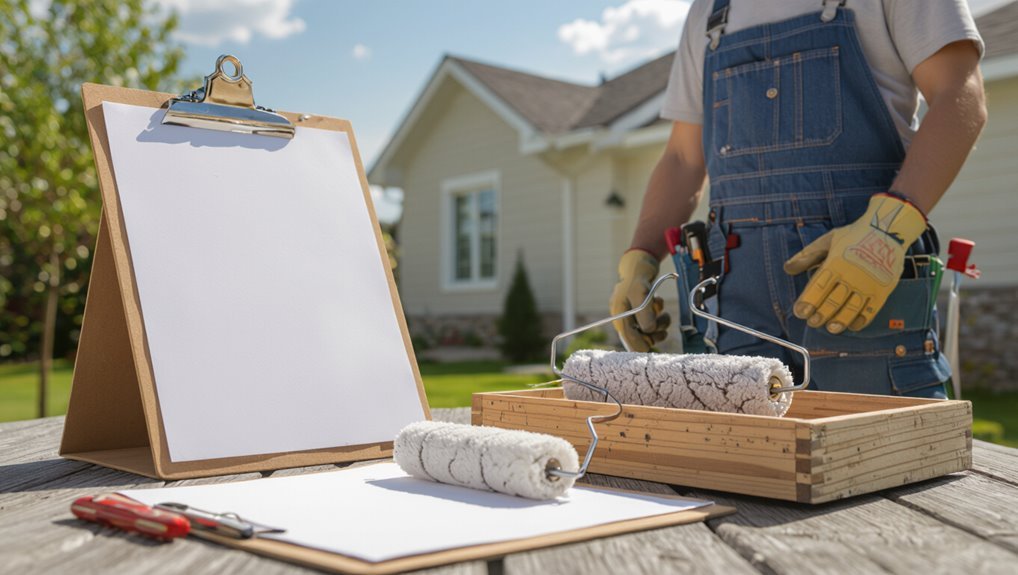
Whether you’re a solo contractor just starting out, a crew leader looking to standardize bids, or a homeowner comparing estimates, this guide shows you how to price exterior painting jobs accurately and profitably.
You’ll see the target audience, clear learning outcomes, stepwise tasks, common pitfalls, and pricing components.
You’ll be able to estimate confidently, justify numbers to clients, and avoid costly mistakes.
Quick Answer: A Simple Estimating Formula for Exterior Painting
Now that you know who this guide is for and what you’ll learn, here’s a quick, practical formula to estimate most exterior painting jobs:
(Surface Area × Paint & Materials Cost per sq ft) + Labor Cost + Overhead + Profit = Total Price.
Use that as a baseline, adjust for site-specific estimating challenges, and pick pricing strategies that reflect materials, complexity, travel, warranties, and desired margin.
Measure the House for an Exterior Painting Estimate
Start by measuring the wall surface area of each elevation so you know how much paint and labor you’ll need.
Subtract openings like windows and doors, and add areas for trim and soffits if they’re being painted.
Also note obstructions—porches, built-ins, or irregular features—that change access time or require special prep.
Measure Wall Surface Area
Measure the wall surface area to determine how much paint and labor you’ll need for an accurate exterior estimate.
Walk the perimeter, measure wall widths and heights, and multiply for each plane. Note surface texture and wall materials since rough or porous substrates absorb more paint.
Sum all wall areas, record totals by elevation, and use coverage rates to calculate required gallons and labor hours.
Account For Obstructions
Because fixtures and features change the amount of paint and time you’ll need, walk each elevation and mark every obstruction—windows, doors, eaves, gutters, porches, railings, light fixtures, and vents—so you can subtract their areas from wall totals and add any extra trim or repair work they require.
Note common obstruction types, measure openings precisely, and document estimating complexities like scaffolding, access, and patching needs.
Calculate Paintable Surface Area by Siding Type
When you’re estimating an exterior paint job, calculate the actual paintable surface area for each siding type separately so your materials and labor estimates stay accurate.
Measure wall dimensions, account for overlaps on clapboard, texture on stucco, and panel seams on fiber cement.
Different siding materials affect coverage rates and surface preparation time, so record each type’s square footage for accurate estimates.
Adjust Area for Doors, Windows, and Trim Openings
Now subtract the square footage of doors, windows, and large trim openings from each wall’s total so your paint and labor estimates reflect only the true paintable surface.
Measure each window and record window measurements, then apply door adjustments for standard and oversized doors.
Deduct trimmed areas, account for shutters and transoms, and update totals before calculating paint quantities and labor hours.
Inspect Surface Condition: How It Changes Labor Needs
Before you estimate labor, walk each wall and assess the surface—look for peeling paint, rot, mildew, chalking, loose caulk, and patched areas—because these defects change prep time and techniques needed.
Before estimating labor, inspect each wall for peeling paint, rot, mildew, chalking, loose caulk, and patches.
You’ll adjust labor hours based on condition to optimize surface preparation and labor efficiency.
- Minor cleaning/sanding: add small time.
- Extensive prep: multiply crew hours.
- Caulking/patching: schedule skilled labor.
Find Rot, Rust, and Hidden Repairs and Estimate Their Cost
If you suspect hidden damage, peel back trim, probe joints, and inspect behind gutters and downspouts so you can find rot, rust, and other repairs that’ll change cost and schedule.
You’ll perform rot detection with a screwdriver, document soft spots, and do a rust assessment on metal flashing.
Tally repair materials, replacement labor, and drying time to add accurate line items to the estimate.
Paint Selection: Coverage, Durability, and Cost per Gallon
Once you’ve accounted for hidden repairs, you’ll pick paints that match the surface and budget while maximizing coverage and longevity.
You’ll weigh paint durability against upfront price, factoring into your cost analysis to choose primers and topcoats that reduce future maintenance.
Consider finish, UV resistance, and warranty when estimating lifecycle expense.
- Surface type
- Durability vs. price
- Warranty and maintenance
Convert Paint Coverage: Gallons From Sq Ft and Linear Ft
Start by measuring the areas you’ll paint in square feet for walls and in linear feet for trim. Then convert those totals into gallons using the paint’s coverage rate (usually listed as sq ft per gallon).
Use simple estimating formulas: gallons = area ÷ coverage for walls. For trim, convert linear feet × height to sq ft first.
Round up for coats and waste, then total.
Budget Primer, Caulk, and Specialty Products Separately
Don’t lump caulking, primer, and specialty paints into your general materials line—break out caulking costs by linear foot so you’re not surprised.
Account for the extra time it takes to apply primer and include that labor in your estimate.
If a job needs stain-blocking or high-build products, budget those specialty paints separately so your margin stays accurate.
Break Out Caulking Costs
Caulking can make or break your exterior paint job, so budget primer, standard caulk, and any specialty sealants as separate line items instead of lumping them into “materials.”
You should price caulking materials distinctly and factor labor costs per hour or per linear foot.
- Prep and primer
- Standard caulk
- Specialty sealants
Budget For Specialty Paints
When you’re estimating an exterior job, itemize primer, standard caulk, and specialty paints or sealants as separate line items so you can see exactly where costs climb and why.
You should list specialty paint types (masonry, metal, high-UV) and calculate coverage, coats, and required sealants.
Include a clear cost comparison to standard paints so clients understand premium pricing and justify choices.
Include Primer Labor
You’ve already broken out specialty paints and sealants; now separate primer labor from material costs so you can show the real work involved in prepping surfaces.
Track hours for each primer task and note primer types used to justify rates and material charges. This improves labor efficiency and client transparency.
- Surface cleaning
- Priming coats
- Caulk and touch-up
Materials Checklist: Step-by-Step Cost Estimate
Before you total labor and overhead, list every material you’ll need and assign a unit cost to each item so your estimate reflects real expenses; categorize material types (paint, primer, caulk, tapes, drop cloths, fasteners), note quantities, and record vendor prices.
Factor in cost factors like waste, delivery, and specialty finishes.
Sum per-item totals to produce a transparent, verifiable materials subtotal.
Price Replacement Boards, Flashing, and Minor Carpentry
If a few rotten boards, damaged flashing, or loose trim will affect the paint’s durability and appearance, you’ll need to price those repairs separately and clearly on your estimate.
Calculate Replacement board costs, include Flashing installation estimates, and list Minor carpentry pricing with Repair material calculations for transparency.
- Board sizes and quantities
- Flashing type and length
- Trim and fastening materials
Labor Basics: Crew Roles and Hourly Rate Guidelines
When pricing labor, start by defining each crew role—lead painter, journeyman, helper, and specialist (e.g., power-washer or carpenter)—so you can assign realistic hourly rates and productivity expectations for every task.
You’ll document crew responsibilities, expected output, and supervision needs. Set hourly rates by experience, local market, and job complexity, then adjust for overtime, travel, and specialized skills to keep estimates accurate.
Break the Job Into Task-Hours: Prep, Paint, Cleanup
Because accurate estimates rest on measurable work, break the job into task-hours for prep, paint, and cleanup so you can assign time and cost to each activity.
You’ll use task prioritization and clear time allocation to schedule crews, tools, and materials. Estimate each phase separately to avoid underbidding.
- Prep: assess, protect, repair.
- Paint: coats, coverage, drying.
- Cleanup: waste, touch-ups, inspection.
Productivity Rates by Siding Type and Height
Now that you’ve broken the job into prep, paint, and cleanup task-hours, adjust those estimates based on siding type and height—these factors change how fast crews work and what equipment they’ll need.
Softer materials slow progress; higher siding often adds setup and transit time.
Factor siding durability into unit rates and account for height impact when estimating labor hours so bids reflect real productivity.
Factor Accessibility: Scaffolds, Lifts, and Safety Gear
If access to the work area is limited, you’ll need to add time and cost for scaffolds, lifts, and safety gear—each affects setup time, crew size, and hourly rates.
You must assess Accessibility challenges, enforce Safety protocols, and plan Equipment rental without yet totaling costs.
Consider these Scaffold considerations when estimating labor and timeline:
Consider scaffold factors—setup complexity, crew training, and site logistics—when estimating labor and scheduling work.
- setup complexity
- crew training
- site logistics
Calculate Equipment and Rental Costs per Job
When you tally equipment and rental costs per job, list each item—scaffolds, lifts, power washers, compressors, sprayers, and safety gear—and note daily or weekly rates, delivery fees, and expected rental duration so your estimate reflects real expenses.
Add ownership costs for tools you own, prorate maintenance, and record equipment types per task.
Sum rental duration charges and one‑time fees to get accurate job-specific totals.
Markup, Overhead, and Profit: Simple Percentage Rules
Now you’ll figure out how much of your bid should cover ongoing business costs by calculating an overhead percentage that captures rent, insurance, admin, and similar expenses.
Then decide on a profit markup that rewards your time and risk while staying competitive.
Together those percentages turn your direct job costs into a sustainable, profitable price.
Calculating Overhead Percentage
A good rule of thumb is to calculate your overhead as a clear percentage of your direct job costs so you can see what you need to cover rent, insurance, office time, and other non-job expenses.
Use overhead allocation and strict expense management to keep estimates honest. Calculate reliably and update yearly.
- List fixed expenses
- Divide by direct costs
- Apply percentage consistently
Setting Profit Markup
Start by deciding the profit percentage you need on top of your direct costs and overhead so each job actually grows your business.
Use profit analysis to test realistic targets—consider risk, market rates, and desired owner pay.
Apply clear markup strategies: add your overhead percentage to direct costs, then layer your profit percent.
Document assumptions and adjust after tracking actual job results.
Build Contingencies for Weather and Unforeseen Work
Because weather and hidden damage can upend timelines and budgets, you should build clear contingencies into every exterior painting estimate.
Build clear weather and hidden-damage contingencies into every exterior painting estimate to keep timelines and budgets realistic.
Factor in likely weather delays and allowances for unexpected repairs so bids stay profitable and realistic. Communicate contingency triggers and percentages to clients.
- Add a weather delays buffer (days/cost).
- Include unexpected repairs allowance (fixed or %).
- Define approval process for extra work.
Create Clear Line-Item Estimates Clients Understand
After you’ve built weather and repair contingencies into the bid, break the estimate down into clear line items so clients see exactly what they’re paying for and why. You’ll use plain terms, itemized costs, and deadlines to improve client communication and estimate transparency. Include a simple table:
| Item | Qty | Cost |
|---|---|---|
| Prep | 1 | $XXX |
| Paint | X gal | $XXX |
| Labor | X hrs | $XXX |
Pricing Models: Fixed, Time-and-Materials, and Unit Bids
When you price a job, pick the model that matches the project’s predictability and your cash-flow needs: a fixed bid works for well-defined jobs, time-and-materials suits projects with unknowns, and unit pricing fits repeatable tasks like siding or trim where you can standardize per-piece rates.
Use clear pricing strategies, solid cost estimation, and proactive client communication.
Use straightforward pricing, accurate cost estimates, and keep clients informed from start to finish.
- Fixed pricing — guaranteed scope.
- Time materials — flexibility for unknowns.
- Unit bids — efficient for repeatable work.
Handling Discounts, Change Orders, and Margin Protection
You should set clear discount rules up front so clients know when and how price reductions apply.
When scope changes happen, use written change orders to capture extra time, materials, and revised timelines.
Protect your margins by building contingency into estimates and enforcing payment terms for approved extras.
Discount Strategy Rules
A few clear rules will keep discounts from eroding your profits: set firm policies for when and how much you’ll discount, require written approval for any change order that alters scope or price, and always recalculate margins before accepting alterations so you don’t take a loss.
- Define discount tiers tied to clear triggers.
- Limit promotional offers with expiration and scope.
- Track margin impact monthly and adjust pricing.
Managing Change Orders
Because change is inevitable on job sites, you’ll need a tight process for handling discounts and change orders that keeps margins intact.
Implement standardized change order management: document scope shifts, itemize costs, set approval deadlines, and require signed client communication for any adjustments.
Price each change transparently, apply agreed discount caps, and update schedules so you control scope creep and preserve predictable revenue.
Protecting Profit Margins
When margins get squeezed, tighten your pricing controls and don’t let goodwill erode profit—set firm discount rules, document every change order, and price adjustments so they preserve your target margin.
Use profit margin strategies and pricing psychology to justify firm offers.
- Standardize discount approvals.
- Issue clear, signed change orders.
- Build contingency into estimates.
Research Local Rates: Competitive Pricing for Painters
Although pricing feels personal, you can’t set rates in a vacuum—researching local competitors tells you what’s workable and what’s out of line. You should perform competitive analysis, compare pricing strategies, and adjust for materials, labor, and reputation. Use this quick comparison:
| Category | Low | High |
|---|---|---|
| Labor | $ | $$$ |
| Materials | $ | $$$ |
Example Estimates: Small, Medium, and Large House Walkthroughs
Start with three representative homes—a small bungalow, a mid-size two-story, and a large custom house—to see how scope, materials, and labor drive estimates so you can adapt numbers to your market;
Begin with three representative homes—a bungalow, a two‑story, and a custom house—to compare scope, materials, and labor.
each walkthrough will list surfaces, prep needs, paint quantities, labor hours, and a sample price range so you can compare line items rather than just a final number.
- small house walkthrough: basic siding, minimal prep, 8–12 hours, 3–4 gallons.
- Mid-size: mixed siding, trim work, 20–30 hours, 8–10 gallons.
- large house walkthrough: extensive prep, scaffolding, 40–60 hours, 15–20 gallons.
Common Pricing Mistakes and How to Avoid Them
Comparing those walkthroughs should make one thing clear: similar-looking jobs can hide big cost differences, and misreading them eats profit.
You’ll avoid pricing pitfalls by itemizing labor, materials, and prep, checking substrate condition, and planning contingencies.
Be transparent with cost transparency in proposals so clients understand scope changes.
Don’t guess—measure, document, and price conservatively to protect margins.
Present Your Estimate So Clients Say Yes
When you present an estimate, make it easy for the client to say yes by being clear, organized, and confident.
Use concise sections, visuals, and a warm tone to improve client communication and deliver a persuasive presentation.
Highlight value, timeframe, and guarantees.
- Clear breakdown
- Visuals and comparisons
- Call-to-action with options
Templates and Tools to Speed Up Future Bids
You can speed up future bids by using standard estimating template sheets that keep your measurements, materials, and labor organized.
Pair those with digital measurement tools to grab accurate dimensions on-site without remeasuring later.
Then plug the numbers into pricing calculator spreadsheets so you get consistent, fast, and defensible estimates.
Estimating Template Sheets
A good estimating template cuts hours from each new bid by capturing the measurements, material costs, labor rates, and common markups you repeatedly use.
You’ll boost estimating accuracy and leverage pricing psychology to present clear, confident proposals. Use a compact sheet you can reuse and tweak.
- Standard measurements
- Cost breakdowns
- Profit and discount fields
Digital Measurement Tools
Anyone can cut estimate time in half by switching to digital measurement tools that capture dimensions, photos, and notes on the spot.
You’ll save trips, standardize data entry, and share files with clients or crews instantly.
Embrace digital measurement benefits for faster turnarounds, and pick accurate estimation tools with laser distance, mobile apps, and photo-markup to reduce errors and speed future bids.
Pricing Calculator Spreadsheets
Spreadsheets that combine pre-built formulas, cost libraries, and adjustable markup let you turn measurements and notes into accurate bids in minutes.
You’ll use templates to standardize pricing strategies, run quick cost analysis, and reduce errors. Choose cloud-enabled sheets for collaboration and versioning.
- Templates for repeatable accuracy
- Cost libraries and unit rates
- Adjustable markup and profit modeling
When to Walk Away: Jobs Not Worth Bidding
If a job will drain your crew, eat your profits, or damage your reputation, walk away—no polite estimate will fix those problems.
Spot job red flags: unrealistic deadlines, vague scope, unpaid change orders, or unsafe conditions.
Set firm boundaries and confirm client expectations in writing. If they push back or haggle on essentials, decline.
Protect margins, morale, and your business.
Frequently Asked Questions
Do I Need a Permit for Exterior Painting in Historic Districts?
Sometimes you do: you’ll need permits if historic preservation guidelines or local permit requirements mandate review, especially for color or material changes. Check your local historic commission and municipal permitting office before starting to avoid violations.
How Should I Price Painting Wood vs. Engineered Trim for Warranties?
Compare realities: you’ll charge more for wood finish options because natural wood’s variability and refinishing needs raise warranty risk, while engineered trim durability lets you offer shorter, cheaper warranties since it’s more stable and predictable.
Can I Price Color Changes That Require Multiple Primer Coats Separately?
Yes — you can charge separately for multiple primer coats. You’ll explain color theory impact, specify primer types needed, estimate labor/materials per coat, and get client sign-off so they know why extra coats and costs are necessary.
How to Account for Homeowner-Supplied Materials in My Estimate?
You’ll list homeowner-supplied materials separately, adjust labor and warranty for homeowner expectations, inspect and note material quality, charge for handling, disposal, or substitutes, and include contingencies if supplied items don’t meet project requirements.
Should I Include Mold/Mildew Remediation as a Separate Line Item?
Yes — you should. While you itemize paint, list mold/mildew remediation separately to show mold remediation techniques and mildew prevention methods, so clients see scope, costs, responsibilities, and you avoid surprises or liability later.
Conclusion
You’ve got the tools to estimate confidently—use them. I once underestimated a Victorian’s trim and learned the hard way: a missed 300 linear feet turned a profitable job into a break-even slog. Industry data shows trim can add 15–25% to material and labor costs, so always measure twice and build buffers. Present clear, itemized bids, and don’t be afraid to walk from lowball requests. Do that, and your margins will follow.
