
Can You Use Semi-Gloss Paint on a Ceiling? Pros, Cons, and When It Works
Yes — you can use semi-gloss on a ceiling when you want durability and easy cleaning, especially in bathrooms, kitchens, or kids’ rooms. It resists moisture and stains and highlights trim, but it also reflects light and can reveal imperfections or create glare under directional lighting. Prep and primer matter more than usual, and use short-nap rollers for a smooth finish. Keep going to see the best scenarios, tools, and fixes for common issues.
Can You Use Semi-Gloss Paint on a Ceiling? Quick Answer
You can use semi-gloss on a ceiling, but it’s usually only recommended for small areas or high-moisture rooms where durability and washability matter.
It gives a tough, easy-to-clean finish that highlights imperfections, so you’ll trade durability for a less forgiving look.
If you want a versatile, low-visibility ceiling, matte or flat is still the safer choice.
Direct recommendation summary
If you want a durable, easy-to-clean ceiling and don’t mind highlighting every texture and seam, go ahead and use semi-gloss paint; otherwise stick with flat or matte for a smoother, less reflective finish.
Decide based on room use: kitchens, bathrooms, or high-traffic areas suit semi-gloss. For living rooms or textured ceilings, you’ll likely prefer flat.
Ask yourself: can you use semi gloss paint on ceiling?
One-sentence pros and cons snapshot
Though semi-gloss will make ceilings durable and easy to clean, it also highlights texture and seams.
So choose it for kitchens, bathrooms, or high-traffic rooms and stick with flat or matte for living rooms or textured ceilings.
Quick snapshot:
pro — washable, durable, reflects light;
con — shows imperfections, can look shiny and busy;
use selectively where cleanliness and moisture resistance matter.
Basic Understanding Paint Sheens and Ceiling Needs
Semi-gloss paint has a noticeable shine and resists moisture and stains better than flatter finishes, which makes it more durable.
The sheen you pick changes how much light the ceiling reflects and how easy it’s to clean, so it affects both appearance and long-term performance.
Most ceilings use flat or matte to hide imperfections and reduce glare, though you might choose semi-gloss in high-humidity or hard-to-clean areas.
What is semi-gloss paint?
Think of paint sheens as a spectrum from flat to glossy; semi-gloss sits toward the shiny end, offering noticeable reflection and a durable, moisture-resistant finish.
You’ll find it’s thicker than eggshell, cleans easily, and highlights trim or architectural details without extreme glare.
- Slightly reflective
- Easy to wipe
- Good for humid spaces
- Shows surface imperfections more
- Often used for trim
How paint sheen affects appearance and durability
When you pick a sheen for your ceiling, you’re choosing how it will look and how well it’ll hold up over time.
Higher sheens reflect more light, highlighting texture and making stains easier to wipe, while lower sheens mask imperfections and reduce glare.
You’ll balance aesthetics, cleaning needs, and room use to decide the right compromise between appearance and durability.
Typical ceiling paint sheens and why flat/matte are common
Because ceilings usually sit in your peripheral vision and often have minor imperfections, most painters choose flat or matte sheens for them.
These low-sheen finishes hide texture, cut glare, and give a smooth, uniform look while keeping maintenance simple.
You’ll find eggshell or satin on ceilings only where durability or washability matters, while semi-gloss is reserved for trims, beams, or ceilings needing frequent cleaning.
Pros of Using Semi-Gloss on a Ceiling
If you want a ceiling that stands up to scrubbing and scuffs, semi-gloss offers superior durability and cleanability.
You’ll also get better moisture resistance, making it a smart choice for bathrooms and kitchens.
Plus, the sheen can make architectural details and trim pop, giving your ceiling a refined, trim-like look.
Durability and cleanability benefits
Though ceilings don’t get handled as walls do, semi-gloss delivers real durability and makes maintenance easier: its harder, more resilient finish resists scuffs, stains, and moisture better than flat or eggshell paints, so you can wipe down splatters and marks without damaging the surface.
- Easier spot cleaning
- Fewer touch-ups over time
- Resists abrasion from ladders/tools
- Hides minor repair work
- Longer-lasting fresh appearance
Moisture resistance and suitability for bathrooms/kitchens
When you paint a bathroom or kitchen ceiling with semi-gloss, you’ll get a moisture-resistant surface that stands up to steam, condensation, and occasional splashes better than flat or eggshell finishes.
You’ll reduce mold and mildew risk, simplify ventilation-dependent cleaning, and preserve paint integrity in humid zones.
Use proper prep and ventilation to maximize longevity and avoid peeling or blistering.
Highlighting architectural details and trim-like effect

Because semi-gloss reflects more light, it draws attention to crown moldings, beams, and coffered ceilings, giving those features a trim-like, intentional look.
You can use it strategically to make architectural details pop, create contrast with matte walls, and emphasize lines and shadows.
Just keep edges neat and accept that imperfections will be more visible on these highlighted surfaces.
Cons and Potential Problems
Be careful: semi-gloss will boost reflectivity and can cause glare under direct lighting.
It also tends to highlight imperfections and ceiling texture, making flaws more visible.
Those lighting changes can alter how tall a room feels, so you’ll want to contemplate visual effects before committing.
Increased reflectivity and glare issues
If you pick semi-gloss for your ceiling, expect noticeably stronger reflections and hotspots under direct lighting; that sheen bounces light back more than flat finishes do, making imperfections and uneven lighting more obvious.
- You’ll notice glare from recessed or pendant lights
- Daylight can create bright streaks
- Contrast increases between lit and shaded areas
- Eye strain in task zones may rise
- Mirrors amplify the effect
Shows imperfections and texture more
When you choose semi-gloss for a ceiling, the finish makes every bump, roller mark, and patch stand out more than a flat paint would.
You’ll notice texture variations, joint lines, and minor surface flaws that flat or matte hides. That means you must prep thoroughly—skim, sand, and prime—or accept a ceiling that looks less smooth and more worn under inspection.
Lighting-related visual effects and perceived height changes
Although semi-gloss can brighten a room by reflecting more light, it also amplifies glare and creates hot spots that draw the eye to imperfections and fixtures. This can make ceilings feel lower and more intrusive than they actually are.
You’ll notice directional lights and windows produce uneven sheen, emphasize shadows, and alter perceived proportions. So, choose finish and lighting carefully to avoid visually shrinking the space.
When It Works Ideal Scenarios for Semi-Gloss Ceilings
If you’ve got a bathroom, laundry room, or other high‑moisture space, semi‑gloss on the ceiling handles dampness and cleaning better than flat paints.
It also makes sense in low‑ceiling rooms where its slight sheen can reflect light, and in kids’ rooms or kitchens where washable surfaces are a priority.
Pairing a semi‑gloss ceiling with matte walls can give you a practical, balanced finish that highlights the room without looking overly shiny.
High-moisture rooms (bathrooms, laundry) conditions and examples
Bathrooms and laundry rooms tolerate semi-gloss on ceilings better than most spaces, because its moisture-resistant finish stands up to steam, occasional splashes, and the higher humidity those rooms see.
You’ll want semi-gloss where ventilation is limited, near showers, tubs, or laundry hookups. It resists mold, wipes clean easily, and holds up to condensation—ideal for small bathrooms, ensuite showers, and utility rooms.
Low-ceiling vs high-ceiling considerations
Moisture-prone rooms are one place semi-gloss proves useful, but ceiling height changes how that finish performs and looks.
On low ceilings, semi-gloss can feel reflective and draw attention to imperfections, so use it sparingly or on trim.
On high ceilings, its durability and light bounce enhance brightness from afar, but inspect for sheen inconsistencies during application.
Ceilings with washable needs (children’s rooms, kitchens)
In rooms where spills, handprints, and splatters are part of daily life, semi-gloss ceilings give you an easy-clean surface that stands up to frequent wiping without degrading.
Use it in kids’ bedrooms, playrooms, and busy kitchens where durability and stain resistance matter. You’ll wipe marks away with mild cleaner, resist scuffs, and avoid frequent repainting, though prep and lighting effects deserve consideration.
Paired finishes using semi-gloss with matte walls
When you want durable, easy-to-clean ceilings without sacrificing a soft, sophisticated look on the walls, pairing a semi-gloss ceiling with matte walls works especially well—semi-gloss handles marks and cleaning while matte keeps walls from reflecting light or showing texture.
You’ll get practical durability above and subdued, forgiving walls below; use coordinating colors and crisp trim to balance sheen differences for a refined result.
When to Avoid Semi-Gloss
Don’t use semi-gloss on ceilings with visible imperfections or heavy texture, because its shine will highlight every bump and flaw.
Skip it in rooms with bright or direct lighting that can create harsh glare.
Also avoid semi-gloss when you need aesthetic continuity with matte walls or adjoining spaces.
Ceilings with visible imperfections or heavy texture
Ceilings with visible flaws show every ripple and repair when coated in semi-gloss, so you’ll want to think twice before choosing it.
If your ceiling has texture, hairline cracks, patchwork, or uneven plaster, semi-gloss highlights those defects.
You’ll usually prefer flatter sheens that minimize contrast and hide irregularities, saving you time and expensive surface prep.
Rooms with bright/direct lighting causing glare
If bright windows or strong overhead fixtures flood a room, semi-gloss paint will amplify that glare and draw unwanted attention to the ceiling’s shine.
You’ll notice hotspots, reflections, and uneven brightness that compete with decor and strain eyes. In such spaces, choose a lower-sheen finish to reduce reflections and create a softer, more comfortable light distribution without calling attention to the ceiling.
Situations where aesthetic continuity matters
When you want a room’s finishes to read as a unified whole, avoid semi-gloss on the ceiling; its reflective sheen will catch the eye and break the visual flow between walls, trim, and architectural details.
You’ll prefer matte or eggshell ceilings in spaces with coordinated color schemes, continuous sightlines, or delicate moldings so surfaces recede, focus stays on furnishings, and the room feels cohesive rather than fragmented.
How to Paint a Ceiling with Semi-Gloss Step-by-Step
Before you start, check the ceiling for damage, existing sheen, and whether semi-gloss will match adjacent surfaces.
Then prep thoroughly—clean, patch, and sand—and prime with a bonding or stain-blocking primer if needed.
Use the right roller nap and cutting technique, and work wet-to-wet to reduce streaks and lap marks.
Step 1: Assess surface condition and sheen compatibility
Since semi-gloss highlights imperfections more than flatter finishes, start by inspecting the ceiling for cracks, stains, peeling paint, or texture differences so you know what prep is required.
You’ll also check existing sheen, humidity issues, and whether fixtures or trim affect reflection.
- Look for hairline cracks
- Note water stains
- Identify flaking areas
- Assess popcorn or texture
- Verify existing sheen level
Step 2: Prepare the ceiling (cleaning, patching, sanding)
Prep the ceiling so your semi-gloss finish won’t call attention to flaws: clean off dirt and grease, patch holes and cracks, and sand glossy spots or rough repairs until the surface is smooth and even.
- Remove cobwebs and dust with a brush or vacuum
- Degrease stains with mild detergent
- Fill holes with spackle, let dry
- Sand patched areas feathered to surrounding surface
- Wipe down with a damp cloth before painting
Step 3: Prime when and which primer to use
Wondering whether you need a primer for a semi-gloss ceiling? You usually do—especially over patched, stained, or porous surfaces.
Use a high-quality stain-blocking or bonding primer (latex for drywall, shellac or oil-based for heavy stains). Primer promotes adhesion, evens porosity, and reduces the number of semi-gloss coats.
Let it fully dry and lightly sand any raised fibers before painting.
Step 4: Tools and technique (rollers, nap length, cut-ins)
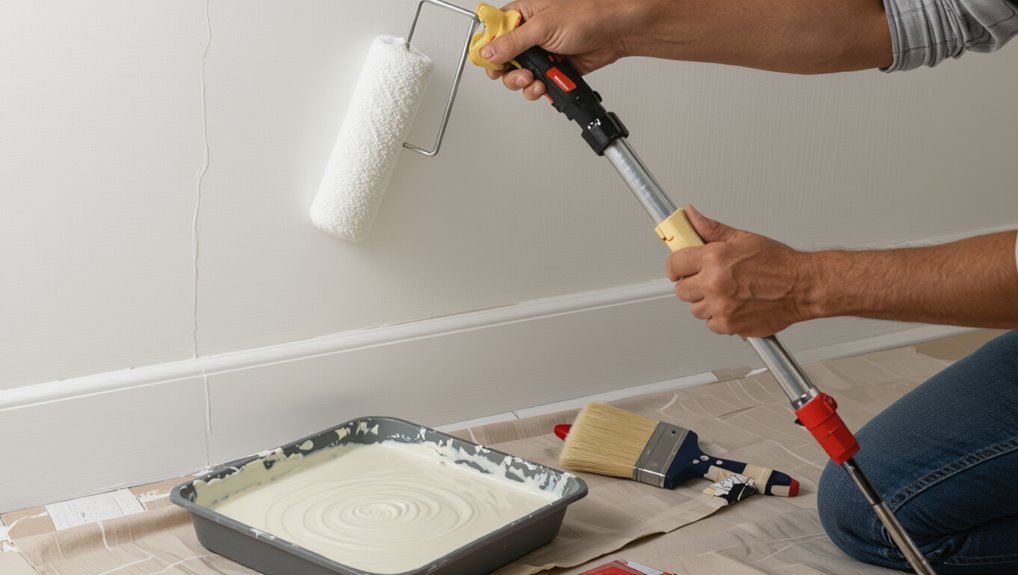
1. You’ll need the right tools and technique for semi-gloss ceilings: a sturdy pole, angled brush, and good roller.
Use a short nap to avoid texture pickup. Cut-ins first, then roll while paint’s wet. Keep consistent pressure and overlap slightly.
- Extension pole
- 3/8″ nap roller
- Angled sash brush
- Paint tray with liner
- Ladder for edges
Step 5: Application tips to minimize streaks and lap marks
Because semi-gloss shows every stroke, work quickly and in consistent sections so wet edges meet before they dry; cut in a 2–3 foot border, then roll straight, overlapping each pass by about 50% with steady pressure to blend edges and prevent lap marks.
Keep a wet edge, maintain even paint load on the roller, avoid stopping mid-panel, and feather out any heavy spots immediately.
Step 6: Drying, recoating, and final inspection
Let the first coat dry fully before you touch it—semi-gloss needs more cure time than flat finishes—so plan for at least 2–4 hours in warm, low-humidity conditions (longer if it’s cool or damp).
Check for tackiness, then recoat using the same technique to avoid streaks.
After the final coat cures, inspect under good light, touch up imperfections, and clean edges for a crisp finish.
Comparison Semi-Gloss vs Other Sheens for Ceilings
When choosing a ceiling sheen, you’ll want to compare semi-gloss to satin, eggshell, and flat/matte for appearance and performance.
Semi-gloss is more durable and easier to clean than satin and eggshell but shows more imperfections than flat or matte.
Consider traffic, lighting, and how much texture you want to hide when deciding which sheen fits your room.
Semi-gloss vs satin
If you’re weighing semi-gloss against satin for a ceiling, focus on durability versus surface forgiveness: semi-gloss gives tougher, shinier coverage that resists stains and cleans easily, while satin offers a softer, lower-reflectance finish that hides imperfections better. Choose semi-gloss for high-traffic rooms; pick satin to mask texture.
| Sheen | Look | Best use |
|---|---|---|
| Semi-gloss | Shiny | Kitchens, bathrooms |
| Satin | Soft | Living rooms, bedrooms |
| Verdict | Durable vs forgiving | Match to room needs |
Semi-gloss vs eggshell
Although semi-gloss and eggshell both handle wear better than flat finishes, they serve different priorities: semi-gloss gives a bright, hard, easy-to-clean surface that highlights texture, while eggshell offers a low-luster, more forgiving look that hides minor imperfections.
| Feature | Semi-gloss | Eggshell |
|---|---|---|
| Sheen | High | Low |
| Cleanup | Easy | Moderate |
| Texture visibility | Pronounced | Subtle |
Semi-gloss vs flat/matte
Because ceilings are usually viewed from a distance, you’ll notice how sheen changes the room: flat or matte finishes hide imperfections and produce a soft, non-reflective look, while semi-gloss throws light back and makes textures and flaws more obvious. You’ll pick matte for hiding defects and semi-gloss for durability and washability; consider room use and lighting.
| Sheen | Look | Use |
|---|---|---|
| Flat | Soft | Living rooms |
| Matte | Conceals | Bedrooms |
| Semi-gloss | Reflective | Kitchens |
| Eggshell | Subtle | Hallways |
| Satin | Durable | Bathrooms |
Common Mistakes and How to Avoid Them
Before you roll on semi-gloss, don’t skip fixing dents, cracks, or texture issues—those flaws show through shiny finishes.
Use the right tools and nap for smooth coverage, and prime well so the paint sticks.
Apply thin, even coats to prevent visible roller marks from ruining the look.
Not addressing surface flaws before painting
If you skip fixing dents, cracks, or texture inconsistencies, paint—especially a semi-gloss—will highlight every flaw instead of hiding them.
You should inspect, sand, fill, and prime imperfections first so the finish looks smooth and light reflects evenly. Skipping prep wastes paint and attention.
- Inspect for hairline cracks
- Sand rough spots
- Use quality filler
- Prime repaired areas
- Recheck before painting
Using wrong tools or roller nap
One common mistake you’ll make is grabbing the wrong tools or roller nap and wondering why the finish looks streaky or textured.
Use a short-nap roller (3/8″ to 1/2″) for smooth ceilings; switch to 3/4″ only for lightly textured surfaces.
Choose a high-quality roller and angled brush for edges.
Keep a proper roller frame and avoid cheap, shedding covers.
Inadequate priming or poor paint adhesion
Even with the right roller and brush, poor priming will undo your work by causing peeling, flashing, or uneven sheen when you use semi-gloss on a ceiling.
You should clean, sand glossy surfaces, and use a quality stain-blocking primer suited to drywall or plaster.
Test adhesion in a small area, let primer fully cure, and follow manufacturer recoat times to prevent failures.
Over-application causing visible roller marks
When you overload the roller with semi-gloss, the excess paint sits on the surface and dries in ridges, leaving obvious roller marks that catch the light and ruin a smooth ceiling finish.
To avoid this, load the roller evenly, work in consistent, overlapping passes, maintain a wet edge, and tamp off excess on the tray.
Thin coats and proper technique prevent streaks.
Best Practices and Professional Tips
Think about how sheen affects a room’s function and lighting before you start, since semi-gloss will reflect more and highlight imperfections.
Keep wet edges and blend carefully as you work, and consider calling a pro for textured ceilings or very large rooms.
Finally, follow simple maintenance tips—easy cleaning and touch-ups will keep a semi-gloss ceiling looking its best.
Matching sheen to room function and lighting
Because sheen affects both light behavior and maintenance, you should match ceiling finish to how you use the room and its lighting conditions.
In high-traffic kitchens or bathrooms, choose higher sheens for durability and easier cleaning; in bedrooms and media rooms, pick flatter sheens to minimize reflections and glare.
Consider natural and artificial light angles so the finish won’t highlight imperfections or create hotspots.
Blending edges and maintaining wet edges
Matching sheen to room use and lighting sets the stage, but getting a smooth-looking ceiling also depends on how you handle the paint at the edges and keep a wet edge.
Work methodically: cut in in small sections, overlap fresh paint into still-wet areas, and feather brush strokes.
Use a quality roller and maintain consistent pressure to avoid lap marks and visible seams.
When to call a pro (textured ceilings, large rooms)
If your ceiling has heavy texture, extensive repairs, or spans a large open area, call a pro—you’ll save time and avoid costly mistakes.
Pros have scaffolding, texture-matching skills, and spray equipment to apply semi-gloss evenly without lap marks. They’ll diagnose structural issues, prep surfaces correctly, and guarantee proper sheen consistency across sightlines, reducing rework and delivering a durable, professional finish.
Maintenance tips for semi-gloss ceilings
When you choose semi-gloss for a ceiling, routine care keeps that durable, easy-to-clean finish looking sharp—wipe down smudges with a soft damp cloth, dust regularly with an extendable microfiber duster, and address stains promptly using a mild detergent solution and gentle scrubbing to avoid dulling the sheen.
Inspect annually for chips, touch up with the original sheen, avoid abrasive cleaners, and ventilate to prevent moisture buildup.
Materials, Tools, and Cost Considerations
Before you start, you’ll want to pick the right paint and primer—look for high-quality semi-gloss formulas and a bonding primer if your ceiling is glossy or stained.
Gather a basic tool checklist (roller with an extension pole, angled brush, tray) plus optional accessories like drop cloths, a sanding block, and a respirator.
Finally, compare costs: semi-gloss can be pricier per gallon and may need more prep than flat or matte, but faster cleaning and durability can offset the upfront price.
Recommended paints and primers
Because ceilings face moisture, stains, and frequent cleaning in some rooms, choose paints and primers that balance durability with light-reflecting properties.
Pick stain-blocking primer for nicotine or water marks, an eggshell or semi-gloss for high-traffic rooms, and a flat or matte for imperfections.
Consider mold-resistant formulas in bathrooms.
- Stain-blocking primer
- Mold/mildew-resistant primer
- Low-VOC paint
- Semi-gloss for trims/edges
- Eggshell for general use
Tool checklist and optional accessories
You’ll need a compact kit to tackle ceiling painting efficiently: a quality roller with an extension pole, a 3–4-inch angled brush for edges, a sturdy paint tray or bucket with a liner, drop cloths or plastic sheeting, painter’s tape, and a ladder or scaffold suited to your ceiling height.
Gather these optional extras to work smarter:
- Microfiber roller sleeve
- Masking film with tape
- Extension pole grip
- Nitrile gloves
- Headlamp for shadows
Cost comparison: semi-gloss vs other sheens
Although semi-gloss paint can give ceilings a durable, washable finish, it usually costs a bit more per gallon than flat or matte options and can change your tool needs slightly.
Factor in the price difference in paint, potential primer, and any specialty rollers or brushes you’ll buy when comparing overall project cost.
You’ll pay more for sheen and prep; balance longevity against upfront expense.
Real-World Case Scenarios
Think about three quick examples to guide your choice: a bathroom renovation where moisture revealed finish and cleaning lessons, a child’s playroom where you weighed durability against looks, and a living room where you considered matching semi-gloss to high-gloss trim.
You’ll see how context changed the outcome in each case. Use those takeaways to decide whether semi-gloss fits your ceiling project.
Case 1: Bathroom ceiling renovation outcome and lessons
When we repainted a small bathroom ceiling with semi-gloss to resist moisture, the finish looked durable but highlighted every imperfection.
We learned a few practical lessons about prep, lighting, and product choice. You’ll sand and skim joints, prime stains, and use flat or low-sheen for textured flaws.
Position lighting to hide imperfections, choose water-resistant primer, and accept sheen trade-offs for longevity.
Case 2: Child’s playroom durability vs aesthetics trade-off
If your bathroom taught you that semi-gloss shows every bump, you’ll want a different approach for a child’s playroom where scuffs, crayons, and frequent washings are the bigger concern.
You’ll balance durability and appearance: use semi-gloss or satin on lower walls for cleanability, reserve flatter ceilings to hide imperfections, and pick washable finishes and mid-tone colors to minimize visible marks while keeping maintenance easy.
Case 3: Living room with high gloss trim continuity decision
Because your living room already flaunts high-gloss trim, you’ll face a straightforward choice about ceiling finish: match that sheen for seamless continuity or opt for a flatter ceiling to mask imperfections and soften the room’s overall reflectivity.
If you want cohesion and easy cleaning, semi-gloss works; if you prefer subtlety and minimized glare, choose an eggshell or matte ceiling and keep the trim glossy.
FAQ
You probably have a few quick questions about using semi-gloss on your ceiling, like whether it’ll make the room feel smaller or if it’s harder to apply than flat paint.
You’ll also want to know if you can paint over flat without priming, how to fix brush or roller marks, and whether semi-gloss works on textured or popcorn ceilings.
I’ll answer each of those clearly so you can decide what’s best for your space.
Will semi-gloss make my ceiling look smaller?
Wondering whether semi-gloss will make your ceiling feel smaller? It can—glossier finishes reflect light and highlight imperfections, drawing the eye upward and making low ceilings seem more defined.
In tall rooms it can add crispness without shrinking the space. Use light colors, smooth application, and minimal trim contrast to keep the room feeling open while enjoying semi-gloss durability.
Can I paint over flat ceiling paint with semi-gloss without priming?
If you liked the crisp look semi-gloss gives on higher ceilings, you might be tempted to switch finishes on your existing flat ceiling without priming—but that’s often risky.
You can sometimes repaint directly if the flat surface is clean, sound, and previously coated with latex.
However, semi-gloss adheres better with a bonding primer; skipping primer risks poor adhesion, visible brush marks, or peeling over time.
Is semi-gloss harder to apply on ceilings than flat paint?
Although semi-gloss gives ceilings a sleek, washable finish, it’s generally trickier to apply than flat paint because it highlights every brushstroke, roller lap, and imperfection.
You’ll need steady technique, thin even coats, and careful lighting checks while painting overhead.
Drying faster and showing flaws more, semi-gloss demands patience and skill to achieve a uniform look, especially on textured or uneven ceilings.
How do I fix brush or roller marks on a semi-gloss ceiling?
Spot and correct brush or roller marks on a semi-gloss ceiling by sanding the affected areas smooth, cleaning away dust, and applying thin, even touch-up coats with a high-quality brush or short-nap roller; feather each pass so the new paint blends into surrounding sections and work under good, angled light to catch any remaining imperfections.
If marks persist, lightly scuff, recoat, and let dry fully before inspecting.
Can I use semi-gloss on textured/popcorn ceilings?
Wondering whether you can use semi-gloss on textured or popcorn ceilings? You can, but sheen highlights texture and imperfections, making bumps and trowel marks more visible.
Semi-gloss cleans well, so it’s fine for kitchens or basements. Test a small area first, use proper spray or nap roller techniques, and accept that texture will look more pronounced than with flat paint.
