
What Do You Call a Painting on a Wall? Explained
You’ll usually call a painting on a wall a mural, fresco, street art piece, graffiti, or trompe-l’œil depending on technique, intent, permanence, and setting. If pigments are fused with wet plaster it’s a fresco; if it’s large, public, and site-specific it’s a mural; if it’s unsanctioned lettering or tags it’s graffiti; if it uses spray and mixed media it’s street art; if it tricks your eye it’s trompe-l’œil — keep going and you’ll learn how to tell them apart.
What Qualifies as a Painting on a Wall?

A painting on a wall is any artwork applied directly to a vertical surface rather than framed and hung—think murals, frescoes, and large-scale canvases affixed or painted in place.
You judge qualification by surface treatment, permanence, scale, and context: is pigment or material bonded to masonry, plaster, or panel installed on the wall?
Assess wall painting characteristics like technique, integration with architecture, and durability.
Consider artistic intent: was the work conceived for that location, interacting with viewers and space?
If it’s created specifically for the wall and alters perception of its setting, you can call it a painting on a wall.
Quick Definitions: Mural, Fresco, Street Art, Graffiti, Trompe-l’Oeil
Think of this section as your quick-reference guide to five common terms you’ll encounter when discussing wall-based art: mural, fresco, street art, graffiti, and trompe-l’œil.
You’ll learn core distinctions fast: murals often carry mural symbolism tied to community; frescoes are pigment fused to wet plaster; street art uses public space and can be ephemeral; graffiti traces its graffiti evolution from tags to complex pieces; trompe-l’œil tricks the eye with realistic illusion.
Use this list to remember purposes and techniques:
- Mural: public, symbolic, large-scale
- Fresco: permanent, plaster-based
- Street art: contemporary, varied media
- Trompe-l’œil: illusionistic, detail-focused
How to Identify a Wall Painting at a Glance
Look at the surface and tools used: spray patterns, brush strokes, or pigment embedded in plaster can tell you the medium and technique.
Notice the subject and style—figurative scenes, abstract shapes, or lettering point toward mural, fresco, or graffiti.
Combining those clues lets you identify the wall painting at a glance.
Medium And Technique
When you step close enough to see brushwork, pigment texture, or surface absorption, you can usually tell whether a mural, fresco, or painted decoration was applied wet into plaster, onto a dry wall, or painted as a removable panel.
Frescos soak pigment into lime plaster and feel integrated, secco layers sit on the surface and may flake, and modern synthetic paints often leave a uniform film with little penetration.
You’ll look for edges, tool marks, and layering to ID medium and technique.
Consider these quick cues:
- Wet-into-plaster integration
- Surface secco flaking
- Acrylic techniques’ smooth films
- Spray paint mist patterns
Subject And Style
You scan subject matter first—people, symbols, landscapes, slogans—then note style: realism, stylization, graffiti, muralism. That combo tells you intent and context: a saint signals devotional use; bold typography suggests advertising; fragmented forms point to modern artistic expression.
Consider color, scale, and placement for clues to cultural significance. With practice you’ll read a wall painting fast, recognizing message, audience, and social role.
Fresco vs. Mural: Technical Differences Explained
How do frescoes and murals differ technically, and why does that matter to how they’re made and preserved? You’ll notice fresco techniques bind pigment into wet plaster, creating durability, while murals use surface-applied media that sit atop walls. That affects materials, timing, and conservation.
- Materials: fresco needs lime plaster; murals accept oil, acrylic, or tempera.
- Process: fresco demands rapid work before plaster sets; murals allow layering and revision.
- Surface: fresco integrates with masonry; murals rely on primed substrates.
- Conservation: frescoes resist flaking; murals often need protective coatings and stabilization.
Trompe-l’Oeil: How Illusionary Wall Painting Works
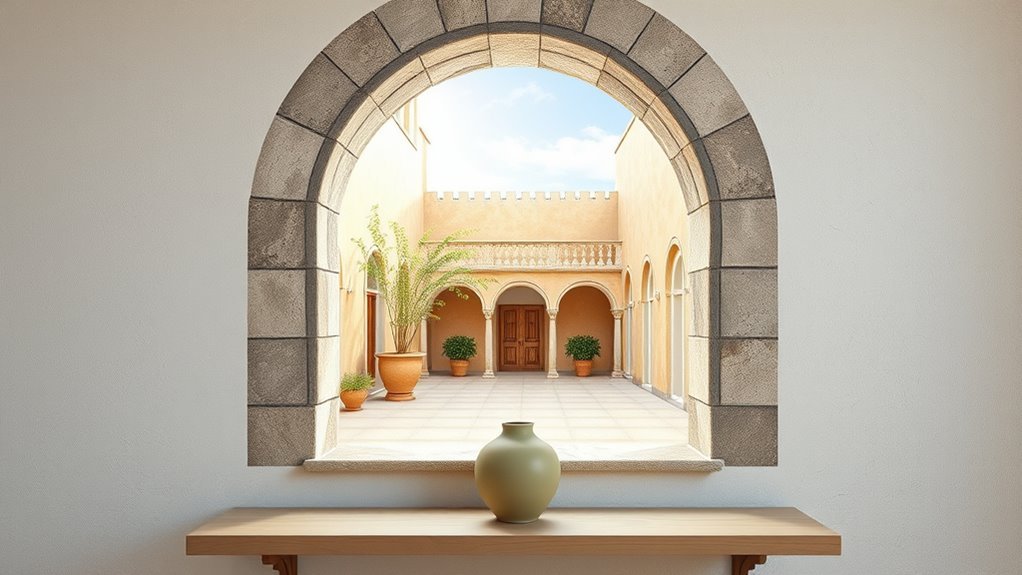
Although it tricks your eye into seeing depth and detail that aren’t there, trompe-l’oeil relies on precise perspective, light, and shadow to persuade viewers that painted forms are real objects or spaces.
You study sightlines, vanishing points, and scale so painted elements match architecture. Using trompe l’oeil techniques, you mirror ambient lighting, cast believable shadows, and texture surfaces to mimic materials.
Your choices guide visual perception, making viewers accept flat paint as volume. Small errors break the illusion, so measurements and observation matter.
When done well, the wall becomes a convincing stage where art and reality meet.
Street Art vs. Graffiti: Intent, Tools, and Audience
You’ll notice street art and graffiti often occupy the same surfaces but not the same legal or social spaces.
Street artists usually work with permission and aim to communicate with a broad public, while graffiti writers sometimes risk penalties to mark territory or reputation.
Consider how those legal statuses shape both tools and audience expectations.
Legal Status Differences
Because intent, tools, and audience shape how authorities and communities treat wall-based art, the legal line between street art and graffiti often comes down to permission and context.
You’ll face different rules depending on ownership, permits, and whether work enters public domain or triggers copyright issues. Know these practical distinctions:
- Permission: sanctioned murals avoid criminal charges.
- Property law: private walls can lead to civil suits.
- Criminal code: unsanctioned tags may be vandalism.
- Removal and restoration: cities balance preservation and enforcement.
You should check local ordinances, document consent, and register original works when possible to protect rights.
Audience And Purpose
Who’s the work for, and what does it want to do? You’ll notice street art often aims broader: you create pieces to spark public conversation, encourage audience engagement, and reshape a neighborhood’s vibe.
Graffiti usually targets peer recognition and territorial signaling; your artistic intent is tied to reputation within subcultures.
Tools and placement reflect that difference—murals invite viewing, stencils and tags demand quick visibility.
When you consider purpose, think about longevity, message, and risk. Street artists seek dialogue and accessibility; graffiti writers pursue identity and impact among insiders.
Both claim walls, but they speak to different audiences.
Legal and Public vs. Private Settings: Why It Matters
Although a painted wall might seem like simple decoration, whether it’s in a public space or on private property changes what you can legally do and who’s responsible for its upkeep or removal.
You’ll need to weigh public perception and legal implications before acting. Consider these factors:
- Ownership: who grants permission and bears liability.
- Permits: municipal rules can criminalize unapproved work.
- Maintenance: public art may get funding; private murals don’t.
- Removal: rights to alter or demand restoration differ by setting.
Knowing these distinctions helps you avoid fines, preserve community trust, and plan responsibly.
Materials and Tools: Pigments, Binders, and Spray Cans
Start with three essentials: pigments for color, binders to lock those pigments to the wall, and the tools—brushes, rollers, and spray cans—that apply them.
You’ll consider pigment properties like lightfastness, opacity, and particle size because they affect hue and durability.
Choose binder types—acrylic for flexibility, oil for depth, lime for breathable murals—based on substrate and environment.
If you use spray paint, control distance and layering to avoid runs and guarantee coverage.
Prepare the surface, test color combinations, and match tools to scale: fine brushes for detail, rollers for backgrounds, and spray cans for gradients and quick coverage.
Historical and Museum Terms for Wall Paintings
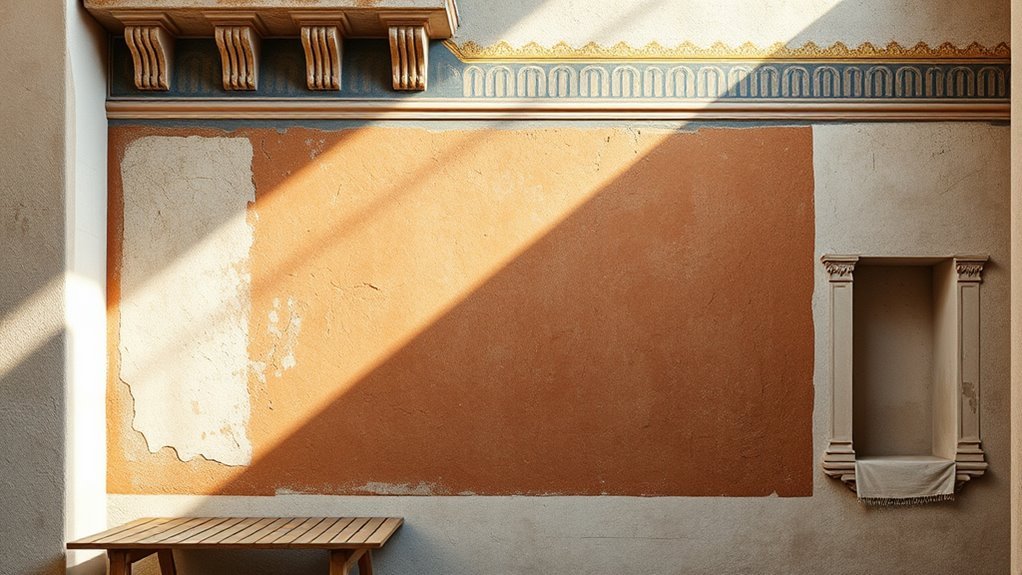
Shifting from the practical side of pigments and tools, you’ll find that scholars and conservators use specific historical and museum terms to describe wall paintings so their techniques, materials, and contexts are clear.
Shifting from pigments and tools, scholars and conservators use precise museum terms to clarify wall painting techniques and contexts.
You’ll learn how terminology reflects provenance, technique, and period without guessing.
- Fresco — painting on wet plaster; noted for longevity and historical influences.
- Secco — applied on dry plaster; highlighted in museum terminology for conservation needs.
- Sgraffito — layered plaster scratched to reveal designs; cues dating and workshop practice.
- Mural fragment — detached or partial works cataloged precisely for display and study.
These terms guide interpretation and preservation.
When to Call Something “Wall Art,” “Mural,” or “Decor
When you’re deciding whether to call something wall art, a mural, or decor, think about intent, scale, and permanence: you’ll name it based on purpose and presentation.
If it’s a designed accent you can move or replace, you’d call it decor. If it’s an artistic statement covering a significant surface, often site-specific, call it a mural—especially when created with traditional mural techniques and tied to community or narrative.
Smaller, framed or hung pieces and varied wall art styles fit “wall art.”
Consider durability and authorship: temporary installations lean decor; lasting, integrated works lean mural; versatile pieces are wall art.
How Curators, Homeowners, and Cities Choose Labels
You’ll notice curators use specific naming practices to position works within art history and influence how viewers interpret them.
Homeowners pick labels based on personal taste, function, and how a piece fits their space.
Cities choose municipal terminology to shape public perception, regulate display, and guide funding or preservation.
Curatorial Naming Practices
How do curators, homeowners, and city officials decide what to call a painting on a wall? You’ll see curatorial frameworks guide naming, balancing historical accuracy and public clarity while tracking terminology evolution.
Curators favor context, provenance, and purposeful interpretation; cities weigh public perception and legal classes; homeowners often follow style or sentiment.
- Intent: exhibition goals shape labels.
- Context: site and history dictate terms.
- Audience: accessibility influences vocabulary.
- Authority: institutional or municipal rules finalize names.
You’ll notice names shift as scholarship, law, and community values change, so labels reflect conversation more than fixed fact.
Homeowner Label Choices
A homeowner often names a painting on their wall based on personal meaning, room function, or the label that felt right when they bought it.
You’ll pick a name that fits your taste, memories, or the mood you want a room to convey. Your homeowner preferences steer choices: a sentimental title, a functional tag like “dining piece,” or a playful nickname.
You’ll balance those preferences with respect for the artist’s intent, but you’ll prioritize how the work’s artistic expression resonates with daily life. Naming becomes practical and intimate, a way you claim the artwork within your home.
Municipal Art Terminology
When cities, curators, and homeowners label a work of art, they’re balancing different priorities—public clarity, historical accuracy, and personal meaning—and those priorities shape the language used on plaques, in catalogs, and in living rooms.
You’ll notice municipal art terminology reflects roles: officials favor neutral descriptors, curators prioritize context, and homeowners choose intimacy. Labels guide interpretation, affect funding, and invite community engagement. Use clear, consistent terms to avoid confusion.
Consider these decision points:
- Function: memorial, installation, mural, decorative
- Attribution: artist, committee, anonymous
- Date and medium
- Access: public art, private display
You’ll pick terms that fit purpose.
Hybrid Wall Paintings: Mixed Techniques and Overlap
Because techniques bleed into one another, hybrid wall paintings ask you to rethink boundaries between mural, fresco, and installation.
You’ll see hybrid techniques—spray, egg tempera, projection, collage—combined so surface, support, and viewer relationship shift.
Artistic overlap blurs authorship: conservators, fabricators, and communities may all contribute.
Creative ownership dissolves: conservators, fabricators, and communities co-author works, reshaping authorship and meaning
You’ll assess intent, material permanence, and site specificity to name the work accurately.
Labels might note primary method plus modifiers (for example, mural with mixed media or fresco-based installation).
Writing Accurate Captions and Catalog Entries
When you write captions and catalog entries, you should confirm the artist attribution with provenance or stylistic evidence.
Be specific about the medium—name binders, supports, and any mixed techniques used.
Clear, precise entries help researchers and viewers understand the work at a glance.
Accurate Artist Attribution
How do you confidently attribute a wall painting to the right artist? You use evidence, avoid assumptions, and note artist recognition while acknowledging attribution challenges.
Check provenance, style, signatures, and records; document uncertainties.
- Provenance: trace ownership and commissions.
- Stylistic analysis: compare motifs, brushwork, palette.
- Technical evidence: use imaging and conservation reports.
- Documentation: cite archives, inscriptions, and expert opinions.
You write captions and catalog entries that state findings, cite sources, and flag contested attributions.
Be precise: use qualifiers like “attributed to” or “studio of” when doubt remains, and update entries as new evidence appears.
Precise Medium Description
Materials matter: describe the wall painting’s medium precisely so readers know what you’re documenting and why it matters.
You should state substrate, binder, pigments, and any surface preparations — for example, fresco (buon or secco), tempera on plaster, acrylic on masonry, or oil on panel applied to a wall.
Use standard medium classification terms and note mixed-media combinations.
Mention visible artistic techniques such as underdrawing, sgraffito, or stencil, and note conservation-relevant details like varnish or overpainting.
Keep captions and catalog entries concise, consistent, and factual so researchers, conservators, and the public can interpret the work reliably.
Quick Checklist: 6 Questions to Name Any Wall Painting
Looking to name a wall painting quickly and confidently? Use this six-question mindset to decide.
Ask about size, medium, location, audience, cultural significance, and artistic intent. Answering them narrows choices—mural, fresco, wall-mounted canvas, or installation—so your label fits context and purpose.
Ask size, medium, location, audience, cultural meaning, and intent—then name it mural, fresco, wall-mounted canvas, or installation.
- What’s the scale and surface?
- Is it permanent or movable?
- What materials define it?
- Who made it and why?
Keep answers brief: scale tells form, permanence signals technique, materials reveal medium, authorship and purpose show intent.
Combine those clues into a concise, accurate name anyone can understand.
Frequently Asked Questions
Can Wall Paintings Be Protected Under Copyright Law?
Yes — you can protect wall paintings under copyright; you’ll own original mural ownership rights, but you’ll also face copyright infringement risks if others reproduce it without permission, and legal nuances vary by location and agreements.
How Do Weather and Sunlight Affect Exterior Wall Paintings?
Think of it as gentle aging: you’ll see color fading as sunlight and moisture attack surface materials, so you’ll choose weather resistance and UV protection measures to slow deterioration and preserve the mural’s vibrancy.
Can a Tenant Legally Paint a Mural Inside a Rented Space?
Yes—you can, but it depends: you’ll need to check tenant rights and get mural permissions from your landlord; otherwise you risk lease violations, damage claims, or being required to restore the wall when you move out.
Are There Conservation Techniques for Modern Spray-Paint Murals?
Yes — you can preserve spray-paint murals using spray paint preservation methods: you’ll use protective varnishes, UV stabilizers, consolidation for flaking, gentle cleaning, and mural restoration techniques, and you’ll consult conservators for tailored long-term care.
How Do Community Stakeholders Influence Public Wall Art Commissions?
You influence public wall art commissions by shaping community engagement, advocating funding sources, setting goals, reviewing designs, and negotiating maintenance. You’ll collaborate with artists, local groups, and funders to guarantee relevance, equity, and sustainability.
Conclusion
You’ll leave a wall thinking of layers: sunlight picking out pigment, plaster’s faint breath beneath paint, and the hand that imagined depth on flat stone. When you name a wall painting—mural, fresco, trompe-l’œil, graffiti—you’re tracing those textures and choices. Let your eye follow brushstroke ridges and mortar seams, and pick the term that fits the making, intent, and site. Naming becomes a small act of reading the wall’s story.
