
What Is It Called When You Spray Paint a Wall?
When you spray paint a wall, you’re creating work that might be called graffiti, street art, a mural, or a tag depending on intent, scale, and permission. If it’s a quick stylized signature, it’s usually a tag; larger, image-driven pieces are often called street art; formally approved large works are murals; and lettering-focused pieces are graffiti. Local laws and community views also shape the label, and the next sections explain how to classify and respond.
Who This Guide Is For and Why
Anyone tackling a wall with a spray gun will find this guide useful.
You’ll learn to address audience demographics, shape creative expression, and consider public perception.
Address audience demographics, shape your creative voice, and anticipate public perception for stronger, more thoughtful work.
It helps with art education, community engagement, and artist identity while exploring cultural significance and social commentary.
You’ll weigh vandalism debates and develop legal awareness so your practice stays informed, responsible, and context-sensitive.
Quick Answer: What to Call Spray-Painted Walls
Labeling spray-painted walls depends on context: you can call them graffiti, murals, street art, tags, or painted panels depending on intent, scale, and legality.
You’ll choose terms based on purpose, audience, and legality, and you’ll use spray paint terminology to be precise while acknowledging artistic expression.
- Intent
- Scale
- Legality
- Audience
Core Definitions: Graffiti, Street Art, Mural, Tagging
You’ll want to understand how graffiti and street art differ, since one often centers on personal or crew markings while the other leans toward commissioned or socially driven pieces.
Also note that tagging is the simplest, most repetitive signature form, whereas murals are larger, planned images with broader public intent.
Keeping these distinctions clear will help you decide how to approach and describe any spray-painted wall.
Graffiti Vs. Street Art
Curious how graffiti, street art, murals, and tagging differ? You’ll spot contrasts in intent, technique, legality, and audience.
Consider these core points:
- Graffiti: lettering focus, graffiti symbolism guides identity.
- Street art: image-driven, street art evolution embraces messages.
- Murals: commissioned, large-scale narratives.
- Tagging: quick signatures, territorial or personal claims.
Tagging Versus Murals
Contrast drives the difference between tagging and murals: tagging is a quick, often clandestine signature meant to stake identity or territory, while murals are planned, usually permitted works that tell a broader story or beautify a space.
You’ll notice tagging techniques favor speed, stylized letters, and repetition to claim presence, whereas mural storytelling uses composition, color, and collaboration to engage viewers and reflect community.
What Specifically Is Tagging?
When you look at tagging, you’re seeing quick, stylized signatures and personal motifs that identify a writer’s name or crew.
You’ll want to reflect on why taggers do it—status, territory, recognition, or pure expression—and how those motives shape their marks.
Also note the legal and community consequences, since tags can spark fines, cleanup costs, and heated local debates.
Tagger Signatures And Styles
1 simple line can tell a lot about a tagger: tagging is the act of quickly writing a stylized signature or moniker in public spaces to mark presence, claim territory, or gain recognition.
You study tagger styles and signature techniques, tracing artistic influences and tagging evolution through spray paint, street culture, visual language, urban expression, graffiti history, and creative identity.
- Handstyle variations
- Letterflow choices
- Tool and paint use
- Composition cues
Purpose And Motivations
Tags serve more than decoration: they’re quick, personal claims that let someone announce presence, stake territory, or chase recognition in public spaces. You tag to assert identity, test motivation psychology, or practice artistic expression—often fast, illicit, and intimate. Below is a simple breakdown:
| Purpose | Emotion | Method |
|---|---|---|
| Identity | Pride | Rapid |
| Recognition | Thrill | Repetition |
| Art practice | Catharsis | Stylized |
Legal And Social Impacts
Although often dismissed as mere scribbles, tagging carries clear legal consequences and visible social effects: you can face fines, trespassing or vandalism charges, and civil liability, while communities wrestle with perceptions of safety, property devaluation, and contested public image.
- Legal frameworks shape enforcement and artistic legitimacy.
- Community perceptions affect local identity and urban aesthetics.
- Tagging as social commentary, cultural expressions, youth engagement.
- Public spaces reflect historical context and contested meanings.
Difference Between Throw-Ups, Pieces, and Tags
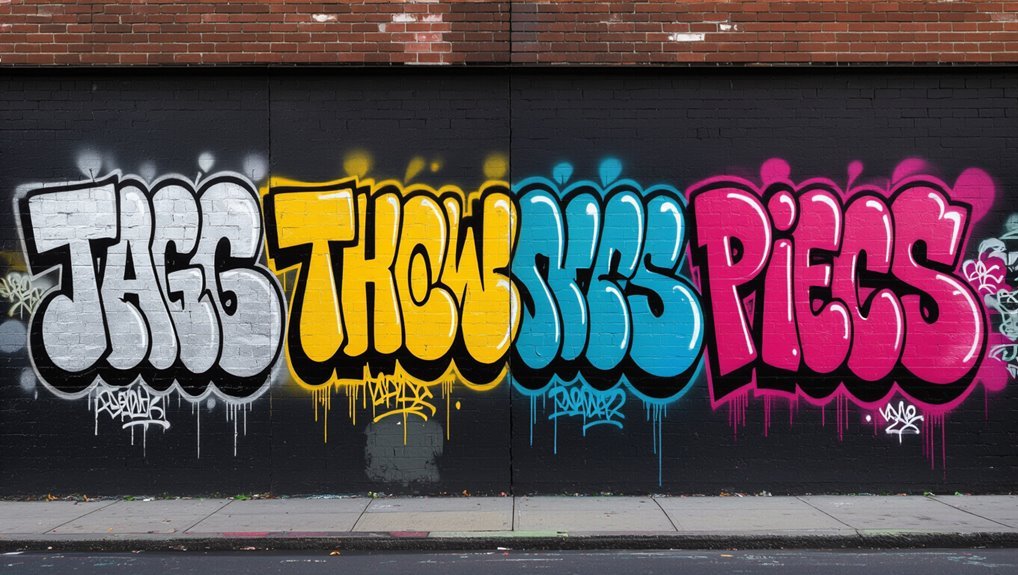
Think of graffiti as a visual language with three common dialects: tags, throw-ups, and pieces.
You’ll recognize tag styles as quick signatures revealing artist identity, throw up techniques as fast, rounded forms done with spray paint, and piece characteristics as complex, colorful compositions.
You’ll note mural distinctions separately, since murals aim for broader public impact and different intent.
How Murals Differ From Other Spray-Painted Work
When you compare murals to tags, throw-ups, or pieces, you’ll notice they’re made with different goals—murals aim to communicate with a broad audience, often reflecting community themes, commissions, or public messaging rather than individual reputation.
You’ll see mural styles, artistic techniques, visual storytelling, and community engagement shaped by cultural significance and historical context, influencing public perception and mural lifespan.
- Scale and intent
- Technique diversity
- Community role
- Durability considerations
When Spray Paint Is Legally Vandalism vs. Art
Murals and graffiti can look similar, but the law treats them differently depending on permission, location, and intent.
You weigh legal implications against artistic expression and artistic intention, noting community perception and public opinion.
Consider cultural significance and historical context; what one group sees as heritage another sees as damage.
Enforcement challenges then determine whether authorities label work vandalism or protected public art.
How Artist Intent Affects the Label (Commissioned vs. Illicit)
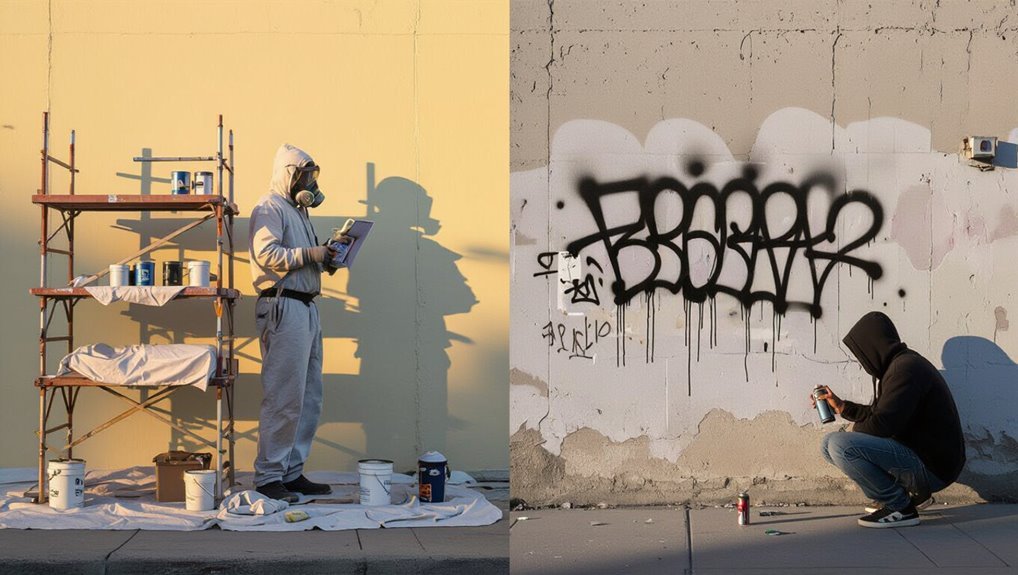
When you look at a painted wall, the artist’s intent and the context—whether it’s part of a commissioned mural project or an unauthorized piece—shapes how people label it.
Commissioned work usually carries permissions, budgets, and community input, while unauthorized street art raises questions about ownership and public space.
You’ll weigh intent, location, and agreements to decide if a piece reads as sanctioned art or illicit marking.
Commissioned Mural Projects
Although intent doesn’t always make the work legal, commissioned murals are usually framed by agreements, budgets, and clear permissions that change how people—and the law—see them.
You plan with clients, use mural techniques responsibly, and manage artist collaboration to meet briefs and timelines.
You balance creativity with obligations, licensing, and community goals.
- Scope
- Budget
- Permits
- Credits
Unauthorized Street Art
Because intent shapes how both communities and authorities judge a piece, unauthorized street art sits in a tricky legal and ethical gray zone: you might see it as bold public expression, while property owners and officials often call it vandalism.
You weigh street credibility, artistic expression, and cultural significance against law enforcement concerns, community response, public perception, urban landscape changes, and broader societal impact.
Artist Intent And Context
If you know an artist painted with permission, you’ll likely judge the work differently than a piece done covertly at night.
You’ll weigh artist interpretation, artistic expression, and historical context against public perception.
Consider cultural significance, aesthetic value, visual communication, and community response to label work as commissioned or illicit.
- Intent
- Context
- Reception
- Legacy
Does Permission Change What We Call It?
When someone gives you permission to spray paint a wall, the label we use often shifts from “vandalism” to “mural” or “commissioned art,” but the underlying actions—covering a surface with paint and altering a space—stay the same.
You’ll notice permission ethics reshape judgment, funding, and legal risk, while cultural significance affects reception, preservation, and whether your work’s seen as public expression or sanctioned decoration.
How To Tell If a Spray-Painted Wall Was Commissioned
Look for permission signs or plaques nearby, since approved murals often display permits or donor credits.
Check the quality and detail—commissioned pieces usually show careful composition, clean lines, and professional finishes.
Finally, consider the location and context; prominent, well-lit spots in civic or commercial areas are more likely to be authorized.
Permission Signage Present
Curious how to tell if a spray-painted wall was commissioned? Look for clear permission types and professional signage design near the piece.
Official plaques, permits posted, donor or project logos, and contact info indicate authorization. These signs show you it’s legal, commissioned work rather than vandalism.
Check placement, materials, and wording for confirmation.
- Plaque
- Permit
- Logo
- Contact
Quality And Detail
Because commissioned murals usually get more time and resources, you’ll spot tighter lines, consistent color blends, and intentional composition that vandal pieces often lack.
You should perform a quick quality assessment: look for crisp edges, layered shading, and deliberate contrast.
Detail orientation shows in refined lettering, matched palettes, and clean backgrounds. Those signs indicate professional planning, materials, and time rather than haste.
Location And Context
Location and setting often reveal whether a painted wall was commissioned: you’ll find murals in clearly sanctioned spaces—business fronts, community centers, alleyways with permits, or along routes meant for public art—while illegal tags tend to cluster in hidden, high-traffic vandalism spots like underpasses, back alleys, or abandoned buildings.
- Check location significance and permits.
- Note cultural context and historical relevance.
- Assess urban expression, social commentary, artistic freedom.
- Gauge community identity and public perception.
Legal Terms: Vandalism, Defacement, Property Damage
1 key thing to know about spray painting a wall is that the law treats it as more than just messy paint: it can be charged as vandalism, defacement, or property damage depending on intent, value of harm, and local statutes.
You should learn vandalism definitions, legal consequences, potential fines, restitution, and criminal records; consult local codes to understand charges and defenses.
How Police Classify Spray-Painted Walls
When you report or investigate spray-painted walls, officers will decide whether it qualifies as criminal vandalism based on intent, damage amount, and local statutes.
If it’s treated as criminal, you can expect potential charges, arrest, or restitution; if it’s deemed civil property damage, the owner may pursue compensation through civil claims.
Knowing which classification applies helps you understand available remedies and how the case will proceed.
Criminal Vandalism Classification
Although it might seem straightforward, police classify spray-painted walls by specific criteria that determine whether the act is criminal vandalism, a misdemeanor, or a felony.
You’ll see decisions shaped by vandalism perceptions and legal definitions. Consider factors that guide charging and investigation:
- Property value damaged
- Intent and motive
- Prior offenses
- Public safety risk
Civil Property Damage
Because civil property damage focuses on reparations rather than punishment, police categorize spray-painted walls by ownership, repair costs, and the affected party’s desire for restitution.
You’ll see civil liability tied to legal consequences and restorative justice options, while community perceptions and public sentiment shape enforcement challenges.
Vandalism debates weigh artistic expression and cultural significance against urban identity, guiding whether authorities pursue repairs or compensation.
How Courts Typically Handle Spray-Paint Cases
If you face a spray-paint case, courts usually focus on three things: the defendant’s intent, the extent of the damage, and any applicable statutory defenses or penalties.
You’ll see court decisions and legal precedents, case studies, and community responses weighed against vandalism definitions, artistic value, public perception, and enforcement challenges.
- Intent
- Damage
- Context
- Defenses
What Penalties and Remedies Look Like
When you’re charged for spray painting a wall, penalties usually mix criminal sanctions, civil remedies, and restorative options: you can face fines or jail time depending on intent and damage, be ordered to pay for cleanup or repairs, and sometimes be required to do community service or participate in restorative justice programs.
You should expect a clear penalties overview explaining available legal remedies, timelines, and appeal options.
How Communities Name and Value Spray-Painted Work
Though attitudes vary by neighborhood, you’ll usually find communities classify spray-painted work along a spectrum—from illegal tagging and vandalism to sanctioned murals and street art—based on intent, location, quality, and community impact.
- You judge community perceptions and aesthetic value.
- You weigh cultural significance, local history, urban identity.
- You note artistic expression, social commentary, youth expression.
- You consider public space and community engagement.
How Location Shapes Labels (Alley, Gallery, Train, Storefront)
When you call a piece an “alley” tag versus a “gallery” wall, you’re judging intent, risk, and audience.
Similarly, labeling work on a passing train or a storefront shifts how people read legality, permanence, and commerce. Those location tags steer both how artists work and how communities respond.
Alley Vs. Gallery
If you paint in a shadowed alley, people call it vandalism; paint the same piece inside a white-walled gallery and they call it art.
You know alley aesthetics and gallery perceptions shift judgment. Context frames legality, audience, intent, and value.
Consider where you place work and expect labels to follow social codes.
- Context
- Audience
- Intent
- Value
Train Vs. Storefront
Alleyways and galleries teach you how surroundings assign meaning, but trains and storefronts push those lessons further: a train’s movement and public transit culture can make a piece read as rebellion or communal messaging, while a storefront frames work as commerce or brand extension.
You’ll weigh legality, audience, and intent—train art signals transience and defiance; storefront murals suggest collaboration, promotion, or sanctioned public art.
How Scale and Complexity Affect Naming
As you scale a spray-paint project from a single accent wall to an entire façade, naming conventions have to grow more systematic to keep work organized and communicable.
You’ll weigh scale implications, complexity considerations, naming conventions, cultural significance, artistic identity, public perception, legal definitions, community engagement, historical context, and artistic intent.
- Scope-based terms
- Role-based labels
- Legal vs. cultural tags
- Collaborative naming
How Aesthetics Influence Whether Something Is Called Art
You decide whether a painted wall reads as art partly by judging the creator’s intent and purpose—were they expressing an idea or just covering up a surface?
Context matters too: the same image can feel like vandalism on a storefront but artwork in a gallery or community mural.
Finally, you weigh technical skill against the strength of the message; sometimes craft elevates a piece, other times a bold idea is enough.
Perceived Intent And Purpose
Intent shapes how we read a painted wall: whether we see vandalism, decoration, or art depends less on pigment and more on purpose.
You judge work by perceived intent and artistic purpose, weighing social commentary, cultural significance, emotional expression, public perception, community impact, and historical context.
- Intent declared
- Message clarity
- Audience response
- Legacy effects
Contextual Placement Matters
1 striking change in where a painted image appears can flip how people label it: on a gallery wall it’s “art,” on a freeway overpass it’s “graffiti,” and on a community center it’s “decoration.”
You judge meaning by surroundings; contextual significance shifts interpretation. Your cultural perspectives shape whether you praise, condemn, or ignore a spray-painted piece, so placement guides public reception more than medium alone.
Skill Versus Message
Consider how technique and message compete when people decide whether a spray-painted piece counts as art: crisp lines, balanced composition, and evident mastery make viewers more likely to praise skill and call it art, while rough execution or overt slogans push attention toward message or dismiss it as vandalism.
- You judge via skill assessment.
- You read message interpretation.
- You weigh context and intent.
- You decide value.
How Artists Describe Their Own Work vs. Outsiders
When artists talk about a painted wall, they usually focus on process, choices, and feeling—why they picked a color, how brushwork or spray technique solved a surface problem, and what they hoped viewers would sense.
You’ll hear artist terminology about visual language and artistic expression; outsiders frame work by outsider perceptions, public reception, cultural context, emotional response, and social commentary, shaping different readings.
Common Slang: Tags, Throw-Ups, Burners, Pieces Explained
You should start by learning tagging basics—simple signatures that mark an artist’s presence.
Then you’ll compare those to complex pieces, which use color, shading, and composition to command attention.
Together they’ll show how street art ranges from quick marks to full-scale murals.
Tagging Basics
Start by learning the names and purposes of the most common forms of graffiti: tags, throw-ups, burners, and pieces.
You’ll study tagging techniques, visual language, identity representation, and urban expression within historical context and cultural significance.
Expect varied public perception and art interpretations. Tagging can spark community engagement and reflect artistic evolution.
- Quick signatures
- Simple throw-ups
- Bold burners
- Letter-based tags
Complex Pieces
Having covered basic tags and throw-ups, it’s time to unpack complex pieces: large, multi-layered works that fuse advanced lettering, color theory, and composition to claim visual territory.
You’ll study complex techniques and artistic styles, observing creative processes that drive urban expression.
These pieces carry cultural significance and community impact, advancing visual storytelling while marking artistic evolution and pushing your skills beyond simple markings.
How Historians and Scholars Categorize Spray-Painted Art
Although spray-painted walls often get lumped together under “street art” or “graffiti,” historians and scholars sort them into more precise categories based on intent, context, technique, and reception.
You’ll use academic frameworks to trace historical context, cultural significance, artistic evolution, public perception, and artistic categorization.
Consider these classificatory angles:
- Authorship and intent
- Technique and style
- Location and context
- Reception and legacy
When “Street Art” Is an Appropriate Neutral Term
When you want a neutral, umbrella term that acknowledges aesthetic practice without imputing legality, motive, or value judgment, “street art” works well: it signals public, often outdoor, visual interventions made with artistic intent, while leaving room for distinctions you’ll add later about authorship, technique, context, and reception.
You can use street art terminology to frame works, letting public perception guide nuance without assuming intent.
How Political Messages Change Public Labeling
If a mural or stencil carries a clear political message, people tend to stop seeing it as neutral “street art” and start labeling it as protest, propaganda, or political speech.
You’ll notice political expressions shift public perception as social commentary intersects cultural contexts.
Message evolution reflects community reactions, artistic intentions, societal norms, visual language, and activism forms.
Message evolution mirrors community response, artists’ intent, cultural norms, visual rhetoric, and modes of activism.
- Framing impacts labels
- Audience divides
- Context alters meaning
- Intent vs effect
How Race, Class, and Gender Influence Responses
When you look at spray painting incidents, you’ll notice people judge them differently based on the artist’s race, treating similar work as either art or vandalism.
You’ll also see class shape enforcement, with wealthier neighborhoods often getting quicker cleanup and lighter policing than poorer areas.
Finally, you’ll observe gendered reactions that label men as transgressive and women as either aestheticizers or victims, affecting how authorities and the public respond.
Perceptions By Race
Although your eyes might register the same painted wall, people’s reactions are filtered through race, class, and gender, shaping what that wall means to them.
You note racial perceptions, cultural expressions, historical context, and social implications influencing artistic identity and aesthetic value.
Public opinion and identity politics inform community responses; cross cultural comparisons reveal varied readings.
- Context
- Authors
- Audience
- Power
Class-Based Law Enforcement
Because enforcement doesn’t occur in a vacuum, you’ll see that the same act of spray painting is policed very differently depending on who’s doing it and where they’re doing it.
You notice wealthier neighborhoods receive softer responses, fueled by private security and community engagement, while low-income areas see heavier policing.
These disparities shape public perception, trust in law enforcement, and who gets prosecuted.
Gendered Public Reactions
If you look closely, reactions to spray painting are shaped as much by the painter’s gender as by their race and class: you’ll notice gendered perceptions alter who’s seen as threatening or artistic in public space.
You judge posture, clothing, and context differently.
- Women perceived as vandals
- Men assumed criminal
- Nonbinary erased
- Mothers defended
How Local Laws and Ordinances Shape Public Language
When city councils pass ordinances restricting signage, graffiti, or even the wording allowed on public murals, they shape how you and your neighbors talk in shared spaces and what messages get seen.
Those legislative frameworks influence linguistic nuances and legal terminology, affecting artistic expression and cultural significance.
You navigate urban environments, balancing community perceptions, public discourse, social dynamics, and historical context.
How To Document a Spray-Painted Wall for Disputes
Before you start cleaning or calling anyone, document the spray-painted wall thoroughly so you preserve evidence for disputes or insurance claims.
You’ll collect spray paint documentation and clear visual evidence:
- Photograph wide, mid, close-up shots with scale.
- Timestamp images and note location specifics.
- Record surrounding damage and materials.
- Keep originals, backup copies, and a brief written log.
How To Describe Spray Paint in Legal Complaints
When you draft a complaint, clearly state the property damage—describe the paint, affected surfaces, and estimated repair costs.
Explain intent or mens rea by citing evidence that shows whether the act was deliberate, reckless, or accidental.
Then specify the relief you want, like restitution, injunctive relief, or statutory damages, and attach supporting documentation.
Property Damage Allegation
Although you don’t need technical jargon, you’ll want to describe the spray paint clearly and precisely in your complaint:
- Note property value impact and physical damage within the urban landscape.
- Cite neighborhood identity, community reactions, and public perception evidence.
- Explain legal implications without arguing the vandalism debate or intent.
- Mention aesthetic appreciation, cultural significance, and historical context as relevant.
Intent And Mens Rea
Intent matters because it shapes which laws apply and how a court will assess responsibility.
You’ll want to describe what the actor knew, believed, or aimed regarding the spray painting without speculating about motives.
You should allege whether the act was intentional expression or accidental, note statements or conduct showing intent, and address claims of artistic freedom while preserving facts that support the chosen mens rea.
Relief And Remedies
Outline the relief you want clearly and tie each requested remedy to the facts you’ve alleged about the spray painting. You’ll frame damages, injunctions, and restoration against alleged harm, noting spray paint as urban expression and visual storytelling that affects public perception and cultural significance.
Emphasize artistic freedom balanced with community engagement and creative outlets when justifying remedies.
- Compensatory damages
- Injunction
- Restoration
- Community programs
How Property Owners Should Respond to Unauthorized Paint
Spot the unauthorized paint quickly and take measured action: document the damage with photos and notes, check local laws or HOA rules about graffiti and vandalism, and decide whether you’ll remove it yourself or hire a professional.
As a property owner, understand property owner responsibilities, notify police if needed, inform neighbors, and use community engagement to deter recurrence while preserving evidence and following legal removal procedures.
How Neighborhoods Can Set Naming and Removal Guidelines
You’ll want clear naming policy options that define what counts as acceptable identifiers and how tags get recorded.
Outline simple removal procedure steps so residents know who to contact, what documentation to gather, and expected timelines.
Together these rules keep responses consistent and fair across the neighborhood.
Naming Policy Options
Anyone setting a naming policy should decide what names are allowed, how long they’ll stay up, and who can request changes or removals.
You should balance naming conventions and artistic categorization with public perception, community standards, and cultural significance while noting legal terminology and artistic intent.
Address classification challenges clearly.
- Criteria
- Duration
- Requests
- Appeals
Removal Procedure Steps
When a neighborhood sets removal procedures, make them clear, consistent, and easy to follow so residents know exactly how and why a name or mural designation might be taken down.
Outline who can initiate removals, what evidence is required, expected timelines, and who makes the final decision.
You’ll specify removal techniques, paint solvents, surface preparation, protective equipment, cleanup methods, safety precautions, environmental considerations, removal effectiveness, wall restoration, and post removal treatments.
How Cities Convert Illegal Paint Into Sanctioned Murals
Although illegal graffiti often starts as a nuisance, many cities now channel that energy into sanctioned murals by creating programs that legalize, commission, or relocate street art.
Cities transform nuisance graffiti into sanctioned murals through legalization, commissions, and relocation, turning tags into public art.
You participate through murals transformation and community involvement, helping select sites, artists, and funding. Cities offer permits, mentorship, cleanup swaps, and visibility to redirect tagging into public art.
- Permit programs
- Artist commissions
- Cleanup exchanges
- Community panels
How Preservationists Decide What to Save
If you care about a building or mural, preservationists start by weighing its history, condition, and community value to decide what’s worth saving.
You’ll see preservation criteria balance cultural significance and historical context against legal considerations and public perception.
You’ll engage community engagement to gauge support, confront ethical dilemmas, and choose conservation techniques that respect original intent while preserving integrity for future viewers.
How the Art Market Treats Work That Began as Graffiti
Because graffiti moves from streets to galleries through a mix of legality, hype, and market taste, you’ve got to understand how that shift reshapes both the work and its value.
- The art market reframes urban expression, altering public perception.
- Graffiti legitimacy rises with commercialization trends.
- Artist recognition can erode street credibility.
- Cultural value pivots between authenticity and commodity.
When Graffiti Becomes Collectible (Cases and Causes)
When graffiti enters galleries and auction rooms, it doesn’t just change venues—it gains new rules, buyers, and meanings that can turn a spray-painted tag into a collectible asset.
You’ll trace graffiti history and street art shifts, see urban culture negotiate art preservation, community engagement, public perception, legal frameworks, commercial value, artist identity, and cultural significance as cases and causes push select works from streets into curated markets.
How To Spot Tags vs. Throw-Ups vs. Full Pieces Visually
How can you tell a tag, a throw-up, and a full piece apart at a glance? You use visual recognition, note tagging techniques and spray techniques, and read artistic styles as urban expressions with color significance and cultural context or social commentary.
Recognize tags, throw-ups, and full pieces through technique, color, placement, and the cultural statements they make.
- Simple signatures: quick tagging techniques
- Bubble letters: fast throw-up spray techniques
- Detailed panels: full pieces, artistic styles
- Placement: urban expressions, color significance
Common Myths About Spray-Paint Labels Debunked
Ever wondered why certain spray-paint labels get dismissed as “vandalism” while others get praised as “street art”? You’ll spot common misconceptions by learning context, intent, and spray paint techniques; you shouldn’t assume legality equals value. Examine style, scale, and placement to judge fairly.
| Myth | Reality | Tip |
|---|---|---|
| Illegality = low art | Not always | Check context |
| Tags = lazy | Can be skillful | Observe technique |
| Any wall is fair | Often illegal | Respect property |
How Other Countries and Languages Name Spray-Painted Work
Words matter, and different cultures give spray-painted work names that reveal how people see it — from graffiti and street art to muralismo, arte urbano, and bombings — so you can read local attitudes through terminology.
Words matter: spray-painted pieces wear names — graffiti, street art, muralismo, bombings — revealing local attitudes and meanings.
- You note Cultural terminology and Language variations shaping Artistic classifications.
- You explore Regional differences and Historical context for nuance.
- You track International slang and Local dialects.
- You face Translation challenges and Linguistic evolution.
How Social Media Affects What We Call Spray-Painted Walls
Building on how languages and local histories shape names for spray-painted work, social media now rewrites that vocabulary in real time.
You watch hashtags, influencers, and viral clips shape social media trends that rename murals, tags, and street art.
You adjust your own labels as public perception shifts, adopting or rejecting terms based on reach, tone, and community response.
How Search Keywords Shape Online Coverage and Labels
Because search terms shape what people find first, they quietly steer how online coverage labels spray-painted work and which pieces get noticed.
You should watch keyword trends and align phrasing with search intent so editors and readers tag pieces consistently. Consider framing that matches common queries, balancing neutral descriptors with popular terms to influence visibility.
- Monitor trends
- Match intent
- Use common tags
- Track results
Practical Reporting: What To Call a Spray-Painted Wall in Complaints
How should you label a spray-painted wall when filing a complaint so officials and landlords act quickly?
Use clear spray paint terminology: “graffiti,” “tag,” or “mural” depending on intent and scale.
Note location, size, and photos.
Mention wall art classification if it’s ambiguous to prompt assessment rather than assumption.
That helps authorities prioritize removal, documentation, or preservation.
How Journalists Can Write About Spray Paint Respectfully
When you report on spray paint, choose words that describe what’s there and why it matters—label pieces as “graffiti,” “tag,” or “mural” only when the intent and scale support those terms, and explain your reasoning so readers and officials understand the context.
- Use journalistic ethics and respectful language.
- Cite community perspectives and artist engagement.
- Note legal considerations and public opinion.
- Frame cultural significance, art classification, social impact, historical context.
How Schools Can Teach About Public Art and Labeling
If you want students to understand public art and labeling, start by grounding lessons in clear definitions, local examples, and respectful dialogue about intent and impact.
You’ll teach visual literacy, art education, and cultural awareness by examining historical context, ethical labeling, and artistic expression.
Encourage collaborative projects and community engagement so students critically assess meanings, responsibilities, and how public works reflect shared values.
How Artists Negotiate Naming and Credit for Murals
Because murals often involve multiple collaborators, negotiating naming and credit starts with clear conversations about authorship, roles, and rights.
You’ll balance artist collaboration, artistic identity, and cultural significance while considering public perception and community response.
Use agreements to define mural ownership, credit attribution, and legal recognition, ensuring community engagement and protecting creative expression.
Use clear agreements to define ownership, credit, and legal rights—protecting artists and honoring community involvement.
- Discuss roles
- Draft agreements
- Consult community
- Record credits
Quick Checklist to Classify a Spray-Painted Wall
You’ve already sorted out who gets credit and how the work will be documented; now you’ll need a straightforward way to classify the wall itself so decisions about permissions, materials, and maintenance match the site.
Check surface type, stability, graffiti history, exposure to weather, and legal status.
Note necessary wall preparation, compatible spray paint techniques, access for scaffolding, and expected upkeep frequency.
Further Reading and Local Law Resources
Looking for deeper guidance or the exact rules that affect your project? You’ll find curated links, books, and local ordinances to help assess legal implications and community engagement opportunities.
Use these resources to plan permits, outreach, and respectful murals.
- Local municipal codes and ordinances
- Arts councils and community engagement guides
- Legal aid clinics and court precedents
- Permit applications and city planning portals
Frequently Asked Questions
Can Building Owners Insure Against Graffiti-Related Devaluation?
Yes — you can buy graffiti insurance to protect against property devaluation; you’ll get coverage for cleanup, repairs, and sometimes reduced market impact, helping you mitigate financial losses and preserve your building’s value.
How Do Cleaning Methods Affect Paint Forensics and Evidence?
Studies show cleaning alters trace evidence in 60% of cases; you should know cleaning methods can wash away or smear pigments, complicating paint analysis, so forensic techniques must document, sample pre- and post-cleaning, and use microscopy.
Are There Nonprofit Programs That Fund Muralization After Removal?
Yes — you can find nonprofit community mural programs that offer funding opportunities; you’ll apply for grants, partner with local arts organizations, and tap sponsorships or volunteer-driven initiatives that support muralization after removal and community revitalization.
What Resources Exist for Artists to Get Rapid Emergency Permits?
About 68% of cities fast-track public art permits; you can use emergency permits and artist resources via municipal arts offices, rapid-review programs, legal aid clinics, and expedited vendor/temporary-use applications to start immediately.
How Do Schools Incorporate Graffiti Into Art Curriculum Assessments?
You integrate graffiti history and artistic expression into assessments by having students analyze styles, create original pieces, critique cultural context, document processes, and meet rubric criteria, so you evaluate skill, concept understanding, community engagement, and reflection.
Conclusion
You’ve learned the quick terms — graffiti, street art, mural, tagging — and how context matters. When you see spray paint on a wall, decide whether it’s a tag, throw-up, piece, or commissioned mural before labeling it. Teach students legal vs. ethical views, and encourage artists to claim credit respectfully. Picture a boombox on a stoop, echoing debates about ownership and expression. Use the checklist, check local laws, and stay curious and considerate.
