
Can You Spray Lacquer Over Latex Paint? Safety Guide
You can spray lacquer over latex only with careful prep because lacquer doesn’t reliably bond to latex by itself. Clean, degrease, sand to dull the sheen, and use a shellac or high-adhesion bonding primer; test a small area first to check for solvent softening or lifting. Spray light mist coats, build with mid coats, and use proper ventilation and a NIOSH respirator to avoid fume hazards. Follow the steps below to learn safe techniques and troubleshooting.
What Search Intent Does “Can You Spray Lacquer Over Latex Paint?” Satisfy?
What does someone typing “Can you spray lacquer over latex paint?” want to know?
You’re revealing search intent and user curiosity: practical guidance, compatibility, prep steps, risks, and finish expectations.
You want a clear outcome—will it adhere, peel, or react—and concise steps to test or prepare surfaces.
Deliver a focused answer that addresses safety, longevity, and when to choose alternatives.
Quick Answer: Can You Spray Lacquer Over Latex Paint?
If you’re wondering whether lacquer will bond to existing latex paint, the short answer is: usually no — not reliably without prep.
You should assume adhesion problems unless you sand, degloss, and prime first. Use appropriate spray techniques, test a small area, and choose compatible primers to guarantee smooth lacquer finishes.
Don’t skip prep or expect instant success.
When Spraying Lacquer Over Latex Works
When you take the right prep steps—sanding to dull the sheen, cleaning off dust and grease, and applying a bonding primer—lacquer can adhere to latex-painted surfaces and deliver a smooth, durable finish.
Small projects or items with factory-cured latex often respond best, and testing a discreet spot first will confirm compatibility before you commit to spraying the whole piece.
- Assess Lacquer compatibility.
- Confirm Latex preparation.
- Sand and clean thoroughly.
- Spray test and cure.
When You Should Avoid Spraying Lacquer Over Latex
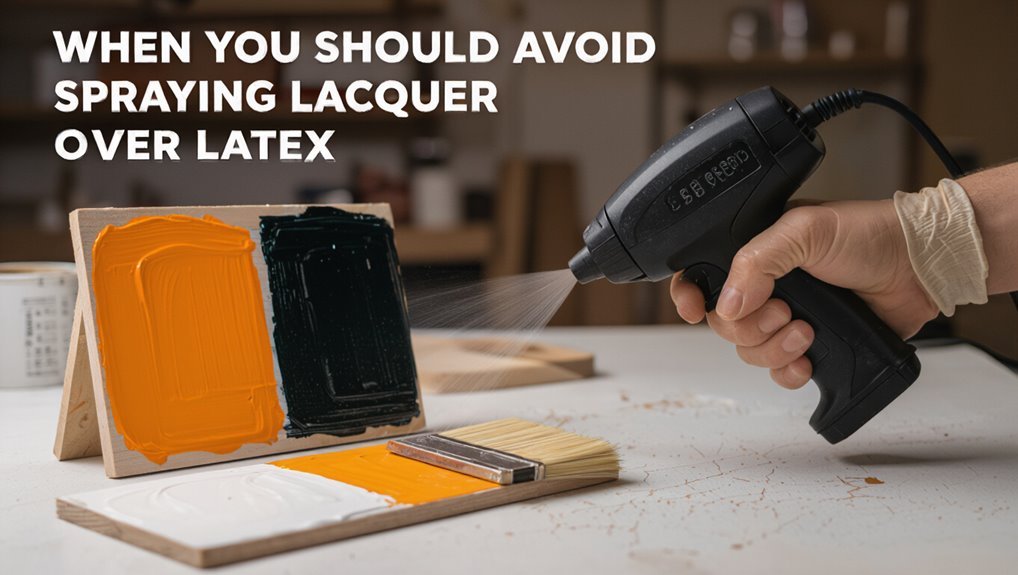
Even though lacquer can bond to well-prepared latex in some cases, there are clear situations where you should avoid spraying it over latex altogether.
Don’t attempt lacquer application on glossy, chalky, or failing surfaces, or over unknown oil-based primers.
If ventilation, breathing protection, or proper spray equipment aren’t available, or the substrate is flexible, skip lacquer to prevent adhesion failure, cracking, or toxic hazards.
How to Decide: Strip and Re-Prime vs. Topcoat
Deciding whether to strip and re-prime or simply topcoat comes down to evaluating adhesion, surface condition, and long-term durability.
You’ll save time by topcoating only when the existing latex is sound, well-adhered, and properly sanded.
However, you should strip and re-prime if you find peeling, significant gloss, contamination, or unknown coatings that could hide adhesion problems.
Strip and re-prime if you encounter peeling, heavy gloss, contamination, or unknown coatings that risk adhesion failures.
- Test adhesion with a tape pull.
- Sand glossy areas smooth.
- Consider stripping paint for contamination.
- Re priming surfaces when bare wood or primer is exposed.
How Lacquer and Latex Differ Chemically
You need to know that lacquer and latex are built from different chemistries: lacquer is solvent-based, often with nitrocellulose or acrylic dissolved in strong solvents, while latex is water-based acrylic or vinyl emulsion.
That solvent difference means lacquer can soften or dissolve underlying latex if the solvents re-emulsify the paint.
Chemical Composition Differences
Because lacquer and latex are built from fundamentally different chemistries, they behave and interact very differently on surfaces.
You need to know chemical properties and how they affect paint interactions before combining them.
- Lacquer: solvent-based, fast-evaporating, hard film.
- Latex: water-based, flexible acrylic/pvc dispersion.
- Adhesion varies by surface energy.
- Curing mechanisms and durability differ greatly.
Solvent Interaction Risks
When lacquer’s strong solvents hit a latex surface, they can soften, swell, or even dissolve the dried latex film, so you can’t assume the two will layer safely. You’ll need to test solvent compatibility to protect paint durability and avoid cracking, peeling, or adhesion failure.
| Property | Effect |
|---|---|
| Solvent strength | Dissolves latex |
| Film swelling | Weakens bond |
| Adhesion | Reduced |
| Durability | Compromised |
Why Lacquer Can React With Latex
You need to know that lacquer and latex are chemically different, so their binders and solvents can clash and cause adhesion failures.
The strong solvents in lacquer can soften or dissolve the latex film, leading to wrinkling or lifting.
That solvent-induced softening is the main reason spraying lacquer over fresh or incompatible latex often fails.
Chemical Incompatibility Risks
Although lacquer can look like a quick way to add shine, it often reacts chemically with latex finishes and can cause softening, wrinkling, or clouding.
You’ll face chemical reactions tied to solvent polarity and binder differences, so check paint compatibility carefully.
- Different binders weaken the finish
- Solvent migration alters film integrity
- Incompatibility causes adhesion loss
- Surface defects increase risk
Solvent-Induced Softening
Because lacquer contains aggressive solvents that can penetrate and swell latex binders, it can quickly soften the underlying paint film and ruin the finish.
You’ll notice tackiness, wrinkling, or lifting as solvent volatility drives rapid solvent uptake.
Adjust application techniques—use light test sprays, longer flash times, or barrier primers—to avoid damaging the latex and guarantee a stable, durable topcoat.
How to Test Compatibility on a Hidden Area
When you pick a discreet spot—inside a cabinet, beneath a drawer, or on the underside of a trim—you’ll confirm whether lacquer bonds cleanly to your latex paint without ruining the visible finish.
Use simple test methods in hidden areas: apply a small lacquer patch, wait to cure, check for lifting, and clean with solvent to observe reaction.
- Apply patch
- Cure wait
- Check lift
- Solvent wipe
Inspect Painted Surfaces: Adhesion, Flexibility, and Solvent Sensitivity
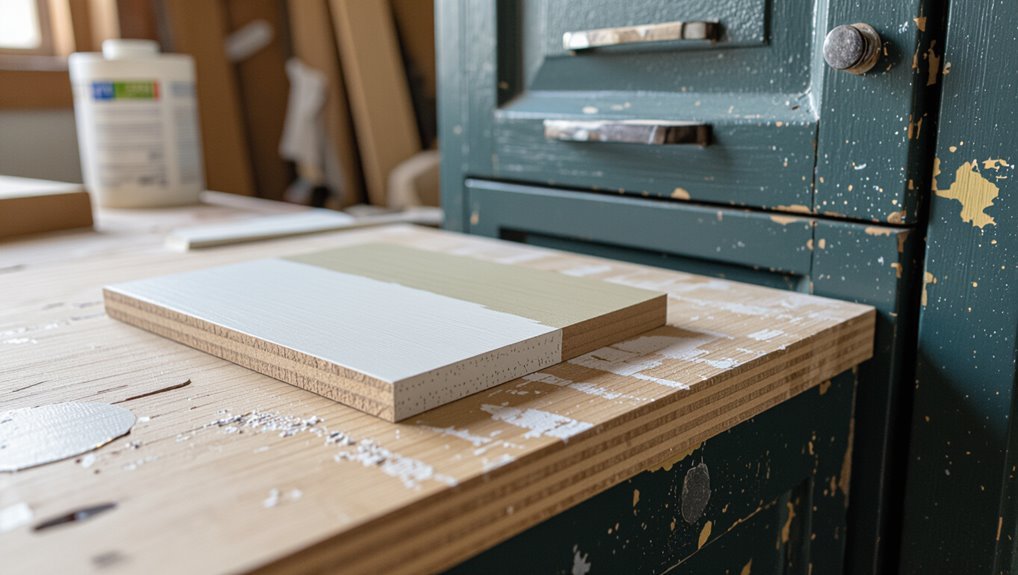
Before you spray lacquer, check the paint’s adhesion by trying a small tape pull to see if any latex lifts.
Test flexibility by gently bending or pressing the surface (or a hidden trim piece) to watch for cracking or crazing.
Finally, assess solvent sensitivity by rubbing a hidden spot with lacquer thinner on a cloth to see if the latex softens or melts.
Check Paint Adhesion
If you’re planning to spray lacquer over existing latex, start by checking how well the latex is adhered, how flexible it remains, and whether it reacts to solvents — these three tests tell you whether the surface can accept a new topcoat or will need more prep.
- Perform tape adhesion tests on the paint surface.
- Scrape edges for loose film.
- Sand small area to check bond.
- Note any flaking or powdering.
Test Paint Flexibility
After you’ve checked adhesion and looked for loose film, assess the paint’s flexibility to see if the latex will withstand the solvent and shrinkage of lacquer.
Gently bend a trimmed scrap or press a fingernail into a discreet area to observe cracking or lifting.
Record results for paint adhesion and perform systematic flexibility testing before proceeding with any lacquer application.
Assess Solvent Sensitivity
When you evaluate solvent sensitivity, you’re checking whether lacquer thinner or other solvents will soften, swell, or dissolve the latex beneath the surface; a paint that reacts means lacquer can cause wrinkling, lifting, or tacky spots.
Do simple compatibility testing: apply small drops of different solvent types, wait, and inspect.
- Choose lacquer thinner, acetone, mineral spirits, water
- Apply to discrete area
- Wait 10–30 seconds
- Note softening, tackiness, or color change
How to Clean Latex Paint for a Lacquer Topcoat
Prepare the surface by removing dirt, oils, and chalky residue so the lacquer can bond properly to your latex paint.
Use mild detergent and water, rinse thoroughly, and wipe with a solvent-recommended wax and grease remover.
Test cleaning methods on a small area to confirm paint compatibility.
Allow full drying before proceeding.
Avoid abrasive cleaners that could damage the latex finish.
How to Sand for Lacquer Adhesion
Once the surface is clean and dry, sand it to create a slightly toothy profile that helps lacquer grip the latex paint.
Use gentle, even strokes and avoid cutting through the paint. Focus on proper sanding techniques and adhesion tips to guarantee bonding.
- Start with 220–320 grit
- Finish with 400–600 grit
- Sand with the grain
- Wipe dust thoroughly
Primers That Help Lacquer Stick to Latex
To help lacquer bond to latex, you can use a shellac-based bonding primer that provides excellent adhesion and seals the surface.
You’ll also get good results with a high-adhesion latex primer formulated to accept topcoats.
Pick the primer that matches your project and follow the manufacturer’s dry time before spraying lacquer.
Shellac-Based Bonding Primer
- Prep surface
- Apply thin coats
- Sand light
- Spray lacquer
High-Adhesion Latex Primer
Although lacquer normally won’t grip latex, a high-adhesion latex primer creates a compatible, toothy base so you can spray lacquer over previously latex-painted surfaces.
You’ll enjoy high adhesion benefits: improved bonding, reduced peeling, and smoother finish.
For best results, follow primer application instructions—clean, sand lightly, apply thin even coats, and allow full cure—then proceed with lacquer spraying for a durable topcoat.
Choosing the Right Lacquer Product for Painted Surfaces
When you’re selecting a lacquer for a painted surface, focus on compatibility, sheen, and drying characteristics so you get durable, attractive results.
Choose lacquer types that bond to latex and match desired gloss; consider fast vs. slow dry for application control.
Choose a lacquer that bonds to latex and matches your gloss preference; pick fast or slow dry for control.
Don’t skip proper surface preparation to guarantee adhesion.
- Nitrocellulose vs. acrylic
- Sheen selection
- Dry time
- Prep steps
Water-Based Lacquer & Acrylic Topcoats for Latex-Painted Furniture
If you want a clear, low-odor finish over latex-painted furniture, water-based lacquers and acrylic topcoats give you durable protection without the strong solvents of nitrocellulose products.
You’ll enjoy water-based benefits like fast drying, easy cleanup, and lower VOCs.
Acrylic advantages include flexibility and scratch resistance.
Apply thin, even coats and sand lightly between layers for best adhesion and a smooth, lasting finish.
Using Shellac as a Barrier Between Latex and Lacquer
Because lacquer solvents can react with latex paint and cause bubbling or wrinkling, you’ll often want a reliable barrier coat—shellac is a fast, compatible sealer that bonds well to latex and isolates it from aggressive lacquer solvents.
Apply dewaxed shellac thinly, let it cure fully, and sand lightly to create a stable base before spraying lacquer.
- Prep surface: clean, scuff, dust.
- Shellac application: thin coats.
- Cure time: follow manufacturer.
- Sand and tack to guarantee barrier protection.
How to Thin Lacquer for Spray Application
Start by checking the lacquer’s viscosity and the spray equipment requirements so you know how much to thin; most spray guns need a flow similar to whole milk, and you’ll adjust solvents to reach that consistency. Use recommended thinning techniques, test cups, and strain before spray application.
| Solvent | Ratio |
|---|---|
| Lacquer thinner | 10–20% |
| Acetone | 5–15% |
| Naphtha | 5–10% |
| Test cup | 1 |
| Strain | Yes |
Spray Technique and Settings for Lacquer
Spraying lacquer cleanly depends on a steady hand and the right gun settings, so set up your workspace and confirm ventilation before you start.
Spray lacquer cleanly: steady hand, correct gun settings, and a well-ventilated, organized workspace before you begin
You’ll control finish and runs by adjusting pressure, fan, and distance, and by practicing consistent passes. Focus on spray techniques and spray settings to avoid orange peel or sagging.
- Maintain 6–8″ distance
- Overlap 50%
- Use light, even passes
- Adjust pressure gradually
HVLP vs. Airless vs. Aerosol: Best Spray Gear for Lacquer
If you want the smoothest, most controlled lacquer finish, HVLP systems give you precision and adjustable flow for thin, even coats.
Airless sprayers cover large areas fast but can overspray and need more thinning, while aerosols are convenient for small touch-ups but lack the control of a gun.
Consider the size of the job and how much finesse you need before choosing.
HVLP: Precision And Control
Precision matters with lacquer, and HVLP systems give you the control to achieve it.
You’ll get fine atomization, less overspray, and easier feathering when you use HVLP benefits and master HVLP techniques.
Adjust air pressure and nozzle for even coats; work in thin passes.
Consider:
- Tip size selection
- Pressure tuning
- Fan pattern control
- Slow, steady passes
Airless Vs Aerosol Tradeoffs
You’ve seen how HVLP gives you fine control for lacquer; now compare that with airless and aerosol options to pick the right tool for your job.
Airless pumps deliver speed and thicker coats but sacrifice some finesse.
Aerosol cans offer convenience for small touch-ups.
Choose based on spray techniques, substrate size, and material compatibility—consider overspray, thinning needs, and cleanup.
How to Spray Lacquer Safely Indoors
Because lacquer gives off strong fumes and dries quickly, you’ll need to control ventilation, airborne particles, and ignition sources before you spray indoors.
Use appropriate spray equipment and follow indoor safety practices. Prep the area, contain overspray, and maintain airflow.
Follow these steps:
- Seal vents and doors.
- Set up exhaust fans.
- Use tack cloths and drop cloths.
- Remove sparks and pilot lights.
Personal Protective Equipment for Lacquer Spraying
When you spray lacquer, protect yourself with proper personal protective equipment—respirators, eye protection, gloves, and clothing—to block toxic fumes, fine mist, and skin contact. You’ll choose NIOSH-rated respirators, chemical goggles, nitrile gloves, and disposable coveralls matched to your Spray equipment and Lacquer safety needs.
| Item | Purpose |
|---|---|
| Respirator | Fume/mist filtration |
| Goggles | Eye splash protection |
| Gloves | Skin barrier |
| Coveralls | Contamination control |
Setting Up Ventilation When Spraying Lacquer
Before you pull the trigger, set up ventilation to remove lacquer fumes and overspray from the work area so you don’t breathe concentrated vapors.
Choose ventilation equipment that exhausts outdoors, monitor air quality, and direct airflow away from you.
- Position exhaust fan near spray source
- Create cross-ventilation with intake vents
- Use HEPA/activated-carbon filters if recirculating
- Wear respirator rated for solvents
Prevent Yellowing and Blush
To prevent lacquer from yellowing over latex, you’ll want to choose non-yellowing formulas and limit exposure to heat and sunlight.
Keep humidity low and let each coat dry fully to avoid moisture blush that clouds the finish.
If you see a blush form, wait for complete cure and gently sand before recoating.
Preventing Yellowing
Although latex paint resists yellowing better than oil-based finishes, clear lacquers can still amber over time, so you’ll want to take steps to minimize discoloration before you spray.
- Choose UV-stable clear coats for yellowing prevention.
- Test lacquer alternatives like water-based polycrylic on a scrap.
- Apply thin, even coats and allow full cure between layers.
- Store and finish in low-UV, dust-free conditions.
Avoiding Moisture Blush
When you’re spraying lacquer over latex, keep humidity and temperature steady so moisture won’t blush the finish; lacquer traps evaporating water vapor and can form a cloudy, sticky film if conditions are too humid or the underlying paint hasn’t fully cured. You’ll use moisture control and blush prevention: monitor RH, cure time, ventilation, and test a small area before full spray.
| Step | Action | Notes |
|---|---|---|
| 1 | Check RH | Aim 40–50% |
| 2 | Wait cure | 24–72 hours |
| 3 | Ventilate | Use fans |
| 4 | Test | Small panel first |
How Many Lacquer Coats to Apply
Most projects need three to four thin lacquer coats for a durable, even finish.
You’ll use lacquer application techniques that build smooth, ideal lacquer finishes without overloading the latex base. Apply thin, even passes, lightly sand between coats, and inspect for coverage.
- Start with one mist coat
- Build with two mid coats
- Finish with one leveling coat
- Lightly scuff between coats
Drying Times: Between Coats and Before Use
Expect lacquer to feel dry to the touch within 15–30 minutes, but wait at least 1–2 hours between thin coats to guarantee proper solvent flash-off and adhesion to the latex beneath.
Use gentle drying techniques—low heat, increased ventilation, and consistent temperature—to prevent trapping solvents.
Follow recommended coat intervals, allow full cure 24–72 hours before light use, and longer for heavy wear.
Troubleshooting: Runs, Orange Peel, and Fish-Eyes
After you’ve allowed proper flash-off and cure, you’ll still run into surface defects like runs, orange peel, and fish-eyes—each has a specific cause and fix.
- Check surface preparation to verify cleanliness and adhesion.
- For run prevention, spray lighter passes and maintain distance.
- Use orange peel solutions: adjust atomization and thin lacquer slightly.
- Apply fish eye fixes: remove contaminants, use additives, and retest spray pattern.
How to Remove Failed Lacquer From Latex-Painted Furniture
Start by evaluating the damage so you know whether to strip, sand, or spot-treat the failed lacquer; small blisters or peeling edges often respond to localized sanding and primer, but widespread failure usually means you’ll need to remove the lacquer completely and recoat.
For failed lacquer removal, strip with a chemical stripper or use careful sanding; clean residue, prime latex correctly, and follow furniture restoration best practices.
Safer Aerosol Lacquer Alternatives
While traditional aerosol lacquers give a quick, glossy finish, you don’t have to accept their high VOCs and strong fumes—there are safer aerosol alternatives that cut emissions and reduce health risks.
- Low-VOC aerosol clear coats for reduced fumes.
- Water-based spray finishes as eco friendly options.
- Plant-derived solvent sprays for gentler chemistry.
- Use proper spray techniques, ventilation, and respirators.
Cost and Time: Refinishing vs. Spraying Lacquer Over Latex
If you’re weighing the costs and time involved, refinishing a piece usually demands more labor and materials up front, while spraying lacquer over latex can be quicker but may require prep to avoid adhesion or finish problems.
You should compare refinishing costs versus lacquer supplies, factor in drying and cure time, and use realistic time estimates for prep, coats, and cleanup to budget accurately.
Common DIY Mistakes When Topcoating Latex With Lacquer
Because latex and lacquer behave differently, DIYers often make predictable mistakes that ruin the finish or force a redo.
- Skipping proper sanding and adhesion checks — you must prep for lacquer application techniques.
- Applying too-heavy coats — causes runs and orange peel.
- Ignoring ventilation and flash times — leads to blushing or poor cure.
- Using incompatible thinners or tools — one of the Common lacquer pitfalls.
Quick Pre-Spray Checklist
Before you spray lacquer over latex, check that the surface is clean and free of grease, dust, or loose paint.
Make sure the latex is fully dry and cured per the paint manufacturer’s recommended time to avoid adhesion and solvent-attack issues.
Finally, mask carefully and set up good ventilation to protect surrounding areas and your health.
Surface Cleanliness Check
1 quick walkthrough will save you hours of rework: check that the latex surface is clean, dry, and free of dust, grease, or silicone residues before you even mix the lacquer.
Follow surface preparation and cleanliness standards to guarantee adhesion. Do quick tests and remove contaminants.
- Wipe with tack cloth
- Degrease solvent wipe
- Remove silicone spots
- Inspect under bright light
Dryness And Cure Time
Now that the surface is spotless, confirm the latex paint has fully dried and cured before you spray lacquer—wet or tacky paint will trap solvents and cause lifting or poor adhesion.
Check manufacturer cure times and consider temperature, humidity, and coat thickness as key cure factors.
Use gentle drying techniques like warm, dry air and give extra time for deep cures before applying lacquer.
Masking And Ventilation
Start by sealing off the work area and setting up ventilation so you control overspray and fumes; tape plastic sheeting over windows, doorways, and floor edges, and cover nearby furniture or fixtures with drop cloths.
- Choose masking techniques: low-tack tape, paper, and plastic.
- Block gaps and vents.
- Use ventilation methods: exhaust fan plus fresh-air intake.
- Wear respirator and goggles.
Frequently Asked Questions
Will Lacquer Change the Color or Sheen of My Latex Paint Over Time?
Lacquer can slowly cause color stability issues and sheen alteration on latex paint; you’ll notice yellowing or gloss changes over time, especially with solvent-based lacquers, so test first and use compatible primers or clearcoats.
Can Lacquer Be Applied Over Latex-Painted Cabinets With Hardware in Place?
You can, but you shouldn’t; cabinet preparation matters. You’ll clean, sand, and degloss surfaces, mask or remove hardware, and use hardware protection like tape or covers if you leave it in place to avoid runs and overspray damage.
Does Lacquer Interfere With Latex Paint’s Flexibility in Outdoor Use?
Yes — but be careful. Lacquer can restrict latex paint’s movement, creating flexibility concerns; outdoors this might reduce outdoor durability over time. You’ll want flexible topcoats or proper primers to avoid cracking and peeling.
Are There Eco-Friendly Lacquers Compatible With Latex Finishes?
Yes — you can choose eco friendly options like waterborne lacquers and low-VOC lacquer types that’re compatible with latex finishes; you’ll still test adhesion, verify proper surface prep, and follow manufacturer guidelines for best results.
How Long Should I Wait After Latex Painting Before Applying Lacquer?
Think of your painted piece as a garden waking slowly; you should wait 24–48 hours for initial drying and up to 7 days for full cure before applying lacquer, ensuring proper drying time and paint compatibility for best results.
Conclusion
Yes — you can spray lacquer over latex paint in some cases, but it’s not foolproof. If the latex is fully cured, sound, and well-sanded for adhesion, lacquer can give a hard, glossy finish. If the latex is fresh, peeling, or incompatible, strip and re-prime instead. For safety and durability, prep thoroughly, ventilate, and test a small area first. Choose alternatives like water-based lacquer or shellac primer when in doubt. It’s a small risk—like juggling flaming torches—but handled right, you’ll get a durable, attractive finish.
