
How to Blend Ceiling Paint Seamlessly for a Flawless, Lap-Mark-Free Finish
To blend ceiling paint seamlessly, work in small sections and keep a wet edge so new paint meets wet old paint; use a consistent roller technique with feathered strokes and light overlapping W or N patterns, and cut in perimeters with an angled brush. Choose the right nap for your texture, thin coats, and use extenders in high heat or low humidity. Fix seams by scuffing and spot-priming before recoating, and continue for tips on tools, timing, and troubleshooting.
How to Blend Ceiling Paint Seamlessly for a Flawless, Lap-Mark-Free Finish
Yes—you can often blend ceiling paint to hide lap marks if you act quickly while the paint’s still wet and match sheen and color closely.
You’ll need to blend when new sections meet dry areas or when touch-ups stand out after the first coat.
Follow proper technique and tools to feather edges and keep the finish uniform.
Quick Answer Can you blend ceiling paint to hide lap marks?
Can you blend ceiling paint to hide lap marks? Yes—you can minimize visible seams if you know how to blend ceiling paint: work quickly, keep a wet edge, use consistent roller pressure and direction, and feather each pass into the previous one.
Match sheen and color, thin edges slightly, and avoid reloading mid-stroke. Proper technique often makes lap marks disappear.
When blending is necessary
You’ll need to blend ceiling paint whenever new coverage meets previously dried paint in a way that could leave a visible seam—typically after stopping mid-room, working around fixtures, or patching a spot.
Blend when you see a color, sheen, or texture shift. Use consistent roller technique, feather edges, and match sheen to hide lines.
- Patch areas
- Stop/start points
- Around fixtures
Basic Understanding: What Causes Lap Marks and Why Blending Works
Lap marks happen when overlapping paint areas dry at different rates or reflect light differently, leaving visible seams.
You’ll see this more with higher-sheen finishes, fast or uneven drying, or paints with the wrong viscosity for your roller.
Temperature, humidity, and how absorbent the ceiling substrate is also change drying and absorption, which is why proper blending corrects those differences.
What are lap marks and how they form
A visible stripe, called a lap mark, forms when you roll or brush over paint that’s already started to dry, so the new wet edge doesn’t level and blend with the older coat.
You’ll see a darker or shinier band where overlap occurred.
Lap marks happen from uneven wet edges, interrupted work, or inconsistent pressure and overlap—preventable by quick, continuous blending while edges stay wet.
Paint properties that affect blending (sheen, drying time, viscosity)
Because finish, drying speed, and thickness change how paint spreads and levels, they’re the key reasons some edges blend while others show lap marks.
You should pick a low-sheen ceiling paint that levels well, use formulas with slower drying for longer open time, and adjust viscosity—thin slightly for smoother flow but not so much that coverage suffers.
Test before full application.
Environmental and surface factors (temperature, humidity, substrate absorbency)
When temperature, humidity, and how porous your ceiling is change during painting, they alter drying speed and paint absorption so visible seams can form; you’ll want to control these factors because they determine how long paint stays workable and how evenly it levels into adjacent wet edges.
Work when conditions are stable, preprime high-absorbency areas, use compatible paint temps, and slow drying with retarder if needed.
Preparation Before Painting
Before you start blending, check the ceiling for old coatings, water stains, cracks, and texture so you know what repairs and primers you’ll need.
Gather your tools and materials—rollers, brushes, patching compound, sandpaper, cleaner, and the right primer—so nothing slows you down.
Clean and patch damaged areas, then prime with a stain-blocking or leveling primer when needed to guarantee an even finish.
Assessing the ceiling condition and previous coatings
Start by giving the ceiling a close inspection so you can identify any damage, texture, or old coatings that will affect blending.
Note cracks, stains, peeling, and sheen differences. Test a small scrape to see layers and adhesion.
Clean and repair before painting so new paint bonds evenly.
- Check for peeling or loose layers
- Identify texture and sheen variations
- Locate stains or water damage
Tools and materials checklist
Now that you’ve inspected and repaired the ceiling, gather the right tools and materials so you can blend paint smoothly and avoid problems mid-job.
You’ll need quality ceiling paint, a matched tint, and tools that promote smooth application. Keep everything accessible and clean to maintain wet edges.
- Roller with extension, angled brush, paint pan
- Feathering brush or soft trim brush
- Stain-blocking primer, tinted to final coat
Surface cleaning and patching process
Once you’ve cleared the room and protected floors and furniture, clean the ceiling thoroughly to remove dust, cobwebs, grease spots, and loose paint so new coatings will adhere evenly.
Then patch imperfections, sand smooth, and wipe residue.
Follow this quick checklist:
- Scrub with mild detergent and rinse.
- Fill cracks and nail holes with spackling compound.
- Sand, vacuum, and tack cloth before painting.
Priming and when to use a stain-blocking or leveling primer
Before you apply ceiling paint, prime any repaired or stained areas so the topcoat adheres uniformly and hides discoloration. Use a stain-blocking primer for water, smoke, or tannin stains, and choose a leveling (high-build) primer when you’re covering patched spots or minor texture differences to create a smooth, consistent surface.
Let primer dry fully, sand lightly if needed, then feather edges before painting for seamless blending.
Blending Techniques for Different Situations
Now you’ll learn practical blending techniques tailored to common ceiling challenges, from feathering with a roller and brush to timing a wet edge so you don’t get lap marks.
I’ll cover when to use multiple thin coats versus one heavier coat, how paint extenders lengthen your open time, and tips for blending around fixtures, corners, and edges.
Follow these methods and you’ll get smoother, less noticeable changes across the whole ceiling.
Feathering technique with roller and brush
Feathering with a roller and brush lets you soften the edge between new and old ceiling paint so the repair disappears; you’ll roll the fresh paint close to the existing finish and then lightly drag a nearly dry brush outward from the seam to blend strokes and thin the edge.
- Use a short-nap roller for controlled coverage.
- Wring brush to nearly dry for subtle blending.
- Work small sections, matching direction and pressure.
Wet-edge strategy and timing to avoid lap marks
One simple rule will save you from lap marks: keep a wet edge and work at a steady pace so adjacent sections overlap while still wet.
Move methodically, don’t stop mid-panel, and watch drying times in heat or humidity.
- Start at one corner and maintain a uniform roll speed.
- Blend into the previous wet area immediately.
- Adjust pace for temperature and ventilation.
Working with multiple coats versus one heavy coat
When you’re deciding between multiple thin coats and a single heavy coat, remember that thin, successive layers give you better blending control and a smoother finish. They dry faster, reduce sagging, and let you correct minor lap marks before they set.
Apply thin coats, feather edges, and sand light between layers if needed. One heavy coat risks drips, uneven texture, and trapped lap marks.
Using a paint extender or retarder to increase open time
If you’re working in warm, dry conditions or tackling a large ceiling area, adding a paint extender (retarder) lengthens open time so you can blend wet edges without rushing; it slows drying just enough to let you back-roll or feather seams for an invisible join.
Use manufacturer-recommended ratios, mix thoroughly, and test a small patch.
Work continuously across the area to maintain wet edges and avoid lap marks.
Blending near fixtures, corners, and edges
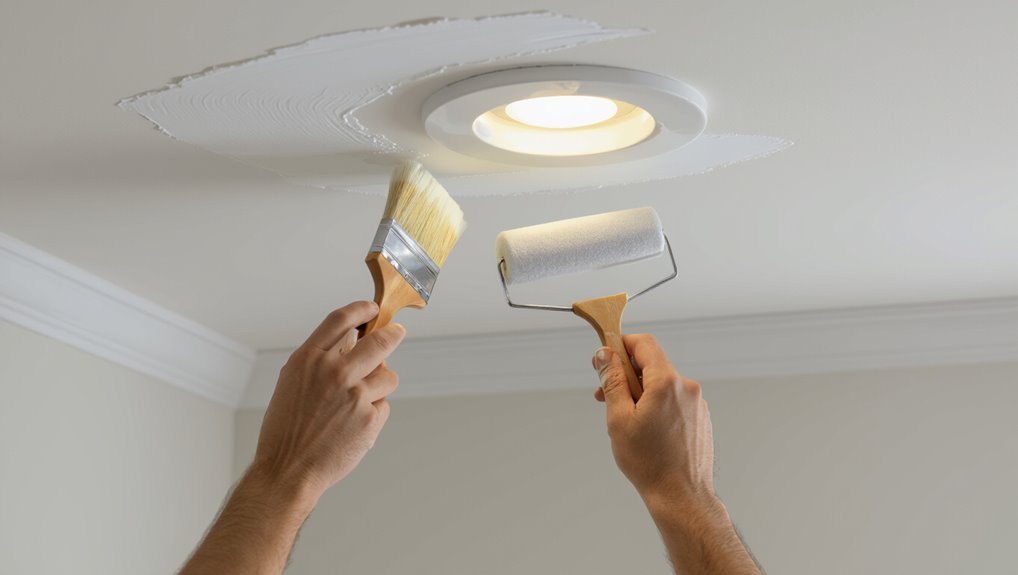
Because fixtures, corners, and edges interrupt your rolling rhythm, approach them with deliberate tools and techniques so seams disappear without splatters or buildup.
Cut in with a sharp angled brush, feathering strokes outward. Work wet edges into the rolled area, blending with a lightly loaded mini roller.
Mask or remove covers, paint around fixtures slowly, and wipe drips immediately for a clean finish.
Roller and Brush Selection and Application Details
Choose a roller with the right nap and a high-quality core for your ceiling texture, and pick brushes suited to cutting in tight lines or feathering edges.
You’ll cut in with a brush on corners and trims, then switch to your roller, loading it evenly and using consistent pressure to avoid lap marks.
Use smooth, overlapping strokes and light, steady pressure to blend each pass into the wet edge.
Choosing the right roller nap and core
Picking the right roller nap and core makes blending ceiling paint far easier and gives you a more even finish.
You’ll choose nap based on surface texture—smooth, light texture, or heavy stipple—and a firm core for control. Match nap length to texture, use a quality core to avoid flex, and keep rolls evenly loaded.
- Smooth: 1/4″ nap
- Light texture: 3/8″ nap
- Heavy texture: 1/2″-3/4″ nap
Brush types and when to cut in by brush
Once you’ve matched your roller nap and core to the ceiling texture, grab the right brush to cut in along edges and fixtures; a good angled sash brush gives control for straight lines, while a synthetic-bristle trim brush works best with water-based ceiling paints.
Cut in before rolling perimeters, keep a wet edge, use short smooth strokes, and reload frequently for consistent coverage.
Roller loading, pressure, and stroke patterns for smooth blending
Load the roller evenly—dip it into the tray’s well, roll it back and forth on the grid until the nap is saturated but not dripping—and keep a consistent amount of paint on the roller as you work.
Apply moderate, even pressure; don’t squeeze paint out. Use overlapping W or N strokes, finish each pass with light feathering, and maintain a wet edge to blend without lap marks.
Blending When Re-touching vs. Repainting Entire Ceiling
If you’re fixing a small spot, follow a step-by-step approach: clean, prime, thin your paint, and feather the edges with light brush or roller strokes.
For larger areas you’ll need broader feathering and overlap to blend into the surrounding paint without lap marks.
If the texture, color mismatch, or extent of damage is too great, it’s usually better to repaint the entire ceiling for a uniform finish.
Small spot repairs step-by-step blending approach
Start by evaluating the damage and deciding whether a local touch-up will blend or the whole ceiling needs repainting: small, isolated spots often respond well to careful feathering and matching, while larger or unevenly aged areas usually require full-ceiling repainting to avoid visible seams.
- Clean, sand, and prime the spot.
- Match paint sheen and color; thin edges.
- Feather with a dry brush or small roller, cure before examining.
Large-area blending and feathering into surrounding paint
When a repair covers a larger area or the ceiling’s age and sheen vary, you’ll often get a far better result by blending the new paint outward from the patch rather than trying to hide an abrupt edge; feathering into the surrounding surface minimizes visible shifts and helps the touch-up read like the original finish.
Work in thin, overlapping passes with a slightly loaded roller or brush, softening edges and matching texture. Then inspect under oblique light to refine.
When a full repaint is the correct choice
Although small touch-ups can blend well, you should choose a full repaint when differences in age, sheen, or overall discoloration make the repaired area stand out despite careful feathering.
You’ll save time and get uniform color and sheen by repainting the whole ceiling.
Consider these reasons:
- Visible color shift across the room.
- Sheen mismatch that catches light.
- Worn or stained finish throughout.
Troubleshooting Common Problems and Mistakes
If you spot visible seams after the paint dries, don’t panic — you’ll want to diagnose whether it’s poor feathering, different sheen, or underlying texture issues before fixing.
Match textures with skim coats or a texture spray, address sheen or color mismatches by scuff-sanding and glazing or, if needed, repainting the whole section, and avoid overworking wet paint because that often makes seams and lap marks worse.
Follow a clear checklist for diagnosis and targeted fixes so you correct the real problem instead of making new ones.
Visible seams after paint dries diagnosis and fixes
Because ceiling paint dries differently across patches, you may notice thin, visible seams where sections meet — a sign of uneven sheen, overspreading, or mismatched application.
- Lightly scuff and clean the seam, then recoat with the same paint and sheen, feathering edges.
- Use a mini-roller to blend wet edges immediately; work small, matching pressure and direction.
- If sheen differs, recoat the whole panel for uniform finish.
Texture mismatches and how to match texture
When your touch-up stands out not for color but for texture, you’ll need to match the original stipple, knockdown, or orange-peel pattern before repainting so the patch blends into the surrounding ceiling.
Feather edges, use the same applicator (spray, brush, or roller), practice on scrap drywall to replicate pattern, adjust material viscosity and spray distance, then blend outward and let fully dry before final coat.
Color or sheen mismatch solutions (scuff-sanding, glazing, repaint)
After matching texture, you might still notice your patch looks different because of color or sheen.
Scuff-sand gently, clean dust, then spot-prime.
If sheen differs, try glazing with a diluted ceiling paint to bridge gloss levels.
When color mismatch persists, repaint the entire span or at least the affected section, feathering edges for a seamless connection.
Test in natural light before finishing.
Overworking the paint and causing more problems
If you keep going over a repair with a brush or roller, you’ll likely make things worse: lifting partially cured paint, creating ridges, or feathering edges that never blend.
Stop once the repair is uniformly level and tack-free. Let paint fully dry between passes, thin subsequent coats if needed, and use light, single-direction strokes.
Overworking wastes paint and guarantees a visible patch.
Best Practices and Pro Tips to Prevent Lap Marks
Plan your sequence so you always work into a wet edge and keep movement consistent across the ceiling.
Control temperature, humidity, and airflow, and keep your tools clean while boxing paint to maintain color and viscosity.
Consider professional options—an HVLP sprayer can give a more even laydown than a roller, but rollers work if you maintain technique and overlap.
Planning your work sequence and maintaining a wet edge
Because ceiling paint dries fast, you’ll get lap marks unless you move methodically and keep each new pass touching a still-wet edge.
So lay out a logical sequence before you start and stick to it.
- Start at the farthest corner and work toward the exit.
- Paint consistent-width strips, overlapping wet edges by a roller’s nap.
- Keep tools loaded and move steadily to avoid dry joins.
Optimal environmental conditions and controlling ventilation
When you control temperature, humidity, and airflow, the paint will dry evenly and give you time to maintain a wet edge, so set conditions before you start.
Aim for 50–75°F and 40–60% humidity. Reduce strong drafts; use gentle fan circulation to equalize drying.
Close windows if outside conditions change, and pause if temperatures or humidity drift beyond ideal ranges to avoid lap marks.
Maintenance of tools and consistent paint mixing (boxing)
If you keep your brushes, rollers, and trays clean and mix paint consistently (“boxing”) before you start each session, you’ll avoid color and sheen variations that cause lap marks.
Rinse tools thoroughly, replace worn nap covers, and strain mixed paint to remove lumps.
Rebox any leftover paint mid-job to maintain uniform tint and viscosity, and store tools properly between coats to preserve performance.
Professional techniques: HVLP sprayer vs. roller for seamless finish
Choose the right tool and you’ll cut lap marks dramatically: an HVLP sprayer lays ultra-fine, even coats that blend seamlessly, while a quality roller gives you control on texture and touch-up work.
Match tool to room, maintain wet edges, and use consistent speed.
- Sprayer: thin, overlapping passes
- Roller: ¾” nap, firm pressure
- Finish: feather edges immediately
Comparison Table: Methods vs. Results
You’ll find that each method gives predictable trade-offs between speed, finish, and touch-up ease, so pick the one that matches your ceiling and skill level. Below is a quick comparison to help you weigh roller blending, brush feathering, spraying, and spot touch-up at a glance.
| Method | Typical Result |
|---|---|
| Roller blending | Smooth finish with visible texture blending needed |
| Brush feathering | Precise control, potential for brush marks |
| Spraying | Fast, uniform finish but needs masking |
| Spot touch-up | Quick fixes, higher risk of visible seams |
Method: Roller blending
Start by loading a quality roller with a moderate nap and you’ll get the smoothest shifts when blending new ceiling paint into an existing finish.
Work in small sections, roll the fresh paint into the old edge with light, even pressure, and overlap strokes slightly.
Keep a wet edge, match roller direction, and feather out excess to avoid texture differences and visible lap marks.
Method: Brush feathering
Switch to a high-quality angled sash brush and feather the new paint into the old using light, short strokes that taper at the edges.
Work small sections, keep a thin, even load, and overlap slightly with existing finish.
Blend until shifts vanish, inspect under natural light, and rework any visible ridges.
Clean edges with a damp brush to remove excess.
Method: Spraying
Spraying lets you cover large ceiling areas quickly and delivers the smoothest, most uniform finish when matched with proper technique and equipment.
You’ll control atomization, overlap, and distance to avoid mottling. Use a HVLP or airless sprayer, maintain consistent motion, and mask thoroughly.
Practice on cardboard first, adjust pressure for the coating, and keep wet edges to guarantee seamless blending.
Method: Spot touch-up
If you’ve finished the broad spraying work but still see small imperfections, spot touch-up gives you a way to fix those areas without recoating the whole ceiling.
Use matching paint, thin with water if needed, and apply with a small brush or mini-roller.
Feather edges into surrounding finish, work quickly while paint’s wet, and blend light strokes to avoid texture or sheen differences.
Materials and Tools Quick Reference
Now that you’ve compared methods and results, let’s cover the exact materials and tools you’ll need to get a seamless ceiling finish.
You’ll want recommended ceiling paints, primers, and extenders plus the right tool sizes and consumables to avoid texture or sheen mismatches.
Check the short list below before you start.
- Paints/primers/extenders: flat ceiling paint, stain-blocking primer, and paint extender
- Tool sizes: 9–12″ roller for large areas, 3–4″ brush for cutting in, appropriate nap (¾”–1¼”) for textured ceilings
- Consumables: extra roller covers, painter’s tape, disposable trays, drop cloths, extension pole
Recommended products for ceilings (paints, primers, extenders)
Choose products that suit your ceiling’s texture, lighting, and traffic level to get a seamless finish; pick a flat or matte ceiling paint with high hide and low splatter, a stain-blocking primer for smoke or water marks, and a latex-based paint for ease of touch-ups.
Use a paint extender to slow drying, improve flow, and reduce lap marks during blending.
Tool sizes and consumables checklist
After picking the right paint, primer, and extender, gather the tools and consumables that let you apply them cleanly and blend wet edges.
You’ll need:
- 9–12″ microfibre roller covers (nap 3/8″–1/2″)
- 9–12″ low-nap roller frame
- 2–3″ angled sash brush
- extension pole
- 6–8″ mini roller for tight spots
- lint-free rags
- painter’s tape
- drop cloths
- mixing sticks
- bucket with grid
- spare covers.
Common FAQ About Blending Ceiling Paint (3 5 Questions)
You probably have a few specific questions about timing, tools, and techniques when blending ceiling paint, so let’s answer the most common ones.
I’ll cover wait times between coats, mixing sheen levels, roller vs. sprayer choices, fixing lap marks, and whether thinning paint helps.
Read on for clear, practical answers you can use on your next ceiling project.
How long should I wait between coats to avoid lap marks?
When you let the first coat dry just until it’s no longer tacky, the second coat will lay down smoothly and cut way down on lap marks.
Wait the manufacturer’s recommended recoat time—usually 2–4 hours for water-based ceiling paints in normal conditions.
If humidity’s high or temperature’s low, extend to 6–8 hours.
Test by touch before rolling the next pass.
Can I blend different sheen levels successfully?
Curious whether different sheen levels can coexist on the same ceiling? Yes, you can, but differences may show.
Flat and matte hide imperfections; eggshell or satin reflect more light, revealing seams and texture changes.
To minimize contrast, feather edges, blend while wet, use the same pigment and base, and test a small area. Aim for consistent light reflection across the surface.
Is it better to use a roller or sprayer for a seamless ceiling?
Which tool gives the smoothest, most consistent finish: a roller or a sprayer?
You’ll choose based on scale and control. Sprayers deliver ultra-smooth, fast coverage on large ceilings but need masking and experience.
Rollers offer more control, less prep, and work well for small rooms or touch-ups.
For seamless results, match method to room size, your skill, and cleanup willingness.
How do I fix lap marks that appear after the paint dries?
Got lap marks after the paint dried? Don’t panic.
Lightly sand the affected areas with fine-grit sandpaper to smooth edges, clean dust, then feather a thin coat of matching ceiling paint with a dry roller or brush, blending outward from the mark.
Work quickly while surrounding paint shares similar sheen. If necessary, repeat sanding and blending until the seam disappears.
Will adding water to paint help blending on ceilings?
Sanding and feathering help hide lap marks, but you may wonder if thinning paint with water can make blending even easier.
Lightly thinning high-quality ceiling paint (per manufacturer limits, usually 5–10%) can improve flow and extend open time, aiding feathering.
Don’t over-thin: it weakens coverage and adhesion. Test a small area first and follow the paint’s guidelines for best results.
Conclusion and Call to Action
Wrap up with a quick checklist to make sure your ceiling is smooth, evenly coated, and free of lap marks.
Practice on a small patch to build confidence, and consider calling a pro if the ceiling’s texture or size feels overwhelming.
Ready your tools, set a realistic timeline, and start with that test area today.
Final checklist for achieving a lap-mark-free ceiling
By following this final checklist you’ll spot and fix potential lap marks before they set, keeping your ceiling smooth and uniform:
Inspect lighting and surface, maintain wet edges, match sheen and tint, work consistent sections, use proper roller nap and pressure, feather overlaps, keep a pace that prevents drying lines, and review under natural light.
Start confidently and correct issues immediately.
Suggested next steps (practice area, when to hire a pro)
If you want to build confidence before tackling the whole room, set up a small practice area on a spare piece of drywall or a hidden corner of the ceiling and run through your full technique—rolling, maintaining a wet edge, and feathering overlaps—until your finish looks uniform.
Consider calling a pro if the ceiling has extensive texture, water damage, or visible structural issues that could hide flaws or require specialty repair.
Then tackle one bay at a time, assess in daylight, and hire a pro for large jobs, tricky angles, or if imperfections persist despite practice.
