
How to Repair Paint Ripped Off a Wall the Right Way
You can fix paint ripped off a wall so it looks seamless and lasts: remove loose paint, sand and clean the area, apply quality filler or joint compound and feather the edges, sand smooth, prime with a suitable primer, then repaint with matching sheen and thin coats. Address any moisture or adhesion issues first to prevent repeat peeling. Follow these steps and tips below to get a durable, professional-looking result and learn troubleshooting and prevention.
Quick Answer Repair Paint Ripped Off a Wall in Minutes
If you need the fastest correct fix, clean the area, apply a thin coat of spackling or lightweight filler, sand smooth when dry, and touch up with matching paint.
Use a quick temporary patch when you’re short on time or the damage is minor and cosmetic.
Opt for a lasting repair—proper filling, priming, and multiple paint coats—when the rip is large or you want a seamless finish.
One-sentence summary of the fastest correct fix
When paint’s come off a small patch, quickly sand the edges, apply a thin coat of primer, then feather on matching paint—this restores appearance in minutes and prevents future peeling.
You’ll work fast but carefully, matching sheen and color, smoothing edges, and blending strokes so the repair disappears; this concise how to repair paint ripped off wall method gives a durable, nearly invisible result.
When you need a quick temporary patch vs. a lasting repair
Because you need to decide fast, choose a temporary patch when aesthetics and speed matter more than durability—signal tape, a thin bead of spackle, or a quick-touch primer-and-paint dab will hide the damage for days or weeks.
For lasting repair, fully remove loose paint, sand, apply quality filler, prime, and repaint. You’ll spend more time but avoid recurring touch-ups.
What Causes Paint to Rip Off Walls
You’ll usually find paint rips are caused by things like moisture, poor adhesion, or incompatible previous coatings.
The substrate matters too—drywall, plaster, and wood each hold paint differently and show peeling in different patterns.
Look for surface flaking or bubbling for superficial damage, but deep cracking, loose plaster, or swollen wood means a structural problem that needs repair first.
Common causes (moisture, poor adhesion, previous coatings)
If paint’s peeling off your walls, it usually comes down to three main causes: moisture, poor adhesion, or incompatible previous coatings.
You’ll want to identify the culprit before repairing. Moisture can lift paint, bad prep prevents bonding, and old glossy or oil finishes resist new coats.
- Check for leaks
- Test adhesion
- Strip incompatible paint
- Prime properly
- Fix ventilation
How substrate type affects peeling (drywall, plaster, wood)
Different wall materials grab and hold paint in different ways, so knowing whether you’re dealing with drywall, plaster, or wood helps you diagnose peeling.
Drywall paper can delaminate if taped or primed poorly. Plaster may crack or lose key coat adhesion over time.
Wood expands, contracts, and tannins can bleed through paint.
Tailor prep: clean, sand, prime to match substrate.
Signs the damage is superficial vs. structural
When paint rips, look for clear clues that tell you whether the problem’s only surface-deep or a sign of something worse: check whether only the finish flakes or underlying paper/mud lifts, probe for soft, crumbling substrate, smell for mold or damp, and inspect for bulges, cracks, or recurring peeling after repairs.
Surface issues need simple prep; structural problems demand moisture or repair fixes.
Tools and Materials You’ll Need
You’ll want a few basic tools—scraper, sandpaper, putty knife, and brushes or a roller—to remove loose paint and smooth the surface.
Stock up on spackle or patching compound, primer, paint, caulk, and joint compound for filling and finishing the repair.
For tricky surfaces you might also need bonding primer or mesh tape.
Essential tools (scraper, sandpaper, putty knife, brushes/rollers)
Before you start patching, gather a good scraper, medium- and fine-grit sandpaper, a flexible putty knife, and the brushes or roller you’ll use to prime and paint; having the right tools on hand makes the repair go faster and cleaner.
You’ll work smarter with proper tools and avoid damage.
- Stiff metal scraper
- Medium-grit sandpaper
- Fine-grit sandpaper
- Flexible putty knife
- 2″ angled brush or small roller
Materials (spackle/patching compound, primer, paint, caulk, joint compound)
Now that you’ve gathered the right tools, pick the matching materials to get the job done: spackle or a patching compound for filling gouges, primer to seal and promote adhesion, paint to match the surrounding wall, caulk for seams or gaps, and joint compound for larger repairs or skim-coating.
- Spackle or patching compound
- Primer (stain-blocking if needed)
- Matching wall paint
- Paintable caulk
- Joint compound for bigger fixes
Optional supplies for different wall types (bonding primer, mesh tape)
One or two specialty items can make a tricky repair much easier: bonding primer for slick surfaces and self-adhesive mesh tape for cracked or jointed areas.
You’ll also grab products matched to substrate—masonry primer for brick, elastomeric for stucco, or a drywall compound compatible with tape. Choose based on wall material and moisture exposure.
- Bonding primer
- Mesh tape
- Masonry primer
- Elastomeric coating
- Drywall compound
Step-by-Step Repair Process (Right Way)
Start by evaluating the ripped paint and clearing the area so you can work safely and accurately.
Next, remove any loose paint, clean the surface (addressing mold or moisture if present), and feather the edges before applying patch or joint compound to fill and smooth the damage.
Finish by sanding with the right grits to refine the surface for priming and repainting.
Step 1 Assess the Damage and Prepare the Area
Before you touch any tools, take a careful look at the ripped paint and the surrounding wall to determine how deep the damage goes and what surface prep you’ll need.
Clear furniture and cover floors with a drop cloth, then turn off nearby lights or fixtures.
Note any underlying issues like dampness or mold, mark repair boundaries, and gather safety gear before proceeding.
Step 2 Remove Loose Paint and Feather the Edges
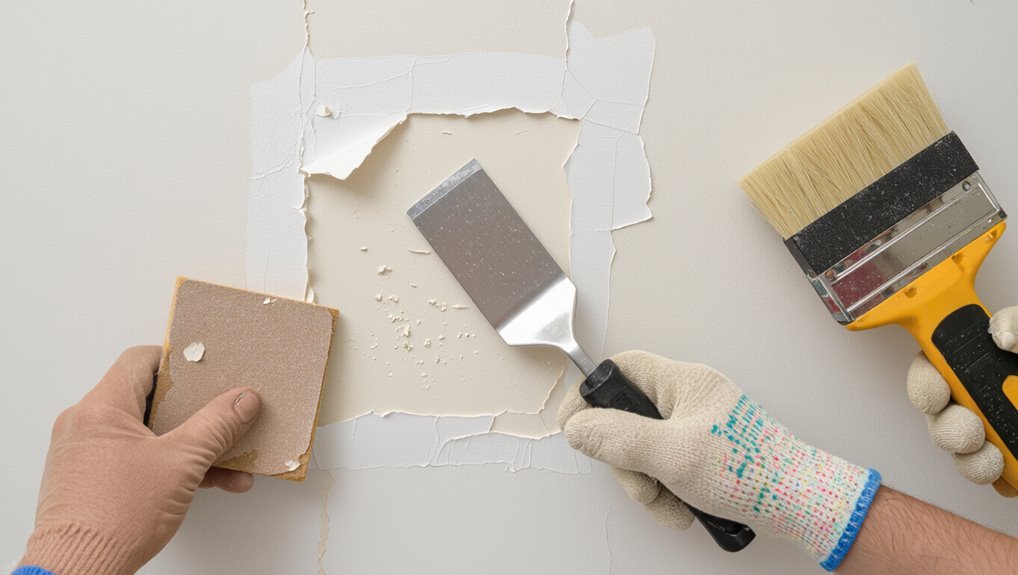
Scrape away any loose or flaking paint with a putty knife or paint scraper, working until the remaining edges are firmly adhered.
Then sand the perimeter with medium-grit sandpaper to feather the edges smoothly into the surrounding surface.
Remove dust with a dry brush or tack cloth.
Keep feathering until junctions are barely noticeable so filler and primer will bond evenly for a seamless repair.
Step 3 Clean the Surface and Repair Underlying Problems (mold, moisture)
3 key checks come next: clean the damaged area thoroughly and fix any underlying issues like mold or moisture so your repair won’t fail later.
Scrub with a mild detergent or fungicidal cleaner, rinse, and dry completely.
Identify and stop moisture sources—leaks, condensation, or poor ventilation—before proceeding.
Treat visible mold with an appropriate cleaner and allow the wall to dry fully.
Step 4 Apply Patch Compound or Joint Compound; Fill and Smooth
Mix and apply a smooth patch or joint compound to fill the ripped area, pressing it firmly into gaps and feathering the edges so it blends with the surrounding wall.
Use a putty knife to build thin, even layers, letting each set per manufacturer instructions.
Remove excess, reshape edges, and check for voids.
Keep the repair slightly proud to allow final refinement.
Step 5 Sanding and Surface Refinement (grit recommendations)
Once the patch compound has fully cured, sand the area to a smooth, feathered finish using progressively finer grits—start with 120–150 grit to knock down high spots.
Follow with 180–220 grit to refine the surface, and finish with 320 grit if you need an ultra-smooth blend for gloss or semi-gloss paints.
Sand lightly, check edges for feathering, and remove dust before proceeding.
Step 6 Apply Primer and Explain Why Bonding Primer Matters
Before you paint, apply a bonding primer to the repaired area so the new paint adheres evenly and hides differences in porosity between the patch and surrounding wall.
Use a high-adhesion or stain-blocking primer, roll or brush thin coats, and let it dry fully.
This creates a uniform surface, improves topcoat coverage, and prevents flaking or peeling where old and new materials meet.
Step 7 Repaint: Matching Color, Sheen, and Application Technique
After the primer’s dry, you’ll repaint so the patch disappears — matching the paint color, sheen, and application technique exactly to the surrounding wall.
Test a small swatch for hue, then use the same finish (flat, eggshell, satin).
Apply paint with the same tool and stroke direction, feather edges, and blend into existing coverage.
Multiple thin coats beat one thick coat.
Step 8 Final Inspection and Touch-ups
With the paint dried, take a careful look at the repair to make sure the patch blends seamlessly with the surrounding wall.
Inspect from different angles and lighting, feeling for texture differences. If you spot thin spots, missed feathering, or slight color shifts, lightly sand or reapply thin glaze coats.
Clean edges, remove stray drips, and let everything cure before declaring the job finished.
Variations for Specific Situations
You’ll handle ripped paint differently depending on the surface: knockdown or orange-peel texture, plaster versus drywall, and whether there’s wallpaper or stains underneath.
For small spots you can match texture and patch, but larger peeling or blistering may mean you need to resurface or replace the damaged section.
Below are specific tips for each situation to help you choose the right approach.
Repairing Paint on Textured Walls (knockdown, orange peel)
When a tear or chip hits a textured wall—like knockdown or orange peel—you’ll need to match not just the color but the texture, because skim-coating a smooth patch will make the repair obvious.
Feather edges, clean loose paint, apply joint compound with a stomp or spray texture matching the pattern, let dry, sand lightly, prime, then touch up paint, blending edges for an invisible finish.
Repairing Painted Plaster vs. Drywall
Plaster and drywall react differently to tears and chips, so you’ll need to adjust your repair method and materials accordingly.
For plaster, use a bonding agent, flexible patching compound, and thin layers to avoid cracking; feather edges carefully.
For drywall, remove loose paper, apply joint compound or patch kit, sand smooth, and prime.
Match texture and paint for a seamless finish.
Dealing with Wallpapered or Previously Stained Surfaces
Wondering how to handle ripped paint over wallpaper or on previously stained walls?
Remove loose paper and adhesive, score and peel carefully, then clean residue with appropriate solvent.
For stained surfaces, bleach or stain-blocking primer prevents bleed-through.
Patch small areas with lightweight spackle, sand smooth, prime, then repaint.
Match texture and paper seams; for extensive damage, consider stripping wallpaper first before full repair.
Large-area peeling or blistering when to resurface or replace
Big sections of peeling paint or blistering usually mean the underlying surface has a more serious problem than a simple spot repair, so you’ll need to decide whether resurfacing or a full replacement is the smarter choice.
Inspect for rot, moisture, mold, or structural damage; if widespread, replace. If sound, sand, patch, prime, and resurface.
- Check moisture source
- Test substrate integrity
- Assess mold presence
- Estimate cost/time
- Choose resurfacing vs replacement
Common Mistakes to Avoid
Don’t paint over loose or flaking areas without scraping and stabilizing them first, because the new coat won’t stick.
Don’t skip primer—or grab the wrong kind—since that causes adhesion and finish problems.
Also avoid over- or under-sanding the patch and be sure the sheen and paint type match the surrounding wall.
Painting over loose paint without preparation
One quick misstep many people make is painting right over flaking or loose paint; it may seem faster, but the new coat won’t adhere and will peel back soon after.
You need to scrape, sand, and remove all unstable material first. Clean dust, vacuum, and wipe with a damp cloth.
Only apply paint to a solid, dry surface to guarantee lasting results.
Skipping primer or using wrong primer
After you’ve removed loose paint and prepared the surface, skipping primer or picking the wrong one is a mistake that’ll undo your work.
You need primer to seal repairs, improve adhesion, and block stains. Use a bonding primer for glossy areas, stain-blocking for tannin or water marks, and an appropriate primer for drywall or plaster.
Don’t assume all primers behave the same.
Over-sanding or under-sanding the patch
If you sand too aggressively you’ll gouge the patch or eat into surrounding drywall, but sanding too little leaves ridges and poor paint adhesion—both ruin the smooth finish you’re aiming for.
Use medium-grit then fine-grit sandpaper, feather edges gently, and check frequently by touch and sight. Aim for a seamless changeover; stop as soon as the patch visually blends with the wall.
Mismatching sheen or using incorrect paint type
While matching color is important, getting the sheen and paint type wrong will make a perfectly patched area stand out, so choose carefully: glossier finishes reflect more light and will highlight texture differences.
Using an oil-based paint over a latex wall (or vice versa) can cause adhesion problems and uneven aging.
You should test a small area, match sheen, and use compatible primers to guarantee uniform finish.
Prevention and Best Practices
Before you repaint, make sure you prep the surface properly—clean, sand, and prime so the new coat will stick.
Pick primers and paints suited to each room (use mildew-resistant formulas in bathrooms and durable, washable paints in kitchens) and control moisture with exhaust fans and dehumidifiers to prevent future peeling.
Do regular maintenance—touch up chips, keep vents clear, and address leaks quickly—to extend the life of your paint.
Proper surface prep before painting
Good surface prep prevents most paint failures, so you’ll want to remove loose paint, clean dirt and grease, and fix any damaged drywall or plaster before you touch up the area.
You’ll sand feathered edges, vacuum dust, wipe with a mild cleaner, apply patching compound, and sand smooth so new paint adheres and blends seamlessly.
- Sand edges
- Clean surface
- Patch holes
- Sand smooth
- Prime repaired spots
Choosing the right paint and primer for rooms (bathrooms, kitchens)
Now that the surface is prepped, pick paint and primer matched to the room’s conditions to prevent future peeling and staining.
Use a high-quality stain-blocking primer for kitchen grease and bathroom water spots.
Choose semi-gloss or satin finish for durability and cleanability.
Opt for mildew-resistant formulas labeled for bathrooms or kitchens, and follow manufacturer cure times before regular use.
Moisture control and ventilation tips to prevent peeling
Because excess moisture is the main driver of paint failure, you should control humidity and guarantee steady airflow to keep painted surfaces dry and stable.
Use exhaust fans in bathrooms and kitchens, run dehumidifiers where needed, and open windows after showers.
Fix leaks, vent clothes dryers outside, and avoid blocking vents.
Monitor humidity with a hygrometer and act when levels exceed 50%.
Maintenance tips to extend paint life
While routine care won’t stop every problem, you can greatly extend a paint job by keeping surfaces clean, addressing small issues quickly, and following a few simple habits.
Wipe dirt and spills, avoid abrasive cleaners, dust trims, and spot-touch chips immediately.
Control humidity, use mats in high-traffic areas, and repaint high-wear zones sooner.
Regular checks prevent larger repairs.
Tools, Materials, and Cost Comparison
Before you start, compare a basic DIY kit (putty, sandpaper, primer, and a small can of paint) with professional-grade materials that give longer-lasting results.
I’ll outline estimated time and cost for small, medium, and large repairs so you can choose what fits your budget and schedule.
That way you’ll know whether to tackle the job yourself or hire a pro.
Basic DIY kit vs. Professional-grade materials
When you’re deciding whether to tackle ripped paint yourself or hire a pro, the tools and materials you choose will make the biggest difference in outcome and cost. You’ll weigh convenience against durability: a basic DIY kit saves money and handles small fixes, while professional-grade materials give longer-lasting, smoother results for larger or high-visibility repairs.
| DIY Kit | Pro Grade |
|---|---|
| Spackling | Joint compound |
| Basic brush | High-quality roller |
| Sandpaper | Sanding block |
| Small putty knife | Stainless steel knife |
| Standard paint | Premium paint |
Estimated time and cost for small, medium, and large repairs
Small, medium, or large repairs will differ widely in time and cost, so plan the job based on size and visibility: a small touch-up (a few square inches) typically takes 30–60 minutes and under $20 using a DIY kit, a medium repair (a few square feet) can take 2–4 hours and $30–100 if you buy joint compound or better paint, and a large repair (several square feet or damaged drywall) may take a day or more and $100–300+ when you factor in pro-grade materials or hiring help.
| Size | Time | Cost |
|---|---|---|
| Small | 0.5–1 hr | <$20 |
| Medium | 2–4 hrs | $30–100 |
| Large | 1+ day | $100–300+ |
Troubleshooting: If the Repair Keeps Peeling
If your patch keeps peeling, first check for hidden moisture, poor adhesion, or structural movement that could be sabotaging the repair.
If you spot mold, soft drywall, persistent dampness, or repeated failure despite proper prep, you should call a pro for remediation.
For long-term fixes, you’ll need to address the root cause—seal leaks, replace damaged substrate, and use appropriate primers and paints.
Diagnosing hidden moisture, adhesion, or structural issues
Although a fresh patch may look fine at first, peeling that returns usually signals an underlying issue you need to find and fix.
Check for moisture with a damp meter or by taping plastic overnight; look for soft drywall, bubbling, or efflorescence.
Verify adhesion by scraping edges, sanding glossy areas, and ensuring primer compatibility.
Inspect for hairline cracks or movement that indicate structural stress.
When to call a pro: signs you need professional remediation
When should you call a pro?
If fresh repairs keep peeling within weeks, underlying moisture, mold, or improper substrate adhesion is likely.
Call a professional when patches repeatedly fail, you see widespread bubbling, crumbling drywall, persistent mold, or unclear causes after basic tests.
Pros diagnose hidden issues, stop deterioration, and recommend targeted remediation rather than repeated cosmetic fixes.
Long-term fixes for persistent paint failure
Because a patch that keeps peeling usually signals a deeper problem, you’ll need to move beyond surface fixes and address root causes like moisture, poor adhesion, or incompatible coatings.
Diagnose humidity or leaks, strip failed layers, sand to sound substrate, apply appropriate primer and compatible paint, and guarantee proper curing.
If failure persists, consult a pro to test substrates or remediate structural moisture.
Frequently Asked Questions
You’ll find quick answers here to common questions like how long to wait between primer and paint and whether leftover paint will work for a patch.
You’ll also learn when spackle can hide larger gouges, how to match texture on repaired areas, and what to expect from paints that claim to prevent peeling.
Read on and you’ll get concise, practical guidance for each issue.
How long should I wait between primer and paint?
If the primer feels dry to the touch, go ahead and paint—most water-based primers need just 1–2 hours to dry, while oil-based primers typically require 24 hours.
Also check manufacturer instructions and room conditions: high humidity or low temperature can extend cure times.
Lightly sand glossy primer, remove dust, then apply paint.
Don’t rush—adequate drying prevents adhesion problems and visible flaws.
Can I use leftover paint to patch a ripped area?
Can you use leftover paint to patch a ripped area? Yes — as long as the paint matches and’s still usable.
Stir and test a small swatch after cleaning and priming the repair. Thin, separated, or hardened paint won’t blend well.
If color, sheen, or age differ, consider tinting the leftover or buying a small matching can for a seamless finish.
Will spackle and paint hide large gouges or holes?
How big is the damage, and will spackle and paint really fix it?
If the gouge is shallow or a small hole, you can spackle, sand, prime, then paint for an invisible repair.
For deep or large holes, use joint compound with backing or a patch kit before finishing.
Big structural damage may need drywall replacement rather than just spackle and paint.
How do I match texture on a patched area?
When you’re blending a patched area into existing wall texture, start by identifying the texture type—orange peel, knockdown, slap brush, or smooth—so you can choose the right technique and tool.
Match texture by practicing on scrap drywall, adjust compound thickness, use appropriate applicator (spray, trowel, brush), feather edges, sand lightly when dry, then prime before repainting for uniform finish.
Is there a paint that prevents peeling completely?
Wondering if a paint exists that completely prevents peeling? No single paint guarantees zero peeling.
You can greatly reduce risk by prepping surfaces: clean, dry, repair, and prime with the right primer for material.
Use quality paints formulated for your substrate and climate, apply correct coats, and control moisture and adhesion issues.
Maintenance and proper technique matter more than a miraculous product.
