
Do You Paint Ceiling Same Color as Walls: Pros and Cons Explained
You can paint the ceiling the same color as the walls to create a cohesive, modern look that feels calm and intentional, but you’ll want to weigh mood, light, and scale first. Lighter matched hues lift low ceilings, while darker wraps make rooms cozier; natural and artificial light can shift undertones and reveal texture. Matching simplifies touch-ups but may narrow buyer appeal. Keep your room’s function, finish, and resale goals in mind and you’ll know when to explore the options further.
Quick Answer: Should You Paint the Ceiling the Same Color as the Walls?
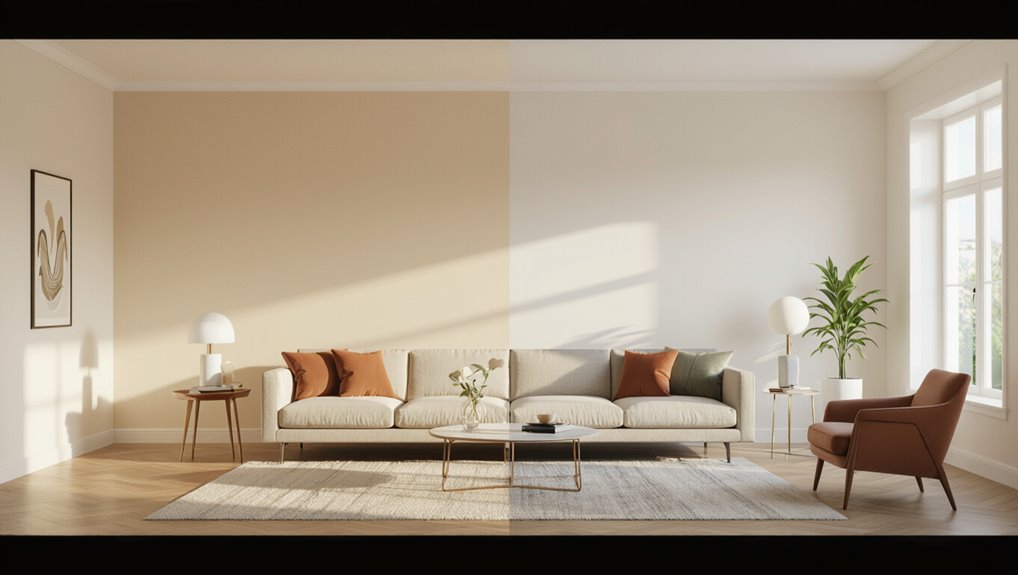
Wondering whether to paint your ceiling the same color as your walls? You can—doing so creates cohesion, supports modern design trends, and lets color psychology shape mood uniformly.
Choose a single hue for calm continuity or a bold match for drama.
Still, consider lighting, trim contrast, and room function before committing; match works well when you want streamlined, intentional spaces.
How Ceiling Color Changes Perceived Room Height
If you decide to paint your ceiling the same color as the walls, know that the hue you choose will also change how tall the room feels. You’ll use color psychology to create perceived height, enhance room ambiance, and achieve design cohesion. Visual harmony and color balance create a space illusion, while architectural features guide choices.
| Effect | Tip | Result |
|---|---|---|
| Bright | Light hues | Taller feel |
| Dark | Deep hues | Cozier feel |
| Match | Same color | Unified look |
Value and Undertone: When Ceilings Read Lighter or Darker
Because ceilings catch and reflect light differently than walls, the same paint can read lighter or darker up there. You’ll want to account for both value (how light or dark a color is) and undertone (the subtle tint beneath the surface) when matching or contrasting.
Consider ceiling hues versus wall undertones to manage color perception, lighting impact, spatial dynamics, paint psychology, aesthetic harmony, and overall design cohesion.
How Natural and Artificial Light Alters Matched Ceilings
Pay attention to how light direction changes what you see: sunlight from windows will hit walls and ceilings differently than overhead fixtures, altering perceived color.
Warmer or cooler bulbs shift undertones, so a matched ceiling can feel more yellow, pink, or blue depending on color temperature.
Also note shadows and gloss — sheen levels and angles create highlights or dark bands that make the same paint read uneven.
Light Source Direction
When natural light pours in from a high window or artificial fixtures cast shadows across the room, the way light hits a ceiling can make a matched paint color read warmer, cooler, brighter, or flatter than it does on the walls.
You’ll notice how light diffusion and ceiling texture interact.
- Side lighting emphasizes texture.
- Downlighting flattens color.
- Grazing light boosts contrast.
Color Temperature Effects
How will the same paint read under different bulbs and daylight? You’ll notice color psychology shifts: warm LEDs boost temperature perception and mood enhancement, while cool daylight sharpens color theory contrasts.
Matched ceilings can promote visual harmony and spatial illusion, but you’ll weigh ambiance creation against changing light.
Follow design trends, test samples at times you use the room, and adjust accordingly.
Shadow And Gloss
Light source and finish choice change more than color; they rewrite how a matched ceiling reads in the room.
You’ll notice shadow play shift with morning sun or warm bulbs, and gloss effects can bounce or blunt highlights.
Consider these scenarios:
- Matte ceiling + soft daylight = subdued depth.
- Semi-gloss + spotlight = pronounced reflections.
- High gloss + mixed light = busy, changing highlights.
Paint Finish Choices for Matching Ceilings
Why match ceiling and wall finishes at all?
You’ll consider paint sheen options to control light bounce and texture; flat reduces glare, while eggshell or matte offers subtle depth.
Matching finishes enhances color harmony, making shifts seamless.
Choose based on room function, lighting, and imperfections—higher sheen hides stains but highlights flaws.
Test samples before committing.
Stains, Touch-Ups, and Maintenance for Same-Color Ceilings
Ceilings painted the same color as walls demand a straightforward maintenance plan because touch-ups and stains stand out differently than on a contrasting ceiling.
You’ll handle stain removal and ceiling touch ups quickly to keep uniformity. Follow these steps:
- Blot stains, clean gently, assess paint match.
- Use leftover paint, feather edges for seamless patches.
- Repaint full panels if mismatch remains.
Core Decision Factors: Height, Light, Function, Style, Budget
Think about how ceiling height changes how a same-color scheme reads—low ceilings can feel lower if you match walls and ceilings, while high ceilings can handle a continuous color without overwhelming the room.
Consider natural light next: bright rooms tolerate darker or matching ceilings, whereas dim spaces often need a lighter ceiling to reflect light.
Finally, match your choice to the room’s function—a cozy bedroom, a formal dining room, or a utilitarian laundry room will each call for different color and budget priorities.
Ceiling Height Effects
Because ceiling height changes how a room feels, it should be one of the first things you consider when deciding whether to paint the ceiling the same color as the walls.
Low ceilings: unify color to raise sightlines.
High ceilings: contrast to define space.
Consider ceiling styles and visual tricks.
- Cozy
- Airy
- Dramatic
Natural Light Influence
How much natural light floods a room will strongly shape whether you should paint the ceiling the same color as the walls. You’ll use brighter ceilings when natural light is low to boost ceiling brightness, and match colors in sunny rooms to create cohesion. Consider contrast carefully to avoid a heavy feel.
| Light Level | Ceiling Choice |
|---|---|
| Low | Bright, lighter |
| High | Match walls |
Room Function Considerations
While ceiling color decisions hinge on height and light, you should also weigh the room’s function—how you use the space will change priorities for color, contrast, and mood.
You’ll choose colors for task focus or relaxation, using ambiance creation and color psychology to guide choices.
- Bedroom: calm, lighter ceiling.
- Home office: bright, neutral ceiling.
- Playroom: bold, coordinated ceiling.
Small-Room Strategies: When to Match or Contrast
Wondering whether to match or contrast ceiling and walls in a small room? You’ll use color perception and spatial dynamics to decide: matching expands height subtly; contrast adds personality but can feel cozier. Consider light, furnishings, and scale.
| Match | Effect | Tip |
|---|---|---|
| Same light | Opens space | Use warm neutrals |
| Contrast | Defines | Accent one wall |
Large-Room Strategies: When to Match or Contrast
Small rooms respond differently to matching or contrasting ceilings, but large rooms give you more freedom to experiment with bold choices and stronger visual statements.
You can emphasize ceiling drama or maintain subtlety to achieve color harmony, visual balance, design cohesion, and aesthetic flow.
Choose based on function:
- Match for calm continuity.
- Contrast for focal drama.
- Partial accent for layered interest.
Open-Plan Spaces: Matching Across Connected Rooms
Because open-plan layouts rely on visual flow, matching ceiling color across connected rooms helps you create a seamless, cohesive look that makes the whole space feel larger and intentionally designed. You’ll reinforce open plan aesthetics and seamless shifts while unifying lighting and trim choices. Consider this quick comparison:
| Benefit | Effect | Tip |
|---|---|---|
| Continuity | Expands space | Use one tone |
| Simplicity | Reduces visual breaks | Coordinate finishes |
Room-by-Room Examples: Living Room, Bedroom, Kitchen, Bath
Having matched ceiling color across open-plan areas, you can apply those same principles room by room to suit different functions and moods.
You’ll consider living room styles, bedroom moods, kitchen brightness, and bath tranquility.
Examples:
- Bold living room styles unify ceiling and walls.
- Soft bedroom moods use muted ceiling tones.
- High kitchen brightness and pale ceilings boost light; bath tranquility favors warm, low-contrast hues.
How Ceiling Color Guides Furniture and Decor Choices
Your ceiling color sets a backdrop that makes other choices—furniture, textiles, and accessories—either pop or blend, so pick tones that support the look you want.
Use ceiling aesthetics to steer color harmonization and furniture flow: light ceilings open space; darker ones anchor pieces.
Prioritize decor cohesion and mood enhancement for rooms you want calm or dramatic, ensuring subtle design continuity throughout.
Quick Swaps: Wallpaper, Beams, Murals, and Partial Color
If you want to change a ceiling’s impact without repainting the whole room, quick swaps like wallpaper, exposed beams, murals, or partial color let you make a big statement fast.
You can:
- Add wallpaper patterns for texture and focal interest.
- Install beams to enhance beam aesthetics and warmth.
- Paint mural themes or a partial color band to boost color contrast and drama.
Budget and Time Trade-Offs of Painting Ceilings the Same Color
Painting your ceiling the same color as the walls can speed up the job since you’ll skip cutting in and juggling multiple paints.
You’ll likely use less total paint and save money on cans and tools.
Just factor in any extra prep for ceilings—scaffolding, patching, or priming can add time and cost.
Faster Overall Process
Because you’re keeping the ceiling and walls the same color, the whole job moves faster—less setup, fewer paint changes, and fewer edges to cut in—so you’ll save both time and money compared with a two-tone approach.
You get a speedy application and a streamlined workflow.
Consider tasks simplified:
- Roll continuous surfaces
- Fewer trim touch-ups
- Quicker cleanup and fewer supplies
Paint Quantity Savings
When you use the same color on ceiling and walls, you’ll often cut down on the total gallons needed since you avoid separate ceiling-specific paints and can apply one finish across larger areas; that not only lowers your material costs but also reduces the time spent swapping cans, stirring different formulas, and doing extra touch-ups.
You’ll gain paint efficiency, clear cost savings, and fewer trips for supplies.
Prep Time Differences
You’ll save on paint quantity, but prep time can shift those savings depending on how you approach ceilings.
You’ll need focused prep strategies to protect trim, mask edges, and sand imperfections; that investment affects time efficiency.
Consider:
- Covering and taping (30–60 min)
- Sanding/priming (15–45 min)
- Cutting in vs. spraying (varies by room size)
Resale Impact: Will Matching Help or Hurt Buyers?
Curious whether matching ceilings to walls will affect your home’s sale? You should weigh buyer preferences, color psychology, design trends, market appeal, emotional response, buyer demographics, renovation impact, and neighborhood standards.
| Pros | Cons |
|---|---|
| Cohesive, modern look | May feel monochrome |
| Perceived quality boost | Limits standout features |
| Easier staging | Could deter some buyers |
Step-by-Step Checklist to Choose Same vs. Different
Wondering which route to take—matching your ceiling to the walls or keeping them different? Use this checklist to decide quickly, blending color psychology and current design trends.
- Assess room height, light, and mood you want.
- Test paint swatches on ceiling and walls at different times.
- Consider resale, maintenance, and whether a unified or contrasting look fits your style.
Real-Room Successes and Failures: Before-and-After Lessons
You’ll see how dramatic contrast transformations can either energize a room or make it feel disjointed when you compare before-and-after photos.
Pay attention to hidden ceiling mistakes—uneven trims, incorrect sheens, or unnoticed stains—that undermine an otherwise strong color choice.
Also note how different lighting changes the same paint combo, turning warm colors cozy or washing cool tones flat.
Dramatic Contrast Transformations
When you flip a ceiling from matching the walls to a bold, contrasting hue, the room’s personality can change overnight—sometimes for the better, sometimes revealing design missteps that hindsight can’t hide.
You’ll learn from real-room dramatic contrast transformations: bold statements and clear visual impact teach fast lessons.
- Pop anchors focal points.
- Dark ceilings cozy but shrink.
- Bright ceilings lift scale.
Hidden Ceiling Mistakes
Switching a ceiling color can make a room sing—or quietly sabotage months of careful styling—and some mistakes hide in plain sight.
You’ll notice poor edge work, uneven sheen, and wrong-scale patterns that clash with ceiling design. Ignore color psychology and you’ll create tension or blandness.
Test samples, assess proportions, and fix prep errors early so the final room feels intentional, not accidental.
Lighting And Color Interaction
Because light changes how paint reads, a color that looks soft and warm in showroom photos can turn harsh or muddy in your own room. That’s where before-and-after lessons become invaluable.
You’ll learn to manage color harmony and light diffusion by testing real setups:
- Morning sun exposure
- Artificial warm vs cool bulbs
- Drapes and reflective surfaces
Adjust ceiling choice accordingly.
Frequently Asked Questions
Will Matching Ceilings Affect Indoor Acoustics or Echo?
Matching ceilings won’t change acoustic absorption markedly, but you’ll notice visual perception shifts that affect perceived echo. You’ll still need soft materials or treatments for real sound control, since paint color doesn’t alter acoustics.
Can I Use Same-Color Ceilings With Textured Popcorn Ceilings?
Yes — you can paint same-color ceilings with textured popcorn ceilings; you’ll keep textured ceiling benefits like hiding imperfections, and color psychology can unify space, but lighter shades prevent a heavy, closed-in feel while preserving texture.
How Does HVAC Venting and Lighting Placement Influence Matching Ceilings?
Will vent color contrast and ceiling height impact your decision? You’ll want vents and lighting positioned to avoid shadows; you’ll balance vent color contrast, ceiling height impact, and fixture placement so matching feels cohesive, not awkward.
Are There Fire-Safety or Building-Code Concerns With Darker Ceilings?
Yes — you should check local fire regulations, but darker ceilings rarely pose code problems; they can affect visual perception of smoke and light, so you’ll want to guarantee detectors, exits, and emergency lighting remain clearly visible and compliant.
Can Pets or Children Cause Unique Maintenance Problems on Matched Ceilings?
Absolutely — you’ll face extra maintenance: pet damage and children’s messes make cleaning challenges, increasing maintenance frequency; you’ll be constantly repainting like chasing shadows, patching scuffs, claw marks, stains, and sticky fingerprints.
Conclusion
Choosing to paint the ceiling the same color as the walls can shrink or soothe a room—so think spatial tricks, light, and finish before you commit. You’ll save time and get a seamless look, but risk losing height or alienating buyers. Test samples under different lighting, weigh budget and resale, and pick a finish that reads right. In short: trust your eye, try before you leap, and let the room whisper its choice.
