
Are Paint Swatches Free? Where to Get Them Easily
Yes — basic paper swatches and small chips are usually free; peel‑and‑stick samples, larger chips, or quart sample cans often cost a few dollars. You can pick up free strips at Home Depot, Lowe’s, Menards, local hardware or indie paint shops, or order free fan decks from manufacturers like Behr, Sherwin‑Williams, and Valspar. Use free swatches to test in natural light and near furnishings, and keep organizing tips handy if you want more guidance.
Are Paint Swatches Usually Free?
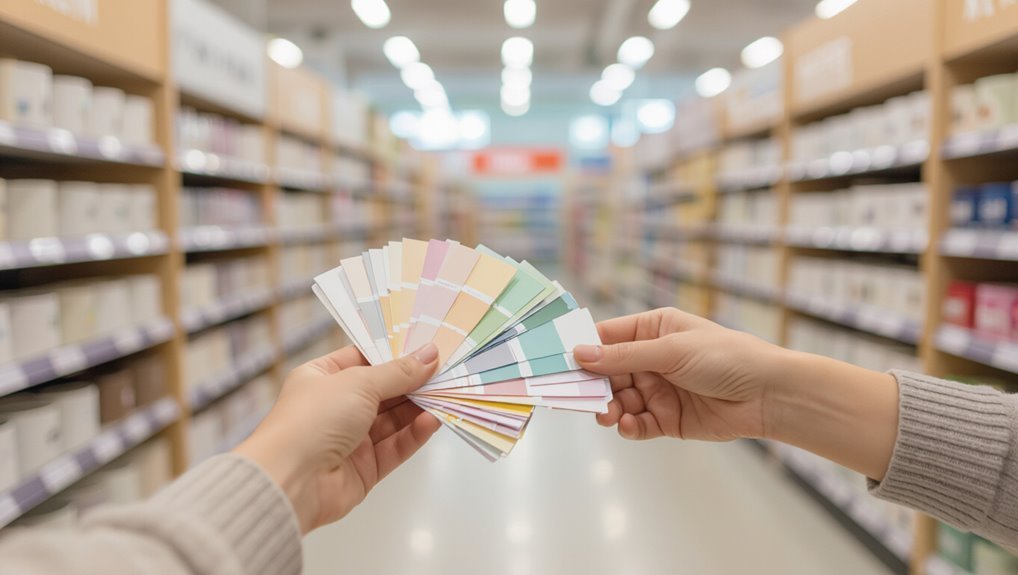
Curious whether paint swatches cost you anything? You’ll often find basic paper swatch types offered free from manufacturers and some retailers, while peel-and-stick samples or larger chips usually cost.
You can request freebies online or in-store, but expect charges for premium formats.
Consider color psychology when sampling—test how tones change in your light before buying a paid sample.
Where to Get Free Swatches at Big‑Box Stores (Home Depot, Lowe’s, Menards)
Wondering where to pick up free paint swatches at big-box stores? You can grab swatch strips at Home Depot, Lowe’s, and Menards near paint aisles or customer service.
Staff usually hand them out free; just ask. Bring measurements and test chips to compare.
Use swatch organization methods—label by room and lighting—and arrange potential color combination samples before deciding.
Manufacturer Websites That Ship Free Paint Swatches (Behr, Sherwin‑Williams, Valspar)
If you prefer getting samples delivered instead of picking them up in-store, many paint makers will mail swatches right to your door.
You can use manufacturer sites for swatch types and place online requests easily.
Try these steps:
- Visit Behr.
- Visit Sherwin‑Williams.
- Visit Valspar.
- Choose free paper or fan swatches, add to cart, and checkout.
Local Hardware and Indie Paint Stores That Hand Out Swatches
Want swatches the same day? Visit local hardware stores and indie paint shops—you’ll often grab free fan decks or single chips right off the counter.
Talk to staff; they can pull obscure tones or cut small samples. Check community events and store workshops where dealers hand out swatches for promotions.
Bring color photos and measure your natural light to pick the best match.
Use Brand Promos and Loyalty Programs to Get Free Swatches
Check a brand’s loyalty program—you’ll often earn free swatches or credit toward samples just for signing up or making repeat purchases.
Keep an eye out for promo codes in emails or on social channels that can waive swatch fees. Use those perks strategically to try more colors without spending extra.
Brand Loyalty Perks
When you join a paint brand’s loyalty program or sign up for promotional emails, you often gain access to free swatches, samples, or exclusive promo codes that make testing colors easier and cheaper.
You’ll use brand loyalty and customer rewards to score perks like:
- Free swatches
- Sample pots
- Early-sale alerts
- Bonus points for purchases
Promo Code Offers
Curious how promo codes and loyalty perks can stretch your paint budget? You can grab free swatches using brand promos, sign up for emails, and apply promo codes at checkout. Watch for discount offers tied to purchases or points. Redeem rewards for swatches or samples to test colors before committing to cans.
| Source | Tip |
|---|---|
| Brand promo | Sign up |
| Check codes | |
| Loyalty | Redeem points |
| Store app | Exclusive offers |
| Receipt | Look for codes |
When Paint Swatches Cost Money: Peel‑and‑Stick and Printed Samples
Although many stores hand out small fan decks for free, you’ll sometimes pay for peel-and-stick swatches or printed sample cards that let you test a true color on your wall.
You’ll weigh value vs cost:
- peel and stick samples: easy application, tidy removal.
- printed swatch costs vary by brand.
- better match than tiny chips.
- ask about return or reuse policies.
Affordable Larger Paint Samples and Sample‑Sized Cans (Prices to Expect)
If you want more than a peel‑and‑stick swatch, you can buy larger sample options like quartettes or sample‑sized cans that let you paint a few walls or test finish and coverage.
Expect to pay roughly $3–$20 depending on brand and size, with premium paints at the higher end.
You’ll find these at big box retailers, paint stores, and many manufacturer websites.
Larger Sample Options
When you want more paint than a free swatch can give, affordable larger samples and sample‑sized cans bridge the gap between testing and committing—letting you roll out, brush on, or repaint a small wall or piece of furniture before buying a full gallon.
Use larger samples for color visualization and sample comparisons:
- Test on actual wall
- Try in different light
- Compare finishes
- Check coverage and touch-up
Sample Can Price Range
Because sample cans sit between free swatches and full gallons, you’ll usually pay a modest amount that still lets you test color, finish, and coverage without committing to a big purchase.
You’ll see various sample can types — small 8–16 oz jars to larger pint/quart options — and should do a quick price comparison across brands.
Expect $3–15 depending on size and brand.
Where To Buy Samples
Looking for bigger, affordable paint samples or sample-sized cans?
You can buy larger sample size cans online or at big-box stores, local paint shops, and brand boutiques for better color matching. Prices vary by brand and volume.
- Big-box retailers
- Paint brand stores
- Local paint shops
- Online specialty sellers
How to Request Free Swatches In‑Store and Online
Want swatches in hand before you commit? Ask staff for free paper or peel samples, request specific codes, and say how many you need. Organize them for swatch organization and perform color comparison at home under natural light. Use polite phrasing online chat or email; include paint codes and delivery address.
| Store Tips | Online Tips | Quick Reminder |
|---|---|---|
| Ask staff | Request codes | Natural light |
Peel‑and‑Stick vs. Paper Swatches: Color Accuracy and Durability
When you compare peel‑and‑stick and paper swatches, focus on two things: color accuracy and how each holds up over time.
- Peel‑and‑stick often shows truer color under different lights, aiding color blending.
- Paper can fade or shift, especially under sunlight.
- Peel‑and‑stick withstands handling better; it’s more durable.
- Texture differences affect perceived color—paper texture can mute tones.
How Many Paint Swatches Should You Get for One Room?
How many swatches should you grab for one room? Aim for 6–10 samples: include your top 3–5 hues plus variations in tint or saturation.
Factor in color preference trends to explore popular palettes, but don’t follow them blindly.
Adjust count for room size considerations—larger rooms may warrant more options for different walls or focal areas.
Keep choices manageable for decision-making.
Test Swatches Under Different Lighting: Day, Night, and North/South Windows
Because light shifts so much through the day and across exposures, you should test swatches at multiple times and on walls facing different directions to see the true color.
Because light changes constantly, test paint swatches at different times and on walls facing various directions to know the true color.
You’ll notice lighting effects change tones. Do swatch comparisons in each condition:
- Morning (east light)
- Afternoon (west light)
- Night (artificial light)
- North vs south-facing walls
Record observations for final choice.
How Big Should a Painted Sample Patch Be?
You’ll want your painted sample patch to be large enough to read how the color really looks—typically a 2×2 foot area works well.
Stand back to the distance you’ll normally view the wall, since color perception changes with viewing distance and surrounding wall area.
Small swatches can fool you, so test a sizable patch to get an accurate sense.
Sample Patch Size
Think of a sample patch as a small experiment: make it large enough to show true coverage and color under different lights, but not so big that it wastes paint or time.
You should consider sample size and color variety when testing.
Try these steps:
- 4×4 inches for quick checks
- 8×8 inches for accuracy
- Test on actual surface
- Label each patch and note drying time
Viewing Distance Impact
After you’ve decided on patch size and location, consider how far you’ll view the wall—viewing distance changes how color and finish read, so your sample needs to reflect real-life sightlines.
Stand where you’ll normally be and evaluate a patch large enough to judge color perception and texture. That helps you assess visual harmony across the room and avoid surprises after painting.
Comparing Swatches Across Rooms, Trim, and Surfaces
Wondering how a swatch will actually look in different parts of your home? Test for color harmony and surface compatibility by sampling on trim, walls, and cabinets.
Try these checks:
- Compare swatch on wall near trim.
- Apply small patch on door or cabinet.
- View across rooms with different light.
- Inspect on textured and glossy surfaces for finish differences.
Budget Color‑Testing Options: Chips, Fan Decks, and Mobile Apps
You don’t need to buy expensive samples to see how a color will perform — inexpensive paint chips, fan decks, and free mobile apps can give you a reliable preview.
Use chips to test light and pairings; study color psychology to predict mood.
Fan decks help compare families; apps simulate rooms.
Keep neat swatch organization so decisions stay clear and fast.
When to Pay for Professional Color‑Matching or Custom Chips
Budget-friendly chips and apps cover a lot of ground, but there are moments when paying for professional color-matching or custom chips makes sense.
You should invest when you need accuracy or long-term swatch storage. Consider:
- Historic restoration requiring exact tones.
- Large open-plan spaces.
- Branding or commercial projects.
- After a formal color consultation for guaranteed matches.
Common Swatch Mistakes to Avoid
Because lighting, placement, and sample size can all skew how a color reads, avoid relying on a single tiny chip or a photo when choosing paint.
You should test multiple full‑size swatches in the actual room, view them at different times, and compare against fixed furnishings.
Use swatch selection tips and practical color comparison strategies to prevent surprises and poor contrast.
Quick Checklist Before You Pick a Final Paint Color
Before you commit, test a sample of the paint on your actual wall so you can see how it looks at different times of day.
Check the color under natural light, artificial light, and in shadows to make sure it reads the way you want.
Also consider the finish and wall texture—flat, satin, or gloss will change the color’s appearance and durability.
Test Paint On Wall
Grab a few sample pots and paint swatches, then apply 12×12-inch test patches on the wall where the color will live—this shows you how light, room size, and nearby finishes change the hue.
Try this checklist:
- Inspect paint durability by scuffing gently.
- Compare color matching to trim and floor.
- View at eye level.
- Live with patches for 48 hours.
Check Under Different Lighting
Once you’ve lived with the test patches for a couple days, check them under every type of lighting the room gets—natural morning and afternoon sun, overhead fixtures, lamps, and even night lighting.
Move around the room and view swatches at different angles to note lighting effects on hue and saturation.
Trust your color perception, and don’t finalize until it looks right in all conditions.
Consider Finish And Texture
1 key thing to lock down after you’ve settled on a color is the finish and texture, because they change how the paint looks, hides imperfections, and cleans up over time.
- Know common finish types: flat, eggshell, satin, semi-gloss.
- Match finish to room use.
- Test texture effects on sample patches.
- Consider cleaning and durability needs before buying.
Where to Recycle or Repurpose Leftover Swatches and Samples
Paint swatches and sample pots don’t have to end up in the trash—you can recycle, repurpose, or donate them instead.
For swatch recycling, check local recycling centers or paint store take-back programs.
For creative repurposing, turn swatches into bookmarks, mood boards, or drawer liners.
Donate leftover sample pots to community theaters, schools, or Habitat for Humanity ReStores for reuse.
Frequently Asked Questions
Do Paint Swatches Fade Over Time if Left in Sunlight?
Yes — if you leave swatches in sunlight exposure, they’ll fade over time. You’ll notice reduced color longevity as UV breaks pigments down, so keep samples shaded or use UV-resistant coatings to preserve their true hue longer.
Can I Get Swatches for Specialty Finishes Like Metallics or Chalk Paint?
Yes — you can get swatches for specialty finishes like metallics and chalk paint; brands and specialty retailers offer sample cards, mini pots, or peel-and-stick swatches so you can test different paint types and effects before committing.
Are Digital Swatches on Websites Color-Accurate for My Monitor?
Mostly, but don’t bank on perfection — digital swatches can mislead. You’ll need color calibration and adjusted display settings to get closer; even then, printed or physical samples remain the reliable final check.
Do Paint Stores Accept Returns on Unused Sample Cans?
Yes — many stores accept returns on unused sample cans, but policies vary. You’ll need a receipt, original packaging, and intact labels; check paint return policies for time limits and sample can limitations before buying to avoid surprises.
Can Swatches Be Used to Match Wallpaper or Fabric Colors?
Yes — you can use swatches to match wallpaper or fabric colors. You’ll get better color coordination and design inspiration by viewing swatches next to materials, testing under room light, and adjusting for texture and finish differences.
Conclusion
You’ll usually get paint swatches for free if you ask — look at big-box stores, manufacturer sites, and local paint shops, and join loyalty programs for freebies. If you need precision, pay for a custom chip or professional color‑matching. Don’t rush: measure lighting and test samples. Remember, “measure twice, cut once” — take your time choosing so you won’t regret it later. Keep leftover swatches for samples or recycling.
