
How to Paint a Wall Evenly Without Streaks or Roller Marks
You can get a streak-free wall by prepping surfaces—clean, fill, sand, and prime patched spots—then use the right roller and paint. Load the roller evenly, apply in overlapping W strokes, keep a wet edge, and work in small sections so you blend fresh paint into wet areas. Use a brush for cutting in and touch-ups, choose a matte or eggshell finish, and let coats dry fully; keep going and you’ll find detailed tips and troubleshooting next.
Quick Step-by-Step: Get a Streak-Free Wall
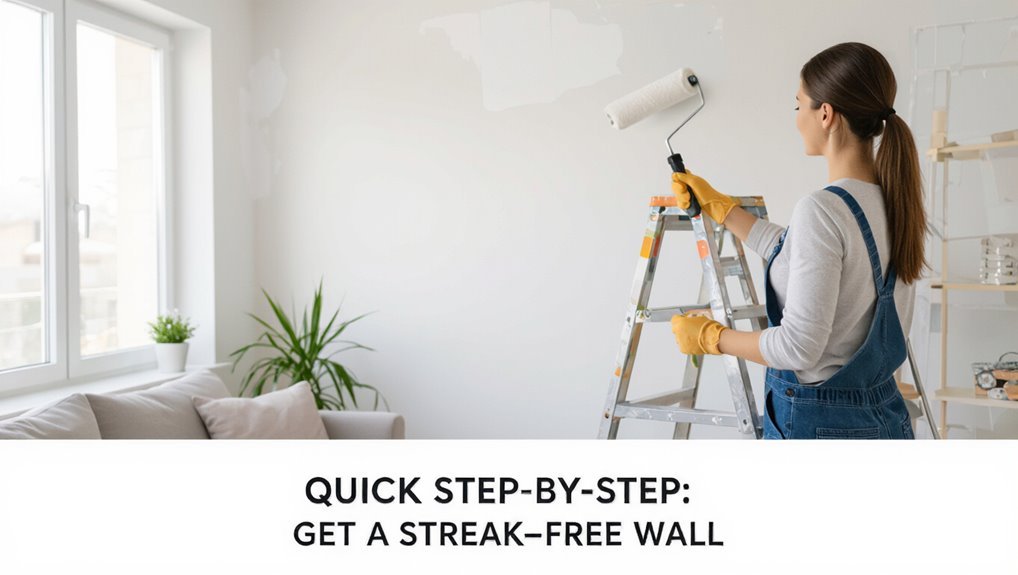
Start by prepping the surface and gathering your tools: clean the wall, fill holes, sand rough spots, and tape edges.
Choose color selection and test swatches in different light.
Prime patched areas for consistent absorption.
Load your roller evenly, work in overlapping W strokes, maintain a wet edge, and inspect for missed spots.
Let coats dry fully before evaluating coverage.
Best Roller Marks Prevention Workflow
Now that you’ve got your prep and rolling rhythm down, focus on preventing roller marks so your finish stays uniform.
Use a consistent roller technique: load evenly, apply in overlapping W patterns, and finish with light, unbroken passes while the paint is wet.
Check paint consistency—thin slightly for better leveling or thicken to avoid drips.
Keep a wet edge and work steadily across the wall.
When to Brush vs. Roll for a Smooth Finish
While rolling covers large areas quickly, you’ll reach edges, corners, and trim where a brush gives you control and a crisp line, so switch to a brush for cutting in and touch-ups while keeping rollers for the field. Use proper brush techniques for edges and match roller selection to paint texture for smooth coverage.
| Task | Tool |
|---|---|
| Cutting in | Brush |
| Large field | Roller |
| Touch-ups | Small brush |
Best Paint Finishes to Hide Roller Marks
To hide roller marks, you’ll want to choose the right finish—matte and eggshell are your best bets because they diffuse light and mask texture.
If you need a bit more durability in high-traffic areas, a high-quality satin can work while still minimizing roller lines.
Test a small patch first so you can see how each finish looks under your room’s lighting.
Matte And Eggshell Finishes
Matte and eggshell finishes hide roller marks better than glossier paints, so you’ll get a smoother-looking wall even if your technique isn’t perfect. Use matte advantages for hiding texture, and eggshell durability where light cleaning’s needed. Choose based on room use and lighting.
| Feature | Benefit |
|---|---|
| Matte | Hides flaws |
| Eggshell | Easier to clean |
| Both | Reduced sheen |
High-Quality Satin Options
If you liked how matte and eggshell hide imperfections, consider high-quality satin for a balance of hide and durability that still minimizes roller marks.
You’ll get improved satin durability and easier cleaning without glossy blowout.
Apply thin, even coats with a good nap roller, maintain a wet edge, and choose paints with strong color retention to keep finish uniform and streak-free over time.
Best Roller Naps by Wall Texture
Texture matters: pick the right roller nap for the surface you’re painting to get even coverage without excess splatter or missed spots.
For smooth walls use 1/4″–3/8″ naps; light orange peel or slight texture needs 3/8″–1/2″.
For pronounced texture or rough brick choose 3/4″–1″.
Your roller nap selection guarantees texture compatibility, efficient coverage, and fewer touch-ups.
Which Paint Types Level Out Best (Acrylic/Latex/Enamel)
When you’re choosing paint for an even finish, acrylic and latex are great because they level easily, resist brush marks, and clean up with water.
Enamel gives a harder, glossier surface but can show more application marks if you’re not careful.
Also pay attention to drying time—slower-drying formulas give more time to smooth out the paint, while fast-drying types can lock in strokes.
Acrylic/Latex Paint Benefits
Because acrylic and latex paints are water-based, they tend to level out more smoothly than oil-based enamels, giving you fewer visible brush strokes and a more even finish with less effort.
You’ll appreciate acrylic advantages and latex versatility when rolling.
Use these tips:
- Thin slightly for better flow.
- Keep a wet edge.
- Use quality rollers.
- Apply consistent pressure.
Enamel Paint Characteristics
Enamel paints, often oil- or alkyd-based, dry to a hard, glossy finish that resists wear and cleans up well, but they don’t level out as readily as water-based acrylics or latex. You’ll choose enamel for enamel paint advantages and enamel paint durability where toughness matters, accepting harder application control.
| Type | Finish | Best use |
|---|---|---|
| Oil enamel | Glossy | Trim |
| Alkyd enamel | Hard | Doors |
| Water-based enamel | Satin | Cabinets |
Drying Time And Leveling
Although drying speed varies by formulation, the key trade-off to grasp is that faster-drying paints level less before they set.
You’ll choose acrylic/latex for forgiving leveling; enamel gives harder finish but needs better drying techniques and additives.
Consider these leveling solutions when planning:
- Slow-drying acrylic blend
- Quality latex with extender
- Alkyd enamel with retarder
- Proper environmental control
How Much Paint to Load on the Roller
Load the roller with enough paint to cover about a 2–3 foot section before you start rolling, so you’ll maintain a wet edge and avoid lap marks.
Use paint roller techniques that balance coverage and control: aim for an even, saturated nap without dripping.
Follow paint loading tips to prevent overloading or undercoating, so each pass lays down consistent, smooth paint.
Load and Roll Off Excess Paint Correctly
Dip the roller into the tray, then roll it back and forth on the ribbed area to evenly distribute paint and remove excess so you don’t get drips or heavy ridges on the wall.
- Check paint absorption by noting how the nap holds color.
- Use a light, consistent roller technique stroke.
- Roll off until the roller feels damp, not saturated.
- Re-load before coverage thins to maintain even finish.
Proper Priming for Drywall and Repairs
Primer matters: before you paint, seal bare drywall and patched areas with a quality primer so paint adheres uniformly and hides repair joints.
You’ll follow drywall preparation and drywall cleaning, use priming techniques for adhesion improvement and surface sealing, control moisture, and guarantee paint compatibility.
Combine patching tips and repair methods with texture matching so finishes blend and dry evenly without visible changes.
Repair Dents and Gouges Before Painting
Now that the drywall and patched areas are sealed, fix any dents and gouges so your finish looks smooth and consistent.
- Inspect and mark dents repair spots.
- Apply lightweight spackle for gouges filling.
- Let dry fully, then check for low spots.
- Spot-prime patches to guarantee surface priming and imperfection smoothing before painting.
Sanding for a Flat, Paint-Ready Surface
Now that repairs are dry, you’ll sand the area to remove any remaining surface imperfections and blend patches with the surrounding wall.
Start with a medium grit to knock down high spots, then finish with a fine grit for a smooth, paint-ready surface.
Keep light, even pressure and check your work by running your hand across the wall for bumps.
Surface Imperfection Removal
Start by scanning the wall for drips, bumps, nail heads, and joint compound ridges—these small flaws telegraph through paint if you don’t smooth them first.
You’ll perform surface preparation with wall assessment and texture evaluation, do defect identification, use repair techniques, and finish with wall cleaning for paint quality and surface compatibility before paint application.
Follow:
- Spot repairs
- Fill and sand
- Feather edges
- Clean surface
Fine Grit Sanding
1. You’ll finish with fine grit sanding to level repairs and smooth the wall before priming.
Use gentle sanding techniques, working light strokes with a sanding block or pole sander.
Choose appropriate grit types—start around 120–150 for putty, then 220–320 for final smoothing.
Wipe dust with a tack cloth and inspect under raking light so paint will lay down evenly.
Clean Walls to Prevent Streaks and Adhesion Issues
Before you paint, clean the walls thoroughly so grime, dust, and grease won’t cause streaks or prevent the new paint from adhering.
You’ll follow wall preparation steps, use cleaning techniques and supplies, inspect surface texture, and consider primer types to guarantee paint adhesion.
Use this pre painting checklist:
- Dust and vacuum
- Degrease high spots
- Repair and sand
- Final wipe with tack cloth
Protect Floors & Furniture When Painting
2 simple steps will save you hours of cleanup and a lot of stress: fully cover floors and move or protect furniture.
Lay heavy drop cloths, use furniture covers, and secure edges with careful tape application.
Prioritize surface preparation, wear protective gear, and guarantee ventilation needs are met.
For paint protection and easy cleanup tips, fold cloths to trap drips and bag small items.
Tape Edges and Protect Trim Without Paint Lines
A straight strip of quality painter’s tape and a steady hand will keep paint off trim and give you crisp lines every time.
You’ll focus on surface preparation, clean edges, and proper tape application to guarantee trim protection and strong paint adhesion. Use masking techniques and edge sealing to avoid bleed-through and preserve a perfect paint line.
- Align tape precisely
- Press edges firmly
- Seal with a brush
- Remove at an angle
How to Cut In Corners and Perimeters Cleanly
Start by picking the right angled sash brush or a high-quality synthetic brush sized to the line you need so you can control paint without overload.
Hold the brush like a pencil and use steady, confident strokes along corners and perimeters to create a clean edge.
Keep your technique consistent—same pressure, angle, and stroke length—to avoid uneven lines.
Choose The Right Brush
Pick a high-quality angled sash brush that fits the width of your trim and you’ll cut clean lines around corners and perimeters with far less fuss.
- Compare brush types for edge work.
- Choose bristle materials suited to latex or oil.
- Match brush width to trim for control.
- Keep a small, stiff brush for tight corners and touch-ups.
Use Consistent Cutting Technique
Now that you’ve got the right brush, use a consistent cutting technique to lay down neat edges before rolling.
Work from ceiling to baseboard, keeping steady pressure and short, controlled strokes.
Practice consistent brushwork techniques and watch paint load to avoid blobs.
Use a cutting tools comparison to pick angled sash brushes or mini-rollers, matching tool to trim width for clean, fast perimeters.
How to Feather Edges to Hide Overlaps and Seams
When you roll or brush a fresh section next to a dry one, feathering the edges helps the new paint blend invisibly into the old so seams and overlaps vanish; you’ll do this by lightening pressure and widening your strokes as you work outward from the wet edge.
- Use feathering techniques with a light touch.
- Widen strokes for smooth edge blending.
- Work from wet toward dry subtly.
- Overlap minimally and soften immediately.
Maintain a Wet Edge to Avoid Lap Marks
Work in manageable sections so paint stays wet while you move along the wall.
Start each new pass by slightly overlapping the previous one to blend the edges before they dry.
That overlap and steady pace will help you avoid visible lap marks.
Work in Manageable Sections
Start with a section you can comfortably cover in a single pass — about 3–4 square feet for a standard roller — and keep your roller loaded enough to finish that area before the paint starts to skin over.
You’ll use section size, rolling strategy, time management, paint technique, area coordination, smooth application, workflow efficiency, and preparation tips.
- Prep area
- Load roller
- Maintain pace
- Finish edge
Overlap Slightly Each Pass
After you finish a manageable section, roll back over the last wet area with a slight overlap so each new pass blends into the previous one; that wet edge prevents lap marks by keeping paint uniform as it dries.
Keep a steady roller technique, working quickly enough to maintain paint consistency. If you pause, feather the edge and reblend immediately to avoid visible seams.
Use the “W” Rolling Technique for Even Coats
Grab your roller and position it near the top of the wall so you can lay down the first “W” shape in a controlled, overlapping motion—this pattern helps distribute paint evenly, prevents lap marks, and makes it easier to blend each section as you work.
Use W rolling to manage paint application and stroke technique for even coverage, accounting for paint consistency, wall texture, paint absorption.
- Start top-left
- Complete W
- Fill in overlaps
- Smooth edges
Control Roller Pressure for Consistent Texture
Keep a consistent, even pressure on the roller so the paint spreads uniformly across the wall.
Use light, steady strokes rather than pressing hard in some spots and soft in others. That uniform touch will help you avoid streaks and achieve a consistent texture.
Maintain Even Pressure
Apply steady, even pressure as you roll so the nap releases paint uniformly and you don’t press ridges or thin spots into the wall.
You’ll monitor paint consistency and adjust roller pressure to avoid pooling or dragging. Keep a light touch at edges, overlap each pass slightly, and pause to reload before the roller runs dry.
- Check viscosity
- Test pressure
- Overlap passes
- Reload timely
Use Light, Uniform Strokes
Work the roller with light, uniform strokes so the nap lays down paint consistently and you avoid heavy ridges or thin streaks.
Keep light pressure and a steady wrist, moving at uniform speed across the surface. Overlap each pass slightly, reload before paint thins, and finish with a gentle, unbroken roll to blend edges for an even, streak-free texture.
How to Blend Fresh Sections Into Wet Areas
When you roll a fresh section into still-wet paint, feather the edge with light, overlapping strokes so the changeover disappears and the sheen stays consistent.
Use blending techniques to maintain a wet edge and avoid lap marks. Work steadily, matching pressure and speed.
- Match roller pressure
- Overlap 50%
- Keep a wet edge
- Smooth final pass
Spot and Fix Roller Marks While Paint Is Wet
If you spot roller marks while the paint’s still wet, act quickly to blend them before they set—lightly re-roll the affected area with the same roller and pressure, using short, even strokes that cross the marks at a 45-degree angle to lift ridges and restore uniform texture.
For spot treatments, feather edges outward and use wet blending to merge tones, avoiding overworking the area.
Avoid Brush Strokes When Cutting In With a Brush
When cutting in, use long, light strokes to lay the paint down smoothly.
Keep a soft, slightly damp edge and blend it into the roller-applied paint before it skins over.
If you work quickly and gently, brush marks will disappear.
Use Long, Light Strokes
Start each cut-in with long, light strokes so the paint lays down smoothly and you avoid visible brush marks.
You’ll control paint thickness and mimic roller technique for uniform texture. Work steadily, reload sparingly, and keep a wet edge.
- Angle brush for thin, even coats
- Pull strokes away from corners
- Maintain consistent pressure
- Blend into adjacent rolled areas
Soften Edges Quickly
Because paint can dry fast at the edges, soften them immediately by brushing outward with light, feathery strokes so you don’t leave a hard line or visible brush marks.
Work while paint’s wet, blending the cut-in into the rolled surface using edge blending and quick softening techniques.
Keep a nearly dry brush, lift gently, and rewet sparingly to avoid streaks.
When and How Long to Wait Between Coats
If you want a smooth, durable finish, let the first coat dry fully before applying the next one.
Check waiting times based on coat thickness and drying conditions: surface temperature and environmental factors matter.
Improve air circulation and remember ventilation importance to reduce humidity levels.
Follow these steps:
- Measure ambient humidity.
- Assess coat thickness.
- Guarantee good ventilation.
- Wait per paint label.
When to Thin Paint (Manufacturer Guidance)
You should only thin paint when it’s recommended or when conditions make application difficult, like very hot, cold, or windy weather.
Check the manufacturer’s label for approved thinners and maximum thinning percentages so you don’t void the finish or warranty.
If you do thin, make small adjustments and test a sample area to confirm coverage and drying times.
When To Thin
Manufacturers tell you when thinning is necessary by listing specific conditions on the can or technical data sheet—follow those guidelines first.
You’ll check paint viscosity and use recommended thinning techniques only when instructions call for faster flow, sprayer use, or extreme temperatures.
- Follow can/TDS
- Match planned application
- Use approved thinners
- Recheck viscosity before painting
Manufacturer Thinning Limits
Think of the can’s label as the paintmaker’s safety net: it spells out exact thinning limits, acceptable thinners, and the conditions that warrant dilution.
Follow manufacturer guidelines strictly—exceeding ratios harms film integrity and warranty. Use recommended thinning techniques and approved solvents when needed, measuring carefully.
If instructions don’t call for thinning, don’t dilute; instead check application method or tools before altering the formula.
Adjusting For Conditions
When conditions like temperature, humidity, or spray equipment change, follow the can’s thinning guidance before you adjust the mix—those limits reflect how the product performs under varying conditions.
- Check ambient temperature and temperature adjustment recommendations.
- Monitor humidity control and ventilation needs for proper drying conditions.
- Consider surface texture and paint absorption; thin only if manufacturer allows.
- Guarantee air circulation and light conditions to mitigate environmental factors.
Choose Rollers and Extension Poles for Reach & Control
Pick the right roller and extension pole to keep your strokes consistent and reduce fatigue—your choice affects coverage, finish, and how comfortably you reach high or tight spots. Choose roller types for texture and nap length; match an extension pole length to reach and control.
| Roller tip | Use |
|---|---|
| Short nap | Smooth walls |
| Medium nap | Slight texture |
| Pole length | Reach/control |
Finish Rollers and Foam for Ultra-Smooth Results
When you want an ultra-smooth finish, pick the right roller nap or a high-density foam roller for your paint type and surface.
Use a light, even pressure and long, overlapping strokes to avoid bubbles and roller marks.
Keep rollers clean and replace foam once it starts shedding to maintain that flawless finish.
Choosing the Right Roller
If you want an ultra-smooth finish, choose a roller designed for fine surfaces—finish rollers and foam sleeves give a flatter, more uniform coat than standard nap.
Pick based on roller types and roller materials, matching paint sheen and surface. Consider:
- Foam sleeve — best for enamels.
- Short-nap woven — durable, smooth.
- Microfiber — holds paint well.
- Sleeve density — affects finish.
Proper Foam Roller Technique
Now that you’ve selected a foam or finish roller for its ultra-smooth capabilities, you’ll want to use specific handling and loading techniques to get the flattest possible coat.
Load evenly, avoid over-saturation, and roll light pressure in a consistent “W” pattern.
Understand foam roller benefits versus nap rollers and choose appropriate roller cover types for sheen and surface to minimize texture and fine defects.
Maintaining Smooth Paint Finish
Although finish rollers and high-density foam need careful handling, they’ll give you the flattest, most professional-looking surface if you follow a few key habits.
- Use thorough paint preparation to remove dust and repair imperfections.
- Keep a light, even load on the roller to control surface texture.
- Work wet edges and avoid overbrushing.
- Sand lightly between coats for ultra-smooth results.
When to Sand Between Coats for a Pro Flat Finish
When you want a pro-level flat finish, sand between coats once the paint is dry to the touch but not fully cured. This allows you to remove imperfections without cutting into the previous layer.
You’ll use sanding techniques and sanding tools with appropriate sanding grits. Follow sanding intervals and apply sanding methods for sanding preparation.
Sanding benefits include smoother sanding finishes. Practice sanding safety and control sanding dust.
Handle Textured or Popcorn Ceilings Near Walls (Advanced)
If your room has textured or popcorn ceilings, take extra care where the ceiling meets the wall to avoid damaging the texture or leaving ragged paint lines; you’ll need different tools and a gentler touch than with smooth ceilings.
- Use a soft-bristle brush for careful paint application at the ceiling junction.
- Mask with low-tack tape for clean edge treatment.
- Employ specialized painting techniques to avoid splatter.
- Feather strokes outward, preserving textured ceilings.
Paint Around Outlets, Switches, and Fixtures Cleanly
1 simple trick makes painting around outlets and switches much neater: remove the cover plates and paint with a narrow-angle brush, keeping strokes small and controlled so paint doesn’t seep into the electrical box.
Use paint tape for crisp lines at fixture edges, keep clean brushes for neat edges, and replace outlet covers and switch plates once dry.
Focus on patient detail work.
Prevent Flashing on Patched or Previously Painted Walls
When you repair or repaint a wall, feather the patch edges so they blend smoothly into the surrounding surface.
Prime any patched or bare areas to seal them and promote even paint absorption.
Finally, match the paint sheen to the rest of the wall to prevent noticeable flash spots.
Feather The Patch Edges
Feathering the patch edges helps the new paint blend into the surrounding wall so you won’t see obvious halos or glossy spots where repairs were made.
Use feathering techniques and edge blending to thin the patch perimeter, sanding lightly and tapering compound. Work methodically, then match texture before painting.
- Sand edges smooth
- Taper compound thin
- Match adjacent texture
- Clean dust thoroughly
Prime Patched Surfaces
Seal patched areas with a quality primer so the repaired spots absorb paint the same way as the rest of the wall.
After surface preparation, sand smooth and remove dust.
Choose primer selection based on patch material—stain-blocking for repairs, latex for drywall.
Apply thin, even coats and let dry fully. That prevents flashing and guarantees your topcoat lays down uniformly without visible patch contrast.
Match Paint Sheen
Because different finishes reflect light differently, you’ll want to match the paint sheen on patched or previously painted areas so the repaired spots disappear instead of flashing under light.
Match by evaluating paint sheen types and selecting finishes that blend. Inspect under real light, test swatches, and feather edges.
- Identify existing sheen
- Use same finish
- Test a small patch
- Feather and blend
How Temperature and Humidity Affect Drying and Streaks
When you paint in extreme temperatures or fluctuating humidity, the paint’s drying behavior changes and streaks become more likely.
You should monitor temperature effects and humidity impacts because drying times and paint absorption shift with environmental conditions.
Adjust technique for surface interaction, seek an ideal climate, and use moisture control to slow or speed curing.
That helps guarantee even coverage without streaking.
Fix Common Mistakes: Streaks, Drips, and Thin Spots
Catch streaks, drips, and thin spots early so you can correct them before they ruin the finish. You’ll inspect, smooth, and touch up while paint’s wet.
Use consistent pressure for streak prevention and tilt the roller to manage drip control. Follow these focused fixes:
- Smooth streaks with a light, even pass.
- Dab and level drips immediately.
- Re-roll thin spots.
- Feather edges to blend.
Test Small Patches to Confirm Technique and Finish
Before you roll the whole wall, test small patches in a few inconspicuous spots to confirm your technique and the finish.
Use a designated test area for patch testing so you can do a quick technique evaluation and finish comparison.
Look for color variation, sheen differences, and application consistency.
Adjust your roller pressure, paint load, or stroke pattern until results match your expectations.
Estimate Paint Quantity for Full and Touch-Up Jobs
Estimate how much paint you’ll need for both the full wall and future touch-ups by measuring the wall area and factoring in coat count and coverage per gallon.
Use a paint calculator online, note waste, and set aside a small amount for touch-up techniques.
- Measure area precisely
- Check coverage per gallon
- Add 10–15% for waste
- Reserve a quart for touch-ups
Work Efficiently in Large Rooms Without Losing Quality
In large rooms, plan a logical workflow so you move steadily without redoing sections: divide the space into manageable zones, start painting from the farthest corner toward the exit, and work across walls in consistent passes so wet edges meet and brush marks blend.
Use large room techniques—maintain a rhythm, load rollers evenly, swap rollers before they dry, and follow efficient workflows to keep coverage uniform.
Clean and Store Rollers and Brushes for Reuse
Once you’ve finished a wall, don’t let leftover paint ruin your tools—cleaning and storing rollers and brushes properly lets you reuse them and saves time and money.
- Use proper cleaning techniques for roller care and brush maintenance.
- Rinse until clear, spin or shake for effective drying methods.
- Choose storage solutions that promote paint longevity and reusable tools.
- Keep an organized workspace to prolong tool life.
How Professionals Achieve Streak-Free Commercial Finishes (Advanced)
Although commercial jobs demand speed, professionals won’t sacrifice prep or technique because streak-free finishes hinge on control: you follow commercial standards, use consistent pressure, high-quality rollers, and extend cutting lines with steady motion.
You manage ambient conditions, maintain wet edges, and apply thin, even coats. These professional techniques reduce lap marks and guarantee uniform sheen across large surfaces.
Troubleshoot Stubborn Roller Marks After Drying
If your freshly painted wall shows roller marks after it dries, don’t panic—you can usually fix them without stripping the coat.
- Inspect under good light to identify peak marks.
- Lightly sand high ridges, dust off, assess.
- Recoat thinly with matching paint using proper nap roller—blend edges.
- Use targeted touch up techniques and roller mark troubleshooting to feather until uniform.
Frequently Asked Questions
How Do I Match New Paint to an Older, Faded Wall Color?
You’ll color match by taking a cleaned wall chip to a paint store, testing paint samples on the wall, letting them dry, then tweaking formulas until the hue, sheen, and aging blend seamlessly with the faded area.
Can Low-Voc or Eco Paints Affect Leveling and Sheen Consistency?
Absolutely — like water behaving differently in a stream, low-VOC or eco paints can alter paint consistency and require adjusted application techniques; you’ll need proper thinning, slow rolling, and mindful overlap to keep sheen consistency and smooth leveling.
Do Wallpaper Seams or Textures Influence Roller Marks?
Yes — wallpaper seam visibility and texture impact roller marks: you’ll see seams telegraph through paint and rough textures cause uneven nap pickup, so you’ll need proper priming, smoothing, and matching roller type to minimize marks.
Can Pets or Children in the Home Affect Drying and Finish Quality?
Yes — pets and kids can disrupt drying time and harm finish durability; when pet behavior or child activity gets near wet walls, you’ll get smudges, uneven sheen, or longer curing, so restrict access and supervise closely.
How Do Metallic or Pearlescent Paints Behave With Rollers?
Metallic and pearlescent paints can show roller texture, so you’ll adjust roller technique and paint application: use high-quality short-nap rollers, apply thin even coats, maintain a wet edge, and lightly back-roll for smoother, consistent sheen.
Conclusion
You’ve got the tools and the technique, so trust yourself: prep thoroughly, choose the right nap, work wet-to-dry, and keep a light, even touch—your wall will repay you with a smooth, streak-free finish. Don’t rush; steady rhythm beats frantic strokes every time. When problems pop up, troubleshoot calmly or call a pro. With practice, painting becomes second nature, and your walls will look as crisp as a freshly ironed shirt.
