
Who Painted Paris Opera House Ceiling? History Explained
You’ll find the Palais Garnier’s original ceiling was painted by Jules‑Eugène Lenepveu in the late 19th century, embodying academic allegory and national triumph, but in 1964 Marc Chagall was commissioned to cover it with a vibrant, modern fresco celebrating music’s myths and colour. You’ll see a clear clash between tradition and innovation, feel how the ceiling shapes the theatre’s atmosphere, and if you keep exploring you’ll uncover the politics, techniques, and reactions behind both works.
Who Painted the Palais Garnier Ceiling?
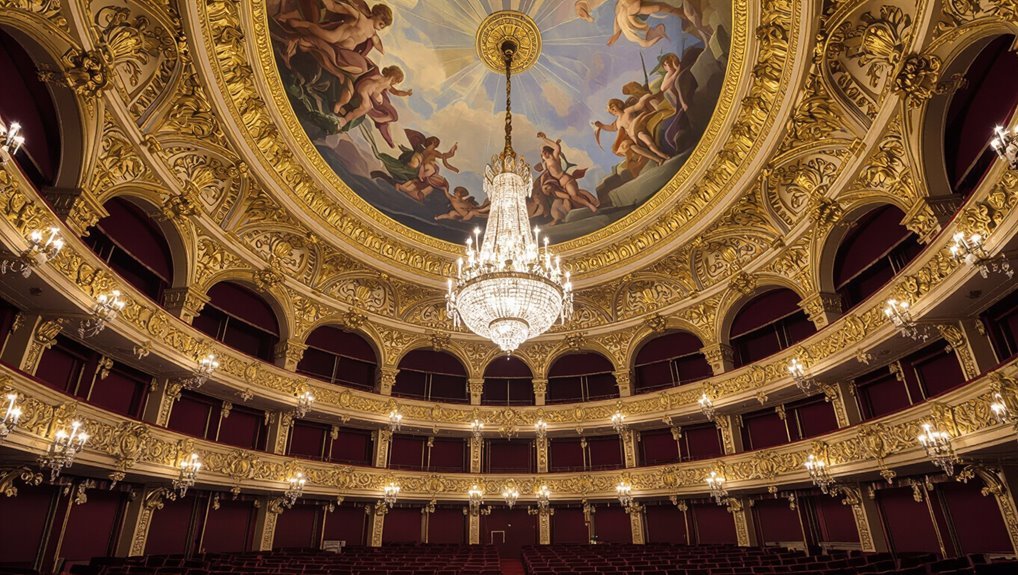
If you’re asking who painted the Palais Garnier ceiling, the original frescoes were done by Jules-Eugène Lenepveu in the late 19th century, but they were later replaced by Marc Chagall’s vibrant commission in 1964 — a striking modern intervention that now dominates the auditorium.
You’ll notice ceiling symbolism in Chagall’s panels; you’ll weigh its bold colors against Lenepveu’s academic artistic legacy.
Quick Answer: Lenepveu (Original) and Chagall (1964)
You’ve already met Lenepveu’s original frescoes and Chagall’s later replacement, so here’s the quick answer:
You’ll find Lenepveu’s grand, academic panels originally crowned the Palais Garnier, reflecting 19th-century tastes and artistic rivalry.
In 1964 Chagall introduced a colorful, modern canopy celebrating music’s myths, shifting the ceiling’s cultural significance and sparking debate about tradition versus innovation.
Why the Ceiling Matters to Visitors
Any visitor will find the Palais Garnier’s ceiling more than decoration—it frames the entire experience, drawing your gaze up and forcing a pause that changes how you hear and see the performance below.
You’ll feel the visitor experience shift: the painted vault reinforces atmosphere, anchors memories, and signals cultural significance.
That visual centerpiece guides attention, complements acoustics, and deepens your connection to the theatre’s history.
Lenepveu: Background and Training
The painted vault that shapes your visit was commissioned to artists steeped in academic tradition, and among them Pierre-Auguste-Eugène Vimar Lenepveu brought a distinctly rigorous training.
You’ll recognize Lenepveu’s influences in his classical composition, careful draftsmanship, and muted palette. His artistic training at École des Beaux-Arts and under established masters taught you to expect disciplined technique, allegorical clarity, and historical references in his work.
How Lenepveu Won the Commission
Because Lenepveu had already shown mastery of historical subjects and a reputation for reliable, academic execution, he emerged as a leading candidate for the Palais Garnier decoration and won the commission through a mix of proven skill, strategic networking, and timely submissions.
You see Lenepveu’s strategy in how he navigated artistic competition, submitting polished proposals, courting patrons, and leveraging institutional ties to secure the prominent commission.
Themes in Lenepveu’s Ceiling Panels
Having secured the commission, Lenepveu turned from networking and proposals to shaping the Opera’s visual program. His ceiling panels reflect a coherent set of themes: the triumph of France, the glory of the arts, and the moral virtues that support both.
You’ll notice symbolic motifs—allegorical figures, laurel crowns, and civic emblems—whose thematic interpretations emphasize national pride, artistic excellence, and ethical order without overt narrative clutter.
Materials and Scale of Lenepveu’s Palais Garnier Ceiling
You’ll notice Lenepveu chose durable pigments and traditional oils to withstand the opera house’s humidity and candle smoke.
Pay attention to the monumental scale—panels span meters and were painted working from scaffolds and cartoons.
Consider how those material choices and dimensions shaped both the visual impact and long-term conservation needs.
Materials And Pigments
When you step back to study Jules-Élie Lenepveu’s ceiling for the Palais Garnier, note how he paired traditional oil paints with a restrained palette suited to vast architectural scale: lead white and natural earths provided opaque grounding, while vermilion, ultramarine, and verdigris were used sparingly for focal figures and drapery.
You’ll notice careful pigment selection and historical techniques—glazing, scumbling, and layered underpainting—to guarantee durability.
Scale And Dimensions
At more than 600 square feet, Lenepveu’s ceiling for the Palais Garnier dominates the auditorium and demands both bold composition and meticulous engineering; you’ll notice how scale significance guides figure sizing, perspective, and viewing angles so ornament and narrative read clearly from below.
You assess ceiling grandeur as structural ribs, scaffold planning, and pigment layering solved practical challenges while preserving artistic impact.
Style and Technique Used by Lenepveu
You’ll notice Lenepveu’s academic allegory composition arranges figures and symbols to teach moral and historical lessons rather than just decorate.
Pay attention to how he used a layered fresco technique—building durable color and depth through successive plaster and pigment stages.
These choices show both his adherence to academic rules and his skill in manipulating surface and light.
Academic Allegory Composition
Although Lenepveu embraced the polished constraints of academic painting, he recharged allegory with clear structure and disciplined gesture, guiding your eye through idealized figures, symbolic props, and a rationalized space.
You read allegorical themes with calm logic and varied artistic interpretations.
- Balanced groupings
- Controlled gestures
- Symbolic objects
- Clear spatial planes
- Measured lighting
Layered Fresco Technique
While working on large-scale murals, Lenepveu built his frescoes in deliberate, overlapping layers that let him refine forms and control chromatic depth; you’ll see layered techniques rooted in fresco history.
You follow artistic processes that manage color application and thematic interpretation, enhancing visual storytelling.
Knowing restoration methods preserves cultural significance, so you respect cadence, material choices, and compositional planning to maintain authenticity.
How the Building Shaped Lenepveu’s Design
Because the Palais Garnier’s grand scale and theatrical program demanded a bold visual solution, Lenepveu tailored his ceiling compositions to match the opera house’s opulence and sightlines.
You see Lenepveu’s Inspiration and Architectural Influence reflected in how he balanced figures, color, light, and perspective to read from the tiers:
- focal grouping
- radial composition
- gilded accents
- exaggerated scale
- hierarchical motifs
Politics and Culture in 19th‑Century France
You’ll see how imperial patronage shaped commissions and rewarded artists who reinforced the regime’s image.
You’ll also explore how decorative programs became political symbols, signaling power and national identity to every visitor.
Finally, you’ll consider how institutions and censorship controlled which themes and styles were allowed into grand public spaces.
Imperial Patronage And Art
If you step into mid-19th‑century France, you’ll see how imperial patronage reshaped not just buildings but artistic careers and public taste: you feel imperial influence and artistic collaboration steering commissions, careers, and institutions.
- state funding focused subject matter
- salons favored government-approved artists
- workshops merged talents
- official schools guided training
- public displays reinforced prestige
Political Symbolism In Decoration
When you stand beneath a richly decorated ceiling or enter a state-funded gallery in 19th‑century France, the imagery isn’t just ornament—it’s a deliberate language of power crafted to legitimize regimes and shape public belief.
You read political allegory in mythic figures and triumphal scenes; decorations act as cultural reflection, guiding popular memory, bolstering authority, and turning aesthetic taste into a tool for national identity and consent.
Artistic Institutions And Censorship
Although artists and officials often clashed, institutions like the Académie des Beaux-Arts, state salons, and ministry-run museums shaped what you could see, teach, and sell in 19th‑century France.
You navigate a system enforcing artistic censorship while provoking institutional critique.
Consider these pressures:
- Salon juries approving history painting
- Academic curricula limiting innovation
- Museum acquisitions shaping taste
- Censorship of political subjects
- Patronage controlling commissions
Public and Critical Reaction at the Opening
Because Paris had been waiting for years, the opening of the Opera’s ceiling drew immediate, intense attention from both crowds and critics.
You witness public sentiment split between civic pride and skeptical whispers, while newspapers shape a pointed critical reception.
You feel the buzz: applause, hushed debate, and sharp reviews that set the tone for the ceiling’s early reputation.
Why Lenepveu’s Ceiling Stayed for Nearly a Century
When you look at why Lenepveu’s ceiling lasted so long, start with his original commission and the weight that official backing gave the work.
You’ll also see how institutional resistance to change — from opera administrators to preservationists — slowed any replacement.
And you can’t ignore public attachment and the comfort of tradition, which made many Parisians reluctant to let go.
Lenepveu’s Original Commission
Charles Lenepveu won the original commission for the Palais Garnier ceiling by delivering a conservative, academically polished design that aligned with the Paris Opera’s traditional tastes and the preferences of the ruling jury.
You’ll see how Lenepveu’s vision and artistic collaboration secured acceptance:
- conservative composition
- harmonious palette
- respected allegories
- committee approval
- smooth installation
You accept its authority until later debates emerged.
Institutional Resistance To Change
Lenepveu’s polished ceiling fit the Opera’s conservative tastes so neatly that the institution itself resisted change, favoring stability over artistic risk.
You’ll find institutional inertia kept his work in place: committees, funding priorities, and hierarchical taste delayed revisions.
You can’t expect rapid cultural adaptation within such a rigid bureaucracy, so pragmatic choices and procedural barriers preserved Lenepveu’s ceiling for decades.
Public Attachment And Tradition
Although visitors and Parisians often took the ceiling for granted, their emotional ownership helped keep it in place for nearly a century.
You felt tied to Lenepveu’s work through public perception and cultural significance.
You defended tradition, resisted abrupt change, and valued continuity.
- collective memory
- civic pride
- artistic identity
- touristic expectation
- ritual use
Chagall: Background and Later Career
While Marc Chagall had already built a reputation through dreamlike canvases and folkloric scenes, his commission for the Paris Opéra marked a decisive turn in his public standing and late-career output.
You’ll note Chagall’s influences—from Russian folklore to Parisian modernism—shape bold color and floating figures.
You’ll see Chagall’s techniques evolve: larger scale, theatrical composition, and confident palette choices that define his later legacy.
Why Chagall Was Chosen (1964 Commission)
You can see why the Opéra’s directors picked Chagall: his colorful, theatrical imagery matched the house’s spirit and public appeal.
His stage-like compositions and bold palette translated well to the vast ceiling surface, ensuring visibility from every seat.
That artistic vision made him a practical and symbolic choice for the 1964 commission.
Why Chagall Selected
When the Paris Opera commissioned a new ceiling in 1964, they chose Marc Chagall because his vivid, dreamlike imagery could revitalize the grand auditorium without erasing its history.
His painterly freedom and international reputation promised a bold, modernizing gesture that would captivate audiences and critics alike.
You’ll see reasons clearly:
- Chagall’s Inspiration
- theatrical themes
- color as narrative
- Artistic Collaboration
- public appeal
Artistic Vision Match
Because his work married theatrical narrative with a jewel-like palette, Chagall seemed uniquely equipped to transform the Opera’s ceiling into both stage and sky; you see how his colors animate dancers, musicians, and mythic figures so the audience feels immersed.
You embrace his artistic collaboration with the institution, recognizing the cultural symbolism that links modern imagination to Parisian tradition, making the commission feel inevitable.
The Commissioning Process for Chagall
Although the idea of a modern artist reimagining the Paris Opera’s ceiling surprised many, the administration actively sought Marc Chagall for a bold renovation in the 1960s.
You’ll learn the commissioning process shaped Chagall’s vision through negotiation, honoring historical context and patron expectations while balancing design influences and ceiling aesthetics.
Consider these factors:
- commissioning process
- artistic collaboration
- cultural significance
- design influences
- ceiling aesthetics
Chagall’s Artistic Vision for the Ceiling
When you look at Chagall’s commission story, you’ll see how his personal history and the opera’s expectations shaped the work’s scale and themes.
Notice how he used a bold, symbolic color palette to link musical motifs, mythical figures, and Parisian landmarks.
That blend of biography and color made the ceiling both a personal statement and a theatrical backdrop.
Chagall’s Commission Story
If you stand beneath Chagall’s work in the Paris Opera, you’ll feel how deliberately he reimagined the ceiling as a dreamscape rather than a historical record.
You learn about Chagall’s Inspiration and Artistic Collaboration that secured his commission. He negotiated bold freedom, blended opera icons, and respected theater tradition.
- visionary proposal
- patron support
- technical planning
- team execution
- public reaction
Symbolic Color Palette
Because Chagall wanted the ceiling to read like a set of emotions as much as a visual program, he chose colors with clear symbolic intent: cobalt blues for night and lyric mystery, vermilion and crimson for passion and drama, and luminous greens and golds to suggest myth, nature, and light. You’ll notice palette influences, color symbolism, and historical context shaping artistic choices and visual storytelling, enhancing emotional resonance and cultural significance.
| Color | Meaning | Context |
|---|---|---|
| Blue | Night, mystery | Symbolic meanings |
| Red | Passion, drama | Palette influences |
| Gold/Green | Myth, nature | Cultural significance |
How Chagall’s Ceiling Was Designed and Painted
Though Marcel Chagall brought a dreamlike palette to the Paris Opéra, he planned the ceiling with exacting care: he sketched motifs to scale, collaborated closely with architects and craftsmen, and mapped color passages so each opera scene would read clearly from the auditorium below.
You’ll follow his creative process, artistic collaboration, and design evolution through visual narrative and cultural significance:
- Chagall’s inspiration
- Color symbolism
- Historical context
- Viewer experience
- Artistic dialogue
How Chagall’s Panels Were Installed
You’ll learn how the Opera commissioned Chagall’s ceiling, from contract negotiations to the artistic brief that guided the work.
You’ll see the studio techniques his team used to prepare the large painted canvases and secure pigments for installation.
Then you’ll follow the technical steps crews took to lift, align, and fasten each panel onto the dome without damaging the architecture.
Commissioning The Project
When the Paris Opera decided to refresh its famous ceiling in 1964, they tapped Marc Chagall for a bold, modern intervention and set in motion a tightly choreographed commissioning process.
You’ll follow steps that balanced vision, logistics, and artistic collaboration:
- Proposal approval
- Design negotiations
- Fabrication scheduling
- Transport coordination
- Onsite mounting and final adjustments
Studio Preparation Techniques
Because the opera house ceiling would be replaced panel by panel, Chagall’s studio had to treat each canvas as a modular unit ready for transport and seamless installation.
You’ll see studio techniques emphasizing rigid stretchers, numbered edges, protective varnish, and reinforced frames.
Your preparation methods include careful color matching, mock-up fittings, and packing protocols so each panel arrives undamaged and aligns perfectly in sequence.
Ceiling Installation Process
One clear step guided the installation: each painted panel was hoisted, aligned, and fixed into place so the new ceiling read as a single, continuous work.
You oversee precise ceiling art placement, using proven installation techniques and careful sequencing.
- Lift panels with cranes
- Align edges and seams
- Secure anchors to structure
- Touch-up joins for unity
- Inspect lighting integration
Palette and Imagery: Lenepveu vs. Chagall
Although their commissions shared the same ceiling, Lenepveu and Chagall couldn’t be more different in color and iconography: Lenepveu favored a restrained, academic palette of earth tones and polished flesh, while Chagall exploded the space with jewel-like blues, scarlets, and whimsical figures.
You’ll notice palette symbolism and imagery contrast: Lenepveu’s orderly allegory versus Chagall’s playful, dreamlike tableaux that challenge academic taste.
Ballet, Opera, and Recurring Motifs in Both Ceilings
You’ll notice how ballet scenes are reimagined on each ceiling, shifting from realistic corps de ballet to more playful, abstracted dancers.
You’ll also spot recurring opera figures—singers, conductors, and patrons—that anchor both compositions.
Compare the motifs that echo between the two works to see how themes repeat and transform.
Ballet Scenes Reimagined
When you look up at the two Paris opera house ceilings, ballet scenes leap out as a shared language: dancers caught mid-leap, couples entwined in adagio, and corps de ballet formations that trace the same graceful geometry.
You’ll note ballet aesthetics shaping color and line, and performance interpretations guiding focus.
- synchronized poses
- flowing costumes
- stage lighting echoes
- rhythmic repetition
- spatial choreography
Opera Figures Recurring
Ballet’s energy gives way to a broader cast of operatic figures that repeat across both ceilings: lovers in embrace, heroic tenors reaching skyward, masked characters caught in mid-gesture, and attendants forming compositional anchors.
You’ll notice opera symbolism threaded through poses and props, guiding your reading of narrative.
The scenes show artistic collaboration—painter and patron shaping dramatic types so you grasp theater’s social myths without excess ornament.
Motif Echoes Between Ceilings
While each ceiling celebrates its own art—dance on one, opera on the other—you can trace the same visual vocabulary threading them together: mirrored poses, repeated prop motifs like masks and lyres, and compositional pivots where dancers and singers balance a scene.
You’ll notice motif significance and layered ceiling symbolism through:
- mirrored dancers
- repeated masks
- lyres and instruments
- balancing groupings
- recurring color accents
Public Controversies Over Making Chagall Visible
Although some Parisians hailed Marc Chagall’s 1964 ceiling as a bold, modern flourish, others soon argued you couldn’t—or shouldn’t—see it the way the artist envisioned.
You confront Chagall visibility debates tied to public opinion, artistic legacy and cultural significance.
Historical context, visitor experience and preservation efforts fuel artistic dialogue, shaping emotional response while posing interpretive challenges about access and authenticity.
How Critics Compared the Two Artists
You’ll notice critics often set the two painters against each other by contrasting their artistic styles—one theatrical and figurative, the other lyrical and modernist.
You’ll also see how contemporary reception shaped their reputations, with public opinion swinging between admiration and skepticism.
Finally, you’ll consider how each artist’s legacy and influence unfolded in later generations of painters and institutions.
Artistic Styles Compared
Because both artists tackled the same monumental commission, critics quickly zeroed in on differences in their techniques and intentions:
- artistic movements vs individual artistic innovation
- cultural influences shaping visual storytelling
- style evolution and thematic contrast
- design philosophy informed by historical context and aesthetic values
- debates over artistic legacy and lasting impact on your perception of the ceiling
Public Reception Then
Moving from their stylistic differences to how those choices landed with audiences, critics of the day lined up quickly behind competing narratives about the two painters.
You’d see immediate splits: public perception favored bold novelty while others praised classical rigor.
You follow contemporary critical reviews noting partisan papers, salons, and debates that framed one as daring and the other as disciplined, shaping immediate reputations.
Legacy And Influence
When critics assessed the long-term impact of the two artists, they framed it as a clash between innovation and continuity. You can still trace those judgments in how later generations read their work.
You’ll weigh artistic legacy, cultural impact, and historical significance while noting artistic influence on visitor experience and aesthetic appreciation.
- artistic evolution
- modern interpretations
- artistic influence
- visitor experience
- historical significance
What the Dual-Ceiling Arrangement Means Today
Though the two ceilings were born of different eras and intents, they still shape how you experience the Opéra Garnier today: the original Chagall evokes the building’s historical grandeur and mythic narratives, while the modern painted dome over the audience reflects contemporary conservation priorities and changing tastes in how public art engages viewers.
You’ll perceive dual perspectives and cultural significance that guide interpretation, tourism, and curatorial choices.
How the Ceilings Reflect Changing French Culture
If you stand beneath both ceilings, you’ll see how France’s tastes and priorities have shifted—from the ornate, allegorical programs of the 19th century to the bold, personal statements of contemporary art.
You notice ceiling symbolism and artistic evolution as cultural reflection; aesthetic shifts echo historical context, while public engagement and design innovation create ongoing artistic dialogue.
- tradition vs. modernity
- audience access
- political signals
- material choices
- narrative change
Fresco vs. Painted Canvas: Technical Comparison
Because the method you choose shapes both appearance and durability, comparing fresco and painted canvas starts with how each is made: fresco is painted onto wet plaster so pigments chemically bond as it dries, while painted canvas is applied on fabric that sits over the structure and relies on adhesives or mechanical fixation.
You’ll weigh fresco techniques’ permanence and matt finish against painted canvas’ versatility, detail, and easier replacement.
Conservation Challenges for Lenepveu’s Ceiling
When you inspect Lenepveu’s ceiling up close, you’ll immediately notice conservation challenges that go beyond surface cleaning.
You must balance historic paint layers, fragile adhesion, and access limits while choosing appropriate conservation techniques for ceiling restoration.
- flaking paint and losses
- aging varnish discoloration
- structural canvas tension
- humidity-driven deformation
- restricted scaffolding access
Conservation and Upkeep of Chagall’s Ceiling
When you visit Chagall’s ceiling, you’ll notice the conservators’ careful regular cleaning protocols that remove dust and surface grime without harming pigments.
You’ll also learn how targeted restoration techniques—like inpainting and varnish consolidation—address paint loss and aging.
Finally, you’ll see why strict long-term environmental controls for humidity, temperature, and lighting are kept to preserve the work for future audiences.
Regular Cleaning Protocols
If you want Chagall’s ceiling to retain its vivid colors and delicate brushwork, establish a regular cleaning schedule that balances gentle surface care with strict conservation standards.
You’ll follow regular maintenance and approved cleaning techniques, document each session, and limit interventions to trained conservators.
- soft dusting tools
- controlled humidity checks
- approved solvents only
- photographic records
- scheduled professional reviews
Restoration Techniques Overview
Although routine cleaning preserves surface appearance, full restoration of Chagall’s ceiling calls for a coordinated program that combines scientific analysis, minimally invasive treatments, and ongoing monitoring to stabilize pigments, mend paint losses, and protect the painting from future degradation. You’ll face restoration challenges and apply conservation techniques precisely.
| Task | Purpose |
|---|---|
| Analysis | Diagnose issues |
| Cleaning | Remove grime |
| Consolidation | Stabilize paint |
| Inpainting | Mend losses |
| Monitoring | Track changes |
Long-Term Environmental Controls
Having stabilized paint layers and addressed surface losses, you now need to lock in those gains through controlled environmental management that prevents new damage.
You’ll monitor and adjust to reduce climate impact and use sustainable practices to protect Chagall’s ceiling.
- Maintain stable temperature and humidity
- Filter airborne particulates
- Schedule minimal lighting exposure
- Use non-invasive sensors
- Plan regular condition assessments
Major Restorations Affecting the Ceilings (Timeline)
Trace the major restorations of the Paris Opera House ceilings through a clear timeline that highlights when each intervention occurred, who led it, and what changes were made to the original artwork and structure. You’ll follow a concise restoration timeline noting ceiling significance, teams, materials, and visual impact.
| Year | Lead | Change |
|---|---|---|
| 1874 | Atelier A | Cleaning |
| 1960 | Conservators | Stabilization |
| 2010 | Restorers | Repaint |
Key Dates in the Palais Garnier Ceiling History
The restoration timeline you just saw sets the stage for the key dates that mark the Palais Garnier ceiling’s history; now we’ll map the specific moments that defined its creation, alterations, and public reception.
The restoration timeline frames the key dates that shaped the Palais Garnier ceiling’s creation, changes, and reception.
You’ll see dates linked to historical context and artistic significance:
- 1874: Commission and initial designs
- 1879: Lenepveu competition win
- 1890s: Early public reactions
- 1960s: Conservation efforts
- 1964: Major repainting debate
Archival Sketches for Lenepveu: What Survives
Although many of Lenepveu’s full-scale cartoons were lost or altered over time, enough preparatory sketches survive to show how he planned the Palais Garnier ceiling’s composition and figural groupings.
You’ll find surviving sketches in museum archives and private collections; their archival significance lies in revealing compositional changes, preliminary poses, and shading experiments that document his process even where larger works no longer exist.
Chagall’s Preparatory Studies and Color Proofs
You’ll notice Chagall’s study drawings map out how figures and motifs shift across versions, giving you a clear sense of his compositional decisions.
You’ll also see how his color proofs test bold palettes and glazing techniques to predict how pigments would read under opera-house lighting.
Together, those materials show how he moved from sketch to monumental ceiling with conscious, test-driven choices.
Chagall’s Study Drawings
When preparing the Paris Opera House ceiling, Chagall worked through a rich sequence of study drawings and color proofs that reveal how he refined composition and light, layer by layer.
You trace Chagall’s inspirations and reference Lenepveu’s techniques in sketches that test scale, motifs, and mood:
- compositional thumbnails
- tonal overlays
- figure placement studies
- palette alternates
- spatial annotations
Color Proof Techniques
One set of Chagall’s preparatory studies that you’ll notice first are his color proofs, where he tested luminous washes and layered glazes to settle on the exact mood for the ceiling.
You’ll see color proofing paired with printing techniques to guarantee visual accuracy; pigment selection and color matching guided each decision.
This artistic process balanced design considerations and archival preservation for lasting impact.
Influence of Other Artists on Lenepveu
Although he trained within the academic tradition, Lenepveu absorbed ideas from a variety of contemporaries and predecessors that shaped his palette, composition, and subject choices.
You’ll notice artistic collaborations and influence analysis reveal borrowed motifs, staging, and color harmonies.
Consider these sources:
- Academic mentors
- Romantic dramatists
- École peers
- Decorative painters
- Historical painters
Influences on Chagall’s Opera Imagery
Because Chagall brought a lifetime of memories and visual motifs to the Opera commission, you can trace how folk tales, Russian Jewish traditions, and Parisian modernism shaped his theatrical scenes.
You’ll see Chagall’s inspirations in Cultural symbolism and Symbolic interpretations, where Color significance and Historical context guide Opera imagery.
This Artistic evolution heightens Emotional impact, letting you read mood, myth, and memory at a glance.
How Palais Garnier Directors Influenced Commissions
When directors at the Palais Garnier chose artists and set project parameters, they shaped not just commissions but the very stories those works could tell.
You see how Palais Garnier patrons, budgets, and politics guided artistic commissions and outcomes.
Consider these levers you’d notice:
- Patron preferences
- Budget constraints
- Political oversight
- Curatorial briefs
- Reputation management
Shifts in Public Taste, 1870s to 1960s
If you follow Parisian taste from the 1870s into the 1960s, you’ll see dramatic swings shaped by wars, technological change, and new social rhythms: you track artistic evolution as artistic movements and societal influences reshape aesthetic preferences.
Public perception shifts with cultural shifts, fostering artistic diversity, modern interpretations, and evolving audience engagement, all rooted in the era’s historical context.
Visitor Reactions: 1875 Versus 1964–Present
Tracing those shifts in taste brings us to how audiences actually reacted: visitors in 1875 and those from 1964 onward encountered the Paris Opera House with very different expectations and sensitivities.
You’ll notice contrasts in:
- visitor perceptions and audience expectations
- aesthetic preferences and artistic interpretations
- historical context and cultural significance
- emotional responses and social commentary
- architectural integration and public engagement
Scholarly Debates on Authenticity and Value
Although restorers and historians often agree the ceiling is central to the Paris Opera House’s identity, they sharply disagree about what counts as its “authentic” appearance and artistic value.
You navigate authenticity debates, balancing historical context, restoration ethics, and artistic integrity while weighing scholarly critiques, aesthetic appreciation, and public perception.
Your value assessments and art valuation influence cultural significance and future conservation choices.
How Lighting Changes Perception of Each Ceiling
When you compare natural versus artificial light in the opera house, you’ll notice colors shift and details either emerge or recede.
Pay attention to color temperature—warmer bulbs bring out golds and reds while cooler light emphasizes blues and grays.
Also watch how shadows and highlights sculpt the brushwork, changing how each ceiling’s texture and depth read from different angles.
Natural Versus Artificial
If you stand beneath a painted ceiling in daylight, you’ll notice details and colors that artificial light can’t fully reproduce — natural light brings out subtle brushwork and tonal changes while creating shifting highlights as the sun moves.
You’ll see differences when you compare natural light and artificial illumination:
- texture emphasis
- depth perception
- shadow dynamics
- color saturation shifts
- focal clarity
Color Temperature Effects
Because different light temperatures shift how pigments and tones register, you’ll see the same painted ceiling take on distinct moods under warm versus cool illumination.
You’ll notice color temperature alters perceived saturation and contrast, emphasizing certain pigments and muting others.
That change modifies overall visual impact and mood, guiding how viewers interpret depth and atmosphere without changing the artwork itself.
Shadows And Highlights
Shifts in color temperature also change where you notice shadows and highlights, and that alters how the ceiling’s forms read.
You’ll see how shadows play across reliefs and how highlights contrast brings depth, shifting focal points.
Consider these effects:
- Warm light softens molded edges
- Cool light sharpens details
- Spotlights deepen shadows
- Diffuse light flattens texture
- Angled light sculpts form
How the Ceilings Appear in Film and Media
When films and TV shows put the Paris Opera House ceiling on screen, they use it as a shorthand for grandeur, mystery, or artistic temperament, and you immediately get a sense of place without exposition.
You’ll notice film interpretations and media representations that emphasize light, texture, and scale; cinematic portrayals often highlight artistic influences to shape mood, character, or social context quickly.
Museum Exhibits and Academic Studies About Them
When you explore museum exhibits on the Paris Opera House ceiling, start with exhibition catalogues to get authoritative overviews and images.
Look at curatorial research methods next to understand how restorations, provenance, and interpretive choices were documented.
Finally, consult academic conference papers for the latest debates and specialized studies on technique, attribution, and conservation.
Exhibition Catalogues Overview
If you’re exploring exhibition catalogues on the Paris Opera House ceiling, you’ll find concise, well-illustrated studies that bridge museum displays and academic research; they document original artwork, restoration history, and curatorial choices while offering accessible scholarship for both specialists and general readers.
- exhibition significance
- catalog design
- illustrated plates
- provenance notes
- bibliography and essays
Curatorial Research Methods
Building on exhibition catalogues’ mix of images, provenance, and essays, curatorial research methods show how those elements were chosen and interpreted for display and scholarship. You’ll learn curatorial practices and exhibition strategies that shape narratives, label text, and object placement, guiding public understanding and future studies.
| Focus | Method | Outcome |
|---|---|---|
| Provenance | Archival | Context |
| Display | Spatial | Engagement |
| Text | Drafting | Clarity |
Academic Conference Papers
Although conference papers vary in form and intent, they give you a concentrated view of current scholarship on museum exhibits—presenting new research, methodological debates, and case studies that often precede fuller publication.
You’ll use them to track academic discourse and evolving research methodologies.
Benefits include:
- early results
- networking leads
- methodological suggestions
- critical debate
- publication leads
Tours and Access to View Both Ceilings
When you plan a visit, know that both ceilings—the original painted by Charles Garnier and Marc Chagall’s later work—are accessible but via different routes and ticket options.
You’ll check tours availability and viewing schedules, choose guided tours or architectural tours, and gauge ceiling accessibility for mobility needs.
Your visitor experience will balance historical significance with art appreciation, so book in advance for best access.
How to Spot Lenepveu’s Original Work in the Opera
Start by looking for the muted earth tones and classical figures clustered around the dome’s perimeter—Lenepveu’s original panels favor sober allegories and finely modeled anatomy rather than Chagall’s vivid, whimsical scenes.
So your eye should follow the ornamental friezes, lunettes, and the more restrained palette near the edges of the ceiling to spot his hand.
- Allegorical motifs
- Measured composition
- Subtle chiaroscuro
- Fresco-like brushwork
- Architectural integration
Use Lenepveu’s techniques and ceiling symbolism as your guide.
How to Appreciate Chagall’s Panels Effectively
If you want to feel Chagall’s panels, let your eyes move from the center outward and linger on the dreamlike vignettes—the luminous blues, floating figures, and playful animals—so you catch how he layers color and narrative across the dome;
stand back to absorb the overall choreography, then step closer to appreciate his loose brushwork, jewel-like pigments, and the way modern fantasy overlays the opera’s classical architecture.
Notice Chagall’s Influence and pursue your own Artistic Interpretation, comparing emotional tone, symbolic motifs, and how color choices reshape familiar scenes.
Photography Rules and Best Tips Inside the Opera
Curious about snapping photos inside the Opéra? You’ll want clear Photography techniques and Lighting considerations, plus Composition tips and Angle selection to honor the art.
Follow Visitor etiquette and jot Personal reflections quietly.
- Use compact Equipment recommendations
- Mind natural and artificial light
- Frame details and wide scenes
- Vary heights and angles
- Respect other visitors and silence
Best Times and Tickets to Avoid Crowds
Because crowds ebb with time and ticket choice, you’ll get the clearest experience by planning visits for weekday mornings or late afternoons on non-holiday dates; buy timed-entry tickets in advance and choose less popular performance days to avoid peak visitor surges. You’ll use best visiting times and ticket options wisely.
| Time | Day | Tip |
|---|---|---|
| Morning | Tue | Arrive early |
| Afternoon | Wed | Timed-entry |
| Evening | Mon | Avoid premieres |
Nearby Features That Complement the Ceilings
While you’re admiring the Opera’s painted ceilings, don’t miss the complementary sights around the building that deepen the experience: the gilded grand staircase, the ornate foyers with chandeliers, and the small museum rooms showcasing costume and set designs.
You’ll connect ceiling architecture to artistic collaborations and cultural significance through nearby exhibits and preserved details that enrich visitor experiences and reveal historical context.
- Gilded grand staircase
- Ornate foyers
- Costume and set displays
- Sculptural details
- Period furnishings
Educational Programs and Guided Talks
If you want deeper insight into the Opera’s art and history, guided talks and educational programs bring the ceilings and surrounding décor to life with expert commentary, multimedia aids, and hands-on activities for different ages.
You’ll join guided experiences led by curators, access tailored educational outreach for schools and adults, and engage in Q&A sessions that clarify motifs, techniques, and restoration choices.
Recommended Books and Articles for Deeper Reading
To deepen your understanding of the Paris Opera House ceiling and its context, start with a handful of focused reads that combine scholarship, restoration accounts, and high-quality images.
You’ll find recommended readings that pair scholarly articles with books on art history, cultural context, artistic influences, preservation practices, visitor engagement, and comparative analysis.
- Conservation reports
- Monographs on ceiling painting
- Scholarly articles collection
- Cultural context essays
- Visitor engagement studies
Common Myths About Who Painted the Opera Ceiling
Curious who really painted the Paris Opera ceiling? You’ll see myths debunked: it wasn’t a single mysterious painter and popular tales mix up dates. You should watch for historical inaccuracies and legends that overstate authorship. Check sources, question sensational claims, and focus on documented commissions, restorations, and artists’ roles.
| Claim | Truth | Source |
|---|---|---|
| Single painter | False | Archives |
| Secret patron | False | Letters |
| Lost original | False | Conserv. reports |
What the Dual Ceilings Tell Us About French Art History
When you compare the two ceilings of the Paris Opera—the original painted decoration by Jules‑Eugène Lenepveu and the later, more famous work by Marc Chagall—you see a compact history of French art shifts: academic classicism giving way to modernism, shifting patronage priorities, and changing ideas about public taste and theatrical spectacle.
Comparing Lenepveu’s academic ceiling with Chagall’s modern fresco reveals France’s art-history in miniature.
You trace artistic evolution, cultural significance, and artistic legacy through dual perspectives.
- French art
- artistic dialogue
- visual storytelling
- historical context
- cultural significance
Frequently Asked Questions
Can Visitors Access Lenepveu’s Original Ceiling Panels Today?
Yes — you can see Lenepveu’s original ceiling panels in parts: guided tours and special access let you view restored sections; ongoing ceiling restoration and strict art preservation measures protect these panels while limiting general access for conservation.
Were Any Sections of Lenepveu’s Ceiling Preserved Elsewhere?
Yes — you’ll find fragments quietly relocated: some of Lenepveu’s panels were removed and housed in museums or archives during ceiling restoration, preserving their historical significance so researchers and visitors can still glimpse the original artistry.
Did Chagall Receive Payment or Royalties for the Commission?
Yes — you received payment for the commission after commission negotiations, and Chagall’s artistic influences shaped the billed work; you didn’t get ongoing royalties, but the upfront fee recognized your creative contribution and career stature.
Are Guided Restoration Workshops Ever Open to the Public?
Like stepping into a painting, yes — you can often join guided restoration workshops open to the public, where you’ll get hands-on public access to conservation labs and learn traditional and modern restoration techniques from experts.
Have Either Ceiling Panels Been Loaned to Other Museums?
Yes — you can find ceiling panels lent under strict loan agreements; institutions display them in museum exhibitions, so you’ll see rotating loans, detailed condition reports, and conservation terms before pieces travel internationally.
Conclusion
So you wandered beneath the glitter and wondered who’d dared decorate heaven for the ballet-obsessed: Lenepveu’s pompous fresco and Chagall’s joyful repainting. You’ve seen how commissions, rivalries, and taste swings turned a ceiling into cultural theater. Now, when you crane your neck, mock the art-world drama you’ve just learned—smile at imperial seriousness and modern whimsy—and enjoy knowing the roof over your head has its own scandalous encore.
