
Who Painted the Ceiling of the Vatican? the Story Behind Michelangelo
You’re looking at Michelangelo Buonarroti: a sculptor turned painter who, under Pope Julius II’s commission, painted the Sistine Chapel ceiling from 1508–1512. He worked on scaffolding, using fresco buon and dramatic foreshortening to create scenes like the Creation of Adam, transforming papal imagery and artistic standards. He’d resisted the job at first, faced technical and ethical debates still discussed today, and if you keep going you’ll uncover how this work reshaped art, faith, and legacy.
Quick Answer: Who Painted the Vatican Ceiling?
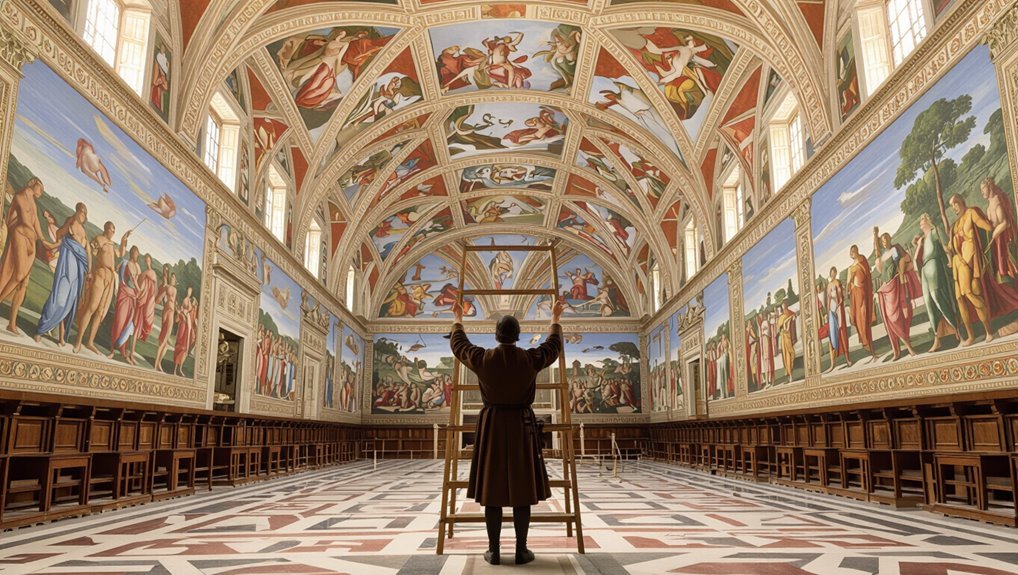
Who painted the Vatican ceiling? You should know Michelangelo Buonarroti executed it between 1508–1512, reshaping Vatican history with monumental frescoes.
You’ll notice Michelangelo’s techniques: fresco buon and dramatic foreshortening, sculptural figures, and vivid anatomical detail.
Though commissioned by Pope Julius II, you’ll view the ceiling as Michelangelo’s bold artistic statement that transformed papal imagery and artistic standards.
Why the Sistine Chapel Mattered to Renaissance Rome
Although it functioned as a papal chapel and a meeting place for Church business, the Sistine Chapel became the visual manifesto of Renaissance Rome—showing you how art, theology, and papal authority could be fused to shape public image, educate the faithful, and assert Rome’s cultural supremacy across Europe.
The Sistine Chapel: a visual manifesto where art, theology, and papal power sculpted Renaissance Rome’s global prestige.
- Symbol of Renaissance significance.
- Model of Artistic patronage and doctrinal teaching.
- Stage for papal diplomacy and civic identity.
Michelangelo Before the Sistine Ceiling: Sculptor, Not Painter
When you think of Michelangelo before the Sistine Chapel, picture a master sculptor whose chisels and marble defined his reputation long before he touched a brush; his fame rested on monumental works like the Pietà and David, where he controlled form, volume, and vantage with a sculptor’s eye rather than a painter’s palette.
You’ll see his sculptural influence shaping compositional choices, marking an artistic shift from carved solidity to painted illusion.
The Commission: How It Started and Michelangelo’s Resistance
Because Pope Julius II wanted a bold statement for the restored chapel, he personally asked Michelangelo in 1508 to paint the Sistine ceiling—a request that shocked the artist, who’d long seen himself as a sculptor, not a fresco painter.
Summoned by Julius II in 1508, Michelangelo—reluctant sculptor—faced the shocking challenge of painting the Sistine ceiling
You learn the commission context and artist reluctance through:
- hesitant refusal
- practical challenges
- eventual acceptance and uneasy determination.
What’s on the Ceiling: Key Scenes and Central Iconography
Look up and you’ll see a sequence of Creation scenes that narrate the Genesis story in bold, dramatic gestures.
You’ll also find central figures—God, prophets, and sibyls—framed by symbolic motifs like the ignudi and medallions.
As we go through them, you’ll spot how image and symbol work together to shape the ceiling’s theological program.
Creation Scenes
Anyone stepping beneath the Sistine Chapel ceiling is immediately met by a series of Creation scenes that organize the composition and announce its theological program:
You’ll read Creation symbolism and Divine intervention framed by Narrative structure and Cosmic themes, blending Artistic inspiration with Mythological references and Human emotion to deliver Visual storytelling and Religious significance with lasting Cultural impact.
- Creation act
- Order from chaos
- Life’s emergence
Central Figures and Symbols
When you tilt your head up, the Sistine ceiling presents a constellation of central figures and symbols that steer the viewer through its theological narrative:
| Adam | Eve | God |
|---|---|---|
| Prophets | Sibyls | Ancestors |
| Creation | Fall | Redemption |
You’ll spot iconic figures whose gestures carry symbolic meanings, guiding you from divine act to human consequence and hope.
Fresco Technique and Why Painting a Curved Ceiling Was Hard
Fresco painting used by Michelangelo meant applying pigment to wet plaster so the color chemically bonded as it dried. That process demanded speed, precision, and exact planning.
You faced fresco challenges on curved surfaces that warped perspective and drained time. You’d to:
- Preplan cartoons precisely
- Mix pigments for fast adhesion
- Pace daily plaster sections
Scaffolding, Assistants, and Daily Life Under the Ceiling
Planning the plaster and pigments only tells part of the story; you also needed a system to reach and work on the ceiling itself.
You managed scaffolding logistics: timber platforms tied to walls, pulleys, and movable bays.
Assistant roles were essential—mixing intonaco, passing pigments, cleaning brushes, stabilizing ladders—so you could paint long hours, conserve fresco freshness, and keep the worksite orderly.
Design Choices: Composition, Anatomical Innovation, and Color
Although the ceiling demanded engineering and endurance, its visual impact came from deliberate design choices: you arranged scenes to guide the viewer’s eye, stretched and posed figures for dramatic readability from below, and selected a palette that balanced naturalism with luminous symbolism.
Though the ceiling required engineering and endurance, its drama came from composition, posing, and a luminous, symbolic palette.
You emphasized anatomical accuracy and compositional balance through:
- Foreshortening to heighten drama
- Grouping for rhythmic flow
- Color contrasts to signal hierarchy
Contemporary Reactions: Praise, Criticism, and Controversy
How did viewers first respond when Michelangelo revealed his ceiling? You’d see immediate awe mixed with debate: artistic reception praised virtuosity, while critical analysis questioned iconography and technique.
Public perception shifted as clergy and citizens debated meaning within historical context. The cultural impact grew through travel and letters, shaping artistic legacy that provoked admiration, rivalry, and ongoing discussion.
Restoration and Conservation: Debates That Changed Our View
When you walk under the Sistine Chapel now, you’ll notice brighter colors that sparked fierce cleaning controversies about whether restorers removed original paint or harmful grime.
You’ll also face the color restoration debate: should conservators aim to recover the artist’s presumed intent or preserve the aged appearance viewers have long known?
These arguments reshaped how scholars and the public judge authenticity and intervention.
Cleaning Controversies
If you step back from the Sistine Chapel’s dazzling blues and then learn they were revealed by a contentious cleaning, you’ll see how restoration can rewrite art history.
You confront cleaning methods and restoration debates that pit preservation against change.
Consider choices:
- Solvent versus mechanical cleaning
- Removing accretions or preserving patina
- Who decides authenticity?
You’ll weigh ethics, evidence, and taste.
Color Restoration Debate
Because color guides what we think a painting meant, the debate over restoring original hues has put conservators and critics at odds: you weigh scientific cleaning that revives pigments against risks of altering intent.
You consider color perception studies, historical records, and pigment analysis, balancing fidelity to the artist’s vision with conservation ethics.
You debate whether preserving patina honors or harms artistic integrity.
How the Ceiling Shaped Michelangelo’s Career and Legacy
Though Michelangelo had already made a name as a sculptor, painting the Sistine Chapel ceiling transformed how patrons, peers, and history saw him, turning a master of marble into a legend of the High Renaissance.
You witness Michelangelo’s transformation and artistic innovation; the ceiling forced you to reassess sculpture, painting, and status.
- Reputation elevated
- Technique expanded
- Patronage secured
Why the Sistine Ceiling Still Matters for Art and Culture
Endurance is part of the Sistine Ceiling’s power: when you stand beneath Michelangelo’s frescoes, you’re confronting ideas about faith, human potential, and artistic ambition that still speak across centuries.
You feel its cultural significance shaping how societies value sacred art, and you trace artistic influence in painting, sculpture, and visual storytelling.
It still challenges creators and audiences to imagine scale, craft, and meaning.
Frequently Asked Questions
Did Michelangelo Work on the Sistine Chapel at Night?
Yes, he sometimes worked at night; you’ll imagine Michelangelo doing night painting to meet deadlines, facing artistic challenges like poor lighting, physical strain, and dwindling supplies while endeavoring for brilliance high on the chapel ceiling.
How Long Did It Take to Paint Each Individual Panel?
Each individual panel took you roughly weeks to months, depending on panel techniques and artistic challenges; you’d plan cartoons, apply wet fresco, paint quickly before drying, then retouch details later as plaster set and light varied.
Were Any Pigments Imported From Overseas for the Ceiling?
Yes — you’ll find pigment sources included imported ultramarine and rare lapis-derived blue; you’ll note local earths too. Artistic techniques required careful mixing and application in fresco, so pigments’ properties shaped Michelangelo’s methods.
Did Michelangelo Include a Self-Portrait on the Ceiling?
Against the grain, yes—you’ll spot a reputed self-portrait in Saint Bartholomew’s flayed face; you’ll read self portrait symbolism there, and you’ll see how that choice reinforces Michelangelo’s enduring artistic legacy and bold, personal statement.
How Much Was Michelangelo Paid for the Commission?
You were paid modestly by church officials: commission details show Michelangelo received a fixed stipend and extra payments totaling roughly 3,000 to 4,000 ducats over years; artist earnings reflected pensions, bonuses, and in-kind support.
Conclusion
You stand beneath a sky of painted muscle and light, where God’s finger almost brushes Adam’s and your breath catches. Michelangelo’s painted vault still hums with the strain of his chisels and the hush of prayer, a fresco that turned stone-born genius into airborne drama. It reminds you that human toil can lift the sacred into sight, and that beauty, once released on plaster, keeps calling us to look up and wonder.
