
Who Painted the Ceiling of the Palace of Versailles? The Artist Behind the Masterpiece
Charles Le Brun designed and directed the grand ceiling programs at Versailles, and you’ll usually find his hand credited as the master behind those monumental allegories. He ran the royal workshop, laid out the compositions glorifying Louis XIV, and oversaw teams of painters, plasterers, and architects who executed the work across the Hall of Mirrors and the state apartments. You’ll learn how his role blended design, political messaging, and collaborative craft if you keep exploring further.
Quick Answer Who Painted the Ceiling of the Palace of Versailles?
You’ll find that Charles Le Brun was the primary artist responsible for the main painted ceilings at Versailles.
He led a large workshop that executed grand allegorical scenes celebrating Louis XIV, completed in the late 17th century (chiefly the 1660s–1680s).
This quick ID gives you the who, what, and when to guide further exploration.
Direct Identification of the Primary Artist(s)
Although several hands contributed over decades, the primary artist most associated with the main ceilings of the Palace of Versailles is Charles Le Brun, who led and painted major decorative schemes under Louis XIV’s direction.
When you ask who painted the ceiling of the Palace of Versailles, credit Le Brun as director and principal painter, though workshops and collaborators executed many sections under his designs.
One-sentence summary of the work and date
While Charles Le Brun designed and directed the major ceiling schemes at the Palace of Versailles and painted key sections between the 1660s and 1680s, his workshop and several collaborators executed much of the work under his supervision.
You can say the celebrated Hall of Mirrors and other grand ceilings were conceived by Le Brun around 1661–1685, executed collaboratively, and celebrate Louis XIV’s reign.
Historical Context Why the Ceiling Was Commissioned
To understand why the ceiling was commissioned, you should start with Louis XIV’s vision of Versailles as the stage for his absolute monarchy.
You’ll see the ceiling served political and cultural aims, projecting royal power and France’s artistic leadership across Europe.
Also consider how 17th-century French artistic trends—grand allegory, classical references, and collaboration between painters and architects—shaped the commission.
Louis XIV’s Vision for Versailles
Because Louis XIV wanted Versailles to project absolute monarchy and royal grandeur, he turned palace decoration into political theater that would communicate his power to every visitor.
You see how he directed artists, chose mythic scenes, and controlled iconography to glorify his reign.
You recognize the ceiling as a crafted statement—an orchestrated image designed to awe, legitimize rule, and shape perception of the monarch.
Political and cultural significance of ceiling decoration
Having shaped Versailles as a stage for his monarchy, Louis XIV commissioned ceiling decoration that went beyond mere ornament: it had to perform politically and culturally.
You’ll see imperial myths, allegories of order, and glorification of royal authority designed to impress visiting diplomats and subjects.
The painted heavens reinforced centralized power, promoted cultural supremacy, and legitimized policies by linking the king to divine favor and timeless destiny.
Artistic trends in 17th-century France
Although rooted in classical models, 17th-century French art moved toward a distinctly courtly grandeur that suited Louis XIV’s political theater: you see artists emphasizing monumental allegory, theatrical perspective, rich coloration, and harmonious composition to glorify the monarch.
- Monumental allegory
- Theatrical perspective
- Rich coloration
- Harmonious composition
The Main Artist: Charles Le Brun Life and Role
You’ll trace Charles Le Brun’s rise from formal Academy training to becoming France’s dominant court artist, noting how his biography shaped his vision.
Appointed Premier Peintre du Roi, he didn’t just paint—he directed the ceiling schemes, coordinated workshops, and set the program’s iconography.
As you examine the ceilings, watch for his bold allegorical compositions, dramatic foreshortening, and controlled color palette that mark a unmistakable Le Brun signature.
Biography and artistic training
Charles Le Brun rose from provincial beginnings to become the artistic director of Louis XIV’s grand program, and his life shaped the style and symbolism of the Palace of Versailles.
You’ll learn he trained in Paris and Rome, studied classical antiques, and absorbed Renaissance masters.
His rigorous workshops taught draftsmanship, composition, and allegory, so you can see how technique and ideology merged in his monumental projects.
Le Brun’s appointment as First Painter to the King
When Louis XIV needed a single artistic voice to translate royal ideology into painting and decoration, he named Le Brun First Painter to the King, a post that put him at the center of Versailles’ visual program and gave him wide authority over design, commissions, and apprentices.
You’ll find his influence shaped artistic standards, court taste, and institutional practices, and you’ll see him directing workshops and mentoring protégés.
His role in designing and supervising the ceiling projects
Le Brun coordinated the ceiling programs at Versailles with the precision of an architect and the imagination of a painter, turning complex iconographic schemes into executable plans for large teams.
You’ll see how he:
- Drafted detailed cartoons and color schemes.
- Assigned scenes to specialists.
- Supervised scaling and perspective.
- Inspected progress, ensuring royal iconography stayed consistent.
Signature stylistic features in the Versailles ceiling
Although you might first notice the grand allegories and gilded drama, Le Brun’s ceilings reveal a consistent visual grammar: a flattened pictorial depth that prioritizes legibility from below, rhythmic groupings of figures, and a controlled palette that ties mythic scenes to royal symbolism.
You’ll spot heroic poses, clear hierarchy, sculptural modeling, and ornamental frames that guide your eye and reinforce Louis XIV’s power.
Other Key Contributors and Collaborators
You’ll meet the painters and plasterers who actually executed Le Brun’s vision and learn how their hands shaped the ceilings’ final look.
You’ll also see how architects, patrons, and workshops coordinated the project’s scale and logistics.
Finally, you’ll explore the clear division of labor between design and execution that made such a monumental collaboration possible.
Painters and plasterers who executed the work
While Charles Le Brun designed the grand program for the palace, a skilled network of painters and plasterers brought his visions down to the scaffold and brush.
You’d meet journeymen who mixed pigments, plasterers who molded stucco frames, and teams coordinating scaffolds and varnishes.
They executed Le Brun’s cartoons with care, speed, and craftsmanship.
- Pigment mixers
- Stucco sculptors
- Scaffolding teams
- Finishing painters
Architects, patrons, and workshops involved
Beyond the painters and plasterers who physically realized Le Brun’s cartoons, a wider circle of architects, royal patrons, and permanent workshops shaped the ceiling’s concept and execution.
You’ll see architects like Mansart coordinating structural integration, patrons—especially Louis XIV—directing iconography, and state-run ateliers providing materials, molds, and skilled assistants, ensuring coherence, supply, and the political messaging embedded in the decoration.
Division of labor: design versus execution
Although Le Brun set the ceiling’s overarching program, execution depended on a tight division of labor: designers established composition, scale, and allegory, while craftsmen, journeymen, and specialist workshops translated those ideas into paint, stucco, and gilt.
You’ll see that Le Brun coordinated, but you relied on skilled hands: assistants mixed pigments, gilders applied leaf, and sculptors completed ornamental frames.
The Ceiling(s): Major Rooms and Their Artists
You’ll first look at the Hall of Mirrors, where the architecture and multiple painters collaborated to shape its famed ceiling vistas.
Then you’ll move through the King’s State Apartments to examine each room’s distinct ceiling schemes and the artists commissioned for them.
Finally, you’ll note standout panels—who painted them and the myths or royal events they portray.
Hall of Mirrors design and contributors
One of the most celebrated spaces in Versailles, the Hall of Mirrors owes its dramatic impact to a tight collaboration between architects, decorators, and court artists who translated Louis XIV’s propaganda into glittering stone, glass, and paint.
You’ll notice Mansart’s architecture framing Le Brun’s allegorical paintings, glassmakers’ mirrors amplifying light, and skilled sculptors adding ornamental stucco, all coordinated to glorify the Sun King.
King’s State Apartments specific ceilings and artists
When you move through the King’s State Apartments, each ceiling announces a different facet of royal power—myth, victory, piety, or daily rule—painted and sculpted by a roster of France’s leading artists who worked to Louis XIV’s visual program.
You’ll notice cohesive iconography, varied palettes, and collaborative workshops coordinating painters, stuccoists, and gilders.
- Grand Apartments coordination
- Apollo and allegory themes
- Studio collaboration methods
- Restoration and authorship studies
Notable individual panels and who painted them
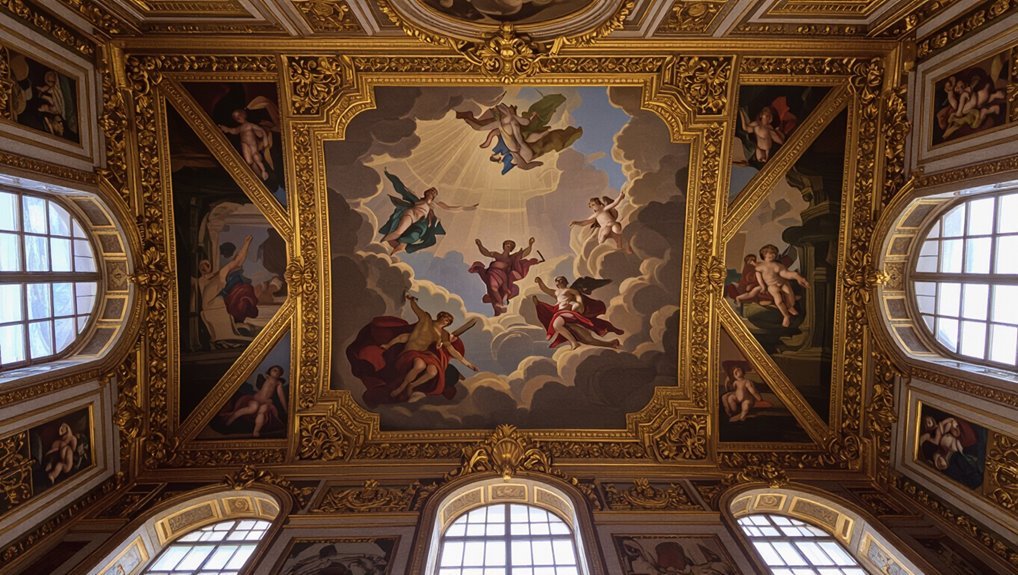
Moving from the overall program and workshop practices, it’s helpful to look at specific panels to see how individual hands shaped the narrative on the ceilings.
You’ll notice Le Brun’s bold central compositions, Bon Boulogne’s delicate allegories, and Coypel’s dramatic foreshortening.
Other panels by Desportes, Jouvenet, and Mignard contribute varied color, mythic detail, and expressive figures that unify Versailles’ visual story.
Artistic Analysis Themes, Style, and Techniques
You’ll notice how mythological and allegorical figures dominate the ceiling narratives, with symbolic meanings tied to royal power.
Pay attention to the bold compositions, dramatic perspective and foreshortening that make figures seem to float above you.
Also consider the fresco and paint materials used and how past restorations have altered colors and surface texture.
Mythological and allegorical themes depicted
Symbolism guides every figure and gesture on the palace ceiling, and you can read those choices as a visual language that praises Louis XIV’s reign.
You’ll spot gods, goddesses, and heroic personifications—Apollo’s sun, Victory crowning the king, and allegories of Peace, Abundance, and Authority—each reinforcing royal virtues, divine right, and triumphant statecraft through familiar myths that legitimize and glorify Bourbon power.
Composition, use of perspective, and foreshortening
Having established how myth and allegory justify Louis XIV’s rule, look next at how composition and daring perspective physically assert that message across the palace ceiling.
You’ll notice radiating arrangements that center the monarch, dramatic diagonals guiding your eye, and calculated foreshortening that makes figures seem to hover above you.
These devices collapse distance, amplify authority, and turn architecture into theatrical spectacle.
Materials and fresco/paint techniques used
1 key to the ceiling’s impact is the materials and fresco techniques the artists chose: they mixed wet plaster frescoes with oil glazes and tempera details to get both the durability fresco demands and the luminous color and fine modeling oil allows.
You’ll notice surface layering, pigment selection, sinopia underdrawing, and careful drying control that preserved crisp chiaroscuro.
- Layered fresco base
- Oil glazes
- Tempera highlights
- Sinopia sketches
Restoration history and impact on original appearance
Those material choices and layered techniques you just examined set the stage for how restorers have worked on the ceiling over centuries: conservation decisions—from cleaning methods to reintegration of losses—have altered color balance, surface sheen, and the visibility of fine brushwork.
You’ll notice earlier varnishes darkened contrasts; recent removals revived subtleties but sometimes erased original glazes. Each intervention reshapes your reading of the artist’s intent.
Controversies, Misattributions, and Common Misconceptions
You’ll notice several ceiling paintings long credited to Charles Le Brun are now questioned or reassigned to his workshop or collaborators.
Historians still argue about evidence and motive, but recent archival finds and technical analyses are shifting opinions.
To check authorship yourself, look for documentary records, stylistic comparisons, and scientific tests like pigment and underdrawing analysis.
Works wrongly attributed to Le Brun
Although Charles Le Brun’s name is often stamped on the grandest decorations at Versailles, a number of ceiling paintings and design elements were actually executed by his pupils, collaborators, or later restorers—and people still credit Le Brun by default.
- You may mistake Pierre Mignard’s touches for Le Brun’s.
- You’ll see François Le Moyne’s panels misattributed.
- You might blame Le Brun for later 19th-century restorations.
- You’ll encounter studio assistants’ work labeled as his.
Debates among historians and recent scholarship
When scholars reexamine Versailles’ ceilings, they challenge long-held attributions and force you to rethink Le Brun’s dominance: new archival finds, pigment analyses, and stylistic comparisons have revealed collaborations, later interventions, and attribution errors that complicate the narrative.
You’ll confront heated debates over authorship, contested restoration records, and persistent myths, requiring careful weighing of evidence rather than accepting traditional attributions at face value.
How to verify authorship in historical ceiling paintings
Because ceilings are layered records—sketches, paint, restorations, and later overpaint, you can’t rely on signature or tradition alone to verify authorship; you need a toolkit of documentary research, technical analysis (pigments, binders, underdrawing), and stylistic comparison, all weighed against the work’s conservation history.
You should cross-check archives, commission infrared and pigment tests, consult specialists, and remain open to revised attributions when evidence shifts.
Comparison Versailles Ceilings vs. Other Baroque Palaces
You’ll notice how Versailles’ vast, propagandistic ceilings contrast with other Baroque palaces in scale, theme, and artistic teams. Below is a quick comparison highlighting scale, theme, artists, technique, and short examples for reference. Use this as a springboard for examining how Versailles both mirrors and diverges from counterparts like the Vatican and the Royal Palace of Madrid.
| Criterion | Example |
|---|---|
| Scale | Versailles: monumental; Vatican: equally grand but more centralized |
| Theme | Versailles: royal propaganda; Vatican: sacred narratives |
| Artists | Versailles: Le Brun-led workshop; Vatican: multiple masters (e.g., Michelangelo earlier) |
| Technique | Versailles: oil on canvas glued to ceiling + frescoes; Vatican: fresco-dominant |
| Short examples | Versailles vs. Vatican; Versailles vs. Royal Palace of Madrid |
Criteria: scale, theme, artists, technique
Although Versailles shares Baroque grandeur with other European palaces, its ceilings stand apart in scale, thematic ambition, choice of artists, and technical execution; comparing these four criteria reveals how Versailles turned ceiling painting into a political spectacle rather than merely decorative art.
You’ll note monumental dimensions, allegories glorifying royal power, selectively commissioned masters, and advanced fresco and oil-on-plaster techniques that maximize illusion and durability.
Short comparative examples (e.g., Vatican, Royal Palace of Madrid)
When you stand under the painted skies of Versailles, the difference from other Baroque ceilings becomes immediately clear: you notice Versailles’ grand political allegory and lighter palette versus the Vatican’s dense theological narratives by Michelangelo and later Baroque frescoes.
In Madrid’s Royal Palace, ceilings echo royal pomp but favor tighter compositions and Spanish colorism, so you see national flavor shaping similar monumental ambitions.
Preservation Challenges and Restoration Efforts
You’ll need to evaluate both environmental hazards like humidity and pollution and human-caused wear from tourism when examining threats to the ceiling.
Note key restorations — for example major campaigns in the 19th century, the 1950s–60s, and the thorough 2009–2012 project — and their specific goals and results.
Also look at how modern conservation techniques, such as climate control, non-invasive imaging, and reversible consolidation materials, are being applied at Versailles.
Environmental and human-caused threats
While the ceiling’s painted surface has survived centuries, it now faces a range of environmental and human-caused threats that demand urgent attention.
You must guard against humidity fluctuations, pollutant deposition, and light damage that fade pigments. Vibration from tourism and structural stress risk flaking.
Pest activity and inappropriate cleaning accelerate loss. You should prioritize monitoring, controlled climate, visitor limits, and trained conservation interventions.
Major restorations: dates, goals, outcomes
Because the ceiling’s scale and delicate paint have faced centuries of wear, major restorations have been planned and executed at key moments to halt deterioration and recover lost detail.
- 19th-century campaigns: structural stabilization, grime removal, aesthetic reintegration.
- Early 20th-century: consolidations after humidity damage, pigment recovery.
- Post-war: emergency repairs, protective measures.
- Late 20th-century: thorough cleaning, reintegration of losses, public reopening.
Modern conservation techniques applied at Versailles
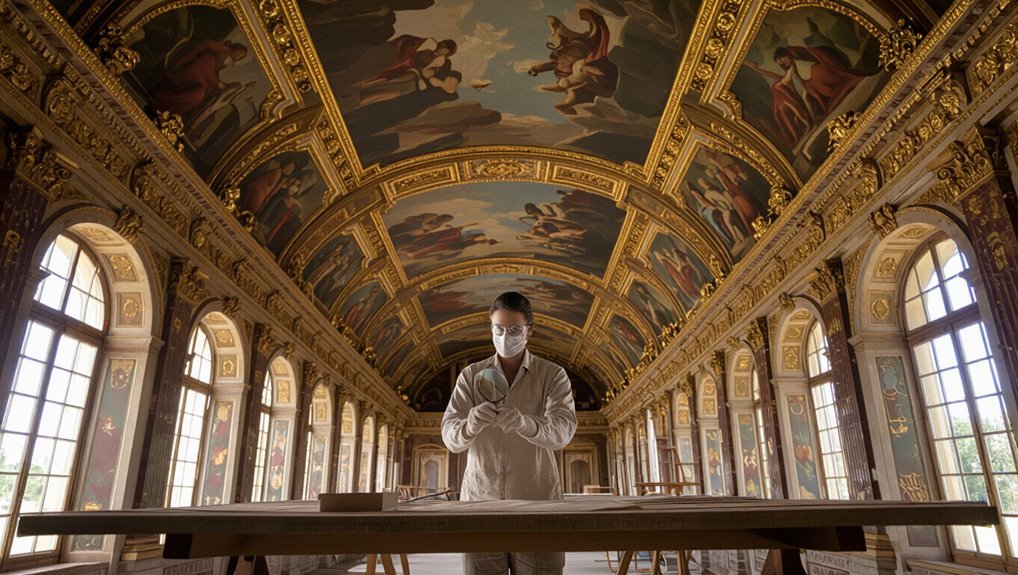
Having reviewed the major restoration campaigns that stabilized and cleaned the ceiling over two centuries, we can now look at how modern conservation techniques have changed the practice and outcomes.
You’ll see noninvasive imaging, moisture and pollutant monitoring, reversible adhesives, laser cleaning, and micro-sampling guiding decisions.
These methods prolong pigments, reduce interventions, and let conservators document treatments precisely while balancing access and long-term preservation.
How to See the Ceilings Today Visitor Guide
When you visit, start with the Hall of Mirrors and the King’s Grand Apartments for the most impressive ceilings. Follow a clockwise route to avoid backtracking.
Check opening times, book a timed entry or guided tour, and note photography restrictions to protect the artwork.
If you can’t be there in person, use the palace’s virtual tours and high-resolution image archives to study details up close.
Best rooms to view and recommended routes
If you want to see the palace’s most stunning ceilings without spending all day inside, plan a focused route that hits the highlights first: the Hall of Mirrors, the King’s and Queen’s State Apartments, and the Hercules Salon.
Move steadily, pause under key panels, and note different artists’ styles.
- Hall of Mirrors
- King’s State Apartment
- Queen’s State Apartment
- Hercules Salon
Timing, tours, and photography rules
Because the Palace gets busiest mid-morning, aim to arrive either right at opening or late afternoon to see the ceilings with fewer crowds and better light.
Join a timed guided tour for contextual commentary and faster access to signature rooms.
Photography without flash is allowed; tripods and commercial equipment usually require permission.
Check seasonal schedules and book skip-the-line tickets to optimize your visit.
Virtual resources and high-resolution imagery
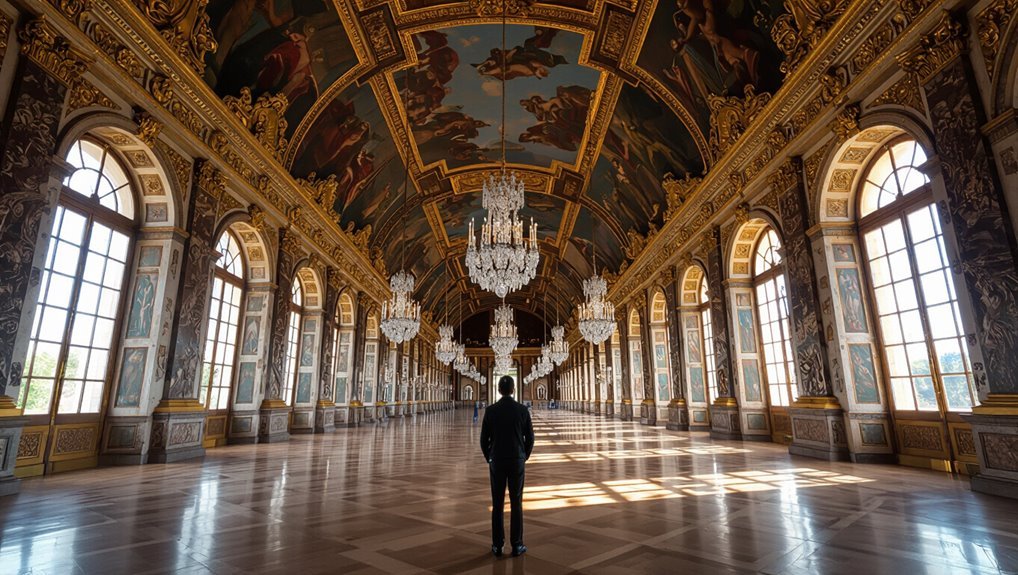
While you may not be able to stand beneath every painted vault, you can explore the Palace’s ceilings in remarkable detail from home: use the official Versailles website’s virtual tours, zoomable high-resolution images, and curated gallery views to study brushwork, composition, and gilding.
Supplement with museum databases and scholarly image repositories for captions, conservation notes, and comparative close-ups you won’t see on-site.
Common Mistakes When Discussing Versailles’ Ceiling Paintings
Don’t assume a single hand painted the ceilings — you’ll overlook the many collaborators and workshop assistants who shaped the work.
Don’t read the allegories as literal stories; they’re layered political and mythological messages that need context.
Don’t ignore later restorations, since repainting and repairs have altered how the originals now look.
Oversimplifying authorship and collaboration
When you point to a single name as the author of a Versailles ceiling, you erase the many hands and decisions behind it: painters, assistants, cartoonists, gilders, and court patrons all shaped the final work.
You should credit workshop systems, atelier hierarchies, and royal directives; recognize restorers’ interventions; and avoid attributing creative choices solely to a celebrated master when collaboration defined the outcome.
Misreading allegories and symbols
If you rely on modern assumptions or a single visual cue, you’ll often misunderstand what Versailles’ ceiling allegories were meant to convey.
You should read symbols in historical context, wary of later reinterpretations. Check patron intent, period iconography, and political messaging.
Contrast sources and avoid projecting contemporary morals.
- Patron intent
- Period iconography
- Political messaging
- Comparative sources
Ignoring restoration alterations
Although restorations aim to preserve, they can also reshape what you think you see on Versailles’ ceilings: overpaint, varnish removal, or past repair campaigns have altered colors, details, and even compositional clarity.
Tips for Further Research and Reliable Sources
Start with authoritative books, museum catalogues, and peer-reviewed articles—then check museum publications from Versailles and related institutions for up-to-date scholarship.
Use academic databases (JSTOR, Project MUSE) and digitized primary sources (archives, inventories, and correspondence) to verify facts.
When you cite paintings or archival records, include artist, title, date, collection/archive, and accession or document numbers for precise reference.
Recommended books, articles, and museum publications
When you’re diving deeper into the artists who painted the ceilings at Versailles, start with a handful of authoritative sources that combine solid scholarship with rich visuals.
You’ll want books by specialists, exhibition catalogs, museum publications, and a few peer-reviewed articles to get context, technique, and provenance.
- Monographs by leading art historians
- Versailles museum catalogs
- Exhibition catalogs with high‑res plates
- Peer‑reviewed journal articles
Academic databases and primary sources to consult
After you’ve gathered monographs, catalogs, and key articles, turn to academic databases and primary sources to verify attributions, dates, and original documentation.
Search JSTOR, Project MUSE, ARTstor, Gallica, and Europeana for journals, high-resolution images, and digitized manuscripts.
Consult archival inventories, correspondence, royal payment records, and early exhibition catalogs to confirm authorship, commission details, and restoration histories.
How to cite artworks and archival records
Because archival records and artworks follow different conventions, you’ll need clear, source-specific citation practices to guarantee provenance and attribution are traceable.
For artworks, include artist, title, date, medium, dimensions, current location, accession number, and image credit.
For archives, cite creator, title, date, collection name, box/folder, repository, and identifier.
Follow a standard style (Chicago, MLA) and keep originals or stable URLs.
FAQ
You probably have specific questions about who painted which ceilings and how original those works are. Below are the most common queries visitors and researchers ask; use them to guide your next steps.
If you want, follow up on any item for quick answers or sources.
- Who exactly painted the Hall of Mirrors ceiling?
- Did Charles Le Brun paint every ceiling at Versailles?
- How can I find out which artist painted a specific ceiling panel?
- Are the ceiling paintings original or later copies/restorations, and can visitors access restoration reports or technical studies?
Who exactly painted the Hall of Mirrors ceiling?
Who painted the Hall of Mirrors ceiling?
You should know Charles Le Brun led the design and overall scheme; he personally painted some central cartouches and supervised a team of eminent painters—Pierre Mignard, François Perrier, and others—who executed large portions.
You’ll credit Le Brun as director and primary creative force, while recognizing the collaborative workshop effort that produced the masterpiece.
Did Charles Le Brun paint every ceiling at Versailles?
Did Le Brun personally paint every ceiling at Versailles? You shouldn’t assume he did.
Le Brun oversaw design and style, painted major compositions, and ran a large workshop. Many ceilings were executed by trusted assistants and specialist painters following his cartoons and guidance.
How can I find out which artist painted a specific ceiling panel?
If you’re trying to pin down which artist painted a specific ceiling panel, start by consulting the palace’s archival records and published catalogues raisonnés: they often list commissions, workshop assignments, and payment receipts that identify authorship or attribution.
Then check museum publications, conservation reports, and scholarly articles; compare stylistic features and signatures, and contact Versailles curators or art historians for confirmation and unpublished documentation.
Are the ceiling paintings original or later copies/restorations?
Wondering whether the ceiling paintings at Versailles are the originals or later interventions?
You’ll find most major vaults are original 17th–18th-century works by artists like Charles Le Brun, but they’ve undergone careful conservation.
Painters retouched damaged areas and conserved layers; full-scale copies are rare.
What you see blends authentic historic composition with professional restoration to preserve color and stability.
Can visitors access restoration reports or technical studies?
Curious whether you can read the experts’ findings? You can.
The Palace and its conservation teams publish summaries, technical bulletins, and occasional full reports online or at the research center. Access may require appointment or permission for detailed archival materials.
Check the Palace website, contact the conservation department, or consult published conservation journals and exhibition catalogues for in-depth studies and restoration documentation.
Conclusion Legacy of the Versailles Ceilings and Call to Action
You’ve seen how the artists transformed ceilings into political and artistic statements that shaped French Baroque taste.
Go see the rooms at Versailles, read further scholarship, or seek nearby exhibitions to experience their scale and skill firsthand.
Your visit or reading helps keep their legacy alive.
Summary of the artist(s) and their historical importance
Masterpieces like the Apollo Room ceiling distilled the ambitions of Louis XIV, but it was the artists—Charles Le Brun, his workshop, and collaborators such as François Lemoyne and Antoine Coypel—who turned royal propaganda into enduring art.
Their skill in large-scale composition, allegory, and theatrical illusion set new standards for courtly decoration that influenced European taste for generations.
You’ll recognize their legacy in academic training, public monuments, and national artistic identity.
Invitation to visit, read more, or explore related exhibitions
If you want to see how Le Brun, his workshop, and their successors shaped French art, plan a visit to Versailles or explore recent catalogues and exhibitions that unpack those ceilings’ symbolism and technique.
You’ll gain insight into restoration, iconography, and artistic process.
Consider these ways to engage:
- Guided tour of the State Apartments
- Château exhibition catalogues
- Virtual gallery tours
- Scholarly lectures and symposia
