
Who Painted the Notre Dame Cathedral Ceiling? The Stunning History Behind It
You’re seeing layers: the original paint was done by anonymous 12th–13th‑century workshop painters, but the ceiling you know today mainly reflects 19th‑century restorations led by Eugène Viollet‑le‑Duc and his team, who combined medieval motifs with contemporary techniques. Records are sparse and many interventions blur authorship, so historians use archives and scientific tests to untangle contributions. If you want the full story, you’ll find how workshops, restorers, and science piece the history together.
Quick Answer Who Painted the Notre Dame Cathedral Ceiling?
You’ll usually see the ceiling credited to a team of medieval workshop painters working in the 12th–13th century Gothic period.
Don’t expect a single name, though, because records are sparse and many hands contributed over generations.
That makes pinpointing exact authorship tricky, since restorations and later repainting further blur the original creators.
One-line summary of the artist(s) and era
Though several hands contributed over centuries, the main painted ceiling of Notre-Dame de Paris we see today is credited to 19th-century artists led by Jean-Baptiste Lassus and Eugène Viollet-le-Duc during their Gothic Revival restoration.
You’ll find that who painted the Notre-Dame Cathedral ceiling centers on their team’s revivalist vision, combining medieval motifs with 19th-century techniques to recreate a historic aesthetic.
Short explanation of why authorship is complex
Building on that revivalist effort, authorship gets messy because the ceiling you see reflects restoration choices as much as original medieval work.
You’ll confront layers: medieval craftsmen, later repaintings, 19th-century restorers, and modern conservators.
Attribution blurs when records are sparse, interventions overwrite originals, and stylistic traits repeat across workshops.
Historical Context Notre Dame in Time
You’ll trace Notre Dame’s building phases from the 12th-century Gothic beginnings through later restorations up to the 19th century.
Notice how shifting artistic trends—early Gothic structural clarity, Renaissance influences, and the 19th-century Gothic revival—shaped its decorative schemes.
That timeline helps explain why different painters and styles appear on the ceiling across centuries.
Construction and major restoration phases (12th’“19th centuries) {timeline}
When you trace Notre Dame’s timeline from the 12th to the 19th century, you’ll see repeated cycles of ambitious construction, wear, and spirited restoration that reshaped the cathedral’s structure and appearance.
You watch aisles rise, flying buttresses appear, vaults rebuilt after collapse, and decorative elements repaired.
Major 17th–19th-century campaigns addressed decay, structural failure, and changing liturgical needs, preparing the monument for modern conservation.
Artistic trends influencing cathedral decoration (Gothic, Renaissance, 19th-century revival)
Although Notre Dame’s fabric was shaped by structural needs, its decorative program followed shifting artistic currents that reflected theology, taste, and politics.
You’ll see Gothic vault painting emphasizing sacred light and didactic imagery, Renaissance humanism introducing classical motifs and realism, and 19th-century revivalists, led by Viollet-le-Duc, reinterpreting medieval styles with Romantic nationalism and meticulous restorative painting techniques.
Basic Understanding What Is Meant by ‘œCeiling’ at Notre Dame?
When you read “ceiling” at Notre Dame, think beyond a single flat surface to include ribbed vaults, roof timbers, side chapels and the choir.
You’ll also want to distinguish materials and techniques—fresco, tempera, polychrome paint and stained or painted wood all appear in different places.
Understanding those terms helps you spot who might’ve worked where and with what methods.
Different surfaces: vaults, roof timbers, chapels, choir
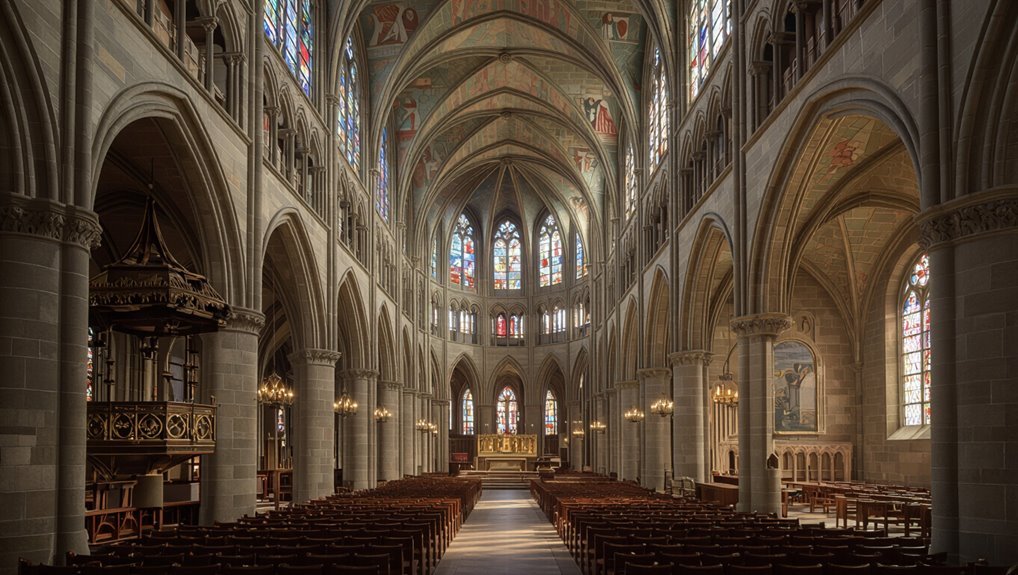
If you picture the “ceiling” of Notre Dame, don’t imagine a single flat plane—you’ve got multiple surfaces layered and decorated in different ways: the stone vaults that span the nave, the timber roof beneath the lead covering, the intimate ceilings of side chapels, and the choir’s elevated overhead.
You’ll notice painters and restorers treated each surface differently, adapting techniques, scale, and iconography to structure, visibility, and liturgical function.
Terminology: fresco, tempera, polychrome, stained wood
Having seen how different surfaces at Notre Dame were treated, you now need clear terms to describe what those treatments are: fresco, tempera, polychrome, and stained wood.
Fresco is pigment on wet plaster; tempera uses egg binder on dry ground.
Polychrome means multi-colored finishes applied to stone or wood.
Stained wood keeps grain visible while adding color and protection.
The Primary Answer Key Painters and Workshops Associated with the Ceiling
You’ll find that the original painters were largely anonymous medieval craftsmen and masons whose work set the initial schemes.
Later restorations brought in named figures like Eugène Viollet-le-Duc and his collaborators, who guided 19th-century conservation choices.
You’ll also want to reflect on the contributions of 19th-century painters and ateliers who executed and refined the visible ceiling decoration.
Medieval anonymous craftsmen and masons
While the names of the artists who painted Notre Dame’s ceiling were rarely recorded, you can still trace the work to skilled medieval craftsmen and masons who ran communal workshops and passed techniques down through apprenticeships.
You’ll find collective authorship: master masons directing structural design, painterly teams executing motifs, and apprentices learning pigments, gilding, and scaffolding methods—producing cohesive decorative programs without individual fame.
Notable named artists linked to later restorations (Eugène Viollet-le-Duc and collaborators)
Although most medieval painters stayed anonymous, the 19th-century restorations led by Eugène Viollet-le-Duc and his team put named artists and workshops back into the story of Notre-Dame’s ceiling.
You’ll encounter architects, painters, and craftsmen credited in records—Viollet-le-Duc’s collaborators supervised repainting, conservation decisions, and decorative schemes—so you can trace specific contributors rather than only anonymous medieval hands.
19th-century painters and atelier contributions
If you look to the 19th century, you’ll find a clear roster of painters and ateliers whose documented work reshaped Notre-Dame’s ceiling: chief among them were Eugène Viollet-le-Duc’s circle—architects, decorative painters, and workshop heads who organized repainting, stenciling, and gilding—and named artists like Jean-Baptiste Lassus’s collaborators, Antoine Desjardins, and workshop teams credited in restoration records for specific panels and motifs.
- Viollet-le-Duc’s decorative ateliers
- Lassus collaborators and painters
- Antoine Desjardins’s workshop
- Anonymous workshop teams documented
Evidence and Attribution How Historians Determine Who Painted What
You’ll start by checking archival records, contracts, and payment documents to see who was officially hired and paid.
Then you’ll compare stylistic features with known works to attribute hands and workshops.
Finally, you’ll use scientific tests—pigment analysis, infrared imaging, and dendrochronology—to confirm dates and materials.
Archival records, contracts, and payment documents
When historians try to pin down who painted the Notre Dame ceiling, they start with archival records—contracts, guild rolls, and payment receipts—that tie names to work and dates.
You’ll examine signed contracts, apprenticeship lists, and ledgers showing payments, noting dates, signatures, and marginal notes.
These documents let you confirm commissions, workshop responsibilities, and subcontracting, providing hard evidence before you assess style.
Stylistic analysis and comparative art history
Although archival documents give you names and dates, stylistic analysis connects those records to a painter’s hand by comparing technique, composition, and motifs across works.
You examine brushwork, figural proportions, recurring ornament, and color choices, then contrast them with authenticated pieces.
You note workshop patterns, apprentices’ interventions, and regional styles to build a persuasive attribution when paperwork alone isn’t conclusive.
Scientific methods: pigment analysis, infrared, dendrochronology
If documentary evidence leaves questions, scientists turn to the materials and hidden layers of a painting to answer them. You’ll use pigment analysis to match palettes, infrared to reveal underdrawings, and dendrochronology to date panels.
| Method | Insight |
|---|---|
| Pigment analysis | Artist’s materials |
| Infrared | Underdrawings |
| Dendrochronology | Panel dating |
Case Study 19th-Century Restoration under Viollet-le-Duc
You’ll examine how Viollet-le-Duc’s intervention reshaped ceilings and vaults across Notre Dame, from structural repairs to added decorative schemes.
You’ll meet the key painters and ateliers he employed and consider how their work blurred lines between conservation and new creation.
You’ll also confront the controversies over whether these efforts restored an authentic past or reconstructed a Victorian vision.
Scope of Viollet-le-Duc’s intervention on ceilings and vaults
When Viollet-le-Duc began his work on Notre-Dame in the mid-19th century, he treated ceilings and vaults not as passive backgrounds but as structural and aesthetic elements requiring both repair and reinterpretation.
You’ll notice he consolidated masonry, replaced deteriorated ribs, recreated missing bosses, and introduced coherent polychromy and iconographic schemes—intervening decisively to stabilize form and reimagine visual unity across the nave and choir.
Key painters and ateliers employed
Having stabilized and reimagined the structural fabric of Notre-Dame’s vaults, Viollet-le-Duc turned to artists who could translate his polychrome and iconographic program into paint.
You’ll meet painters like Jean-Baptiste Lassus’s collaborators, Étienne-Theodore Dommanget, and workshop teams trained in medieval techniques.
You’ll rely on their ateliers’ disciplined fresco and tempera skills to restore symbolic programs with historical fidelity and technical rigor.
Controversies: restoration vs. reconstruction
Although Viollet-le-Duc framed his 19th-century work as faithful restoration, his interventions often crossed into reconstruction, and you’ll see why this distinction still sparks heated debate: he didn’t just repair damaged vaults and painted programs—he reimagined them, filling gaps with stylistically coherent, but sometimes conjectural, solutions that reflect his vision as much as the medieval originals.
You’ll judge whether his creativity preserved or altered Notre Dame’s authentic past.
Visual Guide Notable Ceiling Panels and Motifs
You’ll notice iconic scenes across the ceiling and can often trace them to specific hands or workshops responsible for each panel.
Pay attention to recurring symbolism and theological themes—Christological imagery, Marian motifs, and saints’ lives all communicate specific doctrinal messages.
Also compare the nave, choir, transepts, and chapels to see how subject matter and style shift with liturgical function and patronage.
Iconic scenes and their attributed hands
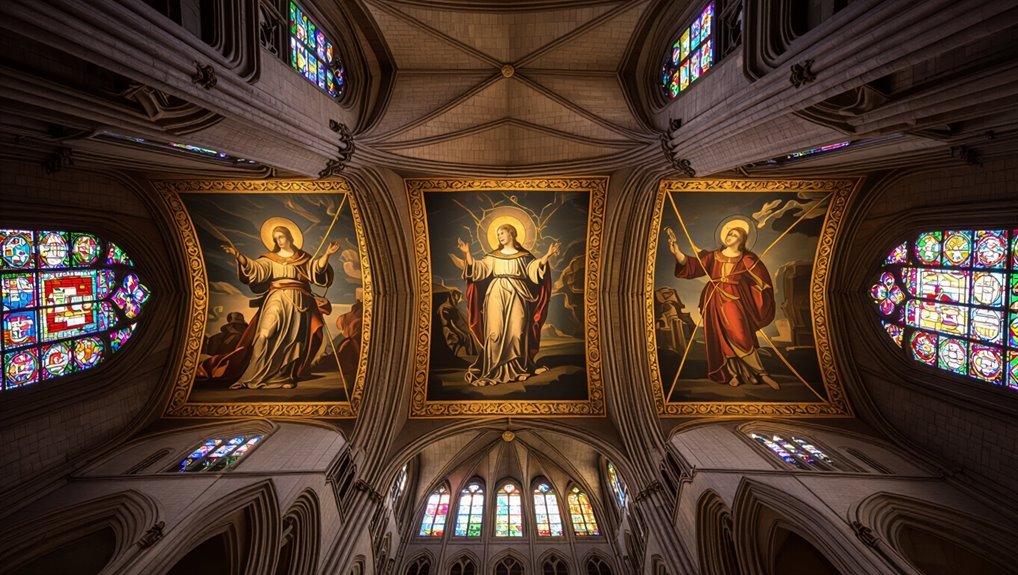
When you walk the nave and tilt your head to the painted vaults, certain panels grab your eye—saints in radiant robes, martyrs mid-gesture, and celestial assemblies arranged like living diagrams—and each was usually painted by an artist whose hand and workshop left telltale marks.
You’ll spot stylistic signatures: an ivory-faced Madonna by a Parisian master, bold color blocks from a Flemish hand, and delicate linework betraying assistants.
Symbolism and theological themes represented
Beyond recognizing who painted each panel, you’ll want to read what those images are saying: the ceiling assembles a theological program that speaks to worshippers from the apse to the nave.
You’ll find Christ’s salvific narrative, Marian devotion, saints as intercessors, and sacramental motifs.
Colors, gestures, and placement guide your devotional reading, reinforcing doctrine, liturgy, and the cathedral’s role as heaven on earth.
Variations between nave, choir, transepts, and chapels
Although the ceiling program maintains a unified theological narrative, each space—the nave, choir, transepts, and side chapels—puts that story to work in different ways, and you’ll notice distinct visual priorities as you move through the building.
- Nave: didactic scenes guiding the laity.
- Choir: liturgical focus, Marian and Christic imagery.
- Transepts: dramatic saints and patronal episodes.
- Chapels: intimate devotions, personalized iconography for donors.
Common Misconceptions and Problems in Attribution
You might assume a single “master” painted the whole ceiling, but that oversimplifies how medieval commissions worked.
You’ll also face attribution problems because original paint has been lost or overpainted, and surviving records are fragmentary.
Add the reality of workshop practices—multiple hands and apprentices—when weighing any authorship claim.
Myth: single ‘œmaster’ painted the entire ceiling
When you look at descriptions of the Notre Dame ceiling, it’s easy to believe a single “master” painted the whole work, but that’s a simplification that misleads more than it clarifies.
You should expect collaborative workshops: multiple hands, apprentices, and specialists contributed designs, pigments, and decorative motifs.
Attribution demands analyzing styles, contracts, and archival records rather than crediting one heroic personality.
Problem: loss of original paint and later overpainting
Acknowledging that multiple hands worked on the ceiling helps, but it doesn’t solve a more practical obstacle: much of what survives today isn’t the original paint.
You can’t rely on visible pigments alone; soot, humidity, restorations and intentional overpainting have altered colors and obscured brushwork.
You must use scientific analysis and careful stratigraphy to separate original layers from later interventions before attributing authorship.
Problem: fragmentary records and workshop practices
Although surviving contracts, payments, and account books give hints, they rarely spell out who actually painted each panel, and that gap lets myths take hold.
You’ll face fragmentary records, collective workshop practices, and apprentices executing masters’ designs. Attribution gets messy: signatures are rare, payments cover teams, and stylistic differences reflect collaboration.
You must weigh documentary gaps against technical analysis to avoid false certainty.
Preservation Challenges and Best Practices
You’ll need to weigh the main threats—pollution, fluctuating humidity, fire risk, and damage from earlier restorations—when planning care for the ceiling.
Modern conservation techniques for painted ceilings, including environmental control, noninvasive analysis, and reversible treatments, should guide any intervention.
For future research and preservation, prioritize systematic documentation, interdisciplinary collaboration, and preventive maintenance.
Main threats: pollution, humidity, fire, prior restorations
When you look up at the Notre-Dame ceiling, remember that its painted surfaces face constant threats: air pollution darkens varnish and corrodes pigments, fluctuating humidity swells wood and detaches paint, fire risks irreversible loss, and past restorations sometimes used incompatible materials that accelerate deterioration.
You should monitor environmental controls, minimize soot exposure, document interventions, and prioritize reversible, documented measures to reduce cumulative damage.
Conservation techniques used for painted ceilings today
Start by evaluating the ceiling’s condition with noninvasive imaging and microclimate monitoring so you can target interventions precisely; conservators now combine infrared, UV fluorescence, X‑ray, and humidity/temperature logging to map losses, identify pigments, and detect unstable joins before any treatment begins.
Then stabilize flaking paint with reversible consolidants, clean surfaces gently with tailored solvents, fill losses with compatible materials, and document every step for accountability.
Recommended practices for future research and preservation
Although conservation needs will differ by site, you should adopt a coordinated, research-led strategy that prioritizes noninvasive diagnostics, routine environmental control, and clear documentation so future teams can assess interventions reliably.
You should also train local staff, share data openly, plan for preventive maintenance, and use reversible materials.
Prioritize ethics, cross-disciplinary review, and community engagement to sustain long-term stewardship.
How to Learn More or See the Work In Person
When you visit Notre Dame, look up in the nave, choir, and chapels to spot surviving painted ceilings and note any panels behind barriers.
For deeper research, check major museums and archives in Paris—like the Musée de Cluny and the Archives nationales—and key publications on Gothic polychromy.
If you can’t go in person, use official digital collections and virtual tours to examine high-resolution images and curatorial notes.
Visiting tips: where to look inside Notre Dame for painted ceilings
Curious where to look inside Notre Dame for its painted ceilings?
Walk slowly, tilt your head upward, and focus on architectural junctions where light pools. Use a guide or audio tour to highlight panels and restorations. Check visiting hours for quiet times.
- Nave vaults near the transept
- Choir and apse ceilings
- Side chapels’ lunettes
- Transept crossing decorations
Key museums, archives, and publications for further research
To dive deeper into the painted ceilings of Notre Dame, start with institutions that preserve the cathedral’s visual and documentary record: the Musée de Cluny and the Musée du Louvre hold comparative medieval artworks and fragments.
The Archives nationales and the Archives de la Ville de Paris house restoration files and contracts.
The Centre des Monuments Nationaux and the Institut de France publish technical reports and catalogs you can consult in person or online.
- Musée de Cluny — medieval comparanda
- Musée du Louvre — fragments, sketches
- Archives nationales / Archives de la Ville de Paris — restoration records
- Centre des Monuments Nationaux / Institut de France — conservation reports
Digital resources and virtual tours
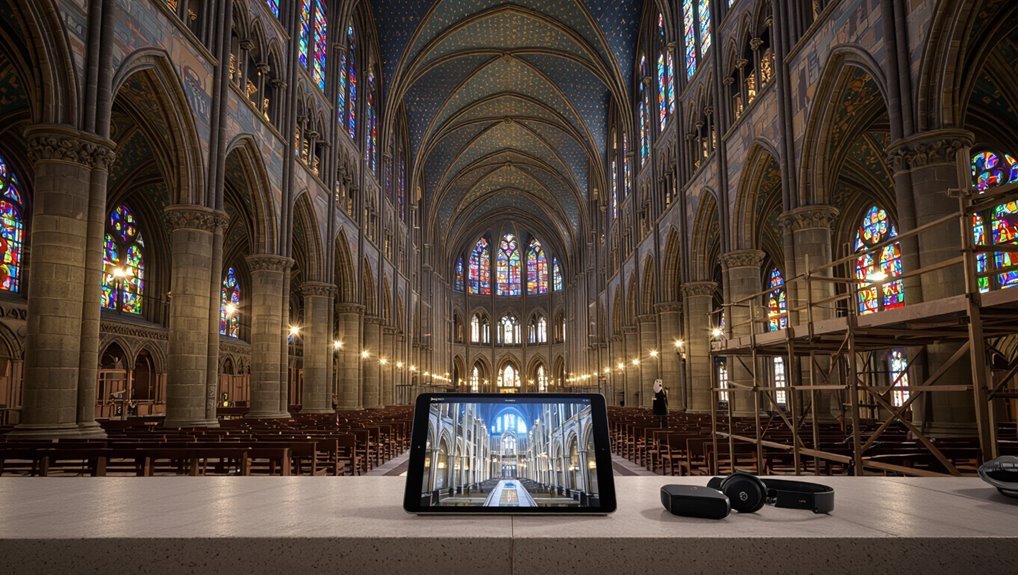
Interested in exploring Notre Dame’s painted ceilings from anywhere in the world?
Use official virtual tours on the cathedral’s website, Google Arts & Culture’s high-resolution panoramas, and digitized archives from French libraries. You can zoom into details, read curator notes, and watch restoration videos.
Subscribe to museum newsletters and follow conservation projects on social media to get updates and behind-the-scenes content.
FAQs
You’ll likely have questions about who actually painted Notre Dame’s medieval ceilings and whether figures like Viollet‑le‑Duc ever picked up a brush.
You’ll also want to know if the panels you see today are original, how experts tell originals from later additions, and whether recent restorations will change the ceiling’s appearance.
Below are clear answers to each of those common FAQs.
Who exactly painted the original medieval ceilings of Notre Dame?
Who actually painted Notre Dame’s original medieval ceilings? You’d find they were crafted by itinerant medieval painters and local workshop teams hired by cathedral officials and guilds.
They mixed pigments on-site, painted wooden vaults and panels, and followed iconographic programs set by clergy. Individual names rarely survive; records list patrons and workshops rather than specific artists, so attribution stays collective and anonymous.
Did Viollet-le-Duc paint any of the ceilings himself?
Did Viollet-le-Duc ever pick up a brush and paint Notre Dame’s ceilings himself?
You should know he wasn’t primarily a painter; he supervised, designed and commissioned decorative schemes.
He occasionally made sketches and prototypes, guiding artists and craftsmen, but the actual ceiling painting was executed by specialist painters working under his direction rather than by Viollet-le-Duc personally.
Are the current ceiling decorations original or restored?
Although parts of Notre Dame’s ceiling still date from the 19th-century restoration, most of what you see today is the result of later conservation and selective retouching rather than untouched originals.
You’ll notice layers of repairs, repainting and protective coatings applied after damage, especially following the 2019 fire.
Conservators aimed to preserve historical appearance while stabilizing surfaces, so many motifs are careful reconstructions, not wholly original fabric.
How do experts distinguish original paint from later additions?
When you look closely, experts combine visual examination with scientific tests to tell original paint from later additions.
You’ll see layers, brushstrokes, and pigment aging under magnification. Scientists use microscopy, X‑ray fluorescence, Raman spectroscopy, and cross‑section analysis to identify materials and sequences.
Historical records and stylistic comparison help date interventions, letting you distinguish authentic medieval work from subsequent repairs or repainting.
Will the ceiling be the same after recent restorations and reconstructions?
How similar will the ceiling look after recent restorations and reconstructions?
You’ll see careful reconstruction matching original color, motifs, and techniques where evidence supports it, but some areas will use modern materials and reversible methods.
Conservators aim for visual fidelity and structural safety, not exact duplication.
Expect informed replication, subtle differences under close inspection, and full documentation of choices for future study.
