
How to Paint Finished Furniture Without Sanding First
You can repaint smooth, intact finished furniture without sanding by cleaning thoroughly, deglossing or using a liquid prep, then applying a high-adhesion primer designed to bond to slick surfaces; use thin, even primer and paint coats with a quality brush or foam roller, letting each coat dry fully and lightly scuffing between coats if needed. This works for non-peeling, non-damaged finishes and will save time—keep going to learn specific products, steps, and pitfalls to avoid.
How to Paint Finished Furniture Without Sanding First Quick Answer
You can save time by using a high-bonding primer or deglosser and a quality paint designed for slick surfaces.
Skip sanding only on smooth, intact finishes that’ll accept primer; don’t skip it on peeling, rough, or heavily worn pieces.
Read the surface first so you know whether the quick route is safe or if full prep’s required.
One-sentence summary of the fastest safe method
One quick, safe option is to clean the piece thoroughly, scuff the finish with a liquid deglosser, prime with a bonding primer, then topcoat with a durable water-based paint—no sanding required.
You’ll follow a simple sequence that lets you refresh finished pieces fast: degrease, degloss, bond-prime, and apply two thin topcoats, ensuring adhesion and durability when learning how to paint finished furniture without sanding.
When skipping sanding is appropriate vs when it’s not
When the existing finish is smooth, intact, and not glossy, you can skip sanding by cleaning, deglossing, and using a bonding primer before painting.
But if the finish is peeling, thickly varnished, or has visible damage, sanding (or stripping) is necessary to guarantee adhesion and a lasting result.
Assess adhesion, primer compatibility, and surface hardness; test a small area to confirm paint will bond without sanding.
Basic Understanding What ‘œFinished Furniture’ Means and Why Sanding Is Usually Recommended
Finished furniture can mean many things—varnish, lacquer, polyurethane, laminate, or existing paint—and each finish behaves differently when you repaint.
Sanding creates tooth for better adhesion, evens out glossy or rough spots, and helps remove minor imperfections so your new paint lays down smoothly.
Skip sanding and you risk poor adhesion, peeling, and visible flaws that ruin the final look.
Types of finishes you might encounter (varnish, lacquer, polyurethane, laminate, painted)
A finished piece means the surface has a protective or decorative coating—varnish, lacquer, polyurethane, laminate, or existing paint—and that coating affects how new paint will stick and look.
You’ll see glossy varnish or lacquer, tough polyurethane, smooth factory laminate, or previous paint layers. Each varies in porosity, flexibility, and durability, so you’ll choose primers, cleaners, and techniques that match the specific finish.
Why sanding helps (adhesion, smoothing, removing gloss)
Now that you know what kinds of coatings you might face, sanding makes more sense: it helps new paint grip, evens out surface imperfections, and removes high-gloss layers that repel primers and topcoats.
- Improve adhesion so paint bonds reliably.
- Smooth scratches, dents, and old drips for a flatter finish.
- Dull shiny surfaces so primers and topcoats lay evenly and resist pooling.
Risks of painting without sanding (peeling, poor adhesion, visible flaws)
If you skip sanding, paint won’t reliably stick and you’ll likely see peeling, flaking, or uneven coverage as the piece gets used.
Without proper tooth, finishes resist bonding, so chips and blistering appear at edges and high-contact spots.
Surface contaminants and glossy coatings hide flaws, causing streaks, brush marks, and poor durability.
Expect more maintenance and possible costly refinishing sooner.
Materials, Tools, and Products You Need
Before you start painting, gather the right cleaning supplies and degreasers plus a deglosser (liquid sandpaper) or chemical prep to make the surface receptive.
Choose an appropriate adhesion or bonding primer—oil-based, shellac, or a shellac alternative—then pick a paint type that suits the piece (acrylic latex, chalk, milk, or enamel) and the application method (brush, roller, or sprayer).
Don’t forget tack cloths and basic protective equipment like gloves, a respirator, and eye protection.
Cleaning supplies and degreasers
A few reliable cleaning supplies and a good degreaser will make the difference between paint that sticks and paint that peels, so gather them before you start.
You’ll need microfiber cloths, a scrub brush, disposable sponges, and a pH-neutral cleaner for dust and grime.
Use a dedicated solvent-based or citrus degreaser to remove wax, oils, and residues; rinse and let dry fully.
Deglossers / liquid sandpaper (chemical prep)
When paint’s clinging to a glossy finish, you’ll want a deglosser—also called liquid sandpaper—to chemically dull the surface so new paint bonds without aggressive sanding.
Choose a water- or solvent-based deglosser, wear gloves and eye protection, test in an inconspicuous spot, apply with a lint-free cloth following directions, wipe thoroughly, and let the surface dry completely before priming or painting.
Adhesion primers and bonding primers (oil-based, shellac, shellac alternatives)
If you’re painting over slick or previously finished furniture, you’ll want a reliable adhesion or bonding primer to give paint something to grip to.
These primers come in oil-based, shellac, and shellac-alternative formulas, each suited to different substrates and problems.
Choose oil-based for durability and stain-blocking, shellac for tough tannin or odor issues, and shellac-alternatives for lower odor and easier cleanup.
Paint types recommended (acrylic latex, chalk paint, milk paint, enamel)
Paint choice sets the look, durability, and application method you’ll use, so pick one that matches the piece and your skills.
Use acrylic latex for easy cleanup and lasting finish on high-traffic pieces.
Choose chalk paint for matte, distressed styles with minimal prep.
Milk paint gives an antique, flaked look.
Enamel provides hard, durable, glossy protection for surfaces that need heavy wear.
Brushes, rollers, sprayers, tack cloths, and protective equipment
Choosing the right applicators and protection makes as much difference to your finished piece as the paint you picked.
You’ll want quality brushes, foam rollers, or a sprayer; tack cloths to remove dust; and gloves, mask, and drop cloths for safety.
Follow this quick checklist:
- Brushes/rollers/sprayer
- Tack cloths
- Gloves, mask, drop cloths
Step-by-Step Method to Paint Finished Furniture Without Sanding
Before you start painting, you’ll inspect the piece and test the finish in an inconspicuous spot to make sure your method will stick.
Then you’ll clean thoroughly, strip wax and grease, use a deglosser with the proper application and safety precautions, and fill any dents so surfaces are smooth.
Finish by applying a high-adhesion primer, following recommended coats and drying times before you paint.
Step 1 Inspect the piece and test in an inconspicuous area
Start by giving the piece a close once-over and pick an out-of-sight spot—inside a drawer, the back of a leg, or under the top—to test your technique and products.
Check for loose joints, veneer edges, previous finishes, and any repairs.
Apply primer or paint sample, let it dry fully, then inspect adhesion, color, and finish texture before committing to the whole piece.
Step 2 Clean thoroughly: degrease, remove wax and grime
Now that you’ve confirmed what finish and products will work on a hidden spot, it’s time to clean the whole piece so paint can bond properly.
Wipe surfaces with a degreasing cleaner or TSP substitute, scrub crevices with a nylon brush, and remove wax buildup with mineral spirits or dedicated wax remover.
Rinse, dry fully, and guarantee no residue remains before proceeding.
Step 3 Use a deglosser properly (application, dwell time, safety)
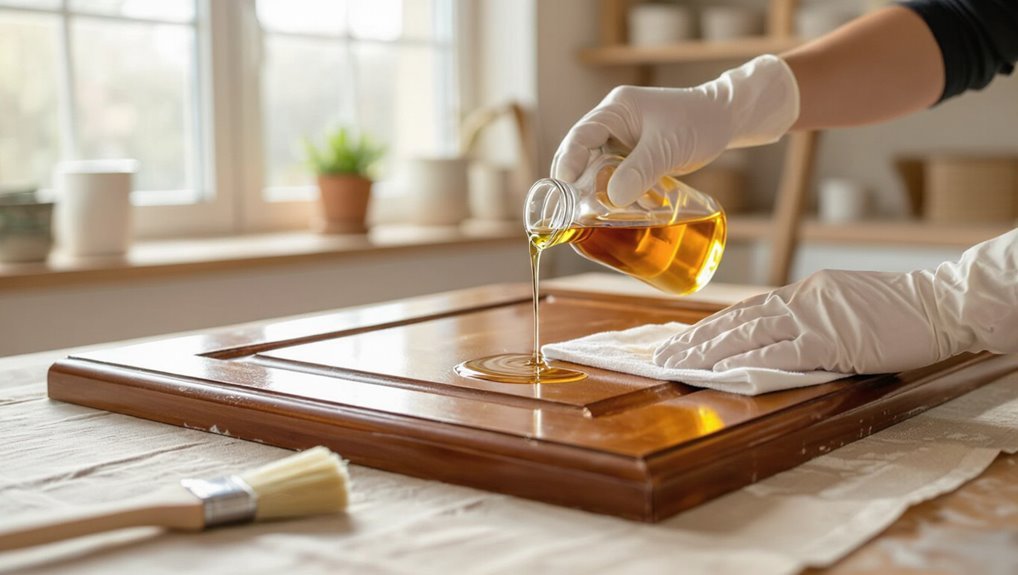
Reach for a liquid deglosser to dull the existing sheen and promote paint adhesion without sanding: apply it with a clean lint-free cloth, work in manageable sections, let it sit the manufacturer-recommended dwell time (usually a few minutes) to soften the finish, then wipe away any residue—repeating if high-gloss areas still feel slick—while wearing gloves and working in a well-ventilated space to avoid fumes and skin contact.
Use gentle pressure, discard contaminated cloths safely, and confirm surfaces are dry before priming or painting.
Step 4 Fill dents/imperfections and wipe smooth
Repair small dents and gouges with a water-based wood filler or lightweight spackling that’s compatible with your paint, pressing it into the damage with a putty knife so the void’s fully filled; smooth the surface flush with the surrounding area.
Let it dry per the product instructions, then lightly wipe away any excess with a damp cloth before final sanding or smoothing to guarantee an even base for primer and paint.
Once dry, sand or scrape gently to blend edges, remove dust, and check for remaining imperfections.
Repeat filling if needed, then wipe the area clean so your primer adheres to a uniform, defect-free surface.
Step 5 Apply a high-adhesion primer (tips on coats and drying times)
With the surface filled, smoothed, and wiped clean, you’re ready to apply a high-adhesion primer that’ll bond to the finish and give paint something to grip.
Use one thin, even coat; wait manufacturer’s recommended dry time (usually 30–60 minutes) before a second coat if coverage’s thin.
Allow full cure per label (often 24 hours) before topcoating.
Step 6 Lightly scuff between primer coats (optional light abrasion with fine pad)
Lightly scuffing between primer coats helps the next layer adhere and evens out any dust nibs or brush marks.
Use a fine abrasive pad or 320–400 grit paper, gently rubbing until the surface feels slightly dull.
Wipe with a tack cloth to remove residue, inspect for imperfections, and only repeat when needed—over-sanding can remove primer and undermine adhesion.
Step 7 Apply paint: technique, number of coats, drying, and sanding between coats if needed
Once the primer’s cured, it’s time to apply your paint—use thin, even coats and let each one dry fully before the next so you get a smooth, durable finish.
Work with a high-quality brush or foam roller, follow the grain, and apply two to three coats.
If you see brush marks or dust nibs, lightly sand with fine grit between coats and wipe clean before continuing.
Step 8 Seal with an appropriate topcoat (water-based polyurethane, wax, or clear enamel)
Seal the paint with a protective topcoat to lock in durability and the look you’ve worked for.
Choose water-based polyurethane for clear, durable protection; wax for a soft, matte finish; or clear enamel for high-traffic pieces.
Apply thin, even coats, follow manufacturer drying times, and lightly buff between coats if recommended.
Let cure fully before regular use to prevent damage.
Alternative Methods and Product-Specific Approaches
You can use chalk or milk paint without sanding to simplify the job, but weigh their adhesion limits and finish differences first.
Decide whether spraying or brushing gives the smoothest result on your prepped surface—sprays are faster, brushes give more control.
For laminate or melamine, pick a specialty primer and use proper tape to guarantee adhesion and clean edges.
Using chalk paint or milk paint without sanding pros and cons
Although chalk and milk paints promise a quick, no-sanding makeover for finished furniture, they come with trade-offs you should weigh before diving in.
You’ll love easy adhesion and matte, vintage finishes, but expect limited durability without a clear topcoat, variable coverage on glossy surfaces, and potential flaking on heavy-use pieces.
They’re great for low-traffic items and fast updates, not for rough wear.
Spray painting vs brushing on prepped surfaces
When deciding between spray painting and brushing on a prepped piece, consider how much control, finish uniformity, and drying time you need: spray gives smooth, fast, even coats but needs ventilation, masking, and practice to avoid runs;
brushing offers precision for edges, less overspray, and easier touch-ups but may show strokes and takes longer to level and dry between coats.
Painting laminate or melamine surfaces special primers and tapes
If you’ve weighed spray versus brush for a prepped piece, the approach shifts again with laminate or melamine—these slick, nonporous surfaces won’t hold standard paint without the right primers and tapes. Use a bonding primer, clean thoroughly, and apply high-tack tape to protect edges; you’ll get durable, clean lines and confidence.
| Primer | Emotion |
|---|---|
| Bonding | Relief |
| Shellac | Trust |
| Epoxy | Confidence |
| Degloss | Assurance |
| Tape | Calm |
Common Problems When Skipping Sanding and How to Fix Them
If you skip sanding, you’ll likely run into peeling or chipping, brush marks and drips, or glossy spots and poor adhesion after curing.
I’ll show how to diagnose each issue and the quick fixes—like spot sanding and bonding primer for peeling, light sanding and reflowing paint for brush marks, and scuff-sanding plus proper recoating for glossy or poorly adhered areas.
Follow these steps and you’ll restore a smooth, durable finish without starting over.
Paint peeling or chipping causes and remediation
Although skipping proper sanding might save time up front, it often leads to paint that peels or chips soon after application.
You’ll usually see failure where the new finish couldn’t adhere to the smooth, glossy surface or to residual dirt, oils, or old finish residues.
Clean thoroughly, degloss with a liquid abrasive or bond-promoting primer, allow full cure, and sand feathered edges before repainting to restore adhesion.
Brush marks, drips, and uneven coverage correction steps
Skipping proper prep can also leave you with visible brush marks, runs, and patchy coverage that scream “unfinished.”
You can fix these by lightly sanding imperfections with fine-grit paper, wiping dust, and applying thin, even coats with a high-quality brush or foam roller.
Tip: keep strokes wet-to-wet, level drips with a damp brush, and let each coat fully dry before re-coating.
Glossy spots or poor adhesion after curing how to reseal or recoat
When you notice glossy spots or areas that won’t accept new finish after the piece has cured, it usually means the original surface wasn’t sufficiently deglossed or cleaned—so you’ll need to reseal or recoat correctly to guarantee adhesion.
Lightly scuff glossy zones with fine-grit sandpaper or synthetic abrasive pad, clean with solvent, wipe dry, apply a bonding primer, then topcoat.
Test adhesion before finishing.
Best Practices and Tips to Ensure Long-Lasting Results
To get a durable finish, pay attention to your environment—work in the recommended temperature and humidity range and keep the area well-ventilated.
Follow manufacturers’ recoat windows and full cure times, and plan your schedule so you don’t rush between coats.
Remove or properly mask hardware and edges before painting, and stick to simple maintenance like gentle cleaning and periodic touch-ups to keep the finish looking good.
Environmental considerations (temperature, humidity, ventilation)
Although paint chemistry matters most, your workspace conditions decide how well finishes cure and how long they’ll last.
So you should control temperature, humidity, and airflow before you start. Work between recommended temp ranges, keep humidity moderate to avoid blushing or cracking, and guarantee steady ventilation to remove fumes and speed solvent evaporation.
Use fans and dehumidifiers as needed for consistent drying.
Timing: cure times vs recoat windows
If you want durable, smooth results, pay attention to both recoat windows and full cure times.
Follow the paint manufacturer’s recommended recoat interval to avoid lifting or tackiness, but don’t assume “dry” equals cured.
Allow full cure before heavy use or moving parts—often days to weeks.
Faster recoats speed projects, but patience prevents dents, adhesion failures, and finish dulling.
Edge, hinge, and hardware handling (removal vs masking)
You’ve waited for proper cure times, now focus on edges, hinges, and hardware—areas that see the most wear and cause the biggest headaches if handled wrong.
Remove hardware when possible for cleaner edges and fewer touch-ups. Tape and paper small fixed pieces, feathering paint from edges to prevent buildup.
For hinges, open fully and paint around pins or remove them; label parts for easy reassembly.
Maintenance recommendations for painted furniture
When cared for properly, painted furniture can stay looking fresh for years; follow a few simple maintenance habits—regular gentle cleaning, quick touch-ups, and smart wear prevention—to keep finishes durable and attractive.
- Wipe with a damp microfiber cloth and mild soap, dry immediately.
- Keep painter’s touch-up paint handy for chips; sand tiny spots lightly before recoat.
- Use felt pads, avoid direct sunlight, and rotate high-use items to reduce wear.
Mistakes to Avoid
Don’t skip cleaning or deglossing—paint won’t stick to grease or shine.
Make sure you use the right primer and paint, apply thin even coats, and let each layer fully dry.
Always test adhesion on an inconspicuous spot before you commit to the whole piece.
Skipping cleaning or deglossing
Even if the finish looks fine, skipping a good cleaning or deglossing will make your paint peel, chip, or fail to adhere.
You need to remove grease, grime, and wax with a degreaser or TSP substitute, then dull glossy surfaces with a liquid deglosser.
Skipping these steps wastes time and money because paint won’t bond properly, causing premature failure and extra touch-ups.
Using the wrong primer or paint type
If you pick the wrong primer or paint, your new finish won’t hold up—so choose products made for the substrate and the topcoat you plan to use.
Use adhesion primers on slick laminates, stain-blocking primers over tannin-rich woods, and water- or oil-based paint compatible with that primer.
Mismatched systems can peel, yellow, or crack, so read labels and test a small area first.
Applying too-thick coats or rushing drying times
When you slap on paint in thick layers or force-dry a coat, you’ll trap solvents and moisture that cause drips, tacky spots, and long-term adhesion problems.
Work in thin, even passes, allowing manufacturer-recommended dry times between coats.
Use proper ventilation and room temperature, resist the urge to speed up drying with heat or fans, and lightly sand between coats if texture builds up.
Failing to test adhesion first
Because old finishes can repel new paint, you should always test adhesion before committing to a full coat.
Pick a hidden spot, apply your chosen primer or paint, let it cure fully, then press with tape and scratch lightly.
If paint lifts or beads, stop and prep properly—clean, degloss, or use a bonding primer—so your finish lasts instead of peeling.
Project Cost and Time Estimates
You can expect different budget ranges depending on product choice: basic supplies might run $30–$75, mid-range $75–$200, and premium products $200+ for specialty paints and finishes.
A typical dresser or table usually takes 6–12 hours spread over sanding, priming, painting, and drying—often split across two to three days.
Use these estimates to plan buying, scheduling, and whether you’ll pay for professional help.
Budget ranges by product choice (basic, mid-range, premium)
Although paint job costs vary with scale and finish, choosing between basic, mid-range, and premium products gives you a clear framework for estimating price and time. You’ll pick basics to save money, mid-range for durability, or premium for top results; each affects coat count, prep, and drying needs.
| Product tier | Typical cost |
|---|---|
| Basic | $15–$40 |
| Mid-range | $40–$90 |
| Premium | $90–$200 |
Approximate time breakdown for a typical dresser or table
Now that you’ve picked a product tier, let’s look at how that choice shapes the time you’ll spend on a typical dresser or table.
Expect 30–60 minutes for prep (cleaning, minor repairs), 1–2 hours per coat for painting (including drying), and 15–30 minutes for hardware and touch-ups.
Budget extra curing time: 24–72 hours before light use, longer for heavy use.
FAQ
You probably have a lot of specific questions—like whether you can paint over polyurethane without sanding, if a deglosser’s needed for matte finishes, or how long before a painted surface can be used.
You’ll also want to know whether chalk paint will hold up on high-traffic pieces without sanding and if you can skip primer when using spray paint.
Below are clear answers to those common concerns.
Can I paint over polyurethane without sanding?
Can you paint over polyurethane without sanding? Yes, but it’s risky.
Polyurethane repels paint, so adhesion will be poor unless you scuff the surface or use a high-adhesion primer formulated for slick finishes.
If you skip sanding, clean thoroughly, degloss with a liquid prep, and apply a bonding primer.
Expect shorter-lasting results than with proper sanding and preparation.
Is a deglosser necessary if the finish is matte?
Is a deglosser necessary if your finish is matte? Not always.
Matte finishes have less sheen, so paint can stick better, but oils, waxes, or sealers still block adhesion. If the surface feels slick or was treated, use a deglosser or light sanding alternative.
If it’s clean, dry, and porous, you can often skip the deglosser—test a small area first.
How long before I can use a painted surface?
Once the paint’s dry to the touch, you’ll still need to wait before putting the piece back into regular use.
Cure times vary by paint type and conditions: latex typically needs 2–4 weeks for full hardness, oil-based around 1–2 weeks, and chalk/mineral paints often several days to a week.
Avoid heavy use and place items gently until fully cured.
Will chalk paint hold up on a high-traffic piece without sanding?
Will chalk paint hold up on a high-traffic piece without sanding? You can, but expect more wear than with sanding and proper prep.
Chalk paint bonds reasonably well to many finishes, yet on tabletops, chairs, or drawers you’ll likely need multiple coats and a durable topcoat (wax or poly) applied carefully.
Touch-ups will be more frequent than on sanded, primed surfaces.
Can I skip primer if I use spray paint?
Maybe — but usually you shouldn’t skip primer when using spray paint.
Primer improves adhesion, hides stains, and prevents bleed-through, especially on glossy or previously finished surfaces. If you’re switching to a lighter color or using a thin spray enamel, primer’s essential.
Only skip primer for identical color and finish on flawless surfaces, but expect reduced durability and potential peeling without it.
