
Is Behr Paint Good for Interior Walls? An Honest Review
Yes — Behr is a solid choice for interior walls when you prep properly and pick the right formula. You’ll get good coverage, often one coat on lighter shades with Marquee, durable washable finishes, and a broad color range at mid-range prices. Low- and zero-VOC options reduce fumes, though ventilating helps. Use primer for big color shifts or stains, quality rollers, and test samples for color accuracy. Keep going and you’ll find tips, comparisons, and real-use scenarios.
Quick Answer Is Behr Paint Good for Interior Walls?
Yes — Behr is a solid choice for most interior walls, offering good coverage, durability, and color selection at a reasonable price.
You’ll get best results in living rooms, bedrooms, hallways, and moderately trafficked areas where you want a reliable, easy-to-apply finish.
For high-moisture rooms or heavy-traffic zones, consider Behr’s premium or specialty formulas for extra protection.
Short verdict summary
If you want reliable coverage, good durability, and a wide color selection without breaking the bank, Behr is a strong choice for interior walls.
You’ll get consistent finish options, decent hide, and easy cleanup.
If you’re asking “is behr paint good for interior walls,” the short verdict: yes — it balances performance, affordability, and availability for most home projects.
Best use cases at a glance
For most homeowners tackling bedrooms, living rooms, hallways, or rental units, Behr delivers dependable coverage, easy application, and a wide color range that makes it a practical go-to.
You’ll find it works well when you need quick renewals, durable finishes, or budget-friendly upgrades.
Consider these ideal scenarios:
- Brightening a compact bedroom
- Revitalizing a high-traffic hallway
- Painting an entryway for curb appeal
- Updating a rental between tenants
- Creating an accent wall in a living room
What Is Behr Paint? Basics You Need to Know
Behr’s a well-known paint brand you’ll recognize from its wide range of consumer and professional product lines.
You’ll most often see interior formulas like Premium Plus, Marquee, Ultra, and Enamel, each aimed at different needs.
Pay attention to their advertised strengths—coverage, durability, and a variety of finish options—to pick the right one for your walls.
Company background and product lines
While you’re shopping for paint, you’ll notice Behr is a major player in the DIY market, selling a wide range of interior and exterior paints, primers, stains, and specialty coatings through Home Depot stores and online.
You’ll find a U.S.-based company with decades of manufacturing experience, extensive color tools, warranty options, and customer support, plus pro and DIY-focused product tiers to suit budgets and project scales.
Common interior formulas (Premium Plus, Marquee, Ultra, Enamel)
When you’re choosing paint for walls, ceilings, trim, or cabinets, Behr offers several common interior formulas—Premium Plus, Marquee, Ultra, and Enamel—each geared to different needs like coverage, durability, and sheen.
You’ll pick based on project scale and surface prep. Imagine these finishes:
- Smooth matte living room walls
- Semi-gloss trim around doors
- Durable kitchen cabinets
- High-traffic hallway walls
- Satin-finish bathroom walls
Key advertised features (coverage, durability, finish options)
After you pick the right formula for each surface, you’ll want to know what Behr actually promises on the can: advertised coverage per coat, how the finish will hold up over time, and what sheen options are available.
You’ll typically see 300–400 sq ft per gallon, durability claims like scuff and stain resistance, and sheens from flat to high-gloss to suit rooms and trim.
How Behr Performs on Interior Walls Detailed Evaluation
When you evaluate Behr on interior walls, focus first on coverage and whether one coat really hides the old color or you’ll need more.
Check that the shade you pick matches swatches and that the chosen sheen—flat, eggshell, satin or semi-gloss—gives the finish quality you want.
Also test for durability, scuff resistance, and how easily marks come off with washing.
Coverage and hide (one-coat vs multi-coat)
Although exact results depend on color and surface, you’ll usually find Behr’s interior paints offer strong initial coverage that often gets you close to a one-coat finish on light-to-medium colors and smooth, primed walls.
For darker shades or porous surfaces you’ll likely need two coats for full opacity and uniform sheen.
Use a quality roller and proper technique to minimize streaks and touch-ups.
Color accuracy and consistency
Because paint can look different under varied light and on different substrates, you’ll want to judge Behr’s color accuracy across real-world conditions rather than relying solely on the swatch.
Test samples on your actual walls in morning and evening light; Behr generally matches its chips closely, though slight shifts occur with different primers or wall textures.
Compare multiple samples before committing.
Finish quality (flat, eggshell, satin, semi-gloss)
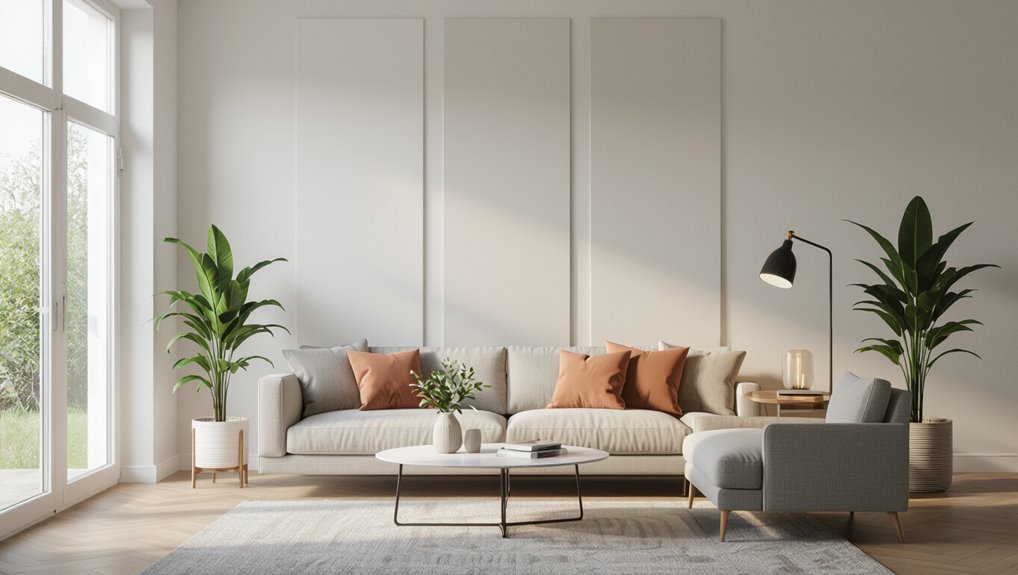
Finish choices matter: Behr’s flat, eggshell, satin, and semi-gloss finishes each deliver distinct looks and performance, so pick the one that fits the room’s traffic and desired sheen.
Flat hides imperfections and gives a soft, matte look; eggshell offers subtle sheen for living spaces; satin adds gentle luster for hallways and kitchens; semi-gloss gives pronounced shine for trim and moisture-prone areas.
Durability and scuff resistance
When you’re evaluating Behr for interior walls, focus first on how its formulations resist everyday knocks, scrapes, and stains—because that’s what determines how long a fresh paint job will look new.
You’ll find Behr offers good film hardness and adhesion, so walls fend off scuffs better than many budget brands. Higher-sheen options boost resistance; proper prep and multiple coats matter.
Washability and stain removal
If you expect your walls to handle fingerprints, crayon, and food splatters without losing their color or texture, Behr’s interior paints generally deliver—especially their higher-sheen and scrub-resistant formulations.
You can wipe most marks with a damp cloth and mild detergent; stubborn stains often come out with gentle scrubbing.
Test a small area first to avoid sheen loss.
VOC levels and odor during application
Although low-VOC options are widely available, you’ll still notice some odor during application—especially in tight or poorly ventilated rooms.
Behr’s low- and zero-VOC formulas emit fewer fumes than older paints, but fresh coats can smell for hours to a day.
Open windows, run fans, and use ventilation to speed dissipation.
Pregnant people and sensitive individuals should minimize exposure during painting.
Comparison Behr vs Popular Interior Paint Brands
You’ll want to compare Behr’s coverage, durability, and price head-to-head with other brands so you can pick the best match for your room and budget. Below is a quick snapshot of how Behr stacks up and which alternatives suit specific needs. Use this as a starting point to weigh trade-offs before you buy.
| Brand/Metric | Quick Take |
|---|---|
| Behr Coverage | Strong at mid-range price |
| Behr Durability | Good for high-traffic rooms |
| Competitor A (premium) | Exceptional durability, higher cost |
| Competitor B (budget) | Lower price, more coats needed |
| Best For | Behr: balanced; Premium: longevity; Budget: cost-conscious projects |
Performance metrics compared (coverage, durability, price)
When comparing Behr to other popular interior paints, focus on three measurable factors—coverage, durability, and price—since those determine how the job turns out and how much you’ll spend over time.
Behr often covers well in two coats, stands up to scuffs and cleaning, and sits mid‑range on price.
You’ll weigh fewer touchups against slightly higher initial cost.
Best alternatives for specific needs
Looking for a paint that fits a specific room or budget?
If you want premium VOC‑low or ultra‑durable finishes, consider Benjamin Moore for richness and Sherwin‑Williams for professional durability.
For budget projects, Valspar rivals Behr on price with decent coverage.
If you need eco‑friendly options, try Clare or Farrow & Ball.
Match finish and prep to your room’s traffic and lighting.
When to Choose Behr Ideal Scenarios
If you’re on a budget or tackling a DIY interior paint job, Behr often gives the best balance of price and performance.
It’s a smart pick for high-traffic rooms thanks to durable, washable finishes, while lower-traffic spaces let you prioritize sheen or color.
Also weigh primer needs—some Behr formulas cover in one coat, but rough or stained surfaces still call for primer.
Budget-conscious projects
Choose Behr for budget-conscious projects when you want reliable appearance and decent durability without overspending; their mid-range lines give you good coverage, easy application, and a wide color selection so you can refresh rooms quickly and stay on budget.
You’ll save on cost without sacrificing a clean finish in living areas, bedrooms, or rental units, and touch-ups remain straightforward.
DIY interior painting
For DIY interior painting projects where you want professional-looking results without hiring a pro, pick Behr when you value easy application, dependable coverage, and quick cleanup; their self-priming formulas and forgiving sheens help you get smooth walls with fewer coats and less fuss.
You’ll appreciate reliable tint matching, durable finish options, and user-friendly products that cut time and mistakes on weekend refreshes.
High-traffic rooms vs low-traffic rooms
When you’re deciding between high‑ and low‑traffic spaces, think about durability and maintenance first: Choose Behr Premium Plus or Marquee for hallways, kitchens, and kids’ rooms because their tougher finishes resist scuffs and clean easily.
For low‑traffic bedrooms or formal dining, a softer sheen or standard formula saves money while still offering good color depth.
Match sheen to use.
Primer requirements and when to skip primer
Although a primer isn’t always required, you’ll save time and get better results when you match the surface and paint to the job.
Use Behr Prime if you’re covering stains, drastic color changes, raw drywall, or patched areas.
For fresh, previously painted walls in good condition, Behr’s paint-and-primer formulas can often suffice.
Always spot-test adhesion and coverage before skipping primer.
Step-by-Step Guide: Using Behr Paint for Best Results
Start by picking the right Behr product and finish for your room. Then prepare surfaces by cleaning, sanding, and patching any flaws.
Use primer when needed to seal stains or improve adhesion, and choose the proper application method—brush, roller, or sprayer—for your paint and space.
Follow Behr’s drying and recoat times, and allow full curing before heavy use.
Step 1 Choosing the right product and finish
Wondering which Behr product and finish will work best for your room? Decide by room use and desired durability: choose Marquee for one-coat coverage in high-traffic spaces, Premium Plus for budget-friendly balance, and interior-specific formulas for bathrooms or kitchens.
Pick flat or matte to hide imperfections, eggshell or satin for easy cleaning, and semi-gloss for trim and moisture-prone areas.
Step 2 Surface prep (cleaning, sanding, patching)
Prepare the surface thoroughly before you open the can: cleaning, sanding, and patching set the foundation for a smooth, durable Behr finish and prevent problems like poor adhesion or visible flaws.
Wipe walls with mild detergent, rinse and dry. Sand glossy spots and feather edges.
Fill holes and cracks with lightweight spackle, sand smooth when dry, then remove dust with a tack cloth before painting.
Step 3 Priming and when to use primer
With your walls clean, smooth, and dust-free, the next step is primer—when to use it and which type will give you the best adhesion and coverage.
Use primer on stained surfaces, new drywall, drastic color changes, or glossy finishes.
Choose a stain-blocking or bonding primer for problem areas, and a latex primer for general use.
Let primer dry fully before painting.
Step 4 Application techniques (brush, roller, sprayer)
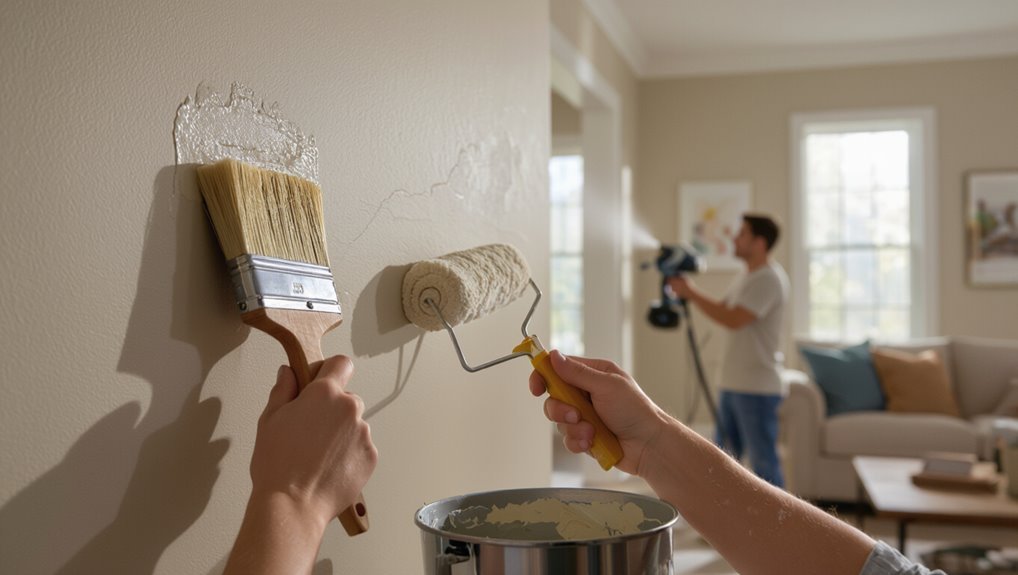
Start by choosing the right tool for each surface: brushes for trim and touch-ups, rollers for walls and ceilings, and a sprayer for large, flat areas or textured finishes.
Load brushes lightly, use a 3/8–1/2″ nap roller for smooth to semi-rough walls, maintain a wet edge, backroll sprayed areas for even coverage, and clean tools promptly with soap and water.
Step 5 Drying, recoating times, and curing
Drying and curing times tell you when a coat is safe to handle, repaint, and return to normal use, so pay close attention to temperature, humidity, and ventilation because they directly affect how quickly Behr paint dries.
Wait the label’s recommended recoat window—usually 1–4 hours for latex; 24 hours for full cure.
Cooler, humid rooms need longer; avoid heavy use until fully cured.
Common Problems and Mistakes with Behr Paint
You’ll run into a few predictable issues with Behr if you’re not careful: thinning too much or not enough can ruin coverage, and adhesion problems often stem from poor surface prep or incompatible primers.
Pay attention to color matching and sheen differences between samples and final coats, and remember that common DIY errors—like brushing over tacky paint or skipping proper drying times—cause most headaches.
I’ll outline causes and fixes so you can avoid these mistakes.
Under- or over- thinning issues
Thinning Behr paint too much or not enough will mess with coverage, finish, and drying time, so it’s important to follow the manufacturer’s recommendations and adjust only when necessary.
If you over-thin, colors wash out, sagging and runs increase, and sheen shifts.
If you under-thin, application becomes heavy, brush marks show, and lap lines appear.
Measure additives and test a small area first.
Poor adhesion causes and fixes
If you’ve been careful about thinning but still see problems, poor adhesion is the next common culprit to check.
You likely applied paint over dirty, glossy, or chalky surfaces. Fix by cleaning, deglossing, sanding, and using a quality primer or bonding primer.
Allow proper drying between coats, avoid painting in high humidity, and follow Behr’s surface-prep guidelines for lasting adhesion.
Color matching and sheen inconsistencies
When paint chips or samples don’t match your wall—especially across batches or under different lights—it usually comes down to color variation, sheen differences, or application technique.
You’ll want to confirm the exact color formula, check batch numbers, and view samples in the room’s light before committing.
If shades shift, request a rematch, compare finishes side-by-side, and insist on same-batch cans to avoid visible seams.
Typical DIY application errors
Color and sheen issues often point to deeper application problems, so it’s worth looking at the common DIY mistakes that create visible flaws with Behr paint.
You might skip proper prep, use wrong primer, overload the roller, or cut in poorly.
Inconsistent drying, painting in extreme temps, and failing to stir thoroughly also cause streaks, lap marks, and uneven coverage—fixable with correct technique.
Tips and Best Practices to Maximize Results
Before you start rolling, focus on prep that cuts the number of coats and gives a smoother finish—clean, sand, and prime where needed.
Use the right tools and accessories—high-quality rollers, angled brushes, and proper tape—to get even coverage with Behr products.
After painting, follow simple maintenance like gentle cleaning and touch-up techniques to keep walls looking fresh longer.
Prep tips that save coats and improve finish
Prep your walls correctly and you’ll cut the number of coats you need while getting a smoother, more durable finish.
Clean grime, sand glossy spots, fill holes, and prime stained areas so Behr adheres uniformly.
Work in thin, even layers and let each coat dry fully for true coverage.
- sponge-cleaned walls
- fine-sanded edges
- patched nail holes
- primed stains
- dust-free surface
Tools and accessories that work best with Behr
A few well-chosen tools will cut your work time and improve the finish when using Behr—grab a high-quality roller, a tapered angled brush for trim, a sturdy pole, and a good tray or liner to keep paint consistent.
Use microfiber rollers for smooth sheens, synthetic brushes for acrylics, quality painter’s tape, drop cloths, and a respirator or mask for ventilation.
Maintenance tips for longevity
To keep Behr-painted walls looking their best for years, follow a few simple maintenance habits: dust and wipe surfaces weekly with a soft cloth, clean stains promptly using mild soap and water, avoid abrasive cleaners, touch up chips with matched paint, control humidity to prevent peeling, and use felt pads on furniture to prevent scuffs.
Regular care preserves finish and color vibrancy.
Cost Considerations and Value Assessment
You’ll want to weigh price per gallon against coverage and durability so you can judge true cost rather than just sticker price.
Think about when paying more for Marquee’s one-coat performance and stain resistance actually saves time and money.
Finally, estimate how much paint a room needs and build a budget that includes supplies and touch-ups.
Price per gallon vs performance trade-offs
When weighing Behr’s price per gallon against performance, consider how upfront savings can cost you time and materials later—cheaper formulas often need more coats, stronger primers, or earlier touch-ups.
You’ll judge value by coverage, durability, and stain resistance. Calculate total gallons, primer, labor, and likely maintenance.
Sometimes mid-range Behr products deliver the best balance of cost and reliable results for typical interiors.
When paying more makes sense (upgrade to Marquee)
If your goal is fewer coats, longer-lasting color, and near-total stain blocking, paying up for Behr Marquee can make financial sense over the life of the job.
Choose Marquee when you need superior coverage, high-traffic durability, or to avoid frequent repainting.
The higher upfront cost often offsets labor, primer needs, and touch-ups, saving time and money long term.
Estimating quantities and budget for a room
A few simple measurements and a quick paint calculator will give you a realistic estimate of how much Behr you’ll need and what it will cost.
Measure wall square footage, subtract windows/doors, and factor coats.
Check Behr’s coverage per gallon, multiply by coats, then compare prices for Premium vs. Marquee.
Add primer, supplies, and a small contingency to finalize your budget.
Real-World Case Examples and User Scenarios
You’ll hear a quick step-by-step recap of a small bedroom repaint and the fresh, even finish it delivered.
You’ll see which Behr product handled a high-traffic hallway best and how it stood up to scuffs.
You’ll also get one user’s experience with stain-blocking in a busy kitchen and how cleanup went.
Small bedroom repaint step summary and outcome
Tackle your small bedroom repaint by breaking it into clear steps: assess lighting and prep needs, choose a suitable Behr interior finish and color, patch and sand surfaces, apply primer where needed, and roll two even coats while trimming carefully around edges.
You’ll see uniform coverage, good hide with quality Behr mid- to high-tier formulas, quick drying, and a durable, washable finish that brightens the room.
High-traffic hallway recommended product and results
When you’re choosing paint for a high-traffic hallway, pick a tough, washable Behr formula—like Marquee or Premium Plus Interior—in a satin or semi-gloss finish to resist scuffs and stand up to frequent cleaning.
You’ll notice fewer touch-ups, easy spot-cleaning with mild detergent, and durable coverage on trimmed edges. Colors stayed true after months; scuffs wiped away without paint loss.
Kitchen with stains stain-blocking and cleanup experience
If grease, tomato sauce, and coffee rings are your kitchen’s daily hazards, pick a Behr formula with stain-blocking properties—like Marquee or Premium Plus Ultra—and a satin or semi-gloss finish so stains stay on the surface and wipe away easily.
You’ll notice spills lift with a damp cloth, stubborn spots need mild detergent, and regular cleaning preserves finish—no constant repainting required.
Frequently Asked Questions
You probably have a few quick questions about Behr before you start painting, like whether Marquee really covers in one coat and when you’ll need primer on previously painted walls.
You’ll also want to know cure times, VOC/safety for kids and pets, and whether performance differs on textured versus smooth surfaces.
Below are concise answers to each of those points to help you decide.
Is Behr Marquee really one-coat coverage?
Curious whether Behr Marquee really delivers one-coat coverage? You’ll often get excellent hide on new, light-colored or similar-toned surfaces with the Marquee line.
However, bold colors, heavy stains, or dramatic color changes may still need a second coat. Expect superior pigment and coverage compared to many brands, but plan for touch-ups or extra coats when conditions aren’t ideal.
Can I use Behr paint without primer on previously painted walls?
Wondering whether you can skip primer on previously painted walls? You often can if the surface is clean, smooth, and the existing paint is in good condition—no peeling, stains, or drastic color changes.
Use Behr Marquee or Premium Plus for better coverage. Spot-prime stains or repaired areas.
When in doubt, prime; it guarantees adhesion and prevents peel or bleed-through.
How long does Behr paint take to cure fully?
Although the paint feels dry to the touch within a few hours, Behr latex paints typically reach full cure in 2–3 weeks under normal room conditions; oils and enamels can take longer, often 7–30 days.
You should wait that period before heavy cleaning, installing trim, or placing furniture against freshly painted walls.
Cure time varies with temperature, humidity, ventilation, and coat thickness.
Is Behr low-VOC and safe for homes with kids/pets?
How safe is Behr paint for homes with kids and pets?
Many Behr interior lines (like Marquee and Premium Plus) offer low-VOC or zero-VOC formulas, reducing odors and emissions.
You should ventilate during and after painting, keep kids and pets away until dry to the touch, and follow label safety guidance.
For allergy concerns, check specific product VOC certifications and SDS.
How does Behr perform on textured vs smooth walls?
If you’ve checked VOCs and safety for kids and pets, you’ll also want to know how Behr handles different wall textures.
You’ll find Behr’s thicker, pigmented formulas hide minor imperfections and grip textured surfaces well with fewer coats.
On smooth walls, Behr levels nicely and shows brush or roller marks less if you use proper nap and technique.
It sands and cleans up easily.
