
Can You Use Latex Paint in a Paint Sprayer? What You Need to Know
Yes — you can use latex paint in a paint sprayer, but you’ll need the right sprayer, prep, and technique to get good results. Thin and strain the paint as recommended, pick a compatible tip size and pressure, and test on a scrap to dial in atomization and coverage. Clean the sprayer immediately after use to prevent clogs. Follow manufacturer guidelines and safety practices, and keep going for practical tips, troubleshooting, and gear choices.
Can You Use Latex Paint in a Paint Sprayer? Quick Answer
Yes—you can use latex paint in many paint sprayers, but there are important caveats.
You’ll often need to thin the paint, strain it, and match the sprayer type and tip size to the paint’s thickness.
If you don’t prepare properly, you’ll risk clogging, poor atomization, and uneven coverage.
Direct short answer (yes/no) and immediate caveats
You can use latex paint in a paint sprayer, but only if you check compatibility and thin or strain the paint as needed; otherwise you’ll clog the sprayer or get poor coverage.
Yes — but only with the right sprayer, nozzle size, and thinning (or an acrylic-specific sprayer).
Test spray, strain, and follow manufacturer guidelines to avoid sputtering, runs, or damage.
Basic Understanding of Latex Paint and Sprayers
You’re working with latex paint, which is a water-based formula made for easy cleanup and flexible finishes.
Different sprayers—airless, HVLP, and compressed-air—use distinct mechanisms to atomize paint, so choosing the right type matters.
You’ll also need to manage paint viscosity, since too-thick latex can clog a gun while too-thin can cause runs and poor coverage.
What is latex (water-based) paint?
Latex paint, despite the name, is a water-based formulation that uses acrylic or vinyl resins as binders, making it easy to thin with water, quick to clean up, and less odorous than oil-based alternatives.
You’ll find it dries fast, resists yellowing, and offers flexible, durable films suited for walls, trim, and exterior siding; it’s user-friendly and widely available.
Common types of paint sprayers (airless, HVLP, compressed air)
Spray equipment falls into three main categories—airless, HVLP, and compressed-air—and each handles water-based latex differently, so you’ll want to match the sprayer to your project’s scale and finish needs.
You’ll choose based on speed, control, and cleanup.
- Airless: fast, handles thicker latex
- HVLP: fine finish, slower
- Compressed-air: traditional, needs skill
- Portability: consider size and power
How sprayers work and why paint viscosity matters
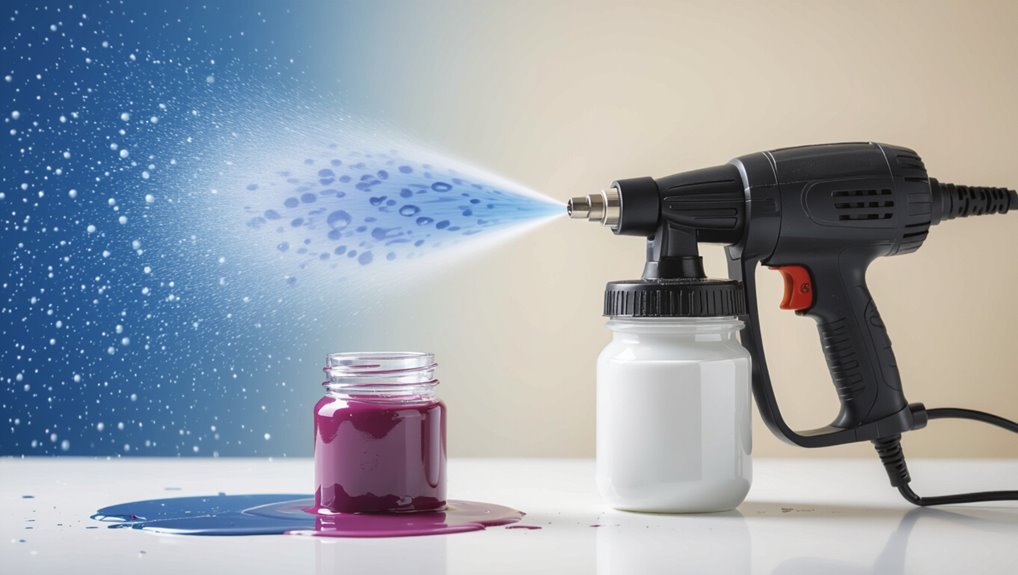
Because the sprayer has to break paint into a controlled cloud of tiny droplets, the paint’s viscosity directly affects atomization, flow, and finish—you’ll see different behavior from the same latex depending on the machine you use.
You’ll need thinner, tip size, and pressure adjustments: too thick clogs or splats, too thin runs and oversprays.
Match viscosity to sprayer and technique for even coverage.
Compatibility: Which Sprayers Work Best with Latex Paint
You’ll find airless sprayers handle latex well for large jobs because they spray thick coatings quickly. However, they can overspray and need stronger thinning and tip sizes.
HVLP sprayers give finer control and less waste for detail work, but they often need thinner paint and lower-viscosity latex to avoid clogging.
For commercial or specialty finishes, a conventional compressed-air sprayer still makes sense when you need the smoothest finish and can manage more prep and cleanup.
Using airless sprayers with latex paint benefits and limitations
While airless sprayers can handle latex paint quickly and evenly, they work best when you match the sprayer size and tip to the paint’s viscosity and the job scale.
You’ll get fast coverage and smooth finishes on large surfaces, but expect higher overspray, thicker atomization, and more cleanup.
Thin or strain latex, choose correct tip size, and test spray to avoid clogging and uneven coats.
Using HVLP sprayers with latex paint benefits and limitations
If airless sprayers give you speed and heavy laydown for large jobs, HVLP guns suit projects where control and a finer finish matter more than outright coverage.
You’ll enjoy less overspray, gentler atomization, and smoother results on trim, cabinets, and furniture.
HVLP handles thinned latex well but needs patience: slower output, frequent tip cleaning, and proper viscosity for consistent performance.
When to use a conventional compressed-air sprayer
When you need the ultimate control over atomization and finish, reach for a conventional compressed-air sprayer; these systems let you dial in air pressure and fluid flow independently, giving smooth, even coverage on latex without the heavy laydown of airless units.
Use them for fine trim, cabinetry, and furniture where reduced overspray, thin films, and a factory-like finish matter—prepare thorough masking and proper thinning.
Preparation: How to Get Latex Paint Ready for Spraying
Before you start spraying, you’ll want to thin the latex only as needed—usually with water or a manufacturer-approved additive—and follow recommended ratios to avoid over-thinning.
Strain the paint through a fine mesh or paint sock to catch lumps and skin that would clog your sprayer.
Finally, pick a compatible tip size and set the pressure to match the thinned viscosity and the job for a consistent spray pattern.
Thinning latex paint when and how much to thin (water vs. additives)
Though most modern latex paints are formulated for spraying, you’ll often need to thin them slightly to get the right flow and atomization for your sprayer.
Thin only if the sprayer sputters or leaves heavy texture. Use water for most jobs; additives for heavy-bodied or exterior paints.
- Test with 5–10% water
- Stir thoroughly
- Check spray pattern
- Add more in 5% increments
Straining and filtering paint to prevent clogs
Clogged spray tips ruin a run in minutes, so strain and filter your latex paint to catch skin, dried bits, and debris that’ll jam the sprayer.
Use a clean funnel and disposable filter bag, then pour into the sprayer cup slowly. Check and replace filters as needed.
- Funnel with 100–200 mesh filter
- Disposable paint sock
- Fine metal sieve
- Clean rags for wiping
Choosing the right tip/nozzle and pressure settings for latex paint
Once your paint’s been strained and filtered, pick a tip and pressure that match the latex’s thickness and the job size—too small a tip or too low pressure will spit and clog, while too large a tip or too high pressure wastes paint and overspray. Test on cardboard, adjust until you get an even fan.
| Tip size | Pressure | Use |
|---|---|---|
| 1.5–1.8mm | 1200–1600 PSI | Thin coats |
| 1.9–2.5mm | 1600–2200 PSI | Thick/multiple coats |
Step-by-Step: Spraying Latex Paint (Practical Guide)
Before you start, make the workspace safe and suit up with eye, mask, and skin protection.
Get your sprayer set up with the right tip and pressure, test-spray on a board to fine-tune, then spray using consistent distance, overlap, and speed.
When you’re done, flush the system and clean parts thoroughly to keep the sprayer working.
Step 1 Prepare the workspace and safety gear
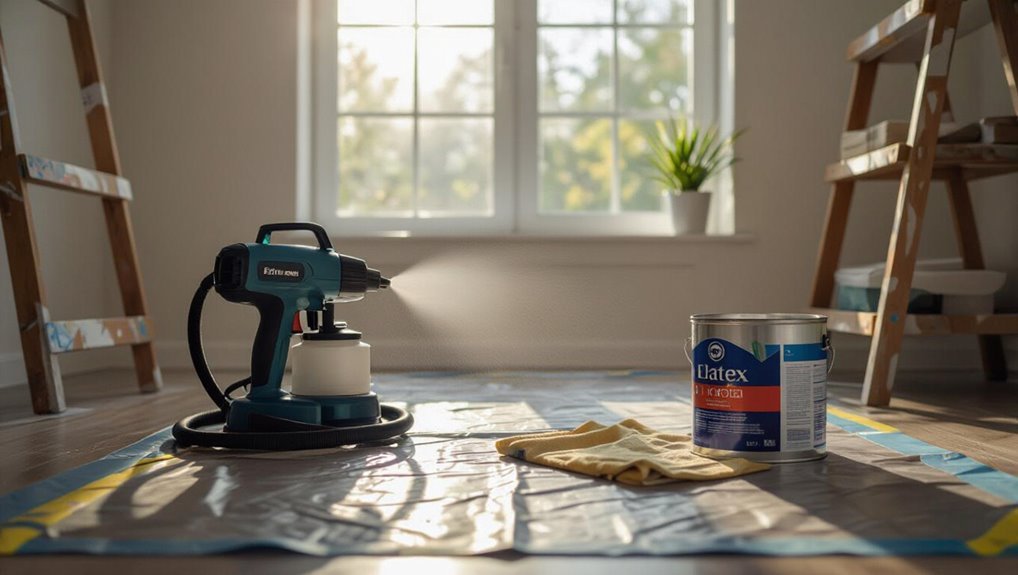
While you’re getting ready to spray, clear the room and set up protective barriers so paint and overspray stay where you want them.
Wear a respirator, goggles, and gloves. Turn off fans or cover vents. Keep a fire extinguisher nearby.
- Drop cloths on floors
- Plastic sheeting on furniture
- Tape along trim and windows
- Designate a ventilation path
Step 2 Prepare the sprayer and choose tip size/pressure
Set up your sprayer and pick a tip and pressure that match the paint and surface—this determines atomization, coverage, and how much thinning you’ll need.
Check manufacturer recommendations for tip size (usually .015–.021″ for latex), confirm the pump and filter are clean, install the correct tip, and set initial pressure moderate.
You’ll adjust later, but start conservative to avoid overspray and clogging.
Step 3 Test spray and adjust technique on a sample board
Now that your sprayer’s tip, filters, and pressure are in place, it’s time to test on a sample board so you can fine-tune technique and settings without risking the real surface.
Spray a few passes, note atomization, runs, and texture. Adjust pressure, tip size, or thinning as needed, then retest until coverage is smooth and consistent.
Record ideal settings for the job.
Step 4 Spraying technique: distance, overlap, speed
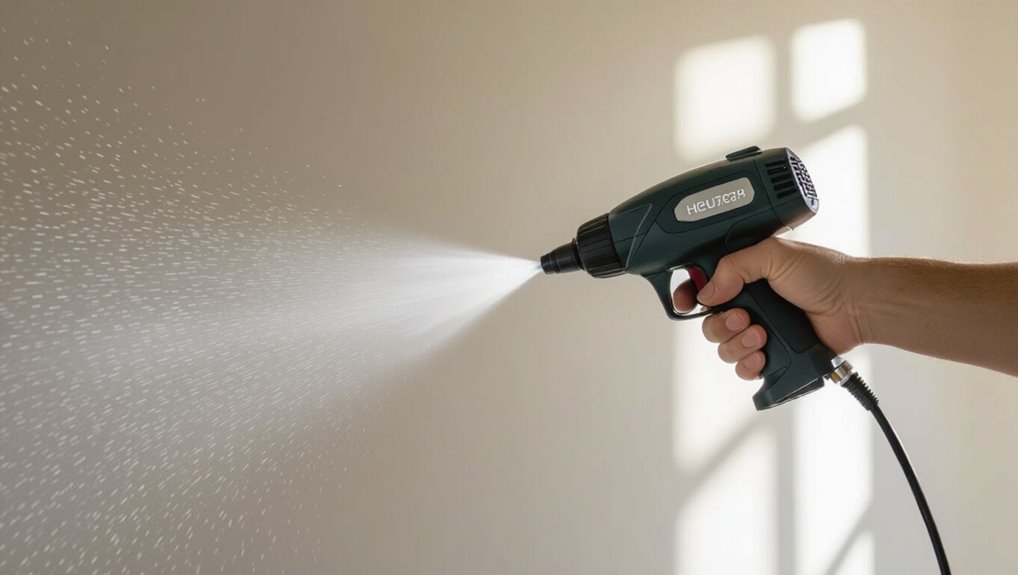
Aim for consistent motion and spacing when you start spraying—hold the gun perpendicular to the surface, keep it 8–12 inches away for most latex paints (adjust for tip size and atomization), and overlap each pass about 50% to guarantee even coverage without buildup.
Move steadily, using smooth, parallel strokes; don’t stop mid-panel. Adjust speed for atomization: slower for thin coats, faster for thicker sprays, avoiding runs.
Step 5 Cleanup and maintenance after spraying latex paint
Finish cleaning immediately after you’re done spraying to prevent latex from drying in the gun and clogging tips.
Flush the system with warm water until clear, then run a mild detergent through to remove residue.
Disassemble and soak removable parts, scrub tips and filters, dry thoroughly, and lightly lubricate moving parts.
Store components protected and inspect seals before the next use.
Common Problems When Spraying Latex Paint and How to Fix Them
You’ll run into a few common issues when spraying latex—clogs and spitting, orange-peel texture or heavy buildup, runs and sags, and adhesion problems.
I’ll show how to troubleshoot each one: cleaning and tip adjustments for clogs, thinning and technique fixes for texture and buildup, proper overlap and drying control for runs, and surface prep plus primer advice for peeling.
Follow these steps and you’ll get smoother, more durable results.
Clogging and spitting causes and fixes
When your sprayer clogs or spits, it usually means the paint, the tool, or your technique needs adjusting; pinpointing which one lets you fix the problem fast.
Check for thick or poorly mixed paint, clogged filters, or a worn nozzle.
Thin paint to manufacturer specs, clean or replace filters and tip, purge air pockets, and maintain steady trigger pressure to stop spitting.
Orange peel texture or heavy buildup prevention and correction
Orange peel texture and heavy buildup happen when paint doesn’t level out properly or you apply too much in one pass, leaving a bumpy, dimpled finish or ridges that show every stroke.
Prevent it by thinning paint per sprayer specs, keeping tip size appropriate, holding the gun steady and overlapping passes.
Fix light orange peel by sanding with fine grit and recoating; strip heavy buildup before reapplying.
Runs, sags, and uneven coverage troubleshooting steps
If paint starts running or sagging, or coverage looks blotchy, you can usually trace the problem to the spray technique, material prep, or equipment settings and fix it without redoing the whole job.
Adjust tip distance and speed, thin paint to manufacturer specs, lower pressure, overlap passes properly, and keep an even trigger rhythm.
Sand light drips, let coats cure, then recoat.
Poor adhesion or peeling surface prep and primer solutions
Fixing runs and uneven coverage is only part of the job — poor adhesion or peeling will undo your work faster than visible flaws.
You should clean, sand glossy or chalky surfaces, remove loose paint, and degloss where needed.
Apply a bonding primer or stain-blocking primer compatible with latex.
Test a small area, let primer cure, then spray latex for lasting adhesion and durability.
Tips, Best Practices, and Safety
To get smooth, professional results you’ll want to follow a few proven techniques for thinning, tip selection, and consistent overlap.
Pay attention to material and environmental factors like temperature and humidity, which can change how latex flows and dries.
Always prioritize safety: ventilate the area, wear appropriate PPE, and use a respirator when needed.
Best practices for smooth, professional results
When you prepare carefully and follow a few proven techniques, you’ll get smooth, professional results with a latex paint sprayer every time.
Clean, strain, and thin paint to spec. Test spray on cardboard. Keep a consistent distance and overlapping strokes. Wear PPE and ventilate.
- Use proper tip size
- Maintain steady motion
- Back-brush heavy spots
- Flush equipment after use
Material and environmental considerations (temperature, humidity)
After you’ve dialed in technique and equipment, pay close attention to materials and the environment—temperature and humidity heavily affect how latex paints atomize, flow, and dry.
Work between 50–85°F when possible; colder or hotter temps alter viscosity and film formation.
Keep humidity under 70% to prevent sagging or long cure times.
Store and condition paint before spraying for consistent results.
Safety precautions: ventilation, respirators, and PPE
Because spray application creates fine airborne droplets and odors, you need to control ventilation and wear proper respiratory protection and PPE before loading the sprayer.
Open windows, use fans, and block airflow to other rooms. Wear an NIOSH-rated respirator and eye protection.
Follow this checklist:
- Open cross-ventilation and exhaust
- NIOSH N95 or better respirator
- Goggles and face shield
- Disposable coveralls and gloves
Comparing Latex Paint vs. Oil-Based Paint for Spraying
When you’re choosing between latex and oil-based paint for a sprayer, consider dry time, durability, and cleanup: latex dries faster and cleans with soap and water, while oil-based stays tougher but needs solvents.
You’ll want latex for interior walls, quick jobs, and easy cleanup, and oil-based for high-wear trim or surfaces needing extra hardness.
Match the paint to the job and your sprayer’s compatibility to avoid finish or equipment problems.
Performance differences (dry time, durability, cleanup)
Although both latex and oil-based paints can produce smooth sprayed finishes, they differ markedly in dry time, long-term durability, and cleanup needs. You’ll notice latex dries faster, cleans with water, and resists yellowing; oil cures slower, buffs tougher, and needs solvent cleanup. Consider workflow and maintenance when spraying.
| Property | Latex | Oil-based |
|---|---|---|
| Dry time | Fast | Slow |
| Cleanup | Water | Solvent |
| Durability | Good | Very good |
When to choose latex over oil-based for a sprayer
If you want faster turnaround, easier cleanup, and better resistance to yellowing, choose latex for sprayer jobs where durability demands are moderate and environmental or quick-recoat concerns matter.
Use latex for interior walls, ceilings, trim that won’t face heavy abrasion, and outdoor siding with proper acrylic formulations.
Pick oil if you need extreme hardness, adhesion to problematic surfaces, or longer open time for leveling.
When Not to Use Latex Paint with a Sprayer
You shouldn’t spray every job—tight trim, textured walls, and small touch-ups often work better with a brush or roller for control and finish.
Avoid spraying paints or specialty finishes that need specific sprayers or extensive thinning, like some heavy-bodied enamels or certain industrial coatings.
If the product label or manufacturer recommends a different application, follow that guidance to avoid poor coverage or equipment issues.
Surfaces or projects better suited to brushing/rolling
When tackling trim, textured surfaces, or small touch-ups, reach for a brush or roller instead of a sprayer—those tools give you more control, less overspray, and a cleaner finish in tight spots.
Use brushes for edges, corners, and detailed trim; choose rollers for walls with pronounced texture or small rooms where masking would be tedious.
Save sprayers for broad, open areas.
Paints or finishes that require special sprayers or thinning
Brushing and rolling handle tight spots and textures better, but some paints and finishes simply won’t behave in a standard latex sprayer and need special equipment or thinning.
You shouldn’t spray heavy-bodied primers, elastomeric coatings, masonry or textured stucco paints, or oil-based enamels without the right high-pressure sprayer or manufacturer-recommended thinning.
Follow specs to avoid clogs, poor atomization, runs, and ruined gear.
Tools, Accessories, and Products to Improve Spraying Latex Paint
To get smooth, consistent results with latex in a sprayer, you’ll want the right tip sizes, filters, and an extension wand for reach and control.
Use approved additives like flow improvers and retarders to reduce splatter and manage drying time without harming finish quality.
Keep a kit of maintenance parts—seals, needles, cleaning brushes, and replacement filters—on hand to prevent clogs and extend the sprayer’s life.
Recommended tip sizes, filters, and extension wands
Although you can get by with a basic setup, choosing the right tip size, using proper filters, and adding an extension wand will make spraying latex paint faster and cleaner; each component affects coverage, finish, and clogging.
- Use 0.015–0.021″ tips for walls, 0.011–0.013″ for trim and cabinets
- Install inline and gun filters to catch lumps
- Pick a lightweight 4–6 ft extension wand
- Match tip to paint viscosity and pressure settings
Helpful additives and compatibles (flow improvers, retarders)
When you’re spraying latex, a few compatible additives can smooth out flow, slow drying for better leveling, and reduce tip clogs without compromising adhesion.
Use a manufacturer-recommended flow improver to reduce orange peel and improve atomization.
Add a retarder on hot days to prevent dry-edge laps.
Always follow mixing ratios and test a small batch for compatibility before full-scale spraying.
Maintenance tools and parts to keep the sprayer working
A few key tools and replacement parts will keep your sprayer performing reliably and save you time and money in the long run.
Keep extra nozzles, filters, and seals on hand, plus a dedicated cleaning brush set and wrench.
Replace worn hoses and o-rings promptly, use pump lubricant, and store parts dry.
Regularly inspect components to prevent clogs and costly repairs.
Cost and Time Considerations
You’ll notice a sprayer covers large areas much faster than brushing or rolling, but you’ll also need to factor in overspray and paint loss.
Think about whether you’ll save time and money by renting for a one-off job or buying if you’ll use a sprayer frequently.
Compare rental fees, purchase price, and cleanup time to decide what makes the most sense for your project.
Comparing speed and waste vs. brushing/rolling
Although sprayers can cover large areas far faster than brushing or rolling, they also demand more prep and careful technique to avoid overspray and waste. You’ll finish walls quicker but may use more paint without masking. Choose sprayers for speed; roll or brush for precision and minimal waste.
| Method | Trade-off |
|---|---|
| Sprayer | Faster, more overspray |
| Roller/Brush | Slower, less waste |
When renting vs. buying a sprayer makes sense
When you’re weighing cost against frequency of use, renting usually makes more sense for one-off jobs or occasional touch-ups because it keeps upfront expenses low and lets you use a higher-end unit without committing to ownership.
Buy if you paint frequently, need specific features, or want long-term savings.
Factor maintenance, storage, cleaning time, and resale value into your decision to avoid surprises.
FAQ
You’ll probably have a few practical questions about spraying latex, like whether you can use it straight from the can, how to keep the gun from clogging, and whether cleanup gets harder.
You’ll also want to know if you can switch between oil and latex in the same sprayer and which tip sizes suit exterior vs. interior work.
I’ll answer each clearly so you can pick the right prep, settings, and maintenance for your job.
Can I spray unthinned latex paint?
Can you spray unthinned latex paint straight from the can? You can with some HVLP or airless sprayers, but performance varies.
Thick paint may clog, spatter, or produce uneven coverage. Check your sprayer’s manual and test on scrap.
If flow seems poor, strain and thin slightly per manufacturer guidelines. Proper tip size and pressure adjustments also help maintain a consistent finish.
How do I prevent the sprayer from clogging mid-job?
1 simple routine prevents most mid-job clogs: keep the sprayer, tips, and filters clean, strain and thin paint as recommended, and flush the system regularly during breaks.
Wipe tip guards, check and replace clogged filters, monitor spray pattern, and pause to run cleaner or water through the gun every 15–30 minutes.
Use correct tip size and avoid letting paint sit in the hose.
Is cleanup harder after spraying latex paint?
Is cleanup harder after spraying latex paint? Not necessarily — latex cleans with water, so you’ll avoid strong solvents.
You’ll still need to flush the sprayer promptly, disassemble the tip and filter, and scrub parts with warm soapy water to prevent dried residue.
Use a brush and rinse until water runs clear. Quick cleanup prevents clogs and preserves sprayer life.
Can I switch between oil-based and latex in the same sprayer?
Wondering whether you can use the same sprayer for both oil-based and latex paints? Yes, but you must clean thoroughly between types.
Flush the system with appropriate solvent for oil-based, then water and detergent for latex, or follow manufacturer cleaning steps.
Replace filters and tips if contaminated.
Never mix finishes in the hopper or lines, and test-spray before resuming your project.
How do I choose the right tip size for exterior vs. interior projects?
Which tip size should you pick depends on what you’re spraying and where: exterior work usually needs larger tips to handle thicker coatings and faster coverage, while interior work benefits from smaller tips for finer atomization and less overspray.
For exterior siding, trim and decks use 0.017–0.021″ tips; for interior walls, cabinets and furniture use 0.009–0.015″ tips for control.
