
Are Ceilings Usually Painted With Flat Paint? Here’s Why
Yes — you’ll usually paint ceilings with flat paint because it has almost no sheen, so it hides surface flaws and reduces glare from overhead lighting. Flat finishes give a smooth, even look that’s forgiving on textured or imperfect ceilings, though they’re less washable than glossier options. In moisture-prone or high-traffic rooms you might pick eggshell or satin for durability. Keep going to learn how to pick the right sheen and prep your ceiling.
Quick Answer Are Ceilings Usually Painted with Flat Paint?
Yes — you’ll usually use flat paint on ceilings because it hides imperfections and reduces glare.
However, you might choose an eggshell or satin finish in high-traffic or moisture-prone areas where washability matters.
Consider the room’s condition and maintenance needs when deciding.
Direct Recommendation Summary
Although you can use other sheens, ceilings are most often painted with flat (matte) paint because it minimizes glare, hides imperfections, and gives a smooth, even look.
For most rooms, choose flat paint: it’s forgiving, looks uniform, and keeps focus off the ceiling.
If you need durability or washability, consider higher-sheen options only where necessary.
When exceptions apply
Flat paint is the default for ceilings, but there are times you’ll want something else.
If your ceiling gets splashed (kitchen, bathroom) choose a satin or eggshell for easier cleaning.
In rooms with low ceilings, a slight sheen can reflect light and feel brighter.
For accent ceilings or textured surfaces, pick a finish that hides flaws while matching durability needs.
Basic Understanding of Paint Sheens and Ceiling Needs
You’ll want to know that flat paint has very low sheen, hides imperfections well, and’s a common choice for ceilings.
Other sheens—matte, eggshell, satin, and semi-gloss—range from low to high reflectivity and durability.
Pick a sheen based on how much light you want reflected and how smooth or forgiving the ceiling surface needs to look.
What is flat paint?
Think of flat paint as the matte option in the paint world: it has no shine, hides imperfections well, and gives ceilings a smooth, uniform look.
- It reduces glare so ceilings appear even.
- It masks minor flaws and texture.
- It’s easy to touch up without noticeable seams.
- It’s less washable than glossier paints, so you’ll reserve it for low-traffic, overhead surfaces.
Other common sheens (eggshell, matte, satin, semi-gloss)
Beyond flat, paint comes in a few common sheens—eggshell, matte, satin, and semi-gloss—each balancing appearance and durability differently for ceilings and walls.
- Eggshell: subtle low sheen, more washable than flat, good for light traffic.
- Matte: close to flat but a touch more forgiving of imperfections.
- Satin: smoother, easier to clean, suits trim and walls.
- Semi-gloss: very durable, best for trim and high-moisture areas.
How sheen affects light reflection and surface appearance
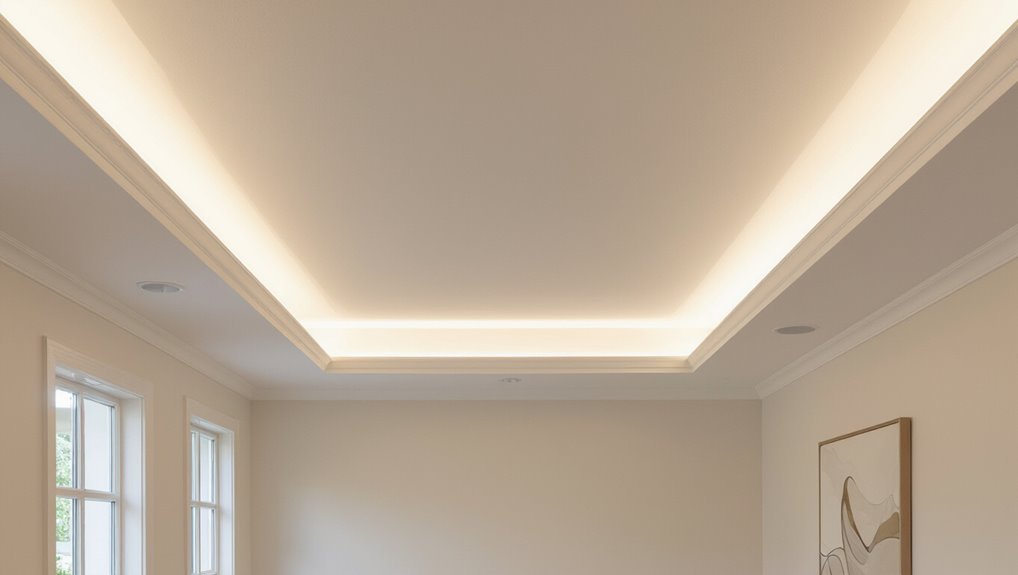
Because sheen controls how much light bounces off a surface, it directly changes how a ceiling looks and how imperfections show up.
You’ll notice glossier sheens reflect light, highlighting texture, patches, and brush marks. Lower sheens absorb light, muting flaws and creating a softer, more uniform appearance.
Choose sheen based on your ceiling’s smoothness, lighting, and desired visual effect.
Why Flat Paint Is Commonly Used on Ceilings
You’ll often see flat paint on ceilings because it hides imperfections and texture better than shinier sheens.
Its low light reflection keeps the ceiling looking uniform, which helps conceal bumps or uneven patches.
Flat finishes also work well with common ceiling materials like drywall, plaster, and popcorn, so you won’t fight compatibility issues.
Hiding imperfections and texture
When you step back and squint at a ceiling, flat paint helps disguise the small bumps, roller marks, and patchy texture that glossier finishes would highlight.
You’ll find it masks minor flaws, evens out inconsistent drywall seams, and softens repaired spots.
Using flat finish means you won’t chase perfection; the surface reads smoother, imperfections retreat, and rooms feel more finished without extra prep.
Low light reflection for uniform appearance
Along with hiding texture, flat paint keeps ceilings visually consistent by reflecting very little light, so shadows and bright spots don’t jump out.
You’ll notice rooms feel calmer and more unified because light spreads softly instead of creating glare. That muted finish reduces attention to lighting inconsistencies and helps paint appear the same across the whole ceiling, even under varied fixtures or bulbs.
Typical ceiling materials and compatibility (drywall, plaster, popcorn)
Most ceilings you encounter—drywall, plaster, and textured “popcorn”—respond well to flat paint because it hides imperfections and won’t highlight seams or bumps.
- Drywall: smooth, needs flat to mask joints.
- Plaster: often uneven; flat softens its look.
- Popcorn: textured surface benefits from low sheen.
- Maintenance: flat hides flaws but can be harder to clean; touch-ups blend well.
Situations Where You Might Choose a Different Sheen
If your ceiling is in a bathroom or kitchen, you might pick a higher-sheen paint for better moisture resistance.
In hallways or kids’ rooms where scuffs are likely, a more durable finish can stand up to cleaning.
And for contemporary looks, you may intentionally choose a slight sheen to catch light and highlight architectural details.
High-moisture rooms (bathrooms, kitchens) moisture resistance considerations
Because bathrooms and kitchens see constant steam, splashes, and humidity, you’ll often want a ceiling paint with better moisture resistance than flat finishes provide.
Choose satin or eggshell blends or moisture-rated flat formulas that resist mildew and staining. Proper ventilation and high-quality primer help adhesion.
These options clean easier, tolerate occasional wiping, and reduce peeling or discoloration in humid environments, extending the ceiling’s appearance.
High-traffic or scuff-prone areas durability needs
Humidity isn’t the only challenge ceilings face; areas with heavy foot traffic or where furniture and equipment brush against walls and lower ceilings demand tougher finishes.
In hallways, stairwells, garages, and playrooms, you’ll often pick eggshell or satin on lower walls or trim to resist scuffs and clean easily.
For low ceilings you encounter frequently, choose a more durable sheen where maintenance matters.
Modern design choices intentional sheen for aesthetic effect

Although flat paint is still the go-to for hiding imperfections, modern design often uses deliberate sheens to shape a room’s mood and focus.
You might choose a subtle satin or eggshell on a ceiling to add softness or reflect light in a controlled way.
You can highlight architectural details, create depth, or tie ceilings to trim finishes; just balance sheen with lighting and texture.
How to Choose the Right Paint Sheen for a Ceiling Step-by-Step
Start by evaluating the room’s function and moisture levels. Then inspect the ceiling’s condition and texture to see what sheen will work.
Match your sheen choice to how the room is lit and the look you want, and test samples on a small area before committing.
Finally, factor in paint quality and any primer needs to guarantee good coverage and durability.
Step 1: Assess room function and moisture levels
Because the room’s purpose and moisture levels affect durability and cleaning needs, you should evaluate both before picking a ceiling sheen.
For bathrooms, kitchens, or laundry rooms choose a moisture-resistant, washable sheen like matte or low-luster; for living rooms or bedrooms where humidity’s low, flat or eggshell hides imperfections and reduces glare.
Match sheen to traffic and ventilation.
Step 2: Inspect ceiling condition and texture
Once you’ve matched sheen to room use and moisture, check the ceiling’s condition and texture to see what that finish will reveal or hide.
Look for cracks, stains, popcorn or knockdown texture, and uneven patches. Flat sheens hide imperfections best; satin or eggshell will highlight texture and flaws.
Repair, sand, or prime as needed so your chosen sheen performs well.
Step 3: Match sheen to lighting and aesthetic goals
As you decide on a sheen, consider how light and style interact in the room: bright, direct lighting will reveal texture and brush marks, so a flatter finish keeps the ceiling looking smooth, while a slight sheen can add a subtle glow that complements modern or high-contrast decor.
Choose flat for hiding flaws and minimizing glare; pick low-sheen for durability and a faint reflective lift.
Step 4: Test samples on a small area
How will the finish actually look in your room? Test samples on a small area before committing.
Paint 12×12-inch patches of flat, eggshell, and satin near corners and light sources. Let them fully dry and observe at different times and angles to check sheen, texture, and imperfection visibility.
Note how each affects brightness and mood, then choose the one that best meets your goals.
Step 5: Consider paint quality and primer needs
Because a higher-quality paint and the right primer can change how a sheen performs, factor them into your ceiling decision now.
Choose durable, low-VOC ceiling paint to resist stains and provide even coverage. Use a bonding primer on patched or glossy surfaces and a stain-blocking primer where needed.
Higher-quality paints often hide imperfections better, reducing coats and touch-ups.
Painting Process and Best Practices for Ceiling Paint
Before you start, make sure the ceiling is clean, repaired, and primed so paint adheres properly.
Use the right tools—a dense-nap roller with an extension pole, angled brushes for cutting in, good-quality tape and drop cloths—and choose ceiling-specific paint when possible.
Work in consistent passes for even coverage, allow recommended drying and recoat times, and keep the room well-ventilated to speed curing and reduce fumes.
Surface preparation (cleaning, repair, priming)
1 step you shouldn’t skip: prepare the ceiling properly by cleaning, repairing, and priming it so your flat paint goes on smoothly and lasts.
- Remove dust, cobwebs, and grease with a mild cleaner.
- Patch cracks and holes; sand smooth.
- Address stains with stain-blocking primer.
- Prime new drywall or repaired areas to guarantee even absorption and adhesion.
Tools and materials recommended for ceilings
With the ceiling cleaned, patched, and primed, gather the right tools and materials so the paint goes on smoothly and you get professional-looking results.
- Quality flat ceiling paint (stain-blocking if needed).
- Sturdy roller frame, high-density nap roller cover.
- Extension pole, steady ladder, drop cloths.
- Angled brush, painter’s tape, sanding block, joint compound, bucket for mixing.
Application techniques for even coverage (rollers, extensions, cutting in)
Start by loading a high-density roller evenly and working in manageable sections so the nap lays down a uniform coat without drips.
Use an extension pole to keep steady pressure, overlap passes slightly, and maintain a wet edge.
Cut in around fixtures with an angled brush, feathering into rolled areas for seamless shift.
- Roller technique
- Extension control
- Cutting in
- Overlap strategy
Drying, recoat times, and ventilation tips
After you’ve finished cutting in and rolling a section, give the paint time to set before reloading the roller or moving to the next coat—drying time and proper airflow dictate when you’ll be ready to recoat.
Aim for manufacturer recoat times (often 2–4 hours for latex), keep windows open, run fans to exhaust moisture, avoid high humidity, and wait longer if temperatures are cool for a smooth finish.
Common Mistakes When Painting Ceilings and How to Avoid Them
Watch out for common ceiling mistakes that can ruin the finish: using too glossy a sheen creates glare, skipping primer over patches or stains lets flaws show through, and painting in poor light means you’ll miss spots.
Also match your roller nap and technique to the ceiling texture to avoid uneven appearance.
With a bit of planning you can prevent these issues and get a smooth, uniform result.
Using too glossy a sheen and causing glare
While a shinier sheen might seem easier to clean, choosing too glossy a finish for your ceiling can create unwanted glare and highlight surface imperfections—making rooms feel smaller and drawing attention away from your decor.
You should pick a low-sheen or flat finish to minimize reflections, hide minor flaws, and keep focus on furnishings.
Test samples under real lighting before committing.
Skipping primer on patched or stained ceilings
Glare and sheen problems are obvious, but another common mistake happens earlier: skipping primer on patched or stained ceilings.
If you don’t prime, patches can show through, stains may bleed, and new paint won’t adhere uniformly.
Apply a stain-blocking or universal primer to repaired areas, let it dry fully, then paint with your chosen ceiling finish for consistent coverage and long-lasting results.
Inadequate lighting during painting leading to missed spots
If you don’t set up good lighting before you start, it’s easy to miss thin spots, roller lines, or unpainted patches on a ceiling.
Use portable work lights or bright LED bulbs to cast even illumination across the surface. Move lights as you work, inspect from different angles, and touch up immediately to avoid noticeable defects once the paint dries.
Incorrect roller nap or technique causing texture differences
Good lighting helps you spot problems, but the way you load and roll the paint will determine whether the ceiling looks smooth or patchy.
Use the correct nap for your ceiling texture—short naps for smooth, medium for slight texture.
Don’t overload the roller or press hard; maintain even pressure and overlapping strokes.
Practice a full wet edge to avoid lap marks and texture inconsistency.
Maintenance and Cleaning for Different Ceiling Sheens
You’ll find that flat ceilings resist touch-ups but don’t take scrubbing well, while washable sheens handle gentle cleaning and spot-wipes with mild soap.
Use soft cloths and avoid abrasive pads or strong cleaners on any sheen to prevent scuffs or sheen changes.
If stains persist or the finish looks uneven after cleaning, plan a touch-up or repaint based on the durability of the original sheen.
Cleaning flat vs. washable sheens’ what works and what to avoid
When deciding how to clean ceilings, remember that flat and washable sheens respond very differently to scrubbing and cleaners.
- Test a hidden spot before using water or cleaner.
- Use a soft sponge and gentle detergent on washable sheens.
- Avoid aggressive scrubbing, bleach, or abrasive pads on flat paint.
- Blot stains; let surfaces dry fully to prevent texture damage or streaks.
When to repaint or touch up based on sheen durability
Cleaning habits tell you a lot about how long a ceiling’s finish will hold up, so use what you learned about gentle care to plan repainting or touch-ups.
If you clean rarely and notice stains or peeling, repaint sooner.
Washable sheens tolerate spot cleaning and delayed repainting; flat finishes show wear faster and need touch-ups or full repainting every few years in high-traffic areas.
Comparison Table of Ceiling Sheens and When to Use Them
You’ll find a quick sheen-by-sheen comparison (flat, matte, eggshell, satin, semi-gloss) helps you pick the right ceiling finish for durability, light reflection, and touch-up needs.
I’ll show where each sheen works best—like flat for hiding imperfections and semi-gloss for trim or high-moisture areas.
Use this table to match room function and maintenance expectations to the right sheen.
Sheen-by-sheen comparison (flat, matte, eggshell, satin, semi-gloss)
Although ceilings are often painted with flat paint, it’s worth comparing sheen levels—flat, matte, eggshell, satin, and semi-gloss—so you can match appearance, durability, and maintenance to each room’s needs.
| Sheen | Look | Best use |
|---|---|---|
| Flat | Ultra low | Hides flaws, living rooms |
| Matte | Soft | Bedrooms, low traffic |
| Eggshell | Subtle | Dining rooms |
| Satin | Slight sheen | Kitchens, bathrooms |
| Semi-gloss | Shiny | Trim, high moisture |
Cost and Environmental Considerations
You’ll notice price varies by sheen and brand, with flat paints often cheaper but premium low-sheen or washable formulas costing more.
Consider how quality affects coverage and the number of coats you’ll need, since that changes overall cost.
Also look for low-VOC or eco-friendly ceiling options so you’re not sacrificing indoor air quality for savings.
Price differences by sheen and quality
1. You’ll pay more for higher-sheen paints and premium formulations. Flat and matte finishes cost less, while eggshell, satin, and semi-gloss run higher per gallon.
Premium brands add pigment and durability, increasing price further. Factor in primer needs and coverage—better quality can reduce coats and labor.
Balance upfront cost against longevity to choose the most economical option.
Low-VOC and eco-friendly paint options for ceilings
After weighing sheen and quality against cost, you may also want to contemplate low-VOC and eco-friendly ceiling paints, since they can affect both your budget and indoor air quality.
You’ll pay more upfront but reduce fumes and long-term health risks.
Consider these factors:
- Certification and VOC levels
- Coverage and required coats
- Durability and maintenance
- Recycled or natural ingredients
FAQs
You’ve probably got questions like whether you can use semi-gloss on a ceiling or if flat paint hides stains better than other sheens.
You’ll also want to know if flat paint is harder to clean on ceilings, whether popcorn ceilings should always be painted flat, and how many coats of flat paint are usually needed.
Let’s answer each of these clearly so you can pick the right finish.
Can I use semi-gloss on my ceiling?
Can you use semi-gloss on your ceiling? Yes—you can.
Semi-gloss cleans easily and resists moisture, so it’s practical for bathrooms, kitchens, or high-traffic areas.
Expect more sheen and light reflection, which can highlight imperfections. Use careful prep, smoothing and priming first.
If you want durability and washability over a perfectly matte look, semi-gloss is a reasonable choice.
Does flat paint hide ceiling stains better than other sheens?
Wondering whether flat paint hides ceiling stains better than glossier sheens?
Yes — flat paint’s low sheen diffuses light, minimizing the appearance of hairline water marks, smoke residue, and texture variations.
It won’t erase severe discoloration, so you’ll still need stain-blocking primer or spot treatment first.
For subtle blemishes, flat finishes generally make ceilings look more uniform than satin or semi-gloss.
Is flat paint harder to clean on ceilings?
How hard is flat paint to clean on ceilings? You’ll find flat finishes less forgiving than eggshell or semi-gloss; they absorb dirt and resist scrubbing.
Light dusting and gentle spot-cleaning with a damp sponge usually help, but vigorous rubbing can dull or remove paint.
If you expect frequent cleaning, consider a more durable sheen or use washable flat formulations.
Should popcorn ceilings always be painted flat?
Should you always paint a popcorn ceiling flat? You don’t have to, but flat is common because it hides texture and minor flaws.
Consider room use: high-traffic or moisture-prone spaces might benefit from washable or semi-gloss options despite sheen highlighting texture.
If asbestos is possible, avoid disturbing the surface; consult a pro.
Test a small area first to confirm appearance and maintenance.
How many coats of flat paint are typically needed on a ceiling?
Typically you’ll need two coats of flat paint on a ceiling to get full, even coverage; a single coat can look patchy, especially over repaired areas or when changing from a darker color.
You’ll sometimes need a third coat for stubborn stains, deep colors, or textured surfaces.
Always prime bare drywall or stains first, and let each coat dry fully before reapplying.
