
How Long After Painting a Bathroom Ceiling Can You Shower? Don’t Rush This
You should wait at least 24 hours before taking a full, steamy shower after painting a bathroom ceiling to avoid softening or tackiness, though quick-dry latex with strong ventilation may allow a brief cool shower after 4–6 hours. Oil-based paints need longer—often 24–48 hours to handle humidity and up to a week to fully cure. Check for no tack, run exhaust fans, and test a short, low-steam wash; more tips follow below.
Quick Answer How Long to Wait Before Showering After Painting a Bathroom Ceiling
If you used latex paint, wait about 2–4 hours for light showers and 24 hours for full steam.
Oil-based needs 24–48 hours, while quick-dry formulas can be comfortable in 1–2 hours.
You can shower sooner for basic safety, but rushing risks tacky spots or finish damage.
Weigh the small safety advantage of earlier use against letting the paint cure for best durability and appearance.
Direct time ranges for common paint types (latex, oil-based, quick-dry)
Timing matters when you plan to shower after painting a bathroom ceiling: with standard latex paint, wait at least 24 hours for the surface to cure enough to resist humidity, though full cure can take 2 weeks.
Oil-based paints usually need 48–72 hours before you expose them to steam, with full cure up to 7 days.
Quick-dry formulas can be touch-dry in 1–2 hours and often tolerate light humidity within 4–6 hours, but give them a full 24 hours for reliable resistance.
How long after painting bathroom ceiling can I shower? Follow those ranges, adjust for ventilation and manufacturer instructions.
Short summary of safety vs. finish quality trade-offs
Because moisture and solvents affect both safety and appearance, you’ll need to balance how soon you shower against the paint’s drying stage: weigh health and odor (ventilate, avoid fumes) against finish risks (tacking, streaks).
If you need to use the shower early, wait until tack-free; for best durability and flawless sheen, give full cure time before regular steamy use.
How Paint Drying Works Basic Understanding
You should know that “dry” and “cured” aren’t the same: paint can feel dry to the touch long before it reaches full strength.
Drying and curing times depend on temperature, humidity, ventilation, and how thickly you applied the paint.
Bathrooms often slow curing because they’re humid and poorly ventilated, so plan extra time before heavy use.
Difference between drying and curing
Although both terms describe changes after you paint, drying and curing are different stages: drying happens when solvents or water evaporate and the surface feels dry, while curing is a chemical process where the paint fully hardens and reaches its maximum durability.
You’ll notice dryness quickly, but full curing takes longer; handle freshly painted ceilings gently until curing completes to avoid marks or reduced longevity.
Factors that affect drying/curing time (temperature, humidity, ventilation, paint thickness)
Now that you know the difference between drying and curing, it’s helpful to look at what controls how fast each stage happens.
Temperature speeds chemical reactions, humidity slows evaporation, and good ventilation removes moisture and solvents.
Thicker coats take longer to dry and cure. You should aim for warm, dry, well-ventilated conditions and apply thin, even layers to shorten waiting time.
Why bathrooms are different from other rooms
Because bathrooms trap moisture and see frequent temperature swings, paint there faces tougher conditions than in other rooms.
You’ll notice higher humidity from showers, rapid condensation, and less steady airflow, all slowing drying and extending cure time.
Mold-prone surfaces and repeated wetting demand mildew-resistant, quick-dry formulations.
You should boost ventilation and wait longer before exposing the ceiling to steam or splashes.
Recommended Waiting Times by Scenario
If you used water-based (latex) ceiling paint, you’ll usually wait a few hours to touch dry and about 4–6 hours before recoating.
Oil-based or alkyd paints take longer—expect 8–24 hours to dry and up to 48 hours before heavy use.
Fast-dry or low-VOC formulas cut those times, but always follow the label for multiple coats and proper recoating intervals.
Fresh coat of water-based (latex) ceiling paint recommended wait times
When you’ve applied a fresh coat of water-based (latex) ceiling paint, the wait time before you can recoat, ventilate heavily, or reinstall fixtures depends on temperature, humidity, and the paint’s formulation; typical scenarios are listed below with practical timing recommendations.
In cool, humid bathrooms wait 24–48 hours.
In warm, dry conditions you can recoat in 2–4 hours and shower gently after 24 hours.
Oil-based enamel or alkyd ceiling paint recommended wait times
Switching from water-based formulas to oil-based enamel or alkyd paints changes drying behavior and recommended wait times.
You’ll wait longer before showering: tack-free in 6–8 hours, dry to touch in 12–24 hours, and fully cured in 5–7 days under normal conditions.
For high humidity or poor ventilation add a few days.
Confirm adequate ventilation while curing to reduce fumes and moisture issues.
Fast-dry or low-VOC paints recommended wait times
Because fast-dry and low-VOC formulations cure differently than traditional paints, you’ll see shorter wait times but still need to account for conditions like humidity and ventilation.
Generally, you can shower lightly after 4–6 hours if the room is warm and well-ventilated; in cool, humid bathrooms wait 12–24 hours.
For heavy steam or continuous moisture, aim for 24–48 hours to guarantee proper cure.
Multiple coats and recoating intervals
1–3 coats are typical for bathroom ceilings, and you should respect the paint maker’s recoat window plus room conditions to avoid lifting or texture issues.
If humidity’s high, wait the full recommended interval between coats—often 2–4 hours for fast-dry, 24 hours for conventional latex.
For primer plus two finish coats, allow final cure 24–48 hours before heavy moisture exposure.
Step-by-Step: How to Prepare and Test a Painted Ceiling Before Showering
Right after painting, you’ll want to ventilate the room and control humidity while keeping the temperature and airflow steady to speed drying.
Test the finish with a gentle touch and tack check, then decide whether a brief cold shower is safe or if you should wait for fuller cure.
Finally, do a quick final inspection of the paint before exposing it to heavy steam.
Step 1 Ventilate and control humidity immediately after painting
Start by running ventilation and reducing humidity as soon as the paint feels dry to the touch; opening windows, switching on an exhaust fan, or running a dehumidifier helps paint cure evenly and prevents moisture-related problems like bubbling or mildew.
Keep fans running for several hours, avoid steaming the room, and use a hygrometer to confirm relative humidity stays below about 50% while the coating hardens.
Step 2 Monitor temperature and air circulation for optimal drying
With vents running and humidity lowered, next pay attention to temperature and air movement to help the paint cure fully before you shower.
Keep the room between 65–75°F (18–24°C); cooler slows curing, hotter can trap solvents.
Aim for steady, gentle airflow—ceiling-level fans or a slightly open door help.
Avoid blasting heat or direct drafts that can cause uneven drying.
Step 3 How to perform a touch and tack test safely
1 simple test will tell you if the ceiling paint’s surface is ready: the touch-and-tack check.
Wait the recommended drying time, then gently press a clean fingertip to an inconspicuous spot for one second.
If no paint transfers and the surface feels firm, it’s tack-free.
If it sticks or smudges, wait longer and retest periodically until fully non-tacky.
Step 4 When to run a brief cold shower vs. waiting for full cure
After the touch-and-tack check shows the paint is non-tacky, you can decide whether a brief cold shower is safe or if you should wait for full cure.
If paint feels dry and manufacturer’s minimum recoat time has passed, run a short, cool rinse to test humid exposure.
If any softening, odor, or sheen change appears, stop and wait the full cure time before using steam.
Step 5 Final checks before heavy steam exposure
Before you expose the ceiling to prolonged steam, run a final checklist to confirm paint integrity and bathroom readiness:
Inspect for tackiness, soft spots, or bubbles; verify ventilation fan works and windows open; remove wet towels and cover fixtures;
Test a short, low-steam run for 5–10 minutes while watching the ceiling; if no issues appear, you can gradually increase steam exposure over subsequent showers.
Tools and Methods to Speed Up Safe Showering Time
You can speed up safe showering by using fans, dehumidifiers, and heaters in targeted ways to dry paint faster and reduce fumes.
For small bathrooms, set up a window fan or inline exhaust with a circulating fan to move air, and place a dehumidifier near the wet surface while keeping airflow away from the painted ceiling.
If you use a low-heat hair dryer or portable heater, keep it at a safe distance, use low settings, and monitor temperature to avoid softening the paint or creating a fire hazard.
Using fans, dehumidifiers, and heaters effectively
When you need to speed drying so you can shower sooner, use fans, dehumidifiers, and heaters together to control humidity and airflow; each tool has a specific role—fans move moist air away, dehumidifiers pull water vapor from the air, and heaters raise temperature to accelerate evaporation—so position and run them properly to avoid trapping moisture against the fresh paint.
- Point fans toward exhaust.
- Run dehumidifier continuously.
- Use low, even heat.
Recommended ventilation setups for small bathrooms
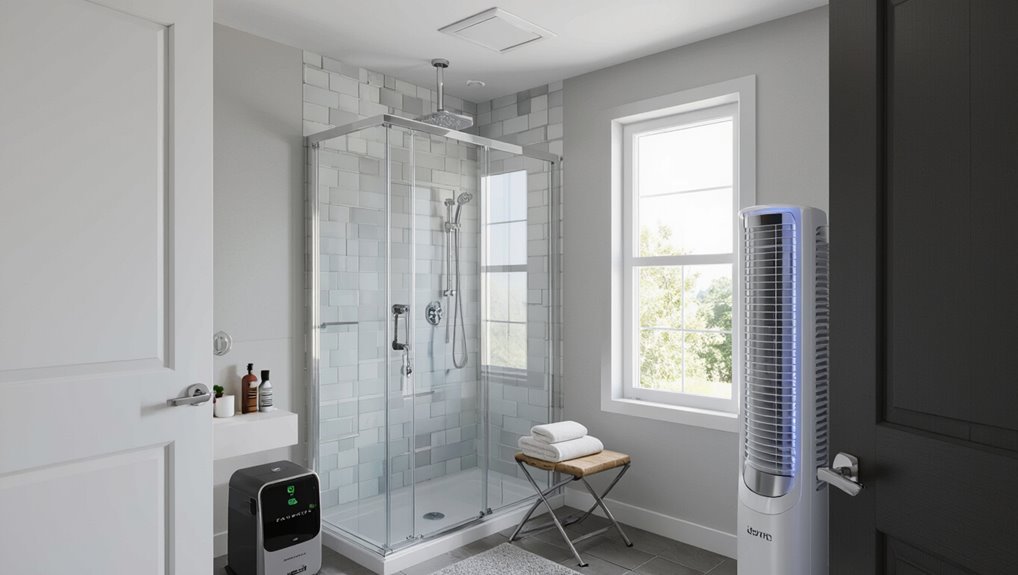
1 practical ventilation setup for a small bathroom combines an exhaust fan, a compact dehumidifier, and a portable heater placed to promote cross-flow;
position the exhaust fan to pull moist air out, aim the portable fan or heater so air moves toward that exhaust, and run the dehumidifier continuously at a low setting to keep humidity down without blowing moisture back onto the ceiling.
Use timers and keep door gaps clear.
When and how to use low-heat hair dryers or portable heaters safely
If your bathroom’s still slightly damp after painting, low-heat hair dryers and portable heaters can speed drying and let you shower sooner—used sparingly and with care.
You should keep devices at least 3 feet from painted surfaces, move them continuously to avoid hot spots, and never leave them unattended.
Use a timer, low settings, and guarantee good ventilation to dissipate fumes safely before showering.
Common Mistakes That Cause Paint Failure in Bathroom Ceilings
If you shower too soon you’ll see tacky spots, bubbling, or peeling that mean you’ll have to rework the ceiling.
Painting in high humidity or without ventilation traps moisture and prevents proper curing, which shortens the paint’s life.
Also avoid overly thick coats or skipping primer, since they cause poor adhesion and longer drying times that lead to failure.
Showering too soon symptoms and consequences
When you shower too soon after painting, you’ll often notice the paint softening, bubbling, or sticking to towels and fixtures — early signs that moisture has interrupted curing.
You’ll also see patchy sheen, tacky spots, and peeling edges within days. That damage forces sanding, spot repairs, or a full repaint sooner than expected, wasting time, materials, and money.
Painting in high humidity or without ventilation
Not letting painted surfaces fully dry before showering is often a symptom of a bigger issue: painting in high humidity or without proper ventilation.
You’ll trap moisture, slow curing, and invite blistering, peeling, or mildew.
Use dehumidifiers, run exhaust fans during and after painting, and wait for manufacturer-recommended dry times.
Proper airflow speeds drying and prevents premature failure, so don’t skip ventilation.
Applying coats too thickly or skipping primer
Because thick, hurried coats look like they’ll save time but actually cause problems, you should apply paint in thin, even layers and always prime bare or patched surfaces first.
If you paint too thickly, it sags, bubbles, and dries unevenly, inviting mildew in bathrooms. Skipping primer reduces adhesion and hides stains.
Take time: thin coats and proper priming guarantee durability and quicker cure.
Prevention and Best Practices for Long-Lasting Bathroom Ceiling Paint
To keep your bathroom ceiling paint lasting, pick a mildew-resistant formula and the right sheen—semi-gloss for moisture-prone areas or flat if texture hides imperfections.
You’ll want to prime and prep the surface thoroughly, paint in moderate temperature and humidity, and use good ventilation while it cures.
Finally, protect your finish with regular ventilation, quick mold checks, and prompt touch-ups where moisture or peeling appears.
Choosing the right paint (mildew-resistant, semi-gloss vs. flat)
When you pick paint for a bathroom ceiling, prioritize mildew-resistant formulas and a finish that suits moisture and visibility needs: semi-gloss repels moisture and wipes clean easily, while flat hides imperfections but can trap humidity and stain more readily. Choose semi-gloss where cleaning matters; use flat only in very low-moisture bathrooms.
| Finish | Moisture Resistance | Visibility |
|---|---|---|
| Semi-gloss | High | Shows flaws |
| Flat | Low | Hides flaws |
Proper priming and surface preparation
Preparation matters: you should clean, repair, and prime the ceiling before painting so the finish lasts in a humid bathroom.
Remove mold, grease, and loose texture; sand glossy areas. Patch cracks and nail holes, then apply a mildew-resistant primer that bonds to drywall or plaster.
That creates a uniform surface, seals stains, and improves topcoat adhesion so paint resists peeling and discoloration.
Ideal environmental conditions to paint in bathrooms
Even though ceilings are out of the direct spray of showers, you should paint only when humidity is low and temperatures are steady so the primer and topcoat can dry and cure properly.
Aim for 40–50% relative humidity and 50–75°F (10–24°C).
Guarantee good ventilation with fans or open windows, avoid painting before heavy storms, and let each coat fully dry before applying the next.
Maintenance tips to protect paint from moisture over time
Good ventilation and proper drying laid the foundation; now you’ll want simple routines and smart choices to keep that ceiling looking fresh despite bathroom moisture.
You should:
- Wipe condensation promptly and run exhaust fans during and after showers.
- Inspect for peeling or mold quarterly; touch up with mildew-resistant paint.
- Maintain humidity below 50% with a dehumidifier or timed fan to prevent damage.
Troubleshooting: If Paint Blisters, Peels, or Smells After Showering
If you notice small blisters or tacky spots after showering, you can often pop them, let the area dry, then sand, spot-prime, and repaint.
For larger peeling or persistent odor problems that return after repairs, sand back to sound substrate and recoat with a mildew-resistant primer and paint.
Call a professional if moisture damage is widespread, mold is visible, or the problem keeps coming back despite proper prep.
Quick fixes for small blisters or tacky spots
Spot treat small blisters or tacky spots as soon as you spot them to prevent bigger problems—lightly sand the area, wipe away dust, and apply a thin coat of compatible paint or primer to reseal the surface.
Let it dry fully, then test for tackiness. If it stays tacky or blisters recur, stop shower use in that bathroom and address ventilation or moisture sources before further painting.
When to sand, spot-prime, and repaint
When paint blisters, peels, or still smells after a shower, don’t repaint right away—you should assess, sand, and spot-prime only after the surface is fully dry and you’ve identified the moisture source.
Remove loose paint, sand feathered edges smooth, clean the area, and apply a mildew-resistant primer to affected spots.
Let primer cure per instructions before repainting with appropriate bathroom paint.
When to call a professional
Because persistent blistering, peeling, or lingering odors after showers often signal underlying moisture or ventilation problems, call a pro when you’ve fixed obvious surface issues and the problem keeps returning or covers more than a few square feet.
A contractor will diagnose leaks, insulation gaps, or vent failures, recommend remediation (repair, mold removal, ventilation upgrade), and guarantee repainting uses appropriate primers and moisture-resistant coatings.
FAQ
You’ll find quick answers here to common worries like whether you can shower 24 hours after painting and if steam will damage fresh paint.
You’ll also learn how long to wait for a hot steam shower, whether it’s okay to run the exhaust fan right away, and how paint brand or VOC level can change the timeline.
If you have specific conditions or paint types, mention them so you get the most accurate guidance.
Can I take a shower 24 hours after painting a bathroom ceiling?
Wondering if you can shower 24 hours after painting a bathroom ceiling?
Usually you can, but it depends on paint type, ventilation, and humidity.
Latex paints often dry to touch within a day, but full cure takes longer.
Wait if paint still feels tacky or smells strong.
Boost airflow and keep showers brief and cool to minimize risk until paint fully cures.
Will steam from a shower ruin freshly painted ceilings?
If you felt comfortable showering 24 hours after painting, you probably still worry that steam could damage that fresh finish.
Steam alone usually won’t ruin fully dry, quality paint, but it can soften paint that’s not cured. You should minimize heavy, prolonged steam exposure and ventilate the room.
Use an exhaust fan or open a window to protect the ceiling while paint continues curing.
How long before a freshly painted ceiling is safe for a hot steam shower?
Although paint can feel dry to the touch within a few hours, you should wait at least 24–48 hours before taking a hot, steamy shower over a freshly painted bathroom ceiling; that gives most latex paints time to set enough to resist softening from brief steam exposure.
For oil-based paints, wait 72 hours or longer.
If humidity’s high, extend drying time before steaming the room.
Is it safe to use the exhaust fan right after painting?
You can and should run the exhaust fan after painting to help remove fumes and speed drying, but do it with care.
Keep windows open if possible, and run the fan continuously for at least several hours.
Avoid blasting high humidity near wet paint; make certain the fan motor won’t spray or drip onto the ceiling.
Turn it off once paint feels dry to touch.
How does paint brand or VOC level affect waiting time?
Because different brands formulate paints differently, the waiting time can vary—lower-VOC and water-based paints generally dry and off-gas faster than high-VOC solvent-based formulas.
So check the manufacturer’s recommended recoat and ventilation times and plan accordingly.
Choose low-VOC to shorten odor and cure time, ventilate well, and wait longer for oil-based or unknown-brand paints before showering to avoid moisture issues and fumes.
