
How to Paint a Sample on the Wall and Actually See the True Color
To see a paint’s true color, paint at least a 2×2-foot swatch on the actual wall (or a primed board) using the recommended number of coats and let it fully dry; use even strokes, label each sample, and place them where the room’s light hits. Check the samples morning, midday, evening, and under artificial light, and view them next to trim and flooring to spot undertones and sheen shifts. Keep going to learn practical tips for reliable, confident choices.
Quick Answer How to Paint a Sample on the Wall and See the True Color
Paint a 6×6-inch swatch with your chosen paint using a brush or small roller for the fastest, most accurate peek at the color.
This quick method works best when you need a rapid comparison under normal room lighting, but it may not show subtle shifts that appear on larger surfaces or in different light throughout the day.
If you need total confidence, test a larger patch and check it at morning, midday, and evening.
One-sentence summary of the fastest method
If you want the quickest way to see the true color, brush or roll a 12-inch square of the sample onto the wall, let it dry fully, and view it at different times of day and under both natural and artificial light.
For how to paint a sample on the wall, apply even strokes, avoid thin coats, and step back to compare the swatch to surrounding finishes before deciding.
When this method is best and limitations
That quick 12-inch swatch method works best when you need a fast, reliable read on color in the actual lighting and beside the actual finishes it will meet; you’ll get accurate results in rooms with consistent light (like north- or south-facing spaces) and on typical wall textures where a single, full-strength coat represents the finished look.
It’s less useful in rooms with variable light, textured surfaces, or when multiple coats, sheens, or neighboring colors affect perception.
Basic Understanding Why Wall Samples Look Different Than Swatches
When you test a paint sample on the wall, the color will change with natural versus artificial light and the angle of the light.
Sheen, texture, underlying paint or primer, and the paint’s opacity and pigments also shift how the hue reads.
Pay attention to application thickness and surface undertones, because they can make a swatch look nothing like the wall sample.
How light affects paint color (natural vs artificial)
Because light changes throughout the day, the same paint can look strikingly different on your wall than it does on a flat swatch.
Observe samples at morning, midday, and evening under natural light, then under your home’s artificial bulbs.
Cool daylight boosts blues; warm bulbs emphasize yellows and reds.
Move or view samples from different angles to judge true, lived-in color.
The role of sheen and texture
Sheen and texture change how light plays on paint, so a color that looks flat on a swatch can read very different on a wall.
You’ll notice gloss reflects more light, boosting vibrancy and hiding flaws. Matte soaks light, muting color and emphasizing texture.
Test your finish choice—roll or brush samples with the aimed sheen to judge the true appearance before committing.
Surface color and undertones (priming, existing paint)
Gloss and texture affect light, but the wall beneath your sample can change color just as much.
If existing paint is darker or has a strong undertone, your new swatch will shift.
Prime or spot-prime to neutralize underlying hues so the sample shows the desired tone.
Test over both primed and unprimed areas to compare results before committing.
Paint opacity, pigments, and application thickness
When you paint a sample on the wall, the paint’s opacity, pigment load, and how thickly you apply it will directly change how the color reads compared with the thin paper swatch.
Thicker coats hide underlying tones and deepen hue; thinner coats reveal substrate and look lighter.
High pigment paints show truer color sooner, while low-opacity formulas need more coats to match the swatch.
Materials and Tools You Need Before You Start
Before you paint, gather the right sample sizes—small sample pots, tester sachets, or peel-and-stick swatches—and choose the type that fits your budget and needs.
You’ll also want brushes or mini rollers, painter’s tape, primer, and mixing sticks on hand.
Decide whether to test directly on the original wall or on portable test boards so you can compare finish and color under different lighting.
Recommended sample sizes and types (sample pots, testers, peel-and-stick)
Choosing the right sample type and size makes the difference between guessing and knowing how a color will read on your wall.
Use 8–12-inch painted swatches for accurate viewing; three coats if matching finish. Sample pots cover several small areas; testers are great for single large rectangles.
Peel-and-stick swatches help visualize pattern and texture but won’t show true finish or depth.
Tools: brushes, mini rollers, painter’s tape, primer, mixing sticks
Tools make the difference between a messy trial and a clean, reliable paint sample, so gather a few key items:
a small angled brush for cutting in,
a 3–4″ mini roller with a smooth or light-textured nap,
painter’s tape,
a primer (or tinted primer if covering a dark color),
and a stir stick for mixing.
Add a damp cloth to wipe edges,
a tray,
and spare roller covers.
Surfaces to test on: original wall vs. test boards
While you can test paint directly on the original wall, try also using test boards so you can move samples into different lighting and compare finishes side-by-side.
You’ll see how texture, undertones, and sheen change. Test both surfaces, note differences, and pick the option that reflects the room best.
- original wall for real context
- primed board for neutrality
- different sheens side-by-side
- test near windows and lamps
- label each sample
Step-by-Step: How to Paint a Sample on the Wall
You’ll start by choosing test spots around the room—pick areas with different light exposure and a few focal points.
Prepare each spot (clean, sand, and spot-prime as needed), then mark, tape, and label evenly spaced sample squares.
If required, apply a primer/base, then paint the test areas with the proper number of coats and allow adequate drying between coats.
Step 1 Choose test locations around the room (light exposure, focal points)
Pick three to five spots around the room to test, focusing on areas that get different light and the room’s main focal points so you can see how the color changes with viewing angle and brightness.
Include a bright window wall, a shaded corner, and the wall behind where furniture or artwork will sit.
Note traffic sightlines and high-visibility areas for final decision.
Step 2 Prepare the wall (cleaning, sanding, spot-priming)
Now that you’ve identified the test spots, get the wall ready so the paint sample shows true color and texture.
Wipe dirt and grease with mild detergent, rinse, and let dry.
Sand glossy or uneven areas lightly, remove dust, and fill small holes with spackle.
If the surface has stains or drastic color differences, spot-prime those patches so the sample adheres and reads accurately.
Step 3 Mark and tape sample areas (size, spacing, labeling)
3 simple marks will keep your paint samples organized and easy to compare.
Measure and mark rectangles about 8–12 inches square, spaced 6–12 inches apart to prevent bleeding and color influence. Use painter’s tape to create crisp edges and label each sample with its color name, formula, and date.
Numbering helps record notes and compare results under different lighting.
Step 4 Apply primer or base coat if needed (when to prime)
Before you apply paint samples, decide whether a primer or base coat is necessary and put it on where needed; doing so guarantees true color and even coverage.
If the wall has stains, drastic color contrast, or porous texture, prime those sections. Use a tinted primer to match lighter or darker samples.
Let primer dry fully before marking sample zones and painting.
Step 5 Apply test paint correctly (number of coats, drying time)
When you’re ready, apply the test paint in the same way you’ll paint the whole wall so the sample reflects real coverage and sheen.
Use the number of coats you’d normally use, letting each coat dry fully per manufacturer instructions.
Keep edges clean, maintain consistent strokes, and note finish differences after recommended drying.
Avoid touching or rushing between coats.
Step 6 Observe samples throughout the day and night (timing checklist)
Now that your test coats are dry, watch the samples at different times to see how light and shadows change the color and sheen.
Check them morning, midday, afternoon, evening, and under artificial light to note shifts. Record observations and photos so you can compare.
- Morning sunlight (cool, low angle)
- Midday (bright, neutral)
- Afternoon (warm, angled)
- Evening (dim, warm)
- Artificial light (bulbs, fixtures)
Step 7 Compare samples in context (furniture, flooring, trim)
Step 7 brings the samples into the room’s full context so you can see how each color reads against your furniture, flooring, and trim; place samples near sofas, wood tones, and baseboards to evaluate harmony and contrast.
Move around, view from seating and entry points, and notice undertones.
Pick the swatch that complements materials and lighting consistently throughout daily use.
Alternative Testing Methods and When to Use Them
You can try peel-and-stick test strips when you want quick, removable samples instead of painting patches.
Use movable boards to compare colors under different lighting throughout the day.
And try digital visualization tools for a fast preview, but remember they may not reproduce true color or texture accurately.
Using peel-and-stick test strips vs painted patches
When you’re deciding how to test a color, peel-and-stick test strips and painted patches each offer clear advantages depending on your goals: strips are quick, tidy, and let you compare multiple hues side-by-side without committing to paint, while painted patches show how a color actually behaves on your wall’s texture, sheen, and under different lighting.
| Method | Best for |
|---|---|
| Strips | Quick comparisons |
| Patches | True finish |
| Strips | Temporary trials |
| Patches | Texture assessment |
Testing on movable boards for different lighting scenarios
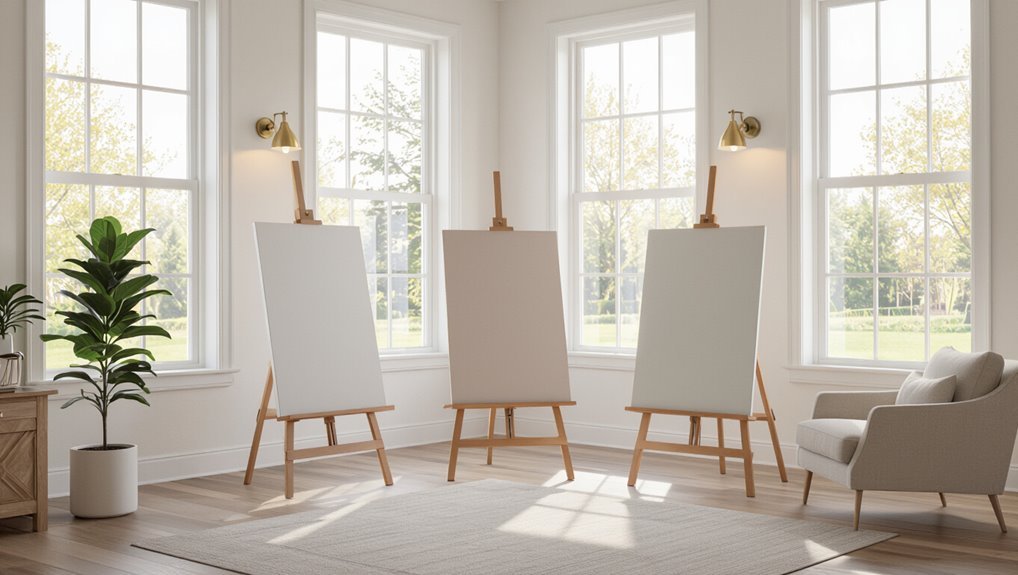
One smart option is to paint samples on movable boards so you can view colors in all the lighting they’ll actually face; mount lightweight boards on casters or carry them between rooms and outside throughout the day.
You’ll see shifts from morning sun, artificial fixtures, and evening shadows. This method reveals undertones and helps you choose a color that performs consistently in real conditions.
Digital visualization tools and their limitations
Movable boards give you real-world feedback, but digital visualization tools can speed up decision-making by letting you preview colors on photos of your space or in augmented-reality apps.
Use them to narrow choices quickly, but don’t rely solely on screens: color shifts, device calibration, and lighting simulation limits can mislead.
Always validate finalists with physical samples under real lighting before committing.
How to Evaluate True Color Accurately
Check your sample at different times of day—morning, noon, and evening—to see how light changes the hue and brightness.
Look closely for undertones and subtle shifts, compare the swatch against trim, ceiling, and flooring, and note any clashes.
Take photos, write brief notes with swatch codes, and use those records to make your final decision.
What to look for at different times of day
Because light changes through the day, you’ll need to view your paint sample at several key times—morning, midday, late afternoon, and under evening/artificial light—to see how its true color shifts.
In each period, note hue intensity, warmth or coolness, contrast with shadows, gloss reflection, and how adjacent surfaces alter perception.
Record observations to compare and decide confidently.
How to assess undertones and color shifts
Now that you’ve observed the sample at different times, focus on identifying undertones and how the color shifts under varying light.
Check north, south, and artificial-lit areas; note cool (blue/green) or warm (yellow/red) hints.
Compare the painted patch to a neutral white nearby.
Watch changes from morning to evening and under lamps to confirm the dominant undertone and overall shift.
Matching samples to room elements (trim, ceiling, flooring)
Start by holding your painted sample beside the room’s key elements—trim, ceiling, and flooring—to see how they interact and whether the sample creates the harmony you want.
Check contrast levels so trim pops or blends as planned. Note how ceiling brightness affects perceived height and how flooring tones shift warmth or coolness.
Walk the room at different times to confirm consistency.
Recording results and making decisions (photo, notes, swatch codes)
After you’ve viewed samples against trim, ceiling, and flooring at different times of day, document what you saw with photos, concise notes, and the exact swatch or paint codes so you can compare later.
Then review images and notes, rank favorites, and note lighting effects before deciding.
- Photo timestamp and location
- Swatch/paint code
- Room orientation and light source
- Observed undertones
- Preferred sample and reason
Common Mistakes and How to Avoid Them
Don’t paint tiny swatches or place them too close to corners, because they won’t show how the color reads on the wall.
Test samples under different lighting and from consistent angles, and always use primer on dark or uneven surfaces before evaluating.
These simple steps prevent misleading results and save you from costly mistakes.
Painting too small or too close to corners
Painting a sample that’s too small or tucked right into a corner can give you misleading results and waste time — you want a swatch that shows how the color behaves on a real section of wall, not how it looks in a shadow or edge reflection.
Paint at least a 2×2-foot area away from corners, apply two coats, and step back to assess how the hue reads at normal viewing distance.
Forgetting to test under different lighting conditions
Because light changes how color looks, you should check your paint sample at different times and with different light sources to avoid surprises.
View it in morning sunlight, midday glare, and evening artificial light. Turn on lamps you’ll use daily and open curtains.
Note shifts in warmth, coolness, and intensity before committing—you’ll avoid choosing a shade that only works under one lighting condition.
Skipping primer on dark or uneven surfaces
Lighting can change how a color reads, but surface issues will change how it sticks and hides—so don’t skip primer on dark or uneven walls.
You’ll get blotchy samples and false undertones without it. Prime to block stains, even out texture, and improve adhesion.
Use a tinted primer when covering deep colors; it reduces coats and reveals the true test result faster.
Comparing colors under inconsistent viewing angles
When you compare paint samples from different angles, your eye can be fooled by shifts in sheen, shadow, and reflection, making two identical swatches look unlike.
Stand back, view samples at consistent eye level and multiple positions, and compare under the same light source.
Rotate samples slowly to spot true hue versus gloss effects, and photograph them for consistent reference.
Tips and Best Practices for Reliable Results
Choose sample sizes and placements that mimic how the room reads—large swatches at eye level and near corners give truer color than tiny patches.
Use the same brush or roller and consistent coats on every sample, and evaluate them with the furniture and textiles you plan to keep.
If colors still feel uncertain or the lighting is tricky, consult a professional or use a color-matching service.
Best sample sizes and placement for realistic color perception
Start with a few sizable swatches — each about 12″ x 12″ — so you can see how the paint reads at normal viewing distance and under different light.
Place samples on both sunlit and shaded walls, near corners, and at eye level plus higher and lower to note shifts.
Leave space between swatches to prevent edge blending and view them at different times of day.
Using consistent application technique across samples
After you’ve placed and sized your swatches, apply each sample using the same brush or roller, stroke pattern, and number of coats so you can judge color rather than technique.
Keep drying time consistent, maintain edge control, and use the same sanding or priming if needed.
Label each patch and record application details so you can compare hues objectively under identical conditions.
Incorporating furniture and textiles during evaluation
When you evaluate paint samples, bring in the actual furniture and textiles you’ll use so you can see how colors interact with upholstery, wood tones, rugs, and metallic finishes.
Test swatches near these items and under the same lighting to reveal undertones and contrast that mightn’t show on bare walls.
Move cushions, drape fabric, and view from seating positions at different times to confirm harmony and mood.
When to consult a professional or use color-matching services
If you’re unsure about color undertones, working with large-format samples, or matching an existing finish, consult a professional or use a color‑matching service to avoid costly mistakes.
Professionals save time, identify tricky undertones, recommend finishes, and handle metamerism under different lights.
Use services for exact swatches, custom tints, or historic color matches.
Hire help when precision or scale exceeds your confidence.
Quick Decision-Making Checklist Before Committing
Before you commit, run a final checklist: check the paint in different lighting, evaluate sheen and undertones, and confirm how many coats you’ll need.
Narrow your options to two or three clear finalists and label each sample area.
Then test those finalists properly by viewing them at multiple times of day and from different angles before you decide.
Final checks to perform (lighting, sheen, undertone, coat count)
Although you’ve already got the sample on the wall, run a quick checklist now so you don’t commit to a color that fails in real use:
Check the paint at different times—morning, midday, evening—and under artificial lights.
Inspect sheen reflections for mismatch.
Look for undertone shifts against trim and flooring.
Confirm complete coverage after planned coat count; add another coat if color reads uneven.
How to shortlist 2’“3 finalists and test them properly
Pick 2–3 finalists and test them deliberately: narrow choices to the strongest contenders, then apply full-size samples in the rooms where they’ll live.
View them at several times of day and under your fixtures, and compare them side by side on the same wall so you can spot subtle differences in undertone, sheen, and coverage before committing.
Then assess fading, cleanability, and mood impact; sleep on it, consult photos, and decide.
FAQ Common Questions About Painting Wall Samples
Before you commit, you’ll want answers to a few common questions: how big the sample should be, whether to prime first, how many coats to apply, and if a chip test will do.
You’ll also need to know how long to wait to see the true color.
Let’s walk through each point so you can test confidently.
How big should a wall paint sample be?
How large should your wall paint sample be to give you a reliable sense of the color?
Paint at least two patches about 12 by 12 inches each on different walls or lighting exposures.
Larger swatches reduce mottling and show sheen; smaller ones mislead.
Apply two coats, let them dry, and observe at various times of day to confirm the true hue and finish.
Do I need to prime before testing paint on the wall?
Do you need to prime before testing paint on the wall? You usually should if the surface is stained, porous, or a drastically different color.
Primer evens absorption and shows the true hue. On clean, already-painted walls you can skip it for quick tests, but spot-priming guarantees accurate results.
Use a small patch of primer where needed before applying your sample.
How many coats of sample paint should I apply?
Wondering how many coats you should put on a sample?
Apply two thin coats for most accurate color and sheen—one to cover the surface, a second to reveal true depth.
Let the first coat dry fully before the second.
If your wall is porous or the color is very light, add a third coat.
Inspect samples under different lighting after final drying.
Can I test paint on a paint chip or should I always paint the wall?
Why rely only on a tiny chip when you can see the real thing on your wall?
Chips can mislead—finish, texture, and surrounding light alter perception.
Always paint a few 12×12-inch patches directly on the wall in different areas: full finish, same trim, and an edge near windows.
That shows true color interaction so you can choose confidently.
How long should I wait to see the true color?
Although the paint will look different as it dries, you’ll get a reliable sense of the final color after about 24 hours—long enough for sheen and wet-darkening to stabilize.
For full accuracy, check samples in morning and evening light after that period.
Consider a second coat and wait another 24 hours if your wall was porous or the sample looks uneven; daylight viewing is essential.
