
How to Paint Stars on Ceiling for a Magical Night Sky Look
You can turn your ceiling into a magical night sky by cleaning and priming the surface, rolling on a dark matte base, then sketching a star map. Use tiny brushes, toothpicks, or stencils for varied star sizes and add glow or luminous paint in thin layers for lasting charge. Blend soft nebula washes and metallic highlights for depth, seal when dry, and set dimmable lighting to enhance the effect — keep going to learn tips for placement, materials, and troubleshooting.
Quick 5-Step How-To: Paint Stars on Your Ceiling
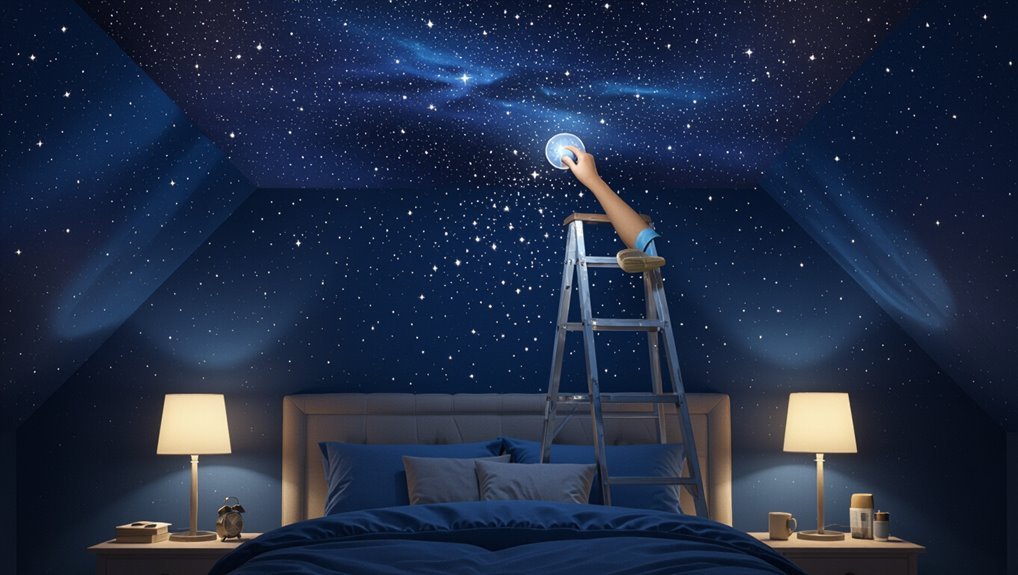
1. You’ll prep the ceiling, sketch a simple layout, and pick star painting techniques suited to celestial themes.
Tape edges, basecoat, then use sponges, toothpicks, or a toothbrush for varied stars.
Add a few larger focal stars and subtle nebula washes. Seal with matte varnish.
Work steadily, step back often, and correct stray marks as you go.
Who This Guide Is For and What You’ll Finish
This guide is for you if you’re comfortable with basic painting tasks and patient enough for a bit of detail work.
You’ll need simple materials like glow or acrylic paint, small brushes or star stencils, painter’s tape, and a ladder or step stool.
Ideal Skill Level
Whether you’re a confident DIYer or someone painting for the first time, this guide walks you through star-stenciling, freehand dots, and glow-in-the-dark finishes so you’ll end up with a polished ceiling you can be proud of. You’ll learn beginner techniques and advanced methods, creative designs, safety tips, color choices, artistic styles, maintenance advice, and project planning.
| Skill level | Outcome |
|---|---|
| Beginner | Simple constellations |
| Intermediate | Layered depth |
Required Materials
Now that you know what skill level and outcome you’re aiming for, let’s look at the materials you’ll need to finish the project with confidence.
You’ll want paint (glow and matte), brushes, sponges, a projector or star stickers, ladder, drop cloths, painter’s tape, primer and sealer.
This list supports star painting techniques and follows essential ceiling preparation tips for a smooth, lasting result.
Finished Project Outcome
By the end of this guide you’ll have a polished ceiling full of crisp, glowing stars that suit a nursery, bedroom, or cozy home theater. You’ll learn star design techniques and pick celestial color schemes to match mood and scale. You’ll finish a durable, low-maintenance night-sky feature that looks professional and personal.
| Who it’s for | What you’ll finish |
|---|---|
| Parents | Starry nursery ceiling |
| Homeowners | Cozy bedroom sky |
| DIYers | Home theater effect |
| Renters | Removable glow accents |
Best Rooms for a Painted Night Sky
A painted night sky works wonders in bedrooms, nurseries, and cozy media rooms where you want to encourage relaxation and imagination; pick the space where people rest or unwind so the ceiling becomes a calming focal point.
You’ll enhance bedroom tranquility and nursery dreams, spark playroom adventures, support study focus, create a meditation space, promote family bonding, and transform cozy retreats into serene, starry havens.
Gather Materials: Quick List for Ceiling Stars
Before you start, gather the essential tools and supplies like a ladder, painter’s tape, brushes, sponges, and a drop cloth so you’re ready to work safely and neatly.
Pick glow paint options suited to your room—long-lasting phosphorescent paints for strong glow or glow-in-the-dark paint pens for precise stars.
Keep a small test kit to check color, brightness, and drying time before you commit to the whole ceiling.
Tools And Supplies
Tools and supplies you gather now will make painting ceiling stars faster and neater, so grab them before you start.
Pick brush types for fine points and sponges, choose paint finishes and color choices, consider glow options later, handle ceiling prep, plan star patterns, test projectors usage, follow safety tips, weigh tool alternatives, and learn simple cleaning methods to keep brushes and spills controlled.
Glow Paint Options
Now that you’ve picked brushes, sponges, and base paints, you’ll want to choose the right glow products to make your ceiling stars pop.
Consider glow paint types: water-based for easy cleanup, solvent-based for durability, and phosphorescent powders mixed into clear medium.
For best glow paint application, test brightness, layer thinly, and charge under strong light to guarantee even, long-lasting luminescence.
Choose the Right Ceiling Paint Finish
Pick a paint finish that hides imperfections and reflects the right amount of light for your starry effect. You’ll weigh paint finish types against ceiling preparation needs: flatter finishes hide flaws; eggshell or satin offer slight sheen. Choose based on texture and light.
| Finish | Best for |
|---|---|
| Flat | Imperfect ceilings |
| Eggshell | Subtle sheen |
| Satin | Easy cleaning |
Pick Glow vs. Luminous Paint (When to Use Each)
You’ll weigh glow paint’s quick, bright after-dark pop against its fading and recharge limits, and luminous paint’s longer-lasting, more even glow with better color options.
Consider glow for small, temporary effects or when you want intense pinpoint stars, and choose luminous for broader coverage or a more reliable nightlight effect.
Think about budget, how long you want the glow to last, and whether you need touch-ups before deciding.
Glow Paint Pros/Cons
If you want a ceiling that really pops after lights-out, choosing between glow-in-the-dark paint and luminous (electroluminescent or phosphorescent-enhanced) options matters — each has clear strengths and trade-offs.
You’ll weigh glow paint types: long-duration phosphorescent versus brighter short-burst blends.
Consider glow paint safety, toxicity, and surface prep.
Pick based on brightness needs, recharge time, durability, and installation complexity.
Luminous Paint Benefits
Contrast helps you choose: glow-in-the-dark paints store light and release it slowly after lights-out, while luminous (electroluminescent or LED-ready) finishes give steady, controllable illumination when you want it.
You’ll appreciate luminous paint advantages like consistent brightness, dimming control, and integration with fixtures.
Expect superior luminous paint durability for active rooms; it resists fading and cleans more easily than glow-only coatings.
When To Choose Which
Now that you know how glow-in-the-dark and luminous paints differ, deciding which to use comes down to how you want the ceiling to perform and where it’ll be installed.
Choose glow paint for subtle glow intensity and quick project timing; pick luminous for stronger night effect and paint durability.
Consider star placement, color choices, design themes, ceiling textures, and overall room ambiance.
Estimate Paint Quantity for Your Ceiling
Start by measuring your ceiling’s square footage — multiply length by width for each room and add them together — because you’ll base paint needs on that number.
Check paint coverage per gallon on the can and divide by your total ceiling dimensions.
Factor two coats plus touch-ups, account for texture or trim waste, and round up slightly to guarantee you don’t run short.
Essential Tools: Brushes, Rollers, Projectors
You’ll want the right brushes for detail work and smooth rollers for background coats.
A projector can save time and keep your star shapes consistent, especially on high or textured ceilings.
I’ll cover when to use each tool and how to pick sizes and finishes that suit your ceiling.
Choosing The Right Brushes
Brush selection matters because the right brush makes crisp star points and smooth edges far easier to achieve than muscle alone.
Choose small round brushes for dots, angled liners for sharp points, and a soft flat for blended glows.
Learn brush types, practice pressure control, and prioritize brush maintenance—clean promptly, reshape bristles, and store upright—to keep tips precise and paint flow consistent.
Using Projectors And Rollers
One clear way to speed up and steady your starry ceiling is to combine a compact projector with a smooth roller: the projector maps precise star placements so you can roll base coats evenly and then touch up points without guesswork.
Choose projector types for desired star patterns, match roller techniques to ceiling textures, consider paint finishes, color combinations, light sources, application methods, room styles, and maintenance tips.
Budget Tool Swaps That Still Work
If you’re on a tight budget, swap expensive specialty rollers and stencils for everyday items that still get the job done: a dense foam roller covers large ceiling areas smoothly, and a shoe sole or round sponge makes a quick, consistent star stamp when cut to shape.
Use budget friendly alternatives and cost effective materials like craft paint, painter’s tape, toothpicks for tiny dots, and sponges.
Clean and Repair: Prepping the Ceiling
Before you paint, clean the ceiling thoroughly to remove dust, grease, and cobwebs so your stars will stick and look crisp.
Patch any cracks and holes with spackle, let it dry, then sand smooth for a seamless finish.
Taking these small prep steps now will keep your final result looking professional.
Clean Surface Thoroughly
Start by clearing the room and removing dust, cobwebs, and any loose paint so the glow and adhesive will stick properly.
Next, use gentle surface preparation techniques: wipe with a microfiber cloth, degrease with diluted dish soap, then rinse.
For stubborn grime, follow cleaning products suggestions like TSP alternatives.
Let the ceiling dry completely before priming or painting to guarantee adhesion.
Repair Cracks & Holes
You’ll want to fix every crack and hole so your paint and glow stars sit smooth and last.
For crack repair and hole filling, scrape loose material, apply compound, and sand for texture smoothing. Good surface preparation supports paint adhesion; use primer application over patched areas.
Regular ceiling maintenance prevents recurrence.
Choose finish selection that matches surrounding sheen for a seamless, durable night-sky result.
Test Base Color and Star Paints First
Test your base color and star paints on a scrap of drywall or a hidden ceiling spot so you can see how they’ll look under your room’s lighting.
You should test paint small swatches, observe at different times and with lamps, and note sheen.
Compare color selection against furniture and trim.
Adjust formulas or pick alternatives before committing to the full ceiling.
Prime the Ceiling for Even Coverage
Before you paint, prime the ceiling to seal stains, improve adhesion, and guarantee the star paint lays down evenly. Use a high-quality, stain-blocking primer and apply it with a roller for flat areas and a brush for seams and fixtures.
For effective ceiling preparation, sand glossy spots, clean dust, patch imperfections, and let the primer cure fully so paint adhesion is consistent and stars appear crisp.
Pick a Base Color for Depth and Mood
When choosing a base color, think about the mood you want to create—deep navy or charcoal will make stars pop and feel intimate, while a soft twilight blue or violet gives a dreamy, airy vibe. Use color psychology for mood enhancement; test swatches on the ceiling under different lights to pick contrast and atmosphere.
| Option | Effect |
|---|---|
| Navy/Charcoal | High contrast |
| Twilight/Violet | Soft ambiance |
Map Star Scale and Density: Layout Guidelines
Start by deciding how big and how many stars you want—mix a few larger focal stars with clusters of smaller points so the sky feels natural and balanced.
Plan star density via simple celestial mapping sketches. Use artistic techniques and painting tools to vary size and brightness across ceiling designs, considering star placement and overall night sky flow to suggest subtle cosmic themes.
- Vary scale
- Cluster lightly
- Randomize spacing
- Test tones
Place Constellations Without Overcrowding
Decide how much space each star group needs so your ceiling doesn’t look cramped, and keep consistent spacing between individual stars.
Mark key constellations first on a simple map so you can position them accurately and avoid overlaps.
Adjust surrounding stars to fill gaps without crowding those main patterns.
Plan Star Spacing
Before you put any paint to ceiling, sketch a simple map of where each constellation will sit so your stars don’t cluster or collide.
You’ll control star density, use layout techniques, and test visual balance to boost aesthetic appeal. Walk the plan with a flashlight, adjust spacing, and mark anchors.
- Count approximate stars per area
- Vary cluster sizes
- Keep focal points clear
- Leave breathing space
Map Key Constellations
With your spacing plan marked, pick the key constellations you want as anchors and place them first so surrounding stars won’t crowd them. You’ll map Orion, Ursa Major, and Cassiopeia as focal points, hinting at constellation myths to spark interest during star gazing. Use a simple grid to visualize balance:
| Orion | Ursa | Cassiopeia |
|---|---|---|
| Anchor | Anchor | Anchor |
| Gap | Gap | Gap |
Paint Natural Random Star Patterns by Hand
Once you’ve prepared your ceiling and gathered a small brush, a toothpick, and thinned glow or acrylic paint, start by planning a loose distribution of stars so they won’t cluster unnaturally.
Use star pattern techniques and embrace celestial artistry as you dot varying sizes, strengths, and small clusters to mimic depth.
- Vary dot size
- Randomize spacing
- Add subtle clusters
- Soften some edges
Use a Projector or Stencil for Precision
If you want crisp, repeatable stars, set up a projector carefully so the image is level and in focus before you start painting.
For stencils, align and tape them firmly, checking edges and overlap to avoid misprints.
I’ll cover practical projector setup tips and a clear stencil-alignment guide next.
Projector Setup Tips
Before you start tracing, position the projector so the image fills the area you’ll paint and sits perpendicular to the ceiling to avoid keystoning.
Check projector types and projector brightness; adjust focus and distance, dim room lights, and secure the unit. Use temporary tape marks for repeatable placement.
- Test contrast and scale
- Lock focus before tracing
- Note power/cable routes
- Keep projector stable
Stencil Alignment Guide
When you’re ready to transfer your star pattern, align your projector or stencil carefully so the design sits squarely where you want it and the edges match reference points on the ceiling. This prevents shifting and uneven spacing as you work.
Choose stencil types and materials suited to your design patterns.
Use alignment techniques, spacing guidelines, precision tips, and proper stencil placement and application methods for consistent results.
Mark the Ceiling Safely Without Damage
Although you’ll be working overhead, you can mark your ceiling without causing damage by using low-tack tools and careful technique.
Use marking techniques and non damaging methods for layout planning, relying on ceiling tape, painter’s tape, safe adhesives, removable markers, and temporary markings. Keep marks minimal and test adhesives first.
- Plan grid points
- Test tape hold
- Use erasable marks
- Remove promptly
Paint Crisp Star Points With Small Brushes
Start with a fine-point brush and steady your wrist so you can paint each star point cleanly and confidently; small, deliberate strokes give you sharp tips without overloading the surface with paint.
Choose brushes using brush selection tips: tiny round or liner brushes hold pigment and control.
Practice star painting techniques on scrap paper, keep paint thin, and lift the brush crisply for defined points.
Create Soft Star Glows and Halos
Now that you’ve nailed the star points, you can soften their edges with a feathered blend technique to create a natural glow.
Use a dry, soft brush to gently pull pigment outward, then layer a thin, semi-transparent halo to build depth without harsh lines.
Keep your strokes light and work in thin layers so the glow looks gradual and luminous.
Feathered Blend Technique
When you want stars that glow gently instead of radiating hard edges, the feathered blend technique gives you soft halos by gradually diffusing paint outward from the star’s center.
You’ll work with a dry brush or sponge and light, controlled strokes to build translucent layers until the glow looks natural.
- Use feathered edges and subtle blending techniques
- Control paint application for varied star patterns
- Layer color gradients for depth and celestial themes
- Embrace artistic freedom and texture variation
Soft Halo Layering
Build soft halos by applying translucent layers that radiate outward from each star’s center; you’ll work in light, circular strokes with a dry brush or sponge to feather paint into the surrounding ceiling until the glow looks naturally diffused.
Use soft halo techniques: thin washes, gradual opacity, and subtle color shifts.
Layer sparingly, step back often, and blend edges for believable glow effects.
Paint Mixed-Size Stars for Realistic Depth
Although a uniform pattern looks tidy, mixing star sizes gives your ceiling a natural, three-dimensional feel; you’ll want a range from tiny pinpricks to a few larger focal stars.
You’ll vary star shapes to enhance depth perception, reinforce celestial themes, and apply simple artistic techniques for realism.
- Place clusters sparingly
- Use random spacing
- Blend sizes subtly
- Emphasize occasional bright stars
Add Nebulae and Subtle Color Washes
If you want the night sky to feel alive, add nebulae and subtle color washes by glazing thin layers of translucent paint—these soft clouds will give depth without overpowering your stars.
Use nebula techniques like dry-brushing, sponging, and glazing, focusing on gradual color blending.
Work in thin layers, step back often, and soften edges so the washes read as distant, airy clouds rather than solid shapes.
Paint a Moon or Planet Focal Point
Choose a single focal body—moon or planet—and decide its size and placement before you paint so it anchors the ceiling’s composition.
You’ll plan moon positioning for balance and use planet detailing for texture.
Paint smooth gradients, add subtle highlights, and blend edges for realism.
Paint smooth gradients, add subtle highlights, and gently blend edges to achieve believable, luminous realism.
- Create visual balance
- Evoke a mood
- Suggest scale
- Guide star placement
Paint a Milky Way Band Across the Ceiling
Once your moon or planet anchors the scene, map a sweeping Milky Way band to complement it—think of it as a soft, luminous ribbon that ties the composition together. Use Milky Way techniques for layered glows and choose Galaxy color palettes with subtle blues, purples, and warm centers. Plan density and changeover points:
| Layer | Color | Opacity |
|---|---|---|
| Core | Warm | High |
| Halo | Purple | Medium |
| Edge | Blue | Low |
Use Sponges and Toothbrush Flicks for Fields
Grab a small sea sponge and a worn toothbrush to build realistic star fields quickly: dab the sponge lightly for soft clusters and use quick, controlled flicks from the toothbrush for scattered pinpricks, varying pressure and paint dilution to create depth and natural irregularity.
- Use sponge techniques for subtle celestial patterns.
- Add toothbrush textures for star variations.
- Control star density with artistic layering.
- Employ color blending to suggest glow effects.
Apply Glow Paint for Nighttime Sparkle
Finish your star field by applying phosphorescent paint to bring a soft nighttime sparkle when the lights go out.
Use a fine brush or dotter to add pinpoint stars and subtle clusters, varying size and spacing.
Let each dot charge under bright light; test glow paint applications before finishing.
Step back to verify balanced night sky ambiance and touch up any sparse areas.
Layer Glow Paint for Longer Afterglow
Before you start, make sure you prep the surface thoroughly so the glow paint sticks and looks smooth.
Apply thin, even coats and let each layer dry fully to build a stronger, longer-lasting charge.
Finish by sealing the stars with a clear topcoat to protect the glow and extend the afterglow.
Prep Surface Thoroughly
1. You’ll tackle surface cleaning and ceiling preparation before glow layers, so paint sticks and shines longer.
Remove dust, grease, and loose flakes; sand any rough spots; and prime where needed.
Then proceed confidently to layering.
- Wipe with degreaser
- Sand glossy areas
- Vacuum dust thoroughly
- Apply suitable primer
Apply Thin Even Coats
With the surface prepped, start applying thin, even coats of glow paint so each layer can charge and emit longer.
You’ll use precise painting techniques and careful brush selection to build glow effects without texture techniques creating clumps.
Layer according to star patterns and artistic styles, mixing color combinations for varied night sky tones.
This controlled approach maximizes visual impact across ceiling designs.
Seal With Clear Topcoat
Seal your stars using a clear topcoat to protect the glow paint and boost its afterglow by trapping more phosphorescent particles near the surface.
You’ll see clear coat benefits immediately: richer glow, scratch resistance, and easier cleaning. For best results, follow careful topcoat application—thin, even layers, light sanding between coats, gentle curing—to preserve detail and extend nighttime brilliance.
- Protects glow pigment
- Enhances luminosity
- Improves durability
- Simplifies maintenance
Create a Twinkle Effect With Layered Pigment
When you layer pigments, you’ll build depth and a subtle shimmer that makes each star seem to pulse; apply a soft base dot, then add a smaller, lighter center.
Use twinkle techniques like glazing and feathered strokes to vary opacity. Focus on layered effects by alternating thin washes and tiny highlights.
Let each layer dry fully so colors read distinctly and glow naturally.
Add Metallic or Pearlescent Accents
After building layered pigments for a subtle twinkle, add metallic or pearlescent accents to make stars catch the light from different angles.
You’ll use metallic paints and pearlescent finishes sparingly, consider star placement for realism, employ color blending for depth, and create light effects with tiny highlights and texture variation to suggest distance.
- Vary metallic sizes
- Highlight edges subtly
- Mix hues for glow
- Keep accents sparse
Blend Edges and Hide Brush Strokes
When your stars are painted, you’ll want to soften the paint edges so they blend naturally into the ceiling.
Use a dry brush or a slightly damp sponge to gently feather the lines and conceal brush marks.
Work in light, overlapping strokes and step back often to spot any visible texture.
Soften Paint Edges
1 simple technique will make your stars look crisp and professional: soften the paint edges to blend them into the ceiling and hide brush strokes.
You’ll use soft blending and feathered edges with a dry brush or sponge, working outward in light taps so each star fades naturally.
- Light pressure
- Radial strokes
- Small circular motions
- Minimal paint on brush
Conceal Brush Marks
To conceal brush marks and get a seamless, professional look, blend each star’s edges with light, controlled strokes so the paint tapers into the ceiling rather than stopping abruptly. You’ll use specific brush techniques and blending methods, feathering outward, wiping excess, and working quickly.
| Tool | Action |
|---|---|
| Small round | Feather edges |
| Dry brush | Soften strokes |
Work Safely Overhead: Ladders and Posture Tips
Start by setting up your ladder on a level surface and locking its spreaders so you’ve got a stable base before you lift a brush overhead.
Keep ladder safety and ladder stability top of mind, adjust for ceiling height, and use ergonomic posture to reduce painting fatigue.
Prioritize ladder safety and stability, adjust for ceiling height, and use ergonomic posture to minimize painting fatigue.
- Check tool accessibility and workspace organization
- Mind overhead risks and balance tips
- Use efficient painting techniques
- Pause to reset posture
Lighting to Showcase Your Night Sky
When you finish painting your night sky, plan lighting that enhances the stars without washing them out: aim for dim, indirect fixtures and adjustable accents so you can control contrast and highlight clusters or a painted Milky Way.
Use low-level ambient lighting and directional spots to avoid glare.
Consider a subtle star projection for occasional sparkle, and position switches or dimmers so you can tailor mood and visibility.
Match the Ceiling Sky to Walls and Decor
Although your ceiling will be the focal point, you should guarantee the painted sky ties into wall colors, trim, and furnishings so the room reads as a cohesive scene.
Use color coordination and texture blending for design harmony, ensuring ceiling accents and light reflection support ambiance enhancement and thematic consistency. Aim for style synergy across surfaces.
Coordinate colors and blend textures so ceiling accents and reflective trims enhance ambiance and unify the room’s theme.
- Match tones with accent pillows
- Reflect light with glossy trims
- Layer textures subtly
- Repeat star motifs
Kid-Safe and Low‑VOC Product Picks
When you’re painting a kid’s ceiling, pick safe low‑VOC paints to cut fumes and irritation.
Look for non‑toxic glow options so the stars shine without harmful chemicals.
I’ll recommend specific brands and application tips next to help you choose confidently.
Safe Low‑VOC Paints
Picking low‑VOC, kid‑safe paints makes a big difference for indoor air quality and your family’s health, especially in bedrooms and playrooms.
Choose eco friendly options and prioritize paint safety by checking certifications, odor levels, and drying times.
Look for washable finishes and clear ingredient lists.
- Greenguard certified
- Zero or ultra‑low VOC
- Washable enamel
- Clear labeling
Non‑Toxic Glow Options
A few safe, low‑VOC glow options let you get that starry ceiling effect without exposing kids to harsh chemicals, off‑gassing, or strong odors.
You’ll choose non toxic paint and eco friendly options that meet safety standards and use child safe materials.
Consider glow longevity, color variety, and paint application ease; read product comparisons and labels to pick the best kid‑safe glow.
Project Timeline: Realistic Time Estimates
Before you lift a brush, map out a realistic timeline that breaks the job into prep, painting, and cleanup so you know how much time to block off each day.
You’ll plan project duration, prioritize time management, and set achievable daily goals to avoid rushing. Estimate drying times and tool setup so each session stays focused.
- Prep: 1–2 hours
- Painting: 2–4 sessions
- Drying: 4–24 hours
- Cleanup: 30–60 minutes
Common Painting Mistakes and Fixes
Don’t panic if your star ceiling doesn’t look perfect at first—most mistakes are fixable with a little patience and the right technique.
Check ceiling preparation, revisit project planning, and refine painting techniques. Adjust color mixing for accurate hues, tweak star shapes and paint layering for depth, and control texture effects.
Consider light sources, design inspiration, and glow longevity to guarantee a lasting, magical finish.
Repair Smudges, Runs, and Uneven Stars
If you spot smudges or runs, start by light spot-sanding the affected area so you don’t damage surrounding paint.
Then feather in fresh paint along the edges to blend the repair with the ceiling finish.
Finally, adjust your technique—thin your paint, work in small sections, and watch brush load—to prevent future runs.
Spot Sanding Techniques
Start by identifying the exact spots that need attention—smudges, paint runs, or stars with uneven edges—and mark them so you don’t miss anything.
Use spot sanding benefits: choose ideal grit, proper sanding tools, and surface preparation to repair imperfections and improve adhesion.
Control dust, aim for finish smoothness, and create texture where needed.
- effective techniques
- dust control
- repair imperfections
- improve adhesion
Blending Paint Edges
Begin by feathering the edges of the smudge, run, or uneven star so the surrounding paint can accept a seamless touch-up; lightly sand or break the ridge with a fine-grit pad, wipe away dust, then apply thin, overlapping strokes of matching paint to blend into the existing finish.
Use precise blending techniques, little pressure, and a soft brush to restore edge softness and repeat until seamless.
Preventing Future Runs
When you want your ceiling stars to stay crisp, prevent runs by controlling paint load, drying conditions, and brush technique from the very first coat.
Keep paint consistency thin enough to flow, use proper drying techniques, and fix smudges quickly.
Follow these steps:
- Wipe excess paint off brush
- Thin slightly for smooth application
- Improve airflow for even drying
- Touch up with tiny strokes
Maintain and Refresh Glow Effects Over Time
Over time the glow from your painted stars will fade, so you’ll want to refresh them periodically to keep the ceiling looking vibrant; inspect every 6–12 months, touching up dim or missing spots with a fine brush or dab applicator and recharging the glow by exposing the paint to bright light for 10–30 minutes before turning off the lights.
| Task | Frequency |
|---|---|
| Inspect | 6–12 months |
| Touch-up | As needed |
| Recharge | Before night use |
| Record | Track paint longevity |
Focus on glow maintenance to preserve color and charge; replace worn paint dots to maintain effect.
Seal and Protect Your Painted Ceiling
Before you finish, seal your painted stars to protect them from dust, moisture, and accidental scuffs; a clear protective coat will lock in pigments and glow material so they last longer.
You’ll improve ceiling protection and paint durability with the right sealer. Apply thin, even coats, dry fully between layers, and ventilate the room.
- Choose compatible clear sealer
- Test a small patch
- Use light, even strokes
- Follow manufacturer cure times
When to Hire a Pro for Complex Designs
If your design involves intricate stencils, multiple layers of metallics, or glow effects that must align perfectly, consider hiring a pro to secure a flawless finish.
You should call in help when design complexity exceeds your skills, when ceilings are high or textured, or when lighting integration matters.
A pro’s professional expertise saves time, assures durability, and delivers the precise look you want.
Creative Variations: Galaxy Murals and Maps
Once you’ve decided whether to call in a pro, you can explore creative variations like galaxy murals and star maps that turn a ceiling into a story.
Decide if you need a pro, then let galaxy murals and star maps transform your ceiling into a story.
You’ll blend galaxy gradients and cosmic colors, use nebula techniques for depth, apply constellation mapping for accuracy, and cluster star clusters into focal points, choosing celestial themes that reflect mood and meaning.
- Personal mythology
- Navigational motifs
- Educational layouts
- Abstract emotion
Add Safe LED or Fiber-Optic Twinkle Effects
When you want a convincing twinkle without the heat or wiring hassle, choose low-voltage LEDs or fiber-optic systems that give bright, cool points of light and are safe for ceilings and bedrooms.
You’ll combine LED Effects and Fiber Optic Twinkles for a Starry Ambiance, plan Light Placement for Safe Lighting, use Twinkle Techniques and DIY Options to add Ambient Glow and a Magical Atmosphere to your Night Sky.
Budget Comparison: DIY vs. Professional Costs
Deciding whether to tackle a starry ceiling yourself or hire a pro comes down to comparing material costs, time, and skill.
DIY lets you control spending by choosing paints, LEDs, or fiber-optic kits and investing your time, while hiring a professional adds labor and project management fees but guarantees speed, precision, and often a warranty.
Choose paints, LEDs, or fiber-optics and invest time yourself, or pay a pro for speed, precision, and warranty.
- DIY Paints vs Material Quality
- Cost Breakdown and Time Investment
- Skill Comparison affecting Project Complexity
- Professional Services and Long term Value
Printable Project Checklist and Quick Steps
1 simple checklist will keep your star-ceiling project on track and prevent costly backtracking; print it out and use it to gather materials, schedule work sessions, and mark completed steps.
Include supplies, surface prep, paint types, stencil sizes, placement map, drying times, and cleanup.
Follow quick steps: prep, mark layout, paint base, dot stars, add depth for starry ambiance, and enjoy magical transformations.
Troubleshoot Glow Paint Failures
Now that you’ve got your checklist and quick steps in place, let’s troubleshoot glow paint failures so your stars actually shine.
You’ll spot Glow Paint Mistakes quickly by checking Surface Preparation Issues and Paint Consistency Challenges.
Address Paint Application Troubles, Adhesion Failures, Color Matching Problems, and Glow Longevity Concerns.
Monitor Light Exposure Effects and retest after fixes.
- Clean and prime
- Thin or stir paint
- Reapply in thin coats
- Test under dark conditions
Find Inspiration and Next Steps to Expand Designs
When you’re ready to expand beyond simple dots, look for inspiration in nature, space photography, and fabric or wallpaper patterns to spark new star layouts and motifs.
Use mood boards to collect star design inspirations and choose celestial color palettes that suit the room.
Experiment with constellations, nebula washes, and layered glows.
Plan scales, test samples, and schedule small practice sections before committing.
Frequently Asked Questions
Can I Paint Stars on Textured or Popcorn Ceilings?
Yes — you can paint stars on textured or popcorn ceilings, but you’ll need gentle star painting techniques and ceiling preparation tips. You’ll clean, prime, and use high-contrast paints plus stencils or glow-dot applicators for best results.
Will Glow Paint Affect Smoke/Co Detectors or Fire Safety?
Think of glow paint safety as a lighthouse: you shouldn’t disable detectors. You won’t usually affect detector sensitivity if you apply thin, nonconductive glow paint away from sensors, and you’ll keep fire safety intact by following product guidelines.
How Do I Prevent Paint Drips From Landing on Furniture/Flooring?
You’ll protect surfaces by covering floors and furniture with drop cloths, using drip trays for brushes and rollers, and securing edges with painter’s tape; you’ll also wring excess paint off tools and place buckets on stable, elevated platforms.
Can I Achieve a Realistic Sky With Ceiling Height Under 8 Feet?
Yes — you can. Like shrinking a mural into a postcard, a 7.5-foot ceiling height still works if you vary star placement, scale, and density; you’ll create depth and a believable night sky from any vantage.
How Do I Remove or Repaint the Ceiling Without Damaging Drywall?
You’ll protect fixtures, score and wet loose paint, sand lightly, patch with joint compound, prime for ceiling preparation, and choose paint selection suited for ceilings (flat or low-sheen). Work gently to avoid damaging drywall seams.
Conclusion
You’ve now got a simple plan to turn any ceiling into a cozy night sky you’ll love. About 82% of people say soft, starry lighting improves relaxation—so this project can actually help you unwind. With your materials, quick steps, and troubleshooting tips, you’ll finish a magical ceiling without stress. Once you’re done, try adding constellations or subtle nebula washes to make the room even more dreamy and personal.
