
Which Rollers Are Best for Painting Walls
For most interior walls you’ll get the best balance of coverage and finish with a 3/8″–1/2″ synthetic nap roller (microfiber or polyester blend) used with latex paint; it holds enough paint for even coats, resists shedding, and works on slight texture. Use short 1/4″ naps or foam for ultra-smooth drywall and long 3/4″–1½” naps or lambswool for heavy texture or masonry. Keep pressure steady and clean rollers well—keep going to learn more tips and picks.
Quick Answer: Top Rollers for Painting Walls
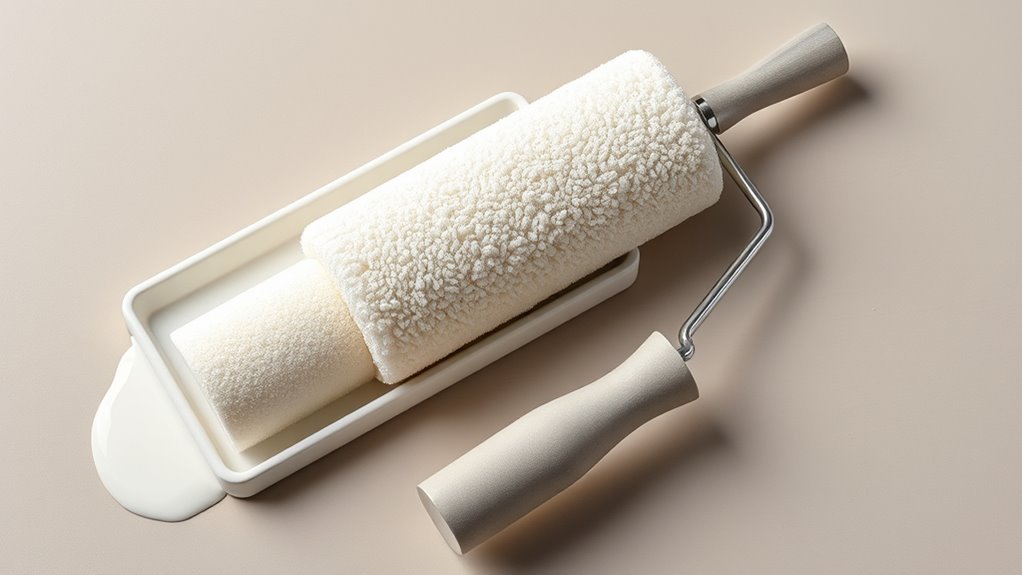
Looking for the best roller to tackle your walls? You’ll want a medium-nap synthetic roller for most interiors — it spreads paint evenly without creating texture or shedding.
For rough surfaces pick a thicker nap; for smooth walls choose shorter fibers.
Use a high-quality frame that won’t flex, and opt for washable covers to simplify color mixing cleanup between shades.
Keep extra covers and the frame clean with proper roller storage: wrap in plastic for short breaks or freeze a sealed roller for longer pauses.
You’ll finish faster with less touch-up if you match nap to surface and maintain tools.
Quick Decision Checklist: Pick the Right Roller
First, match the roller to your surface: smooth walls need a short nap, textured surfaces need a longer one.
Next, choose nap length based on texture and paint type so you get even coverage without excess splatter.
Use those two checks and you’ll pick the right roller quickly.
Surface Type Match
If you’re tackling a smooth plaster wall you’ll want a short-nap roller (1/4″–3/8″) for a fine, even finish.
Textured surfaces like stucco or popcorn need a long-nap roller (3/4″–1½”) to reach into crevices and hold more paint.
Assess surface porosity and irregularities before you buy: smoother walls suit denser covers that reduce stipple and highlight paint sheen, while rough walls need thicker covers to prevent patchiness.
Match roller material to substrate—synthetic for latex, natural for oil—and consider how color matching may be affected by texture-driven light reflection to avoid surprises.
Nap Length Choice
Why choose one nap length over another? You’ll match nap to texture: short naps for smooth walls, medium for light texture, long for heavy texture. Consider paint color compatibility—lighter colors may show roller texture more—so adjust nap accordingly. Also factor in roller maintenance; longer naps trap more paint and need thorough cleaning.
- Short (1/4″) — finest finish on plaster, less texture.
- Medium (3/8″-1/2″) — versatile for typical drywall.
- Long (3/4″+) — hides imperfections on rough surfaces.
- Specialty naps — for ultra-smooth or stucco, choose based on surface and paint.
How Roller Nap Affects Coverage and Finish
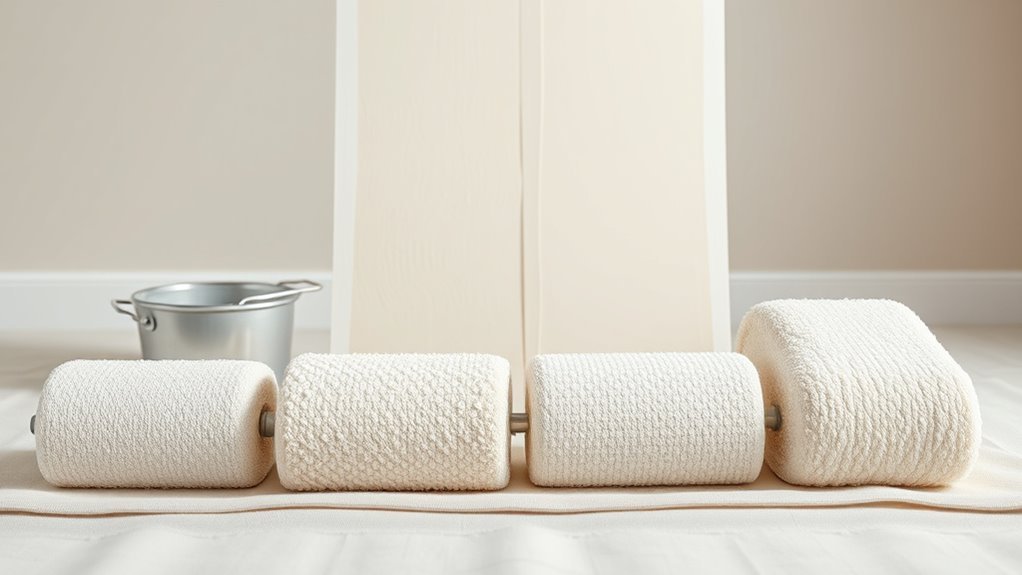
Although it’s easy to overlook, the roller nap you choose directly changes how much paint you lay down and the final texture of your walls. You’ll find short naps deposit thinner, smoother coats while longer naps hold more paint and bridge textured surfaces.
Match nap to surface to avoid excess drip or thin spots, and maintain even paint consistency to prevent streaks. Load rollers uniformly and work in overlapping passes for consistent coverage.
After use, clean and store properly—roller storage affects longevity and future performance. Choosing the right nap saves time, reduces touch-ups, and gives the finish you expect.
Roller Nap Guide: Smooth, Light, and Deep Texture
When you pick a roller nap, you’re deciding how much texture will show on your wall. You’ll choose smooth for sleek finishes, light for typical walls, or deep for textured surfaces. Match nap to surface for consistent paint adhesion and easier roller maintenance; the wrong nap wastes paint and roughens finish.
- Smooth (1/4″) — hides little, good on drywall.
- Light (3/8″) — versatile, balances coverage and texture.
- Medium (1/2″) — for lightly textured or patched walls.
- Deep (3/4″+) — fills nooks on rough surfaces.
Rotate naps for different rooms and clean promptly to extend roller life.
Roller Materials: Polyester, Nylon, and Blends
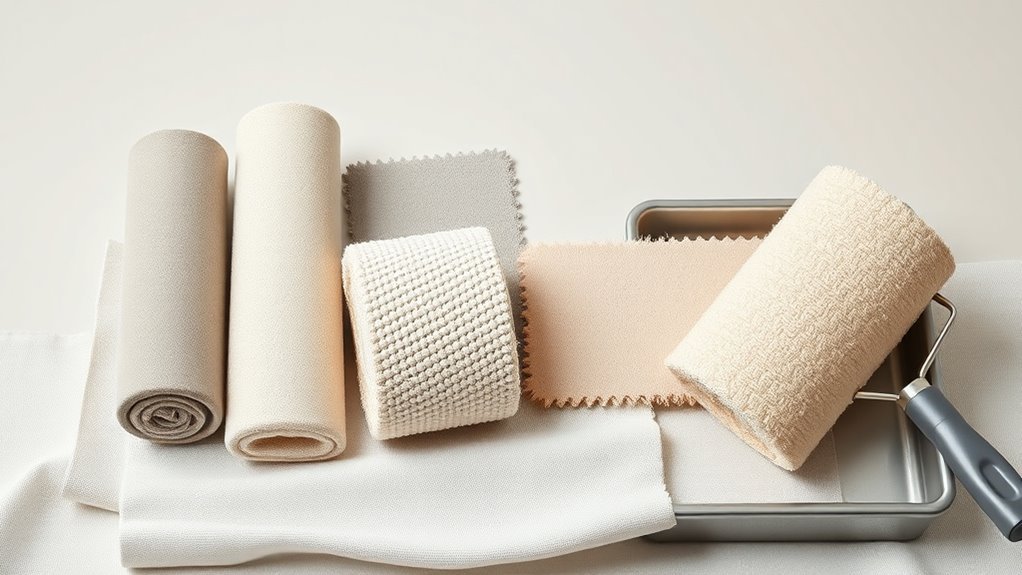
You’ll find polyester rollers are durable and shed less lint, making them great for most latex paints.
Nylon offers better spring and a smoother finish on fine textures, especially with oil-based paints.
Blended fabrics aim to give you the best of both—balanced paint pickup, release, and surface coverage.
Polyester Rollers Pros
If you want a durable, budget-friendly option that works well with water-based paints, polyester rollers are a smart pick. You’ll appreciate their resilience, easy cleaning, and consistent finish when you follow proper painting techniques and simple roller storage habits to prolong life.
They grab paint well, release evenly, and suit smooth to semi-smooth walls. You’ll avoid lint and minimize splatter compared to cheaper foams.
- Durable: stands up to repeated use.
- Inexpensive: great for large jobs on a budget.
- Easy to clean: compatible with soap and water.
- Low lint: smoother finish, less touch-up.
Nylon Roller Advantages
Although they cost a bit more upfront, nylon rollers give you superior durability and smoother results on a wider range of surfaces. You’ll find they resist matting, shed less, and handle high-gloss to flat paints without changing texture. Proper roller maintenance extends life and keeps nap performance consistent. Check paint color compatibility when switching finishes to avoid pickup or staining. Use gentle cleaning and store dry. The quick table below highlights key traits to help you choose confidently.
| Durability | Texture | Care |
|---|---|---|
| High | Smooth finish | Easy clean |
| Low shedding | Versatile | Long-lasting |
Blended Fabric Performance
Nylon’s durability and smooth finish set a high bar, but blended rollers—typically polyester/nylon mixes—give you a middle ground that balances cost, resilience, and paint pickup. You’ll notice balanced nap memory, improved fabric durability over pure polyester, and better colorfastness when using water-based paints.
Blends resist matting, shed less, and adapt to varied sheens. Choose blend ratios for your project: more nylon for longevity, more polyester for affordability.
- Faster paint release for smoother walls
- Lower linting than pure polyester
- Good abrasion resistance for repeated use
- Versatile across latex and enamel finishes
Natural-Fiber Covers: Mohair and Lambswool Uses
When you need a smooth, lint-free finish on satin or gloss paints, natural-fiber covers like mohair and lambswool deliver superior pickup and release compared with many synthetics. You’ll appreciate natural fibers for their ability to hold paint evenly, letting you work steadily without constant reloads.
Mohair gives a silky, low-texture result ideal for flat, smooth walls. Lambswool offers slightly more nap for subtly varied wall textures while still minimizing lint. Use these covers on primed surfaces and trim where finish matters most.
Clean them carefully after use to preserve loft and performance for future projects.
Knit vs Woven Covers: Coverage, Lint, and Finish
Because knit and woven roller covers handle paint differently, choosing the right one affects coverage, lint, and the final look more than you might expect. You’ll prefer knit for thicker coatings and smoother, low-lint results; woven excels with thinner paints and higher pickup for fast coverage.
Mind how you use them: proper roller storage preserves nap and prevents dried edges that cause streaks. Also consider color mixing—knit traps less stray pigment than loose woven loops, reducing contamination between tones.
Visualize performance:
- Knit: smooth, low lint, even spread
- Woven: high pickup, fast coverage
- Edge control: woven may leave more lint
- Storage: dry, clean, upright
Which Roller Material for Latex vs Oil Paint
When you’re choosing between latex and oil paints, the roller material matters.
Foam rollers work great with latex for smooth finishes and less splatter, while mohair and lambswool hold more oil-based paint and give a glossier, even coat.
Pick foam for water-based jobs and mohair or lambswool for oil-based projects to match absorption and finish.
Foam Rollers For Latex
If you’re using latex paint, foam rollers can be a smart choice because they lay down a smooth, even coat without the nap marks you get from woven covers. You’ll get crisp edges and minimal texture, making touch-ups easier.
Foam suits thinner latex; avoid heavy-bodied formulations unless you thin carefully during paint mixing.
Clean foam promptly for roller maintenance—don’t let latex dry into the pores.
Use light pressure and short strokes to prevent bubbling.
Consider these scenarios:
- Smooth interior walls
- Cabinet or door surfaces
- Light trim work
- Small rooms and touch-ups
Mohair And Lambswool
Foam rollers work great for smooth latex jobs, but you’ll want different covers for other paints and textures—mohair and lambswool each shine in specific situations.
You’ll pick mohair for oil-based paints because its tight, smooth nap gives a fine finish and resists shedding. It’s ideal when you’ve done careful paint mixing and want minimal texture.
Lambswool traps more paint and works well with thicker latex or textured surfaces, offering better coverage but a slightly nappered finish.
You should follow brush maintenance routines for both—clean solvents for mohair and warm soapy water for lambswool—to prolong life and performance.
Best Roller Naps for Smooth Drywall
Looking for the smoothest finish on drywall? You’ll want low-nap rollers that lay down paint evenly without texture.
For precise color matching and clean paint mixing, pick rollers that minimize stipple and spread thin coats.
- 1/4″ microfiber — ultra-smooth, great for latex and minimizes orange peel.
- 3/16″ foam — gives a glass-like finish on primed drywall.
- 3/8″ woven knit — slightly thicker but still smooth for light sheen paints.
- Microfiber blend 1/4″ — balances coverage and finish for rapid jobs.
Use consistent pressure and overlap to avoid lap marks.
Best Roller Naps for Lightly Textured Walls
When tackling lightly textured walls, you’ll want a roller nap that grabs paint into the crevices without exaggerating the texture. Choose a 3/8″ to 1/2″ nap—it balances coverage and subtlety, letting your paint color sit evenly without leaving roller marks.
Use a synthetic blend for latex paints; it resists matting and sheds less. Load the roller evenly and work in overlapping passes to avoid buildup in low spots.
After painting, clean thoroughly and dry before proper roller storage to maintain nap integrity and prevent odor or damage, so your next coat performs consistently.
Best Rollers for Deep Texture and Masonry
Lightly textured walls benefit from shorter naps, but for deep texture and masonry you’ll want a different approach: pick a high-nap roller that can push paint into crevices and hold enough volume to cover rough surfaces without constant reloading.
You’ll favor thick microfiber or lambswool blends for reach and durability. Consider synthetic blends for exterior work where moisture and abrasion matter.
Check paint compatibility—some rollers shed or react with solvents. Practice proper roller maintenance to extend life and avoid contamination.
- Thick microfiber for indoor masonry
- Lambswool for deep crevices
- Synthetic blends for exteriors
- Long-handle kit for reach
Roller Pile Density: Lint, Pickup, and Smoothness
Although pile height grabs headlines, pile density often decides whether your roller sheds lint, soaks up paint, or lays down a smooth coat. You’ll pick dense piles for minimal lint and even laydown; open piles for heavy pickup on rough surfaces. Consider paint compatibility—thicker nap with heavy masonry paints, finer density for enamel or gloss. Store rollers properly: roller storage in a sealed bag keeps fibers aligned and prevents dust. Test a sample stroke before committing.
| Density | Lint Risk | Best Use |
|---|---|---|
| High | Low | Smooth walls |
| Medium | Medium | General use |
| Low | High | Textured finishes |
Roller Widths Compared: 9″, 12″, and Trim Sizes
Pile density affects finish quality, but choosing the right roller width determines how quickly and accurately you cover a room. You’ll pick 9″ for tight spaces and trim work, 12″ for broad walls, and small trim rollers for corners and edging.
Consider roller durability and paint absorption: denser naps last longer but soak less, while fluffier naps hold more but wear faster. Match width to surface and your pace so you minimize seams and reloads.
- 9″ — maneuverable for doors, closets.
- 12″ — efficient for large walls.
- Trim rollers — precise edging.
- Specialty narrow — tight gaps.
Roller Frame & Handle Choices to Reduce Fatigue
Choose roller frames with ergonomic handles so your wrist and grip don’t tire during long sessions.
Prefer lightweight frame materials like aluminum or composite to cut down on arm strain without sacrificing stability.
Together, those choices let you paint longer with better control and less fatigue.
Ergonomic Handle Designs
When you’re rolling large walls or painting for hours, the right roller frame and handle can cut fatigue and improve control. You’ll want an ergonomic design that fits your hand, reduces wrist strain, and maximizes handle comfort.
Choose shapes that let you maintain a neutral wrist, rubberized grips that prevent slipping, and contours that suit your grip size. Balance matters: a well-positioned handle reduces torque and keeps strokes steady.
- Soft rubber grip for shock absorption
- Contoured shape for neutral wrist alignment
- Thumb rest or textured zones for secure hold
- Angled handle to keep forearm relaxed
Lightweight Frame Materials
Because a lighter frame cuts fatigue and improves control, opt for materials like aluminum, fiberglass, or reinforced plastics that shave ounces without sacrificing strength. You’ll paint longer with less strain, keep wrists steady, and maintain consistent strokes—helpful when doing color mixing or fetching paint from paint storage. Choose corrosion-resistant frames for longevity, and prefer quick-release handles for fast sleeve swaps.
| Material | Weight | Durability |
|---|---|---|
| Aluminum | Low | High |
| Fiberglass | Very low | High |
| Reinforced plastic | Very low | Medium |
| Steel | High | Very high |
Select what balances weight and toughness for your projects.
Using Extension Poles and Adapter Compatibility
If you want to cover high walls or ceilings without ladders, extension poles let you reach farther while keeping steady control of the roller. Choose poles with secure threaded or quick-lock adapters so your roller frame won’t wobble.
Match adapter size to the roller handle; universal adapters add compatibility across brands. Keep paint mixing tidy in a tray at waist height before extending, and plan roller storage: detach rollers, clean, and store poles collapsed.
Match adapter size to your roller, keep paint in a waist‑height tray, then detach, clean, and collapse poles.
- Threaded adapter: rigid, secure
- Quick-lock: fast on/off
- Universal adapter: versatile
- Telescoping pole: adjustable length
Nap Compression and Pressure: Effects on Finish
After you’ve got your pole and roller set up, pay attention to nap compression and how firmly you press—those two factors shape the texture and coverage you’ll get.
You’ll flatten nap by pressing too hard, leaving streaks, thin spots, and visible roller lines; apply consistent, light-to-medium pressure and overlap passes.
Thicker naps hide imperfections but compress more easily on uneven surfaces. Match nap to paint compatibility and wall texture, and don’t assume heavier pressure improves spread.
Treat roller care like brush maintenance: clean promptly, restore nap loft, and store correctly to keep finish predictable and smooth across your walls.
Best Rollers for High-Gloss and Semi-Gloss Paints
When you’re working with high-gloss or semi-gloss paints, choose a roller with a very smooth nap to avoid texture showing through.
Pick lint-free materials so the finish stays clean and shiny.
Make sure the roller has a firm core to keep pressure even and prevent roller marks.
Smooth Finish Nap
Although glossy paints can highlight every imperfection, you can get a mirror-like finish by choosing a short, dense nap roller designed for high-gloss and semi-gloss coatings. You’ll want a roller that minimizes texture patterns and leaves a uniform sheen. Use light, even pressure and work wet edges to avoid lap marks.
Pay attention to roller maintenance—clean thoroughly and store dry to prevent shedding or contamination that ruins gloss.
For visualization, consider these actions:
- Smooth, overlapping passes
- Minimal pressure for thin film
- Frequent reloads to maintain wet edge
- Immediate cleaning after use
Lint-Free Materials
To keep that mirror-like sheen, pick rollers made from truly lint-free materials—microfiber, woven knit blends with tight construction, or foam specifically formulated for high-gloss finishes. You’ll avoid stray fibers that mar reflective surfaces and interfere with color mixing. During wall preparation, use tack cloths after sanding to guarantee no debris sticks. Choose a dense, low-pile roller for smooth coverage and minimal texture. Test on a scrap panel to confirm finish. Clean rollers thoroughly between coats to prevent contamination. Proper technique yields an even, glossy surface that shows professional results.
| Material | Pile | Best Use |
|---|---|---|
| Microfiber | Low | High-gloss |
| Woven knit | Very low | Semi-gloss |
| Foam | Zero | Trim/doors |
| Blend | Low | Panels/trim |
Firm Core Support
Because high-gloss and semi-gloss paints highlight every imperfection, you’ll want a roller with a firm, rigid core that keeps the nap flat and transfers paint evenly without sagging.
Choose a short-nap roller whose solid core resists bowing so the finish stays smooth.
Match nap and core to paint viscosity: thinner enamels need tighter nap, thicker semi-gloss may need slightly thicker.
Confirm the roller handle connects snugly to avoid wobble.
Clean and inspect cores between coats to keep edges crisp.
- Short nap for smooth surfaces
- Rigid core to prevent sag
- Secure roller handle fit
- Match to paint viscosity
Best Rollers for Eggshell, Satin, and Flat Paints
When you’re choosing a roller for eggshell, satin, or flat paints, pick one that balances smooth application with enough nap to conceal minor wall imperfections.
You’ll want a 3/8″ to 1/2″ synthetic nap for most interiors: it encourages even color blending and supports paint adhesion without texture. Use microfiber or high-density foam for ultra-smooth finishes; they reduce roller marks and shed less lint.
For mildly textured walls, opt for a slightly thicker nap to ensure coverage.
Hold the roller steady, maintain consistent pressure, and overlap passes to avoid stripes while preserving finish uniformity.
Priming and Undercoats: Which Rollers Save Paint
When you’re priming or laying an undercoat, nap length matters because a shorter nap gives smoother coverage. A longer nap holds more primer, which is better for textured walls.
Choose roller material—synthetic for water-based primers, natural for oil-based—to match the product and cut absorption.
Balance coverage versus absorption: you want a roller that releases primer evenly without soaking up too much.
Nap Length Matters
Wondering which roller nap will actually save you paint during priming and undercoating? You’ll pick nap length based on surface texture and how much primer you want absorbed.
Short naps (1/4″) hold less primer so you waste less on smooth walls; medium naps (3/8″) balance coverage and economy for lightly textured walls. Longer naps trap more primer in fibers, costing extra and increasing paint fumes during application and while in roller storage. Choose to match nap to wall texture and minimize reloading.
- Smooth: 1/4″ nap
- Light texture: 3/8″ nap
- Medium texture: 1/2″ nap
- Heavy texture: 3/4″ nap
Roller Material Choice
You’ve matched nap length to surface texture; now pick the roller material to control how much primer the cover holds and releases.
Synthetic blends suit water-based primers and let you manage release for a consistent base before switching to paint color.
Natural fibers work with oil-based primers but can over-saturate if you’re not careful.
Microfiber offers precise release and easy touch-ups, cutting waste.
Choose a washable cover to simplify roller cleaning and extend life, reducing cost.
Test a small section to confirm how the material behaves with your primer and undercoat, then proceed with the best-performing roller.
Coverage Vs. Absorption
Although nap and material matter, the roller’s absorption and release behavior ultimately decide how much primer you’ll use, so pick one that balances coverage with minimal waste. You’ll want a roller that holds enough to cover evenly without dripping, because over-saturation wastes primer and harms paint durability. A controlled release helps you achieve consistent color matching between coats and speeds up undercoats.
Consider surface texture and primer type, and test-swatch to confirm performance before committing to large areas.
- Dense foam for smooth walls — low absorption, precise release.
- Short nap for light texture — balanced coverage.
- Medium nap for typical walls — versatile.
- High nap for rough surfaces — more pickup, careful rolling.
How to Test a Roller Before Painting a Wall
Before you roll a wall, test the roller to catch shedding, uneven nap, or texture issues that could ruin your finish.
Lay out a scrap board or cardboard, dampen the roller lightly, and load it with the paint you’ll use. Roll a few passes, checking for lint, streaks, and even coverage.
Watch for color mixing problems if you’re blending batches—roll each sample separately to spot tint variations.
Inspect edges for loose fibers and feel the nap for consistency.
Note performance, then store the unused cover properly in roller storage to keep it ready for the job.
Cleaning and Reusing Roller Covers Properly
After testing and confirming a roller’s performance, clean it promptly so you’ll get reliable reuse and a consistent finish on future jobs. You rinse excess paint, use warm water for latex or the recommended solvent for oil-based finishes, and work fibers until water runs clear.
Follow drying and storage steps to avoid mildew and matting. Cleaning tips and Reuse techniques keep pile uniform and prevent texture defects. Handle covers gently to preserve nap.
- Remove excess paint with a comb or scraper.
- Rinse thoroughly until clear.
- Spin or roll on old rags to expel water.
- Air-dry upright in a dust-free spot.
When to Toss a Roller Cover and Why It Matters
If a roller cover no longer sheds paint evenly, feels matted, or keeps leaving lint or streaks, it’s time to toss it—using a compromised cover will ruin your finish and cost you time fixing uneven texture. You should retire covers after heavy solvent exposure, persistent clogging, or when fiber loss affects paint color matching. Regular roller maintenance extends life, but know when replacement saves effort. Dispose of ruined covers promptly and switch to a fresh nap matched to your surface for consistent results.
| Sign | Cause | Action |
|---|---|---|
| Shedding | Worn fibers | Replace |
| Matting | Overuse | Replace |
| Clogging | Old paint | Replace |
| Lint | Poor cleaning | Replace |
Troubleshooting Common Roller Problems (Lap Marks, Lint)
Now that you know when to retire a roller, let’s look at common problems you’ll see with even a fairly fresh cover: lap marks, lint, and uneven coverage. You can fix most issues quickly by adjusting technique and focusing on roller storage and roller maintenance.
Rollers left uncovered gather dust; clean and store them properly. Check naps for loose fibers and shake or brush them out before use.
- Overlapping wet edges causes lap marks—work steadily and feather edges.
- Poor nap quality sheds lint—buy better covers and prep them.
- Uneven pressure creates streaks—apply even pressure.
- Clogged roller traps paint—clean often.
Pro-Grade Rollers Worth the Extra Cost
When you’re deciding whether to spend more, focus on how pro-grade rollers hold up over time and resist wear.
You’ll also notice they lay down paint more evenly, giving better coverage and a smoother finish with fewer passes.
That durability and improved finish can save you time and money on touch-ups.
Durability And Longevity
Because you’ll use a roller again and again, its build quality matters. You want resilient nap that resists matting, a secure frame, and fibers that survive solvent and scrubbing. Knowing paint roller history helps you appreciate modern materials and why pro-grade options last.
Also look for eco friendly roller options if sustainability matters. Expect longer life from dense, tightly woven covers and rust-resistant frames.
- Durable nap resists shedding and matting
- Solid core and reinforced seams
- Corrosion-resistant frame and bearings
- Easy-to-clean materials that withstand solvents
Coverage And Finish
A roller that lasts is only half the story — you also want one that lays paint evenly and gives the finish you’re after. You’ll notice pro-grade rollers resist shedding and distribute coating uniformly, minimizing lap marks and reducing the need for touch-ups.
They handle variations in paint viscosity better, so thick or thin batches flow consistently across the wall. That steadiness also helps prevent unwanted color mixing when you cut in or blend edges.
Choose the right nap for your surface: short for smooth, medium for light texture, long for heavy texture. That choice determines final appearance and coverage efficiency.
Budget Rollers That Still Deliver Good Performance
If you’re watching your budget but still want smooth, even coverage, there are several affordable rollers that punch above their price point. You’ll want options that balance nap length with durability, offer easy roller maintenance, and match paint compatibility so you don’t waste time or money.
Look for dense microfiber or woven polyester covers and sturdy frames that won’t bend on wider walls. Consider these budget-friendly picks to visualize performance and application:
Look for dense microfiber or woven-polyester covers and sturdy frames that hold their shape on wide walls.
- 9mm microfiber roller — smooth latex walls, easy to clean.
- 12mm woven polyester — hides minor texture, versatile with primers.
- Foam roller — ultra-smooth for enamel.
- Budget frame with secure cage — lasts job after job.
Quick Shopping Checklist: What to Buy for Your Job
When you shop for rollers, focus on the essentials that match your wall texture, paint type, and project scale so you won’t waste time or money.
Start with the right nap: 1/4–3/8″ for smooth, 1/2″ for lightly textured, 3/4″+ for rough surfaces.
Buy two roller covers per finish, a sturdy frame, extension pole, and a quality tray.
Add painter’s tape, drop cloths, sanding block, spackle, and a putty knife for wall preparation.
Pick brushes for cutting in and a small foam roller for trim.
Consider color mixing tools and a stirrer for consistent paint.
Frequently Asked Questions
Can a Roller Be Used to Paint Ceilings Without Special Rollers?
Yes — you can use a regular roller to paint ceilings, but you’ll want the right roller texture for smooth coverage and an extension roller handle for reach; practice control to avoid drips and keep even pressure while painting.
How Do Rollers Perform With Eco-Friendly/Low-Voc Paints?
Rollers work well with eco friendly compatibility but can show variable coverage; you’ll want low-nap, dense rollers to limit low VOC absorption and avoid streaks, and you’ll clean them promptly to preserve performance and finish.
Can Rollers Be Used for Stain or Wood Finish Applications?
Think of a craftsman trading chisels: yes, you can use rollers for stains and finishes, but they’re brush alternatives best for thin stains; choose roller texture options (low-nap for smooth, microfiber for gentle penetration) and test first.
Are Disposable Roller Covers Better for Quick Color Changes?
Yes — disposable covers make quick color changes easier because you’ll swap them instantly, avoid thorough cleaning, and prevent cross-contamination; they’re convenient for short jobs, touch-ups, and renters, though they can cost more over time.
Do Roller Covers Affect Tackiness or Drying Time of Paint?
Yes — roller covers can affect tackiness and drying time: you’ll get better paint adhesion and drying efficiency with low-lint, appropriate-nap covers; dirty or high-lint rollers trap solvents, slowing cure and leaving tacky or uneven finishes.
Conclusion
So, pick the nap and material that match your wall texture and paint—smooth for sheen, thicker naps for texture, and blended or polyester-nylon for durability. Want pro-grade for fewer passes and less lint, or budget for one-off jobs? Whatever you choose, grab a quality frame, tray, and a lint roller to prep. Use the right roller and you’ll finish faster with a smoother result—ready to roll?
