
Can You Acid Stain Painted Concrete? The Truth Most DIYers Miss
You can only acid stain painted concrete if the paint is thin, porous, or removed first, because latex, epoxy, and urethane coatings block the chemical reaction the stain needs to bond with the concrete. You’ll usually need to test a small area, strip or grind stubborn paint, clean and etch the slab, then stain for consistent results. Expect muted or blotchy tones if paint remains. Keep going and you’ll learn the prep steps and smarter alternatives.
Can You Acid Stain Painted Concrete? Quick Answer and Bottom Line
Yes — but with conditions: you can acid stain painted concrete only if the paint is fully removed or the coating is thin, porous, and compatible; otherwise the stain won’t penetrate and will fail.
It might work after mechanical or chemical paint removal or on very old, weathered paint that’s gone porous, but it won’t on fresh, latex, or epoxy coatings.
If you’re a DIYer, plan to test a small area and be ready to strip paint thoroughly before staining.
Direct yes/no answer and short explanation
You can, but only after removing the paint and profiling the surface; acid stain reacts with bare concrete, so painted concrete must be stripped or abraded to expose clean, porous cement before staining.
So, can you acid stain painted concrete? Yes — but only on properly prepared, uncoated concrete.
If residue, sealer, or smooth paint remains, the stain won’t bond or develop color.
When it might be possible vs. when it’s not
Having to strip paint first doesn’t tell the whole story — whether you can acid stain painted concrete depends on what’s under that paint and how it was applied.
If paint is thin, porous, or previously bonded weakly, you might remove it and reveal receptive concrete.
If it’s epoxy, impermeable latex, or sealed, staining won’t penetrate; stripping could damage surface profile and make staining ineffective or uneven.
One-sentence recommendation for DIYers
If the paint is thin, flaky, or easily stripped and you’re comfortable doing prep work, go ahead and acid-stain after fully removing coatings and profiling the slab;
but if the concrete’s covered by epoxy, heavy latex, or sealers that won’t come off without aggressive grinding, skip staining or hire a pro.
You should test a small area, expect variable results, and seal afterward to protect the new finish.
How Acid Stain Works Basic Understanding
You’ll want to know that acid staining is a reactive coloring process where mineral salts in the stain chemically bond with the concrete’s lime content to create permanent color.
The stain’s acids trigger a reaction that develops color in the substrate rather than just sitting on the surface.
Paint blocks that chemistry by covering the lime-rich concrete, so the stain can’t penetrate or react properly.
What is acid staining?
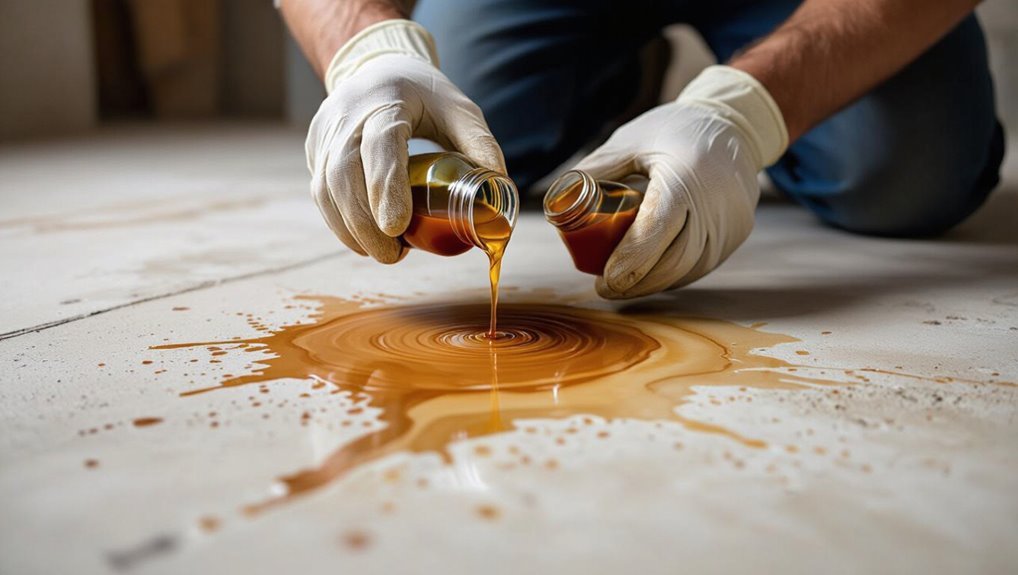
Think of acid staining as a chemical patina for concrete: it reacts with minerals in the slab to create permanent, variegated color instead of simply coating the surface.
You apply liquid acid stains, let them develop, then neutralize and seal. The result is translucent, mottled tones tied to the concrete itself, offering depth and natural variation you won’t get from paint or surface dyes.
Chemical reaction with concrete: how color develops
After the stain soaks in and reacts with the slab’s minerals, color actually forms through a chemical process rather than by sitting on the surface.
You’ll see metal salts in the stain react with lime and other components, producing permanent color changes in the concrete matrix.
Resulting tones vary with mineral content, porosity, and application—so expect subtle, mottled, natural-looking variation rather than uniform paint.
How paint interferes with the acid-stain chemistry
When paint’s on the concrete, it blocks the stain from reaching and chemically reacting with the cement minerals.
As a result, the acid can’t form the permanent metallic-salt color you expect; instead, the stain just sits on or bonds to the paint film, producing uneven, often faded or blotchy results.
You’ll get surface staining, poor penetration, adhesion issues, and colors that lack depth and permanence.
Assessing Your Painted Concrete Can It Be Stained?
First, identify the paint or coating type—latex, acrylic, epoxy, or urethane—since that determines whether stain can penetrate.
Then run simple tests like a water drop, a scratch test, and a small spot acid test to check adhesion and porosity.
Finally, inspect for cracks, efflorescence, or contaminants that could block or react with the stain.
Identifying the type of paint/coating (latex, acrylic, epoxy, urethane)
Wondering whether that painted concrete can take an acid stain? You need to ID the coating—different binders react differently.
Check these common types and what they mean for staining:
- Latex — water-based, often removable.
- Acrylic — similar to latex, stronger film.
- Epoxy — thick, durable, blocks stain.
- Urethane — high-performance, usually impermeable.
Knowing the type guides next steps and prep.
Testing adhesion and porosity: simple DIY tests (water test, scratch test, spot acid test)
If you’re unsure whether your painted concrete will accept an acid stain, do a few quick DIY tests to check adhesion and porosity before committing to prep work.
Tap and listen for hollow spots, rub with a thumbnail or coin to test paint adhesion, sprinkle water to watch absorption, then apply a tiny acid-stain patch in an inconspicuous area to observe reaction and bonding.
Checking surface condition: cracks, efflorescence, contamination
After you confirm the paint’s adhesion and the concrete’s porosity, examine the surface for physical and chemical issues that will affect staining.
Look for hairline and structural cracks—repair and fill them.
Watch for efflorescence (white powder) and remove it with a proper cleaner.
Check for oil, grease, paint bleed-through, or dirt; degrease and clean thoroughly before any stain to guarantee uniform results.
Main Options: Methods to Apply Acid Stain to Painted Concrete
You’ve got three main choices for handling painted concrete before staining: remove the paint first (the preferred route), attempt acid staining over paint in very limited, high‑risk situations, or choose a stain-like coating or overlay instead.
Removing paint gives you the best chance for true acid stain results and long-term durability.
If removal isn’t feasible, be prepared for unpredictable outcomes or opt for alternative decorative finishes.
Option A Remove paint first (preferred)
Start by stripping the paint off the concrete so the acid stain can penetrate the surface and react properly with the substrate.
You’ll prep, test, and expose bare concrete before staining. Follow these steps:
- Use chemical stripper or grinder for full removal.
- Clean with degreaser and rinse thoroughly.
- Etch to open pores if needed.
- Perform a small stain test to confirm reaction.
Option B Acid stain over paint (rare, high-risk scenarios)
If removing paint isn’t possible, you can sometimes apply acid stain over painted concrete—though it’s rare and carries significant risk.
You’ll only try this on very thin, porous, well-adhered paints. Test small areas first; expect unpredictable color, poor penetration, and short-lived results.
Sealers and coatings may fail. Prepare to revert to full removal or replacement if staining disappoints.
Option C Use alternative decorative finishes (stain-like coatings or overlays)
Consider alternative decorative finishes—like stain-look coatings, water-based or epoxy dyes, and thin overlays—when acid staining painted concrete isn’t practical.
You can apply breathable, adhesion-promoting primers, then choose a coating that mimics mottled stain effects or install micro-toppings to reset the surface.
These options reduce chemical risks, work over paint, and let you control color, texture, and durability without etching or unpredictable reactions.
Step-by-Step: How to Prepare Painted Concrete for Acid Staining (Paint Removal Method)
Before you start, gear up with a respirator, chemical-resistant gloves, and good ventilation. Then mark and test a small area to document the current finish.
Remove paint mechanically with grinders, shot blasters, or sanding where possible, and use chemical strippers only when needed—following label directions and safety precautions.
Finish by thoroughly cleaning with a pressure washer and neutralizing any residues (muriatic or other recommended neutralizer) before staining.
Step 1 Safety gear and prep (respirator, gloves, ventilation)
Gear up: you’ll need a proper respirator, chemical-resistant gloves, eye protection, and good ventilation before touching acid stain or paint removers.
Don full PPE, seal nearby vents, and clear the area of pets and people.
Mix chemicals outdoors or in a well-vented space, keep a neutralizer and water handy, and read product labels.
Work slowly and never rush exposure controls.
Step 2 Test area and document existing finish
Once you’ve got your PPE on and the area cleared, pick a small, inconspicuous patch to test how the paint and underlying concrete will react to your chosen remover and acid stain.
Document results with photos and notes. Test different sequences and note timing.
Use this checklist:
- Photo before
- Remover type
- Reaction time
- Final appearance
Step 3 Mechanical paint removal methods (grinding, shot blasting, sanding)
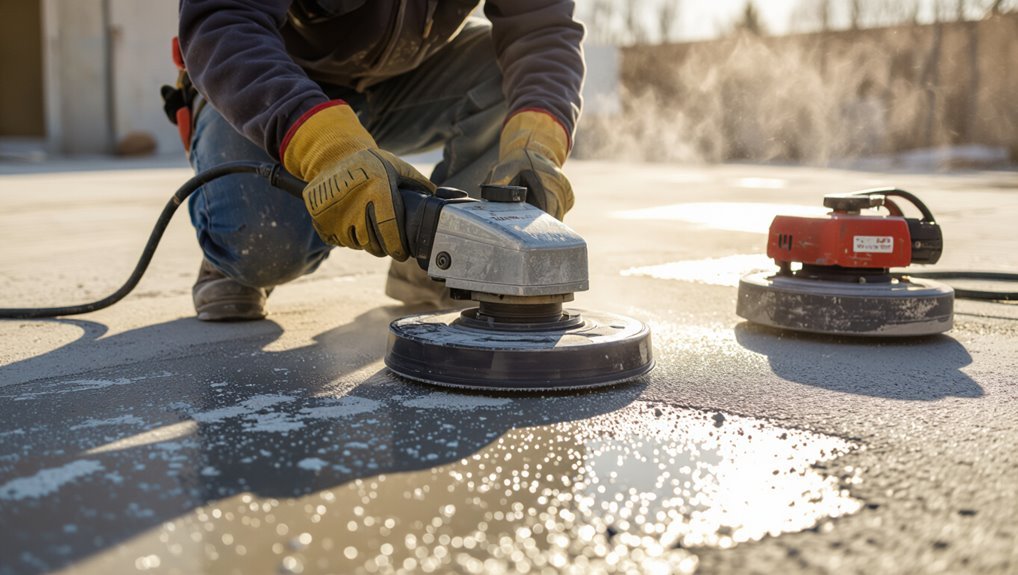
Start by choosing the mechanical method that best matches your paint type, surface condition, and project scale: grinding for thorough removal and profile control, shot blasting for large areas and heavy coatings, or sanding for small patches and thin paints.
Use proper abrasives, control dust with vacuums, work evenly to avoid gouges, and inspect frequently.
Wear PPE and follow equipment safety procedures.
Step 4 Chemical strippers: when and how to use them safely
Because mechanical methods can’t always remove every layer or stubborn primer, you’ll often need a chemical stripper to dissolve remaining paint before acid staining.
Choose a stripper labeled for concrete and the paint type, test a small area, wear respirator, gloves, and eye protection, and work in ventilation.
Follow dwell times, scrape softened paint, and dispose of waste per local regulations to avoid substrate damage.
Step 5 Concrete cleaning and neutralization after stripping (pressure wash, muriatic neutralization)
After you’ve removed softened paint and rinsed away stripper residue, you’ll need to thoroughly clean and neutralize the concrete before acid staining.
Pressure-wash at 2500–3000 psi to remove residues and open the surface. Let dry, then test pH with strips.
If alkaline, neutralize with diluted muriatic acid per label, rinse until pH returns to 7, and let fully dry before proceeding.
Step 6 Porosity restoration and patching cracks
Once the concrete’s surface is clean and neutral, you’ll restore porosity and fill cracks so the acid stain can penetrate evenly. This step fixes low spots, hairline fractures, and any densified areas left by paint or stripper so you get uniform color and avoid blotches.
Open pores with a light etch or diamond pad, vacuum thoroughly, then patch cracks with a cementitious repair or epoxy, feathering edges.
Step 7 Acid stain application steps and timing
Begin by planning your stain sequence and work area so you can apply the acid stain consistently and finish each section within its reaction window.
You’ll work in manageable bays (usually 50–150 sq ft) to keep wet-edge blending and timing uniform.
Mix stain per manufacturer, test small area, apply with pump sprayer or brush, let react 15–60 minutes depending on color, then rework edges for uniformity before moving on.
Step 8 Neutralizing, rinsing, and sealing for long-term durability
With the stain set and you’ve smoothed any seams, you’ll need to neutralize the acid, rinse thoroughly, and seal the surface to lock in color and protect the slab.
Mix a baking soda solution (1 lb per 5 gallons), scrub, then rinse until pH is neutral. Let dry fully, apply a compatible penetrating sealer, and cure per manufacturer instructions for lasting durability.
If You Try Acid Staining Over Paint: Procedure, Risks, and How to Minimize Failures
Before you commit, run adhesion and color-sample tests on small, inconspicuous areas to see how the stain reacts to the painted surface.
If thin, porous paint remains you can tweak the application—use a lighter acid mix, shorter dwell time, and more uniform rinsing—to encourage penetration without lifting the coating.
Expect muted or patchy color with common failures like flaking, blotching, or no reaction at all, and plan to strip and start fresh if tests fail.
Pre-application tests to attempt (adhesion, color sample)
Because painted concrete can vary so much, you’ll want to run two quick pre-application tests: an adhesion check to see if the stain will bond, and a small color sample to confirm the look.
For adhesion, scuff a discreet square, apply stain, tape-test after curing.
For color, stain a few square inches, rinse per instructions, and view in different light before committing.
Application tweaks if thin, porous paint remains
If some thin, porous paint stays after your prep, you can still acid-stain—but you’ll need to tweak application and expect variable results.
Lightly scuff and dilute stain 10–25% to improve penetration, test small areas, and apply multiple thin coats rather than one heavy coat.
Rinse between coats, neutralize properly, and accept slower development; always document mixes and timings for repeatability.
Expected visual outcomes and common failure modes
Even with the tweaks above, expect a wider range of visual outcomes than you’d get on bare concrete—colors may look muted, patchy, or mottled where paint alters penetration.
You’ll see uneven etching, ghosting of the paint layer, blotchy reactions, or scant color uptake.
Failures usually stem from residual coating, improper neutralization, or inconsistent surface porosity; test small areas and accept unpredictability.
Comparison: Acid Stain vs. Alternative Approaches for Painted Concrete
If you’re weighing options for painted concrete, compare true acid stains on bare concrete to water-based stains, which give more predictable color but less chemical bonding.
Consider concrete dyes and pigments for brighter, more uniform hues, noting they don’t penetrate and age like acid stains.
Also look at epoxy or stain-look coatings if you want a stable, protective surface that mimics staining without the longevity or patina of actual chemical staining.
Acid stain (on bare concrete) vs. water-based stains
When you’re choosing between acid stains and water-based stains for concrete, know they work very differently and suit different goals:
| Acid Stain | Water-Based Stain |
|---|---|
| Reacts with minerals, earthy, unpredictable beauty | Consistent, vibrant, predictable color |
| Penetrates deeply, permanent feel | Sits nearer surface, easier to refresh |
| Requires bare concrete, chemical handling | Safer, user-friendly for DIYs |
Concrete dyes and pigments vs. acid stain
Although acid stains transform concrete by reacting with its minerals to create variegated, permanent tones, dyes and pigments offer a very different toolkit for painted or sealed concrete: they deliver consistent, saturated hues and precise color control.
You’ll choose dyes when you need uniform color, fast penetration, or mixing flexibility; pigments suit tints in mixes or overlays. Both lack the natural, variegated depth of acid stain.
Epoxy or stain-look coatings vs. actual staining
One clear choice you’ll face is whether to simulate stained concrete with epoxy or stain-look coatings, or to use genuine acid stain that chemically alters the slab.
Epoxy coatings hide flaws, offer uniform color, and protect paint, but they sit atop concrete and can peel.
Acid stain penetrates and reacts with the slab for long-lasting, variegated color that won’t flake, but needs bare concrete.
Common Mistakes DIYers Make and How to Avoid Them
Before you start, test the paint type and porosity so you know whether staining will work or if paint must come off.
Don’t skip proper surface prep—using the wrong stripper, grinder setting, or leaving residue will ruin the finish.
Always neutralize the acid thoroughly and apply the correct sealer to lock in results and prevent failure.
Mistake: Not testing paint type or porosity
If you skip testing the paint type and concrete porosity, you’ll risk uneven staining, poor adhesion, or a finish that flakes off in months.
Always patch-test a small area: check whether paint is acrylic, epoxy, or latex and whether stain penetrates.
Use water, sanding, and a dilute stain sample.
Record results and choose removal, primer, or compatible stain based on those findings.
Mistake: Skipping proper paint removal or surface prep
When you skip proper paint removal and surface prep, the acid stain won’t penetrate evenly and the finish will look blotchy or start peeling within months; take the time to strip loose paint, sand glossy surfaces, and clean away dust and contaminants so the stain can react consistently with the concrete.
You’ll improve adhesion, color uniformity, and longevity—don’t rush prep or expect professional results.
Mistake: Using wrong stripper or grinder setting
Because the wrong stripper or a grinder set too aggressively can damage the slab or leave residues that interfere with acid reaction, choosing the correct products and settings matters more than you might think.
Test a mild chemical stripper and use a low-speed grinder with diamond pads. Work in small sections, rinse thoroughly, and inspect for remaining paint or glazing before acid staining to guarantee proper penetration.
Mistake: Improper neutralization and sealing
After you’ve removed paint and cleaned the slab, failing to neutralize the surface and apply the right sealer is a common way projects go wrong.
If you skip neutralizing acid residues, staining will be uneven and concrete can etch. Rinse thoroughly, test pH, then use a compatible sealer for your stain type.
Proper neutralization and sealing guarantee color consistency and long-lasting protection.
Best Practices and Professional Tips
Decide whether the job’s complexity, surface condition, or local regulations mean you should hire a pro or can tackle it yourself.
Pick stain and sealer products rated for painted concrete and match them to your climate, scheduling window, and maintenance expectations.
I’ll also outline typical costs and timeframes for common scenarios so you can plan accurately.
When to hire a pro vs. DIY
Wondering whether you should tackle an acid-stained painted concrete project yourself or call in a pro?
If your surface is small, paint poorly bonded, and you’re comfortable with etching, neutralizing, and safety gear, DIY can save money.
Hire a pro for large areas, structural concerns, complex patterns, or if you lack ventilation, time, or confidence—professionals guarantee consistent results and proper cleanup.
Choosing the right stain and sealer products
Because the right products determine both appearance and longevity, you’ll want to match stain chemistry and sealer type to your surface, traffic, and aesthetic goals.
Choose penetrating stains for natural, variegated looks and water-based stains for safer fumes on previously painted concrete.
Pick a solvent or high-solids sealer for durability in heavy traffic; use breathable, UV-resistant topcoats for exterior longevity.
Climate, timing, and maintenance considerations
When you plan staining painted concrete, factor in local climate, seasonal timing, and a realistic maintenance schedule to protect your investment and keep finishes consistent.
Choose dry, mild days; avoid freeze/thaw cycles; schedule sealers after full cure; plan regular cleaning and reseal intervals.
Consider:
- Temperature range
- Humidity levels
- Weather forecast window
- Maintenance frequency
Cost and time estimates for common scenarios
If you’re weighing options, expect costs and timelines to vary by surface size, paint condition, and whether you DIY or hire a pro:
Small DIY patio (200–400 sq ft) runs $50–200 and takes a weekend;
mid-size job with paint removal costs $300–900 and 1–3 days;
professional full resurfacing for 1,000+ sq ft costs $1,500–4,000 and 2–5 days.
Include sealing and cure time.
FAQ
You’ll get clear answers to whether acid stain can penetrate latex or acrylic paint and if muriatic acid is appropriate for prep.
You’ll also learn how long to wait after paint removal, whether staining will hide old paint imperfections, and what maintenance keeps the finish lasting.
Read on for practical, concise guidance so you can plan the job confidently.
Can acid stain penetrate latex or acrylic paint?
Can acid stain penetrate latex or acrylic paint? No — not effectively.
Those paints form a film barrier that prevents acid and colorants from reaching concrete pores. If paint is thinly worn or flaking, stain might adhere inconsistently, but true penetration won’t occur.
You’ll need to remove or thoroughly profile the painted surface before expecting authentic acid-stain results and color development.
How long after paint removal should I wait to stain?
Since painted surfaces block penetration, you’ll need to remove paint and properly profile the concrete before staining — but don’t rush to apply stain immediately.
After removal, wait at least 48–72 hours for moisture to evaporate from grinding, washing, or blasting.
Verify dryness with a moisture meter or plastic sheet test.
Only stain when surface is fully dry and free of dust, oils, or residue.
Will acid stain hide imperfections in old paint?
Will acid stain hide imperfections in old paint? Not really — acid stain reacts with concrete, not paint, so any remaining paint flakes, brush marks, or uneven patches will still show through.
You’ll get mottled color where concrete is exposed and unchanged spots where paint remains. For a uniform finish, remove paint thoroughly or use an appropriate overlay or solid-color coating instead.
Can I use muriatic acid to prepare painted concrete?
How effective is muriatic acid for prepping painted concrete?
You can use diluted muriatic acid to remove chalky paint and etch the surface, but it often won’t strip durable coatings fully.
Test a small area, neutralize thoroughly, and rinse well.
Wear proper PPE and work outdoors or with ventilation.
For stubborn paint, mechanical stripping or chemical paint removers may be safer and more reliable.
How long does acid-stained concrete last and how do I maintain it?
Curious how long acid-stained concrete will last? It can endure decades—often 10–25+ years—if you seal and protect it.
Clean regularly, avoid harsh deicers, and reapply a quality topical or penetrating sealer every 2–5 years depending on traffic.
Address spills quickly, buff scuffs, and perform spot repairs for chips. Proper maintenance preserves color, sheen, and longevity.
