
Can You Paint an RV Ceiling? Everything You Need to Know Before You Start
You can paint an RV ceiling if it’s dry, clean, and structurally sound, but you’ll need to assess material and damage first. Avoid painting over leaks, mold, or sagging panels and repair any soft spots. Prep by cleaning, sanding, priming with a compatible adhesion primer, then use flexible, low‑VOC paint or marine/RV products. Mask fixtures, work in thin coats, and allow full cure. Keep going and you’ll get tips on materials, tools, and troubleshooting to finish it right.
Quick Answer Can You Paint an RV Ceiling?
Yes—you can paint an RV ceiling, and it’s a smart fix when it’s stained, faded, or you want a fresh look.
Don’t paint if the ceiling has active leaks, mold, sagging, or damaged material — those issues need repair or replacement first.
With a clean, dry, and sound surface, painting is quick, affordable, and effective.
Short direct answer
You can paint an RV ceiling, but success depends on preparation, the ceiling material, and using the right paint.
Yes — can you paint an RV ceiling? Absolutely, if you clean, repair, and prime properly, choose compatible paint (flexible, low-VOC), and work in thin, even coats.
Skip painting over active leaks, heavy mold, or severely delaminated panels.
When painting is a good idea and when it’s not
When is painting the RV ceiling worth the effort?
You should paint if stains are minor, texture’s sound, and you want a quick refresh or color change.
Don’t paint when there’s rot, mold, bubbling, or structural damage—these need repair or panel replacement first.
Also skip painting if the surface won’t hold primer or you plan to sell and prefer original condition.
Basic Understanding What Makes RV Ceilings Different
Your RV ceiling can be made of vinyl, aluminum, wood, fiberglass, or fabric, and each material handles paint and moisture differently.
You’ll also face common issues like stains, sagging, dents, and delamination that affect prep and finish choices.
Understanding how each surface reacts to paint and humidity helps you pick the right products and avoid further damage.
Common RV ceiling materials (vinyl, aluminum, wood, fiberglass, fabric)
RV ceilings come in several distinct materials—vinyl, aluminum, wood, fiberglass, and fabric—each with its own repair, prep, and painting quirks you’ll want to understand before starting a project.
Vinyl needs adhesion-friendly cleaners and flexible primers; aluminum demands deoxidizing and etch primer; wood requires sanding and sealing; fiberglass benefits from scuffing and specialized primer; fabric often needs stabilization or replacement rather than paint.
Typical ceiling problems (stains, sagging, dents, delamination)
Those material differences affect how ceilings fail, so before you paint you should know the common problems you’ll face: stains from leaks, sagging panels, dents and punctures, and delamination where layers pull apart.
You’ll inspect for soft spots, water stains, mold, and warped seams. Address structural issues, replace badly damaged sections, and fix leaks before any cosmetic work.
How RV ceilings react to paint and moisture
Because ceiling materials vary so much, they’ll react to paint and moisture in different ways, and you need to understand those differences before you start.
Fiberglass, vinyl, wood, and drywall absorb and release moisture differently, affecting adhesion and drying.
Porous surfaces may need primer; slick surfaces require deglossing.
Trapped moisture causes peeling, stains, or mold, so always dry and prep thoroughly before painting.
Is Painting an RV Ceiling Worth It? Pros and Cons
You can boost your RV’s look, protect the ceiling surface, and brighten the interior by painting it, but you should weigh those gains against added weight, possible warranty issues, and the risk of hiding underlying damage.
Painting is usually cheaper than full replacement, yet it may only be a temporary fix if the substrate is compromised.
Consider the condition and long-term goals for the RV before deciding.
Benefits of painting (appearance, protection, light reflectivity)
Painting an RV ceiling can transform a cramped, dated interior into a brighter, more protected space that feels like new.
You’ll improve appearance by covering stains and yellowing, protect surfaces from moisture and mildew with proper paint, and boost light reflectivity to make the cabin feel larger and reduce lighting needs.
It’s a cost-effective refresh that upgrades comfort and resale appeal.
Downsides and limitations (weight, warranty, surface damage)
While a fresh coat can look great, it also brings trade-offs you should weigh carefully: painting adds weight that can affect payload and fuel efficiency, and heavy textured coatings worsen that.
You might void manufacturer or roof-warranty if coatings aren’t approved. Poor prep or aggressive sanding can damage delicate ceiling panels, causing sagging or delamination, so proceed only with compatible products and careful techniques.
Cost vs. replacement comparison
Deciding whether to paint or replace your RV ceiling comes down to balancing upfront cost, long-term value, and the condition of the substrate. You’ll save money and time by painting if the surface is sound; replace when water damage or sagging threatens structure. Weigh aesthetics, resale, and future repairs before choosing.
| Option | Cost | Feeling |
|---|---|---|
| Paint | Low | Relief |
| Replace | High | Anxiety |
| Delay | Variable | Regret |
Preparing to Paint Assessment and Tools
Before you paint, inspect the ceiling for water stains, soft spots, loose adhesive, and any mold so you can address damage first.
Gather a checklist of materials and tools—cleaners, primer, paint, rollers, brushes, drop cloths, and a sturdy ladder—so you won’t stop mid-job.
Take safety steps like working with ventilation, wearing a proper mask, and following ladder-safety practices.
How to inspect your ceiling (water damage, adhesive bond, mold)
Curious whether your RV ceiling is ready for paint? Inspect for soft spots, stains, or bubbling—signs of water damage.
Press gently for detached areas and tap to detect hollow sounds indicating delamination.
Look closely for black or fuzzy mold; use a flashlight. Smell for mustiness.
Document damaged zones, measure affected areas, and plan repairs before painting to guarantee lasting results.
Materials and tools checklist
Gather the right materials and tools so your RV ceiling prep goes smoothly and the paint job lasts.
You’ll need cleaners, primers, and paint suited for flexible surfaces. Gather sanding pads, patching compound, and tack cloths.
Use proper rollers, extension poles, and angled brushes.
- Cleaning & prep supplies
- Repair materials & sandpaper
- Painting tools & trays
Safety precautions (ventilation, masks, ladder safety)
Because paint fumes can build up quickly in a small RV, make ventilation your top priority: open windows and vents, run roof fans, and set up a box or oscillating fan to pull fresh air through while you work.
Wear an N95 or respirator for solvent or aerosol paints, use eye protection, and stabilize a ladder on level ground; have a helper hold it when needed.
Step-by-Step: How to Paint an RV Ceiling
Start by thoroughly cleaning the ceiling to remove dirt, grease, and any adhesives so paint will stick.
Next you’ll repair soft spots, re-glue or replace panels, then sand or scuff the surface for good adhesion.
Finally, pick an appropriate primer and flexible paint, and carefully mask and protect lights, vents, and furnishings before you paint.
Step 1 Clean and remove contaminants
Wipe the ceiling thoroughly to remove dust, cobwebs, and loose dirt before you touch any paint—these contaminants will ruin adhesion and show through new coats.
Next, degrease with a mild cleaner or trisodium phosphate substitute, rinse, and let dry.
Use a soft brush for textured areas and a microfiber cloth for smooth surfaces.
Wear gloves and protect fixtures and vents.
Step 2 Repair and stabilize (patching, re-gluing, replacing panels)
Once the ceiling’s clean and dry, inspect it closely for soft spots, peeling seams, holes, or loose headliner material that will keep paint from sticking.
Remove damaged sections, re-glue loose fabric with headliner adhesive, and press seams flat.
Patch small holes with flexible filler; replace severely water‑damaged panels.
Secure edges with screws or adhesive-backed tape so repaired areas stay stable before painting.
Step 3 Sanding and scuffing for adhesion
Prep the surface by sanding and scuffing so paint will grip evenly — use a 120–150 grit sandpaper or a sanding sponge and work gently across the entire ceiling, concentrating on glossy areas, repaired spots, and edges.
Wipe dust with a tack cloth or vacuum with a brush attachment.
Check for missed shiny spots and feather changes for a uniform, mechanically keyed surface before priming.
Step 4 Choosing primer and paint (adhesion primers, flexible paints)
Although sanding gives you a keyed surface, choosing the right primer and paint is what guarantees long-lasting adhesion and flexibility; pick a high-adhesion primer formulated for glossy plastics or fiberglass and pair it with a flexible, low-VOC topcoat designed for RV interiors.
Test compatibility on a small area, use thin even coats, allow full cure between layers, and prefer products labeled for RV or marine use.
Step 5 Masking and protecting interior components
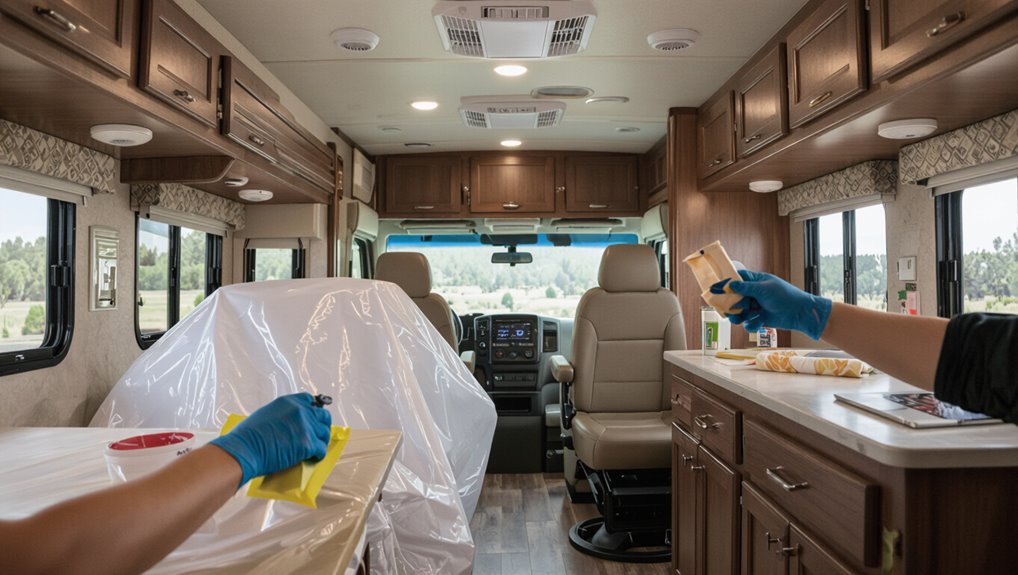
With primer and paint chosen and cured, you’ll need to mask and protect the interior so paint only goes where you want it.
Cover vents, lights, cabinets, and upholstery with plastic sheeting and painter’s tape. Remove or wrap fixtures, secure loose trim, and floor-protect with drop cloths.
Label taped areas for easy removal and check seams to prevent bleed-through before painting.
Step 6 Application techniques (brush, roller, spray) and recommended order
Start by choosing the right application method for each ceiling area: use a brush for edges and tight spots, a roller for large flat sections, and a spray gun for fast, even coverage on textured or high ceilings.
Work in this order: brush trim, cut-in corners, roll main panels, then spray if needed for final blending.
Maintain wet edges and even pressure.
Step 7 Drying, curing, and reassembly
Once the paint feels dry to the touch, give the coating its full cure time before you reattach fixtures or store items nearby; rushing reassembly can mar the finish or trap solvents.
Check manufacturer cure hours, ventilate the RV, and keep temperature stable.
Reinstall lights and vents gently, tighten fasteners without overtorqueing, and wait before cleaning to guarantee a durable, even finish.
Product Recommendations and What to Look For
When choosing products for your RV ceiling, focus on primers matched to the substrate—vinyl, wood, or bare metal—to guarantee adhesion.
Pick paint and finish types based on durability and application: aerosol for touch-ups, acrylic for ease, and elastomeric for flexible coverage.
Don’t forget adhesives, sealants, and specialty cleaners that bond, seal seams, and remove contaminants before painting.
Best primers for various ceiling materials
Although ceiling materials vary, choosing the right primer is the single most important step before painting an RV ceiling because it guarantees adhesion, seals stains, and prevents future peeling.
Use primers matched to substrate:
- Shellac-based for nicotine, water stains.
- Bonding primer for glossy plastic or laminate.
- Oil-based or stain-blocking acrylic for wood or drywall.
Pick mildew-resistant, fast-dry options.
Best paints and finishes (aerosol, acrylic, elastomeric)
Because the ceiling’s surface and your maintenance goals determine the right product, pick paints and finishes that match the substrate, traffic, and moisture conditions in your RV. Choose aerosol for spot repairs, acrylic for easy cleanup and good adhesion, elastomeric for crack bridging and moisture resistance.
| Type | Best Use | Key Benefit |
|---|---|---|
| Aerosol | Small fixes | Fast, low mess |
| Acrylic | Overall coat | Durable, breathable |
| Elastomeric | Damp areas | Elastic, seals |
| Hybrid | High wear | Tough, low odor |
Adhesives, sealants, and specialty products
Pick adhesives, sealants, and specialty products that match your RV ceiling’s material and the conditions it faces—flexible adhesives for vinyl or fabric, mildew-resistant silicone for wet areas, and high-solids contact adhesives for laminates.
Choose low-VOC, paintable sealants; solvent-resistant contact cement for stubborn glue lines; and foam-safe spray adhesives for insulation.
Test compatibility on a small hidden area before full application.
Alternatives to Painting
If painting isn’t the right fit, you can replace the ceiling panels or headliner for a fresh, lasting look.
You might also try peel-and-stick panels or specialty wallpapers for an easier, less permanent update.
For bigger jobs, weigh professional re-covering services against a DIY approach to compare cost, skill, and finish.
Replacing ceiling panels or headliner
When the ceiling’s paint is beyond salvaging, you can replace the panels or headliner to give your RV a fresh, long-lasting look.
Remove damaged material, measure accurately, and choose lightweight, moisture-resistant substrates.
Install new panels or fabric using appropriate adhesives and fasteners, sealing seams and access points.
This restores structure, improves insulation and appearance, and avoids repeated paint touch-ups.
Using peel-and-stick panels or wallpaper alternatives
Replacing panels or a headliner can solve serious damage, but you might prefer a faster, less permanent route that still updates your RV’s look.
Peel-and-stick ceiling tiles, vinyl wallpaper, or foam panels install quickly, hide stains, and resist moisture. Choose lightweight, fire-rated materials, measure carefully, and test adhesion.
Removable options let you change styles without commitment or heavy tools.
Professional re-covering services vs DIY
Choice matters: you can hire a professional re-covering service to get a durable, neatly finished RV ceiling without the hassles of prep, tools, or learning curves.
Or you can tackle a DIY alternative like peel-and-stick panels, fabric wraps, or headliner replacement to save money and customize the result.
Professionals guarantee warranty, speed, and flawless seams; DIY gives control, lower cost, and flexible styling—pick based on budget, time, and skill.
Common Problems When Painting RV Ceilings and How to Fix Them
You’ll run into a few common issues when painting an RV ceiling, but most have straightforward fixes.
Address peeling or flaking by sanding, priming, and choosing a compatible paint; smooth visible seams and texture mismatch with joint compound or matching texture before repainting.
Prevent fading and yellowing by using UV-resistant, low-VOC paints and proper ventilation while curing.
Peeling or flaking paint causes and remedies
When paint starts to peel or flake from your RV ceiling, it usually signals poor adhesion caused by dirt, moisture, or incompatible coatings beneath the surface; addressing the root cause first will save time and prevent repeat problems.
Clean thoroughly, dry completely, and remove loose paint with a scraper and sandpaper.
Prime with a bonding primer and use a compatible, moisture-resistant paint to restore a lasting finish.
Visible seams, texture mismatch, and sagging after painting
If seams show through, textures look uneven, or the ceiling sags after painting, it usually means surface prep, paint choice, or application technique fell short.
You should sand and clean, re-tape or skim seams with flexible joint compound, match texture with the right roller or spray, and use lighter, water-based ceiling paint.
For sagging, remove heavy coats and reapply thin, even layers after proper drying.
Paint color fading and yellowing prevention
Although ceiling paint might look fine at first, long-term exposure to sunlight, heat, cooking fumes, and nicotine can make colors fade or yellow.
So you’ll want to choose the right products and maintenance steps up front.
Pick a UV-resistant, low-VOC enamel or acrylic primer and topcoat, clean regularly, ventilate while cooking, avoid smoking inside, and touch up with matching paint before discoloration spreads.
Best Practices and Maintenance After Painting
After painting your RV ceiling, you’ll want to schedule seasonal checks and keep moisture under control to prevent peeling or mold.
Clean the surface gently with mild cleaners and soft cloths so you don’t damage the finish.
For long-term care, monitor for chips, touch up promptly, and maintain good ventilation to preserve the paint.
Seasonal checks and moisture control
When seasons change, keep a regular schedule of inspections to catch moisture issues early and protect your newly painted RV ceiling.
Check seals, vents, and roof joints for leaks, inspect for soft spots or discoloration, and monitor humidity levels inside.
Use a dehumidifier or vent when cooking/showering, repair any leaks promptly, and re-seal seams seasonally to prevent mold and paint failure.
Cleaning painted ceilings without damage
If you want your freshly painted RV ceiling to stay clean and undamaged, adopt gentle, regular cleaning habits that match the paint type and surface texture.
Use a soft microfiber cloth or sponge, mild detergent diluted in warm water, and test a hidden spot first.
Avoid abrasive scrubbers, strong solvents, and soaking.
Wipe gently, rinse with clean water, and dry with a soft cloth.
Long-term care tips to preserve finish
Keeping up with gentle cleaning habits will only get you so far; to preserve your RV ceiling’s fresh finish over years, you should adopt a simple maintenance routine that prevents wear, stains, and moisture damage.
Inspect quarterly for chips, peeling, or mildew; touch up with matching paint.
Control humidity, ventilate after cooking or showering, avoid abrasive cleaners, and address leaks immediately to prevent costly repairs.
Cost, Time, and Difficulty Estimates
You’ll want to compare a DIY timeline—usually a weekend for prep, priming, and two coats—against a pro who can finish in a day or two.
Expect materials (paint, primer, tape, rollers) to run $50–$200, while professional labor can push the total to $300–$1,000 or more depending on complexity.
If you’re comfortable with ladders, masking, and touch-ups you can save money DIY, but hire a pro for textured ceilings, water damage, or if you need perfect results fast.
Typical time breakdown for DIY vs professional
Budgeting for an RV ceiling paint job hinges on whether you tackle it yourself or hire a pro:
DIY will save money but take more time and effort, while a professional costs more upfront yet finishes faster and with less hassle.
Expect a DIY weekend of 10–20 hours (prep, priming, drying, touchups).
A pro typically completes it in 4–8 hours including cleanup.
Cost estimate ranges (materials vs labor)
Now that you know the time trade-offs between DIY and hiring a pro, let’s look at what that means for your wallet: materials for a typical RV ceiling paint job usually run $30–$150 (paint, primer, rollers, sandpaper, tape, and drop cloths), while labor can add $150–$600 if you hire someone — more in high-cost areas or for complex ceilings.
| Item | DIY | Pro |
|---|---|---|
| Materials | $30–$150 | Included/charged |
| Labor | $0 | $150–$600 |
| Total | $30–$150 | $180–$750 |
Skill level and when to hire a pro
If you’re comfortable on a ladder, can do careful prep (sanding, cleaning, masking) and have patience for drying times, painting an RV ceiling is a realistic DIY weekend project that typically saves you $150–$600.
Still, hire a pro if ceilings have water damage, textured popcorn, extensive repairs, or you want perfect streak-free results.
Pros cost more but save time and guarantee a durable finish.
FAQs
You’ll have common questions about staining, paint choice, weight, longevity, and fabric headliners.
Can you cover water stains, use house paint, or safely paint a fabric ceiling without adding noticeable weight?
Read on for concise, practical answers.
Can I paint over water stains on an RV ceiling?
Wondering whether you can just paint over water stains on your RV ceiling? You shouldn’t—paint hides stains but won’t fix leaks or mold.
First locate and repair the source, dry the area, treat any mold with a mildew cleaner, and apply a stain-blocking primer before painting.
That sequence prevents recurrence and guarantees a durable, even finish without wasting time or materials.
Will painting add significant weight to my RV?
After fixing leaks and treating stains, you might worry that repainting will weigh your RV down. It won’t in any meaningful way: a coat of RV-specific paint adds only ounces per square foot.
Even multiple coats keep added weight negligible compared to furniture and gear. Focus on proper prep and lightweight products; avoid heavy primers or thick textures to keep weight minimal and performance ideal.
Can I use regular house paint in an RV?
Can you use regular house paint in an RV? You can, but it isn’t always ideal.
House paints may off-gas, flex poorly, and peel with vibration and humidity. If you choose house paint, pick a low-VOC acrylic latex, prime well, and use thin coats.
Better: use paint rated for RVs, mobile homes, or marine environments for durability and adhesion.
How long will a painted RV ceiling last?
If you use the right products and prep the surface properly, a painted RV ceiling can hold up for several years—typically 3–7 years for regular use.
Lifespan depends on moisture, temperature swings, ventilation, and traffic. Proper primer, mildew-resistant paint, and good ventilation extend life.
Touch-ups and spot repairs will keep it looking fresh longer; neglect accelerates peeling and staining.
Is it possible to paint a fabric headliner?
Wondering whether you can paint a fabric headliner? You can, but it’s tricky.
Use fabric-safe paint or dye and test a small hidden area first. Clean and de-grease, avoid soaking the material, and apply light, even coats to prevent stiffening or sagging.
If the headliner’s old, brittle, or glued, replacement is often a better, longer-lasting solution.
