
Can You Use Wall Paint on MDF? What Works and What Doesn’t
Yes, you can use standard wall paint on MDF, but only if you prep it correctly. Sealed or factory-sanded MDF works best; raw/unsealed MDF drinks paint, raises fibers, and can blot or peel. Sand lightly (120 to 180–220), vacuum, and wipe tack-free. Seal cut edges first with bonding or stain-blocking primer (shellac if needed). Apply even thin coats, letting primer cure fully, and dry between layers for smooth results—keep going to learn the best approach.
Can You Use Wall Paint on MDF (What to Expect)?
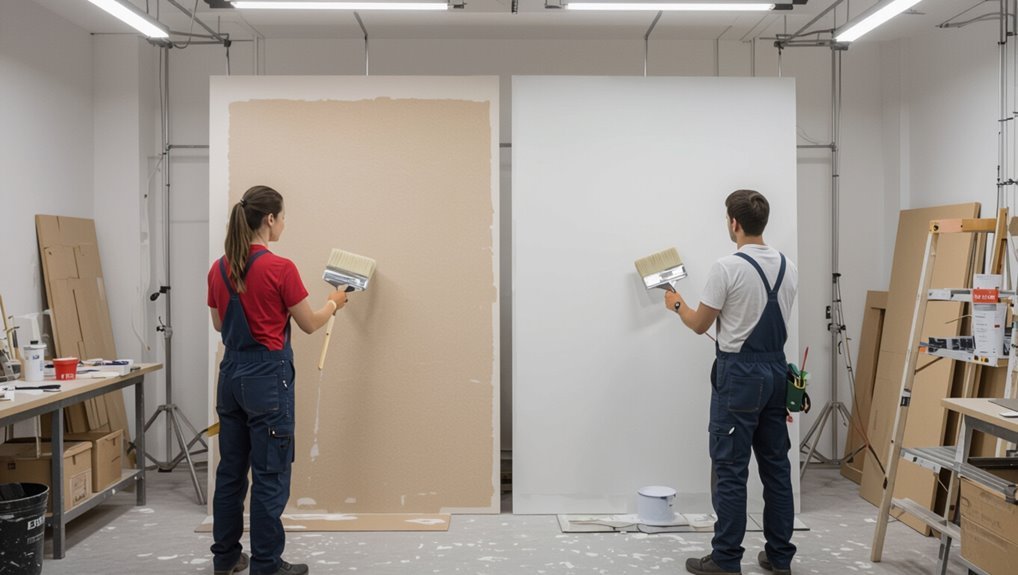
You can use wall paint on MDF, but you need to know what to expect from the material first.
MDF absorbs moisture and can swell if you trap water, so you shouldn’t assume every paint behaves the same. Your chosen MDF finishes matter: smooth, sealed boards usually accept paint more evenly, while raw edges soak up more and can look patchy.
Focus on wall paint compatibility—latex and acrylics often work best once the surface is properly protected.
Expect better coverage after priming, and watch for raised fibers if the top layer isn’t sealed.
What Kind of MDF Surface Are You Painting?
First, check whether your MDF is sealed or unsealed, since each one drinks paint differently and needs different prep.
If you want smooth adhesion, prime the surface before painting, then sand it evenly and remove all dust with a tack cloth.
When the surface is clean and properly primed, your wall paint will lay down more consistently and look better.
Sealed Vs Unsealed MDF
Sealed and unsealed MDF behave very differently under wall paint, so checking the surface first saves time and prevents peeling or soaking.
If it’s sealed, you usually get steadier coverage and smoother color, and you’ll enjoy sealed MDF benefits like reduced drink-in.
If it’s unsealed, expect unsealed MDF drawbacks: rapid absorption, rough blotches, and raised fibers as moisture swells the sheet.
- Test with a light water dab.
- Look for visible fibers and dusting.
- Check edge soak after 1–2 minutes.
- Decide to paint only after you identify the type.
Prime For Smooth Adhesion
Before you prime, identify what surface you’re working with—factory-sanded, raw/unfinished, or already painted—because that determines how well wall paint will grip MDF.
Use the right primer types to match each surface: for raw MDF, choose a bonding primer that seals porous fibers; for factory-sanded, a stain-blocking, adhesion-focused primer helps smooth coverage; for previously painted MDF, use a bonding primer to prevent peeling.
Apply primer in an even coat, then let it cure fully.
Good adhesion techniques start with proper coverage, not rushed drying.
Sanding And Dust Removal
Once you’ve chosen the right primer for your MDF, you need to sand and clean it so the wall paint can grab evenly.
Use sanding techniques that smooth raised fibers, not gouges; start with 120-grit, then move to 180-220 for a uniform finish.
Vacuum thoroughly and wipe with a tack cloth to improve dust control. If you see dark spots, sand again lightly and re-clean.
- Sand with even pressure
- Vacuum every pass
- Tack-wipe edges and corners
- Let cleaned MDF dry before painting
How to Prep MDF Before You Paint It
Before you paint MDF, clean the surface thoroughly to remove dust, grease, and any loose particles.
Sand the edges and flat areas smooth, then wipe away the sanding residue.
Prime with an appropriate sealer so the paint grips evenly and won’t soak in irregularly.
Clean MDF Surface Thoroughly
Thoroughly clean your MDF surface so paint can grip evenly and won’t trap dust or grease.
Start with dry vacuuming, then wipe using the right cleaning techniques for surface preparation. MDF sheds fine particles, so don’t skip the first pass—remove all loose fibers before any wet cleaning.
Next, wipe with a damp microfiber cloth and a mild degreasing cleaner, then follow with a fresh water wipe to prevent residue.
- Vacuum seams and corners
- Wipe with microfiber + mild cleaner
- Rinse lightly with water cloth
- Let it fully dry before painting
Sand Edges And Flat Areas
Sand the edges and flat areas of your MDF until they feel smooth and uniform to the touch. Use light, steady pressure so you don’t gouge the board, and switch to finer grit as you progress.
Focus on any rough corners, sharp bevels, and raised fibers—those spots telegraph through paint. For flat areas, sand in long strokes with the grain to keep the surface even.
For edge preparation, round or soften edges slightly, then feather them into the face. Vacuum dust often and wipe clean between passes.
Prime With Appropriate Sealer
Now you need to prime MDF with the right sealer, because MDF drinks moisture and can swell or raise fibers if you skip this step.
Choose sealer types made for MDF: shellac, oil-based, or a dedicated MDF primer. Apply an even coat, especially on edges and cut faces, because those spots wick moisture fastest. Let it dry fully, then lightly sand to knock down raised grain.
Use these steps for smooth results:
- Vacuum dust after sanding
- Seal edges first
- Do primer application in one consistent direction
- Re-sand, then topcoat with wall paint
Do You Need to Sand MDF for a Smooth Finish?
You usually need to sand MDF if you want a truly smooth finish, because its surface can show tiny milling marks and slight fuzziness from manufacturing.
You can skip sanding only if you’re painting for a quick, forgiving coat, but you’ll still see texture up close.
Use sanding techniques that start with medium-grit to knock down high spots, then switch to fine-grit for smooth finishes.
Always sand with the grain lightly, and wipe off dust between passes.
If fuzz rises, sand again briefly, then repaint.
How to Seal MDF to Stop Swelling and Soak-Through
Before you paint MDF, you need to seal it well, because MDF drinks up moisture and can swell or bleed through, especially at cut edges and any exposed fiber.
Start by brushing or rolling a high-build primer/sealer over all faces, then spot-seal the edges with extra coats. Let it dry fully, scuff lightly, and apply a second seal layer for moisture protection.
Check for fuzzy fibers and wipe them off before sealing.
Use these steps:
- Seal cut edges first
- Apply 2+ seal coats
- Allow full dry time
- Recheck for soak-through spots
This reduces MDF swelling.
Which Primer Works Best for Wall Paint on MDF?
After you’ve sealed and dried the MDF to stop swelling and soak-through, the next step is choosing the right primer so wall paint bonds evenly and doesn’t telegraph the surface.
Use a bonding primer or an MDF-specific primer for dependable adhesion. If your MDF is smooth, a sanding sealer plus primer evens out absorption; if it’s slightly rough, a thicker bonding primer hides grain variations.
Prioritize primer selection for low-odor, fast-drying products when you need quick turnarounds.
Apply with a quality roller for flats and a brush for edges, using thin, even coats with proper dry time between layers.
Best Wall Paint Types for MDF (Water vs Oil-Based)
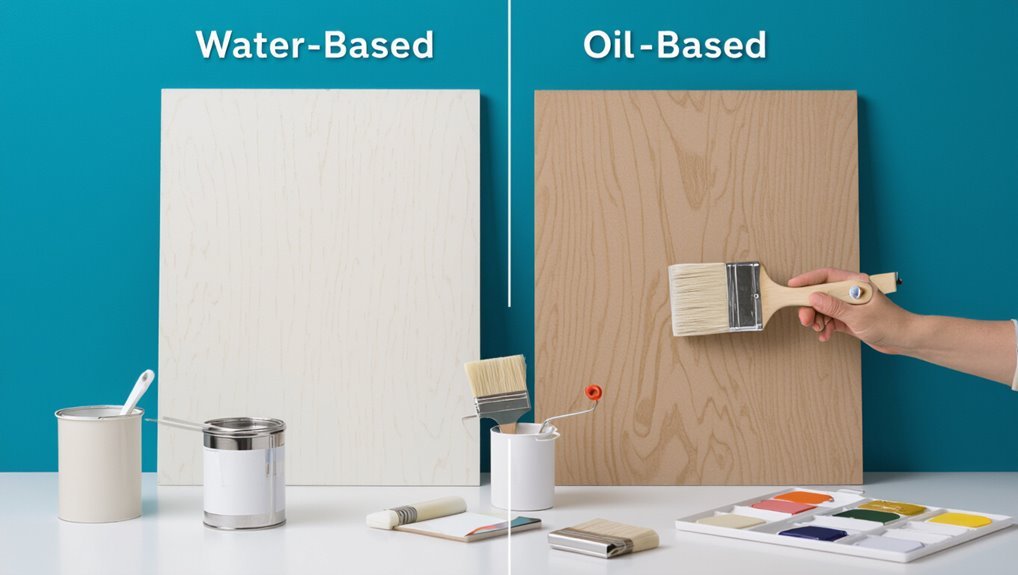
Water-based and oil-based wall paints both work on MDF, but the better choice depends on the finish you want and how quickly you need the job done. You’ll get strong results when you match paint type to your workflow.
Consider these factors:
- Water-based benefits: low odor, easy cleanup, faster dry times.
- Water-based benefits: easier touch-ups since layers blend more readily.
- Oil based drawbacks: stronger odor and longer curing.
- Oil based drawbacks: harder cleanup and more fumes, so ventilate well.
Pick water-based for quick, cleaner interior jobs; pick oil-based when you need durability and don’t mind the wait.
Can You Use Satin, Eggshell, or Gloss on MDF?
When you paint MDF, satin can look smooth while still hiding minor flaws in the surface.
If you choose eggshell, you’ll usually get a softer sheen that’s forgiving, but gloss will show every scratch and sanding mark.
Decide based on how flat your MDF is and how much shine you want.
Satin Versus MDF Surface
You can absolutely use satin, eggshell, or gloss paint on MDF, but the finish you choose changes how smooth it looks and how well it hides imperfections.
If your MDF has a visible MDF texture, a satin finish often balances coverage and easy wiping. You still need to prep and sand properly, because any roughness will telegraph through sheen.
Pick higher sheen only if you’ve already filled and sanded well; otherwise it will spotlight dips, seams, and tool marks.
- Satin = forgiving, smooth-looking
- Eggshell = medium hide, soft reflection
- Gloss = highlights every flaw
- Always prime before topcoat
Eggshell And Gloss Performance
Eggshell and gloss both work well on MDF, but they perform differently once the sheen goes on.
On MDF, you’ll usually get better eggshell durability because the lower sheen hides micro-scuffs and hairline imperfections. You should expect a softer look and easier touch-ups, especially on doors and trim that see daily handling.
Gloss makes MDF feel smoother visually, but the gloss sheen highlights uneven patches, brush marks, and any unfilled grain. If you choose gloss, you’ll need careful sanding, priming, and thin, even coats to prevent glaring flaws.
When to Use Shellac or a Zinsser-Style Blocker
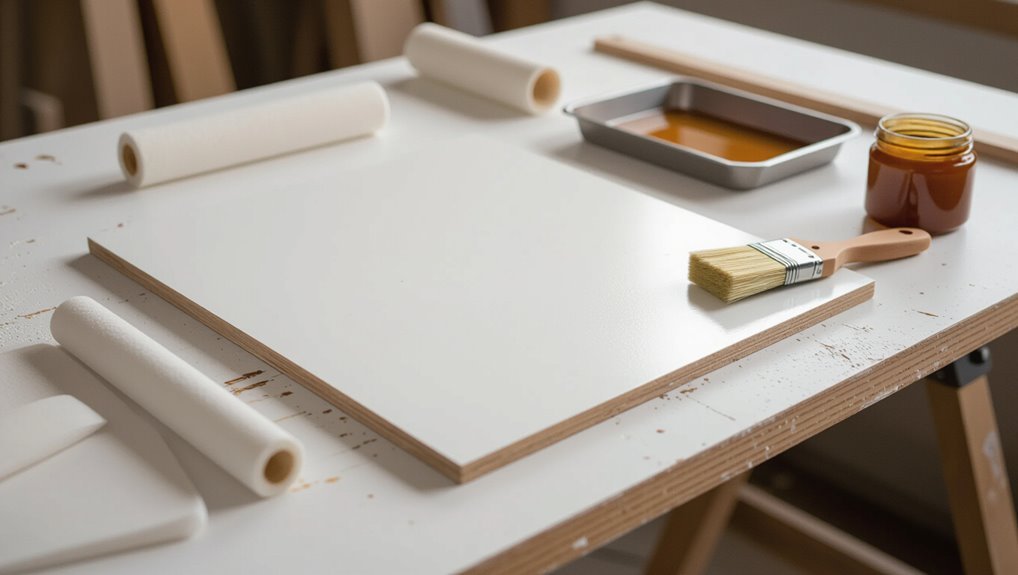
Shellac or a Zinsser-style blocker earns its place when MDF shows stains, odors, or tannin-like bleed-through that regular primer can’t fully control.
You’ll get shellac benefits and stronger sealing when you’re dealing with knots, water spots, or old dye migration. Choose zinsser alternatives when you want a fast dry coat and reliable adhesion.
Use these cues:
1) See dark rings after sanding.
2) Smell sour or smoky residue.
3) Spot fibers fuzzing near edges.
4) Weathered MDF needs stain lock.
Apply thin, even coats, then top with your finish system.
Can You Skip Primer on MDF and Still Get Good Results?
You can sometimes skip primer on MDF if it’s sealed properly, but your paint adhesion may suffer on bare, thirsty fibers.
Without primer, coverage often looks uneven because the surface absorbs paint differently, leaving blotches or patchy sheen.
If you want consistent results, use primer when you can’t guarantee a well-sealed surface.
When Primer Can Be Skipped
So, can you skip primer on MDF and still get good results? Sometimes, but only if you control moisture, sealing, and surface condition.
You can use primer alternatives when the MDF is properly sealed and lightly sanded. Focus on preparation techniques, not shortcuts:
- Verify MDF is fully cured and dust-free.
- Seal edges with a shellac or MDF sealer.
- Use a bonding primer paint product if water sensitivity is high.
- Test a small area; if it soaks unevenly, don’t proceed.
If the surface feels rough or shows blotching, prime to avoid uneven absorption and poor durability.
Paint Adhesion And Coverage Quality
Even when you’re tempted to skip primer on MDF, adhesion and coverage quality depend on how consistently your paint grabs the surface and how evenly the panel absorbs it.
If your surface preparation is sloppy—dust left behind, edges rough, or moisture present—topcoat can bead, streak, or rub off.
Without primer, MDF often drinks paint unevenly, so you get patchy coverage and need more coats.
You can improve results by sealing bare spots, sanding smooth, and using a stain-blocking undercoat. This helps paint durability and keeps color looking uniform.
How to Prevent Peeling on MDF After Painting
Preventing peeling on MDF starts with surface prep that seals the fibers and creates a solid bond for the paint.
For peeling prevention, you must control moisture and improve paint adhesion. Sand the surface lightly to remove fuzz, then vacuum dust well. Wipe with a tack cloth, and apply a dedicated MDF primer/sealer before any topcoat.
Use thin coats, letting each layer dry fully, so edges don’t lift.
- Sand 150–180 grit, then vacuum.
- Apply MDF primer/sealer.
- Let coats dry completely.
- Inspect and re-prime any rough spots.
How to Avoid Brush Marks on MDF (Smoother Results)
Once your MDF is sealed to stop peeling, you can focus on getting a smooth finish that doesn’t show brush marks.
Use fine foam rollers or high-quality synthetic brushes, and keep a wet edge so you don’t drag paint. Load your brush lightly, then apply in straight, even strokes, using brush techniques that blend each section before it tacks up.
Don’t overwork the surface—if it starts to resist, stop.
After drying, lightly sand with 220 grit, wipe dust, and apply again for a smooth finish without ridges.
How Many Coats of Wall Paint MDF Usually Needs
If your MDF is raw, patch-filled, or stained, you may need extra coverage:
- One heavy coat only for small touch-ups
- Two coats for most panels
- Three coats for dark stains
- Spot-prime bare spots first
Watch paint absorption so coverage stays uniform.
Drying Times: What Slows Cure on MDF Surfaces?
Drying and curing on MDF usually take longer than you expect, especially when conditions slow evaporation and let solvents fully set. If you notice soft spots, you rushed the cure.
Key drying factors include temperature, airflow, coat thickness, and how well you sealed raw fibers before painting. High humidity impact can keep the surface tacky, even when it looks dry. Thick coats trap moisture and slow solvent escape.
Poor ventilation extends drying time and increases the chance of dull, uneven finish. You should wait longer between coats and before handling, not just until it stops feeling wet.
How to Paint MDF for Bathrooms and Kitchens
Painting MDF for bathrooms and kitchens works best when you treat moisture resistance as a prep step, not an afterthought.
You should sand, dust, then seal MDF edges thoroughly to stop swelling. Use a moisture-resistant primer, then apply wall paint in thin, even coats, letting each coat dry fully.
Plan your color selection around light, steam, and stains; choose semi-matte or satin finishes for easier wipe-downs.
To get reliable results, follow:
- Seal edges with primer or sealer
- Prime all faces fully
- Sand between coats for smoothness
- Paint with thin coats, curing completely
How to Protect Finished MDF With a Clear Topcoat
Once your wall paint has cured, you can protect finished MDF with a clear topcoat that seals the surface and makes it easier to wipe clean. Choose from clear varnish, polyurethane, or a water-based acrylic—these topcoat options control moisture and scuffing. Apply thin, even coats, sanding lightly between layers to lock everything down. Watch out for durability factors: humidity, abrasion, and direct heat exposure.
| Step | What to do |
|---|---|
| Prep | Dust-free surface |
| Seal | First light coat |
| Build | 2–3 total coats |
| Finish | Buff for smoothness |
Frequently Asked Questions
Can You Paint MDF Directly, or Does It Always Need Primer?
Yes, you can paint MDF directly, but primer necessity matters for best adhesion and a smooth finish. Without primer, wall paint can raise grain and soak in unevenly. Use a sealant/primer at minimum before direct painting.
Will Paint Crack or Chip on MDF Edges Over Time?
Yes, paint can crack or chip on MDF edges over time like glass under stress, unless you nail MDF durability with proper surface preparation, strong paint adhesion, and thorough edge treatment. Seal edges, sand smooth, and prime, then topcoat.
What’s the Best Way to Fill MDF Pores and Seams Before Painting?
Before painting, seal MDF pores and seams by sanding smooth, vacuuming dust, then applying a thin wood-filler or spackle. Use pore filling methods like sanding sealer or diluted primer, let cure, then sand again for a flawless surface.
Can MDF Be Painted With Spray Paint for a Smooth Finish?
Yes, you can paint MDF with spray paint for a smooth finish. You’ll get spray paint advantages like even coverage, quick drying, and less brush marks. For a clean result, use light spray paint application passes, letting each coat cure fully.
How Long Should MDF Cure Before Heavy Handling or Hanging?
You should let MDF cure fully before heavy handling or hanging: follow your paint’s cure time, usually 24–48 hours to touch-safe and up to 7 days for full hardness. Use handling guidelines, lifting carefully at edges. Avoid moisture while curing.
Conclusion
Yes—you *can* use wall paint on MDF, but only if you prep and seal it first. If you skip sealing, MDF will drink in paint and can swell or look rough, which is the main reason people say it “doesn’t work.” Sand the surface lightly, prime/seal with an MDF-friendly primer, then apply thin coats of wall paint. Finish with a clear topcoat if it’s in a humid spot.
