
How Much Paint Do You Need for an Accent Wall? Here’s the Formula
Measure your accent wall (width × height) to get square feet, then divide by paint coverage—usually 350–400 sq ft per gallon—to find gallons per coat. Plan for 1–2 coats depending on color change and surface texture, add 10–15% for touch-ups and waste, and round up to the nearest gallon. Use a primer for dramatic shifts to cut coats, and pick finish based on durability; keep going for step‑by‑step examples and tips.
Quick Answer How Much Paint Do You Need for an Accent Wall?
If your accent wall is 12 by 8 feet (96 sq ft), you’ll need about one quart for a single coat or roughly one gallon for two coats.
For typical rooms, expect 1 quart to 1 gallon for small bedrooms, 1–2 gallons for medium living rooms, and 2–3 gallons for larger spaces when doing two coats.
Measure your wall and factor in texture and primer needs to pick the right amount.
One-sentence direct calculation
Measure the wall’s square footage (width × height), divide by your paint’s coverage per gallon (usually 350–400 sq ft), and you’ll know how many gallons to buy—round up to the nearest whole gallon.
To answer how much paint do I need for an accent wall, compute area, divide by coverage, account for one coat (or two if needed), then buy the rounded-up gallons.
Typical gallon ranges for common room sizes
For most homes you’ll typically need between 1 and 2 gallons of paint for an accent wall. Smaller rooms (8×10) usually need 1 gallon; medium rooms (12×12) often need 1–1.5 gallons; larger rooms (15×20) may need up to 2 gallons. Use this quick guide:
| Room size | Gallons | Notes |
|---|---|---|
| Small | 1 | One coat possible |
| Medium | 1–1.5 | Two coats likely |
| Large | 2 | Two coats, touch-ups |
Basic Understanding What Is an Accent Wall and Why Paint Coverage Matters
An accent wall is a single wall you paint to draw attention and change a room’s mood. You’ll pick colors and finishes to achieve that effect.
To figure how much paint you need, you measure the wall’s square footage and use the paint’s stated coverage per gallon.
Keep in mind texture, dramatic color changes, and whether you’ll apply multiple coats all raise the amount of paint required.
Definition and purpose of an accent wall
Think of an accent wall as a single painted surface that sets the room’s tone by drawing attention and adding depth; you’ll often use bolder color or a different finish than the surrounding walls.
You choose one wall to highlight architectural features, create a focal point, or change perceived proportions. It anchors decor, complements furnishings, and can refresh a space without full repainting.
How paint coverage is measured (square footage, coverage per gallon)
Because paint covers a set area per can, you’ll measure your accent wall in square feet and compare that to the paint’s coverage rating (typically given as sq ft per gallon) to know how much you need.
Multiply wall height by width for square footage, then divide by the coverage per gallon. Round up to account for whole cans so you don’t run short.
Factors that affect paint quantity (surface texture, color change, number of coats)
When you’re calculating paint for an accent wall, remember that surface texture, color change, and the number of coats all change how much paint you’ll actually need.
Rough or porous surfaces soak more; plan extra.
Dramatic color shifts often require multiple coats or primer. Dark-to-light changes need more coverage than light-to-dark.
Count coats, include primer, and add a small contingency for touch-ups.
How to Calculate Paint for an Accent Wall Step-by-Step
Start by measuring your wall (height × width) and subtracting areas you won’t paint like doors and windows.
Check the paint’s coverage per gallon, multiply by the number of coats needed for your color change, then add a small contingency for waste, patterns, or touch-ups.
Finally, convert the total square footage into gallons to know how much paint to buy.
Step 1: Measure the wall (height × width)
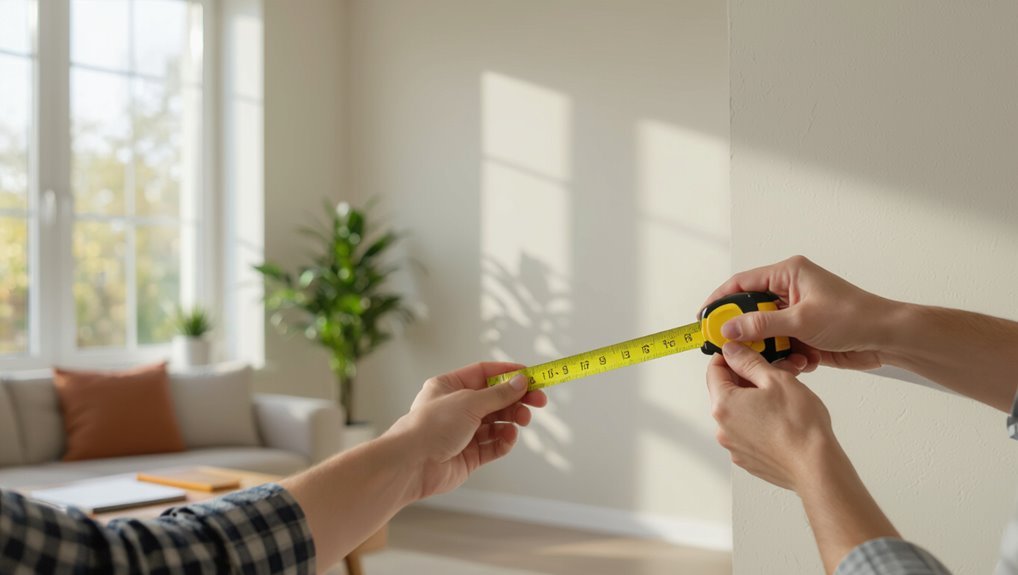
Measure the wall’s height and width and multiply those two numbers to get the square footage you need to cover.
Use feet for both measurements to match paint coverage specs. Round measurements to the nearest inch, then convert to decimal feet (inches ÷ 12) for accuracy.
Write down the result; this square footage is the basis for estimating gallons and calculating primer or finish coats.
Step 2: Subtract areas not painted (doors, windows)
After you’ve got the wall’s total square footage, subtract the areas of doors, windows, and other openings so you don’t overestimate how much paint you need.
Measure each opening (height × width), calculate its area, and subtract the sum from the wall total. This gives you the true paintable surface.
- Measure accurately
- Include trim exclusions
- Round sensibly
- Recheck totals
Step 3: Determine paint coverage per gallon (manufacturer specs)
Because coverage can vary widely by formula and finish, check the paint can or manufacturer’s spec sheet to find the square feet covered per gallon so you’ll know how much to buy.
Note the stated coverage, usually 250–400 sq ft/gallon, and whether that’s for one coat on smooth surfaces.
Use that figure for your wall area calculation and adjust for surface texture or porosity separately.
Step 4: Account for number of coats and color change
If you’re switching to a much darker or lighter shade, plan on more than one coat—usually two for a typical color swap, and three or more if you’re covering deep hues or using a high-gloss finish.
Multiply your wall area by the number of coats to get total square footage.
Also factor primer needs when color change is extreme; primers reduce additional finish coats.
Step 5: Add contingency (waste, touch-ups, pattern/trim) and convert to gallons
Since small extras can add up, plan a contingency when you finish your square-foot total—add 10–15% for waste and touch-ups, more if you’re doing patterns, trim work, or cutting in around moldings. Multiply adjusted sq ft by coverage (sq ft/gal) and divide by coverage to get gallons; round up to nearest quart or gallon.
| Task | Extra% | Note |
|---|---|---|
| Touch-ups | 10% | Small fixes |
| Patterns/trim | 15% | More cut-ins |
| Large waste | 20% | Complex jobs |
Example Calculations by Room and Wall Size
You’ll walk through three quick examples to turn measurements into paint needs: a small bedroom accent wall with the exact math and gallons, a living room wall with high ceilings that changes coverage, and an accent wall that has built-ins or molding where you’ll subtract those areas.
I’ll show the formulas and final gallon counts so you can compare. Then you can apply the same steps to your own room.
Small bedroom accent wall example (measurements, math, gallons)
When planning an accent wall for a small bedroom, start by measuring the wall’s width and height in feet and multiplying them to get square footage; you’ll then divide that number by the coverage listed on your paint can (usually 350–400 sq ft per gallon) to determine how much paint you need. Example:
| Wall size (ft²) | Gallons needed |
|---|---|
| 40 | 0.1–0.11 |
| 60 | 0.15–0.17 |
| 80 | 0.2–0.23 |
| 100 | 0.25–0.29 |
Living room accent wall example with high ceilings
Moving from a small bedroom to a living room with high ceilings means you’ll need to adjust your measurements and paint estimates because wall area grows fast as height increases.
Measure width and full height, subtract window/door area, then multiply for square footage.
Divide by paint coverage (usually 350–400 sq ft/gal) and account for two coats.
Round up to the nearest gallon.
Accent wall with complex features (built-ins, molding) adjusted calculation
If your accent wall includes built-ins, picture molding, or chair rails, measure each feature and subtract their areas from the total wall square footage before calculating paint needs.
Then determine net square footage, divide by the paint’s coverage per gallon, and factor in two coats.
Round up for touch-ups and complex textures.
Record measurements and coverage to avoid underbuying.
Choosing the Right Paint Type and Finish
Pick a finish based on how much sheen and coverage you want—matte hides imperfections but may need more coats.
Eggshell and satin balance durability and appearance, and gloss gives the most pop but highlights flaws.
For bold accent colors, expect heavier pigmentation and possible extra coats or stronger tints to hit the true shade.
Decide whether you need a separate primer (for dark colors, porous surfaces, or dramatic color shifts) or a paint-and-primer-in-one for quicker jobs.
How finish affects coverage and appearance (matte, eggshell, satin, gloss)
Because finish changes both how paint lays down and how the wall looks, you should factor sheen into your coverage calculations and style choices.
Matte hides imperfections and often needs more coats; eggshell balances softness and washability with moderate coverage.
Satin boosts durability and reflects more light, covering well.
Gloss shows texture and requires the fewest coats but highlights flaws, so plan accordingly.
Pigmentation and tinting for bold accent colors
Bold accent colors demand paint with strong pigmentation and accurate tinting, so you should choose a formulation designed for high color strength—typically 100% acrylic or high-quality alkyd—because they carry concentrated pigments that lay down rich, even color with fewer coats.
Check pigment load and lightfastness ratings, request a precise tint match, and test a small swatch under your room’s lighting before committing.
Primer vs. paint-and-primer in one when to use each
After you’ve confirmed a rich pigment and tested a swatch, decide whether you need a separate primer or a paint-and-primer combo to get that color right.
Use primer for raw drywall, stains, dramatic color shifts, or porous surfaces—it seals and boosts coverage.
Choose paint-and-primer for light color changes, low-porosity walls, or faster jobs.
Always follow manufacturer guidance for best adhesion and coverage.
Tools and Materials Checklist Before You Buy Paint
Before you buy paint, make sure you’ve got the right tools and materials so your coverage estimates and final result are accurate.
You’ll want measuring tools or apps to get square footage right, consider how rollers, brushes, or sprayers change how much paint you’ll use, and account for primer, sealers, or any specialty products.
Gather these items before shopping to avoid surprises at the store.
- Measuring tools, calculators, and apps
- Rollers, brushes, sprayers, and trays
- Primer and sealer
- Specialty products (tints, bonding agents, patching compound)
Measuring tools, calculators, and apps
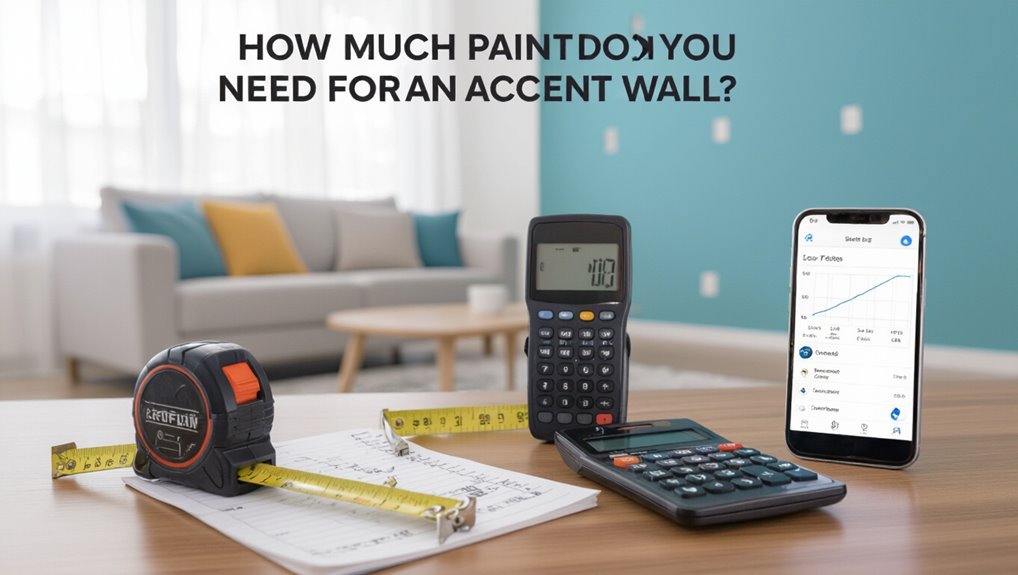
When you’re planning paint for an accent wall, accurate measurements are the foundation of everything—so arm yourself with a tape measure, a laser distance meter or a reliable room-measurement app, plus a simple calculator (or the calculator built into many apps) to convert square feet into gallons.
Measure height and width, subtract doors/windows, double-check corners, and use the app’s export or notes to keep totals handy.
Painting supplies that affect quantity (rollers, brushes, sprayers, trays)
Having accurate measurements in hand makes it easier to figure out how much paint you’ll need, but the tools you choose will also change that number.
Rollers lay down more paint faster and increase coverage; thicker naps absorb more.
Sprayers apply thin, even coats but use more paint and need masking.
Brushes handle cutting-in; trays determine how much you load.
Choose tools to match finish and waste.
Primer, sealer, and specialty products
If your wall has stains, uneven color, or bare drywall, you’ll want a primer or sealer to secure the topcoat sticks and shows true—these products can cut the number of finish coats and prevent problems like bleed-through.
Choose stain-blocking primer for marks, bonding primer for slick surfaces, and mildew-resistant formulas for damp rooms.
Specialty primers and sealers save paint and guarantee a durable, even finish.
Common Mistakes That Cause You to Buy Too Little or Too Much Paint
Don’t assume a smooth wall soaks up the same amount of paint as a textured or porous surface—you’ll need extra if the wall’s rough.
Pay attention to dark-to-light or light-to-dark color changes, since dramatic shifts usually take more coats.
And don’t skip primer or misread the coverage specs on the can, or you’ll either run out or end up with too much leftover.
Underestimating texture or porosity
Because rough or porous surfaces can drink paint like a sponge, you’ll often need more than the smooth-wall estimates suggest.
Inspect texture—stucco, brick, or unsealed drywall absorb more. Adjust your coverage calculation upward or buy an extra quart per coat.
Priming seals porous areas and improves coverage, so factor primer into your material list to avoid running short mid-project.
Ignoring dark-to-light or light-to-dark color transitions
When you switch from a dark wall to a pale one (or vice versa), paint requirements change dramatically and you’ll likely need more coats than your square-footage estimate suggests.
Dark-to-light shifts demand additional primer or extra tinted base coats to block bleed-through; light-to-dark swaps may need richer pigments and multiple layers.
Factor in at least one extra coat and adjust your gallon count accordingly.
Skipping primer or misreading coverage specs
If you skip primer or take coverage numbers at face value, you’ll often end up short—or with way more paint than you need.
Primer evens porosity and can cut required topcoats; without it you’ll need extra paint.
Also factor surface texture, wasted trim, and real-world spread rates (not idealized can claims).
Measure, prime when needed, and round up modestly to avoid surprises.
Best Practices and Tips to Save Paint and Money
Before you start, decide whether the wall needs a primer or a tinted primer to block stains and cut the number of topcoats.
Use roller and brush techniques that lay paint evenly and boost coverage per coat so you waste less.
Buy a sample pot to test color, check return policies, and consider having cans mixed together for a consistent finish.
When to prime and when to use tinted primer
Although you might be tempted to skip priming, choosing the right primer—or a tinted one—can cut costs and improve coverage on an accent wall.
Prime when surfaces are bare, stained, patched, or drastically color-changed. Use tinted primer if moving from dark to bold or to reduce coats with deep colors.
It evens porosity and boosts adhesion, saving paint and time.
Techniques to maximize coverage per coat
Maximize each coat by working methodically: roll in a “W” pattern for even distribution, back-roll to level the paint, and keep a wet edge to avoid lap marks.
Use quality rollers and appropriate nap for your wall texture, stretch the paint thinly, and maintain consistent pressure.
Sand lightly between coats if needed, and allow full drying time to assess true coverage before reapplying.
Buying tips: sample pots, return policies, mixing cans for consistent color
Want to make certain the color and coverage match your plan? Buy sample pots to test light, finish, and coverage on your wall — swatch several spots.
Check store return and tinting policies before purchase. If you need multiple cans, have the store mix them from the same batch or blend opened cans together at home to guarantee consistent color across the accent wall.
Quick Reference Charts and Conversion Tools
You’ll find quick charts and simple conversion tools handy when you’re planning paint for an accent wall, so you can match coverage to finish and room size. Below is a compact reference to get you started:
| Paint type/finish | Coverage (sq ft per gallon) |
|---|---|
| Flat/Matte | 350 |
| Eggshell/Satin | 400 |
| Semi-gloss/Gloss | 450 |
Use this alongside common wall size guides to pick the right number of gallons without guessing.
Coverage per gallon by paint type and finish
Different paints and sheens cover different areas, so knowing the typical square footage per gallon for each type helps you plan precisely.
Generally, flat or matte covers about 300–400 sq ft/gallon, eggshell and satin 350–400, semi-gloss 300–350, and high-gloss 250–350.
Primer often covers 200–400 depending on porosity. Use these ranges to match finish choices and adjust for surface texture.
Common wall sizes and recommended gallons
Now that you know typical coverage per gallon by paint type and finish, let’s look at how that translates to real rooms: common wall sizes and the gallons you’ll likely need.
A 8×10 wall (80 sq ft) needs ~1/2 gallon.
10×12 (120 sq ft) needs ~1 gallon.
12×14 (168 sq ft) needs ~1–1.5 gallons.
Always round up for primer or dark colors.
FAQ Fast Answers to Common Accent Wall Paint Questions
You’ll get quick, practical answers to whether dark accent colors need extra coats, if one gallon can cover several small walls, and how much extra to keep for touch-ups.
You’ll also learn how primer affects total coverage and how to adjust calculations for textured or brick surfaces.
Use these FAQs to plan paint quantities and avoid costly shortfalls.
How many coats do I really need for a dark accent color?
Wondering how many coats a dark accent color really needs? You’ll usually need two coats for good coverage, but some rich pigments require three.
Prime first if the wall is patched, stained, or you’re switching from a much lighter shade—that boosts adhesion and reduces coats.
Use thin, even layers, allow full drying between coats, and inspect under natural light before deciding.
Can I use one gallon for multiple small accent walls?
How many small accent walls can one gallon cover? It depends on wall size and coats: one gallon typically covers about 350–400 sq ft per coat.
So you can paint several small accent walls (for example, three 10×8 ft walls) with one coat.
Dark colors or textured surfaces may need extra coats, so calculate total square footage and planned coats before deciding.
How much extra paint should I keep for touch-ups?
Need a small reserve for touch-ups? Keep one quart per wall painted or at least 10–15% extra of the paint used.
That covers scuffs, nail holes, and color checks later. Store leftover paint sealed, labeled with date and room, and shake or stir before use.
If you used a custom-mixed color, keep more—quart to a gallon—since remixes can vary.
Will a primer count toward my total coverage?
Keeping a small reserve for touch-ups is smart, and you’ll also want to contemplate whether primer counts toward your total coverage.
Primer can reduce the number of finish coats needed, especially on raw or stained surfaces, but it isn’t a substitute for finish paint when calculating final coverage.
Count primer separately: include it for surface sealing, but plan finish paint by square footage and desired opacity.
How do I calculate paint for textured or brick accent walls?
Wondering how texture or brick changes your paint math? Textured surfaces absorb and hide more paint, so increase coverage by 25–50%.
Measure wall area, then multiply by 1.25–1.5. For rough brick, lean toward 1.5x.
Check paint can coverage (sq ft/gal) and divide adjusted area by that number. Always round up and buy a bit extra for touch-ups.
