
How Much Paint to Paint a House Exterior: Complete Guide to Estimating Paint Needs
You’ll generally need 8–15 gallons to paint a typical single‑family exterior, but calculate precisely by measuring each wall’s height × width, subtracting window and door areas, and dividing net square footage by about 350–400 ft² per gallon for smooth surfaces (use ~175 ft²/gal for porous). Add two coats, factor trim separately, and include a 10–15% buffer for touch‑ups and porosity. Keep notes on finish and batch numbers—continue for detailed step‑by‑step estimating tips.
Quick Estimate: Gallons Needed for a Typical House
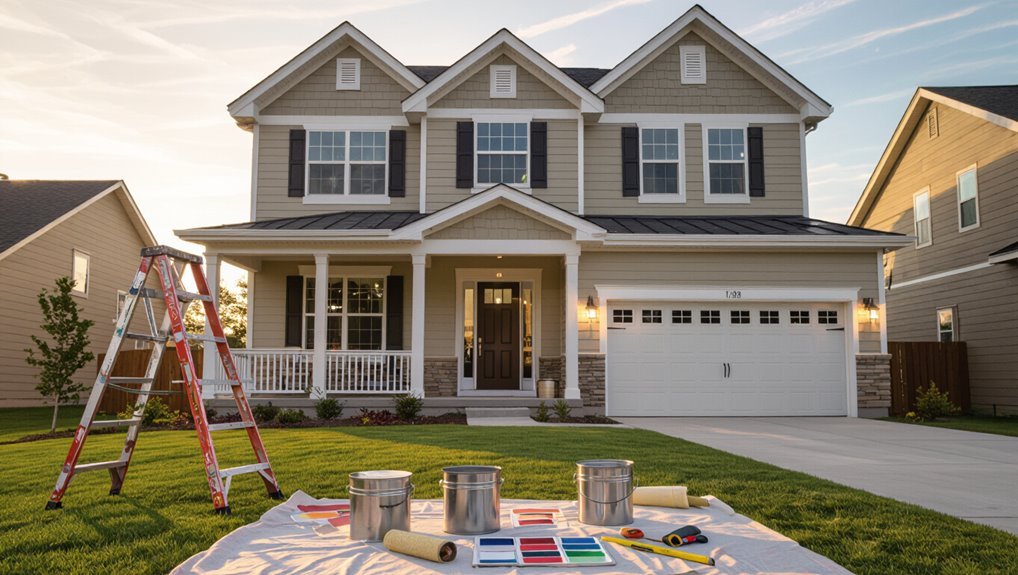
A quick rule of thumb: plan on about 1 gallon of exterior paint for every 350–400 square feet of wall surface.
For a quick estimate, measure wall area, subtract windows and doors, then divide by 375 to get gallons.
For typical houses, this usually means 8–15 gallons depending on size and stories.
Always round up to account for porosity and touch-ups.
Which Paint Coverage Numbers You Should Trust
Which coverage figures can you actually rely on when planning paint?
You should cross-check coverage standards from reputable brands, compare paint types, and use estimating tools like online calculators.
Adjust for surface conditions and application methods, factor environmental factors and local regulations, and seek professional advice when unsure.
That layered approach gives more reliable numbers than any single source.
Measure Wall Surface Area Step by Step
Start by measuring each exterior wall individually so you get precise surface areas to base your paint estimate on. Measure height and width, record openings to subtract, and note wall materials since texture affects coverage.
Use consistent measuring techniques—tape, laser, or measuring wheel—and sketch walls with dimensions. Total your net square footage per wall, then sum walls for the house exterior paint calculation.
Measure Porches, Stoops, and Attached Structures (Sq Ft to Add)
Measure each porch, stoop, and attached structure separately and add their net square footage to your wall totals, subtracting openings like doors and large windows; include ceilings and railings if you plan to paint them.
For porch measurements and stoop dimensions, measure length × width and any vertical surfaces.
For attached structures and other exterior additions, record each surface area so you can accurately add their square footage.
Subtracting Windows and Doors From Your Totals
Measure each window and door and calculate their total square footage so you don’t overestimate how much paint you need.
Subtract that combined area from your wall totals before converting to gallons. That’ll give you a more accurate paint estimate and save time and money.
Measure Window And Door Areas
Before you calculate how much paint you’ll need, subtract the area occupied by windows and doors so you don’t overbuy; you’ll simply measure each opening’s height and width, multiply them, and total those areas.
Use consistent window measurements and door dimensions, record sizes on a sketch, and group identical openings to speed math. Double-check totals before adjusting your paint estimate.
Subtract From Total Square Footage
Once you’ve totaled the exterior wall area, subtract the combined square footage of all windows and doors to get the paintable surface you actually need to cover.
Use careful surface assessment and calculation tips to avoid estimating errors. Account for paint waste, paint thickness, coverage adjustments and color effects.
Consider paint durability, preparation importance and project timeline when finalizing quantities.
Include Gables, Dormers, and Rooflines in Your Math
Because gables, dormers, and rooflines add irregular surfaces and trim you can’t ignore, you’ll need to account for them separately when calculating paint needs.
Measure each gable face and dormer, noting gables measurement for triangles and rectangles.
Add trim length for fascia and soffits.
Use roofline calculations to convert combined square footage into gallons, and include extra for texture and waste.
Adjust for Siding Type (Clapboard, Stucco, Brick) : Exterior Paint Tips
After you’ve handled gables and rooflines, consider how siding type changes coverage and prep. You’ll adjust estimates for siding materials—clapboard, stucco, brick—choose paint types, plan surface preparation, and time work for weather conditions. Match color choices and application techniques to environmental factors and set maintenance schedules to keep coverage lasting.
| Siding | Tip |
|---|---|
| Clapboard | Brush/roll, prime seams |
| Stucco/Brick | Thick coats, masonry paint |
Factor in Texture and Surface Porosity for Coverage
Porous surfaces soak up more paint, so you’ll need a higher coverage estimate than for smooth siding.
Rough textures like stucco or heavily grained wood eat up extra product and can require thicker coats.
Adjust your coverage rates upward for porous or textured areas to avoid running out mid-job.
Surface Porosity Effects
Surface texture and porosity directly change how much paint you’ll need, so assess the substrate before you buy.
Check surface texture and measure or estimate absorption rates: rough, porous surfaces soak more primer and paint, raising coverage loss.
You’ll plan extra primer coats, allow longer drying, and increase paint quantity accordingly.
Record observations to refine future estimates and avoid surprises.
Texture Type Impact
Texture and porosity together determine how much paint actually sticks and spreads.
So once you’ve assessed absorption, you should factor in the specific texture type—smooth, eggshell, stucco, clapboard, or rough-sawn wood—because each changes coverage considerably.
You’ll adjust expectations based on texture impact and prioritize surface preparation to guarantee even film build and true coverage.
- Smooth: higher coverage, less absorption
- Stucco: heavy texture, more paint
- Clapboard/wood: joints and grain need attention
Adjusting Coverage Rates
When you’re calculating how much paint you’ll actually need, start by increasing the manufacturer’s coverage rate to account for both porosity and texture—smooth, sealed areas might match the label, but rough or highly porous sections can cut effective coverage by 25–50% or more. Use coverage adjustments and estimating techniques:
| Surface Type | Porosity | Adjustment |
|---|---|---|
| Smooth | Low | 0% |
| Wood | Medium | 25% |
| Stucco | High | 50% |
How Many Coats Will Your Exterior Need?
Wondering how many coats your exterior will need? You’ll assess substrate, coating types, and desired paint finishes to decide.
Most jobs require two coats for durability and even color, but conditions vary.
- Smooth, intact siding: usually two coats.
- Rough or porous surfaces: consider three coats.
- High-traffic or harsh climates: add an extra protective coat.
When to Plan for a Primer Coat
If you’re starting with bare wood or other new surfaces, you’ll want a primer to seal and protect before paint.
Use a stain- or rust-blocking primer when tannins, old stains, or metal corrosion could bleed through.
And plan for a bonding primer when paint needs to adhere to an existing, glossy, or chalky finish.
Bare Wood Or New Surfaces
Because bare wood and many new surfaces haven’t absorbed paint yet, you’ll need a primer to promote adhesion and seal the substrate.
You should inspect, sand, and clean for bare wood preparation, and account for new surface considerations like porosity and manufacturer specs.
Choose a compatible primer and plan one coat before topcoat.
- Sand and remove dust
- Test porosity
- Follow product instructions
Stain Or Rust Blocking
When stains, tannins, or metal corrosion are present, you’ll want a primer specifically formulated to block bleeding and prevent discoloration or rust from showing through the topcoat.
Choose primers labeled for stain prevention techniques and follow manufacturer cure times.
For rusty areas, remove loose corrosion, apply appropriate rust treatment methods, then prime.
This guarantees uniform color and long-lasting protection before painting.
Adhesion Over Existing Paint
Although existing paint can sometimes seem sound, you’ll want to plan a primer whenever the old coating is chalky, glossy, peeling, or a different type (like oil over latex).
This is because primer promotes mechanical and chemical adhesion and evens out porosity so the new topcoat bonds properly and lasts. You should inspect the surface, test adhesion techniques, and choose primer based on existing paint.
- Clean and scuff glossy areas
- Spot-prime peeled sections
- Use bonding primer for incompatible layers
Choosing Between One Coat and Two Coats Realistically
If you want even, durable coverage you should plan on two coats in most real-world situations.
You’ll assess surface porosity, primer needs, and paint application techniques to decide if a single coat will suffice.
Two coats usually deliver uniform color and longevity despite higher upfront cost; factor cost considerations, drying time, and labor for a realistic, long-lasting estimate.
How Color Change Affects Coats (Light→Dark, Dark→Light)
If you’re moving from a light color to a much darker one, expect to need extra finish coats for full coverage.
Switching from dark to light usually means you’ll want a primer to block the old color and reduce the number of topcoats.
Both scenarios affect how much paint you should budget for, so plan accordingly.
Light To Dark: Extra Coats
When you switch from a light shade to a much darker one, expect to apply additional coats because darker pigments hide less readily and can show streaks or unevenness.
Conversely, going from dark to light often needs a high-coverage primer or several coats to fully mask the original tone. You’ll plan for extra coats during a light to dark color change.
- Test a small area first.
- Use higher-pigment formulas.
- Allow full drying between coats.
Dark To Light: Priming Needed
Because dark pigments can bleed through lighter topcoats, you’ll usually need to prime before switching from a dark to a light color; a quality, high-hide primer evens out color and reduces the number of finish coats required. You should plan primer application for stain blocking and color matching, inspect coverage, then apply two finish coats.
| Step | Purpose |
|---|---|
| Prime | Block bleed |
| Inspect | Verify match |
| Finish | Even coats |
| Touch-up | Final uniformity |
Quick Formulas to Convert Square Feet to Gallons
Start by figuring out your paint’s coverage rate—most exterior paints list square feet per gallon—and then divide your total square footage by that number to get the gallons you’ll need; round up to account for waste, texture, and extra coats.
Use a paint calculator or a coverage chart for quick checks.
- Adjust for porosity and priming
- Count doors, windows, trims
- Add 10–15% buffer for touch-ups
Using Square Footage to Convert to Gallons
Start by measuring the painted surface area of each wall, including doors and windows so you know what you’re actually covering.
Then divide the total square footage by the paint’s coverage rate (usually listed on the can) to calculate how many gallons you’ll need.
Round up to account for touch-ups and surface variation.
Measure Painted Surface Area
Before you buy paint, measure the exterior surfaces you’ll actually coat so you can convert square footage into gallons accurately.
Use surface measurement techniques that suit walls, trim, and features, and record dimensions for accurate area calculations. Subtract doors and windows, note textured areas, and plan coats. Your clear measurements prevent waste and guarantee correct ordering.
- Measure each wall separately
- Exclude nonpainted openings
- Note texture adjustments
Calculate Gallons Required
With your measured square footage in hand, convert those numbers into paint gallons so you order the right amount.
Divide total square feet by the coverage per gallon listed on the can, then add 10–15% for waste and touch-ups.
Consider paint quality—higher quality often covers better—plus the environmental impact of disposal and leftover cans when deciding whether to round up.
How to Use Manufacturer Coverage Rates Correctly
When you read a manufacturer’s coverage rate—usually listed as square feet per gallon—treat it as an ideal estimate, not a guaranteed yield; you’ll need to adjust for surface texture, application method, and the number of coats.
Follow manufacturer instructions, account for coverage variability, and plan extra paint.
Follow manufacturer instructions, expect coverage to vary, and always buy extra paint to be safe.
- Test a small area first
- Note porosity and roughness
- Add 10–20% contingency
Estimating for Trim, Fascia, Gutters, and Soffits
You’ll measure trim by linear feet and multiply by the trim width to get surface area for paint.
For soffits and fascia, calculate length times height for each run and add those totals to your estimate.
Don’t forget gutters and downspouts — measure their length and account for the number of coats and overlap when converting to coverage.
Trim Surface Area
Trim includes all the narrow wood and metal elements—window and door casings, corner boards, rake boards, fascia, gutters, and soffits—that frame your house and usually require a different paint type or color than the main walls.
Measure linear feet per element, note trim materials and trim styles, then calculate surface area and coat count.
- Measure lengths and heights
- Account for overlaps and joints
- Add extra for repairs and waste
Soffit And Fascia Calculations
Start by measuring the length and width of every soffit and fascia run around the house. Multiply lengths by widths to get square footage, subtract openings.
Group by soffit styles (vented, solid) since coverage or coats may differ.
Note fascia materials (wood, aluminum) to decide primer and coats.
Add a 10–15% waste allowance and convert total square feet to paint gallons.
Gutters And Downspouts Coverage
Having measured soffits and fascia, move on to gutters and downspouts since they add narrow but linear surface area that affects paint and trim estimates.
You’ll calculate linear feet, pipe circumference, and attachment hardware. Consider gutter maintenance frequency and downspout materials when estimating primer and topcoat needs.
- Measure linear feet and joints
- Account for brackets and elbows
- Choose coating per material type
Paint Needs for Doors, Shutters, and Window Frames
Because doors, shutters, and window frames sit at eye level and endure the most handling and weather, you’ll want to plan paint quantities and finish types specifically for them; they often need less surface area than walls but more durable, higher-quality paint.
Choose door paint types and shutter color choices that resist wear, pick window frame finishes suited to material, and match exterior trim styles for cohesive coverage.
How to Estimate Primer Quantities Separately
Before you pick up primer, calculate its coverage per gallon so you know how many coats you’ll need for the total square footage.
Then adjust that estimate for surface type—porous wood and bare drywall soak up more primer than smooth, previously painted siding.
That way you’ll buy just enough primer without running short or wasting gallons.
Calculate Primer Coverage
Primer coverage usually differs from topcoat coverage, so you’ll want to estimate it separately to avoid running short or overbuying.
Calculate surface area, check the manufacturer’s coverage rate, and factor coats needed. Consider primer types and primer benefits when choosing product and coverage specs.
- Measure exterior wall square footage accurately.
- Compare spread rates on cans.
- Account for one versus two coats.
Adjust For Surface Type
When you’re estimating primer separately, factor in how the surface texture and material change coverage rates—smooth, painted siding soaks up less than bare wood or masonry, and rough or porous surfaces can require twice the primer per square foot. Use surface preparation techniques, check material compatibility, and adjust gallons accordingly.
| Surface | Rate | Notes |
|---|---|---|
| Smooth | 350 ft²/gal | Low absorbency |
| Porous | 175 ft²/gal | May need two coats |
Planning for Stain vs Paint on Wood Surfaces
If you’re choosing between stain and paint for wood surfaces, start by thinking about the wood’s condition, exposure, and the look you want to achieve.
You’ll weigh stain benefits like grain visibility and easier touch-ups against paint durability and color options.
Choose based on maintenance willingness and lifespan expectations.
- Exterior exposure and UV
- Desired aesthetic and texture
- Maintenance frequency and cost
How to Adjust Estimates for Peeling or Rough Surfaces
Check the surface first so you can assess peeling, rough patches, and how much repair work you’ll need.
Then factor extra coverage into your paint estimate—rough or porous areas can soak up considerably more than smooth, intact surfaces.
Finally, account for prep and repair materials (scrapers, fillers, primer) and the added time when you finalize quantities and costs.
Assess Surface Condition
Because peeling paint and rough surfaces increase paint absorption and reduce coverage, you’ll need to adjust your material and time estimates before buying supplies.
Do a thorough surface inspection and condition assessment to identify flakes, blistering, and rough patches. Prioritize repairs, note primer needs, and factor in extra labor.
- Scrape and sand damaged areas
- Patch and fill cracks
- Apply primer where bare wood shows
Calculate Extra Coverage
When surfaces are peeling or rough, plan to increase your paint allowance so coverage estimates stay accurate; rough textures and exposed substrate can cut typical coverage by 20–50%.
Prep And Repair Needs
Start by surveying every exterior surface for peeling, blistering, or rough patches so you know what needs repair before you buy paint.
You’ll factor in extra primer and patching when estimating; use proven prep techniques and focused repair strategies to avoid surprises.
- Scrape, sand, and clean damaged areas
- Apply filler and allow proper curing
- Prime repaired spots before topcoat
How Weather Affects Paint Absorption (What to Expect)
1 factor you’ll notice right away is that temperature and humidity change how much paint your siding soaks up, and that affects both coverage and drying time.
You’ll judge weather impact by monitoring humidity effects and temperature influence: hot, dry days raise absorption rates; cold or damp slows drying.
Consider seasonal considerations for timing to protect paint durability and achieve consistent coats.
Allowances for Waste, Touch-Ups, and Future Repairs
Weather and surface absorption affect how much paint you need now, but you’ll also want to plan for waste, touch-ups, and future repairs to avoid shortages later.
Allocate extra for drips and trimming, keep a small sealed can for touch-ups, and track remaining color codes for future repairs. Good waste management saves money and time.
- Reserve 5–10% extra
- Label batches and dates
- Store sealed tins
How to Size Paint for High Ceilings and Tall Walls
If you’ve got high ceilings or tall walls, calculate surface area by measuring wall height times length for each wall and adding ceiling area separately—this gives you the true square footage to size your paint.
Then factor in coat count, paint coverage per gallon, and obstacles like windows and doors.
Buy extra for touch-ups and uneven absorption on high ceilings and tall walls.
Estimating Paint for Multi-Story Houses
When you’re painting a multi-story house, start by breaking the job into levels so you can measure each wall and roofline separately; this makes it easier to account for varying heights, eaves, and balconies.
You’ll calculate surface area per level, factor windows/doors, and adjust for access complexity and multi-story considerations affecting paint application.
- Measure each facade by level
- Subtract openings
- Add contingency for access
Estimating Paint for Rooflines and Turrets
You’ll need to measure complex rooflines by breaking them into simple shapes—rectangles for flats, triangles for gables, and trapezoids for hips—so you can total the area accurately.
For turrets, treat each as a cylinder or cone (depending on the roof) and use circumference times height for the curved wall area, adding the sloped roof area separately.
With those basic calculations you’ll get a reliable surface-area estimate to convert into paint quantities.
Measuring Complex Rooflines
Complex rooflines and turrets add character but also complicate paint estimates, so you’ll want to break them into simple shapes before measuring.
Account for roofline complexities and nearby architectural features when mapping surfaces. Measure slopes, overhangs, and decorative trim separately, then total square footage.
Use sketches and labeled dimensions for accuracy.
- Measure slopes and ridges
- Include eaves and soffits
- Note trim details
Calculating Turret Surface Area
Start by treating the turret as a collection of simple shapes—cylinders for walls and cones or pyramids for roofs—so you can calculate each surface area separately and then add them together.
Measure turret dimensions (height, radius, face width) and note architectural features like windows, cornices, and trim.
Subtract openings, add roof slope area, then sum for total paintable square footage.
How to Estimate Paint for Mixed-Material Exteriors
When working with mixed-material exteriors—like siding, brick, and trim, you’ll measure each material separately and convert those areas into paintable square footage so you can choose the right primer and paint quantities.
You’ll account for porosity and coats per finish, then total gallons per product.
- Record area by material (mixed materials)
- Adjust for porosity and coats
- Match primers to exterior finishes
When to Hire a Pro Estimator vs. Do-It-Yourself Math
If your exterior has complex surfaces, lots of trim, or mixed materials and you’re unsure about coverage or waste factors, consider calling a pro estimator to avoid costly mistakes.
For simpler, regular walls you can do the math yourself by measuring areas, subtracting windows and doors, and checking the paint’s spread rate.
Use a contractor only when tricky angles, multiple textures, or tight timelines make accuracy critical.
When To Call
Though simple homes and clear siding types let you crunch numbers yourself, there are times you’ll want a pro estimator. You should call when scope, surfaces, or color changes complicate coverage; pros offer contractor advice and know paint types, wear patterns, and waste factors.
- Complex surfaces or high trim detail
- Uncertain substrate or damage needing repair
- Large jobs with tight timelines or bids
DIY Estimating Tips
Because your house and goals determine the effort, you can handle simple paint estimates yourself but should call a pro for anything that adds uncertainty—extensive repairs, tricky surfaces, major color changes, or projects where exact bidding matters.
Use DIY paint estimation for straightforward siding, measure areas carefully, subtract windows/doors, factor coats, and account for surface preparation.
Hire a pro if conditions or stakes rise.
Complex Surfaces Considerations
Once you move beyond flat, uniform siding, the math gets trickier and you’ll want to weigh whether to handle the estimate yourself or call a pro estimator.
You’ll assess complex surface types and decide if intricate detailing demands specialist measurement.
Consider these factors to choose the right approach:
- Measurement difficulty: curves, gables, trim
- Time vs. cost tradeoff
- Risk of underestimating materials
How to Use Online Paint Calculators Effectively
Wondering how online paint calculators can save you time and reduce waste?
Use online tools that let you input wall dimensions, window and door counts, and coat number for quick paint estimation.
Pick calculators from reputable paint brands, confirm surface type and coverage rates, and adjust for trim.
Save or export results, then compare options before buying to avoid excess.
Verifying Online Results With a Manual Check
Online paint calculators speed planning, but you should verify their numbers with a quick manual check to catch input errors or unusual surfaces.
Do a manual verification: measure walls, subtract openings, and note texture changes. This guards against online discrepancies and guarantees you buy enough paint without waste.
Trust calculators, but confirm with simple measurements to avoid costly surprises.
How to Convert Liters and Quarts to Gallons
Converting liters and quarts to gallons is straightforward once you know the exact conversion factors: 1 US gallon = 3.785 liters and 1 US gallon = 4 quarts, so you can divide liters by 3.785 or quarts by 4 to get gallons for your paint calculations.
For quick liters conversion, divide liters by 3.785. For quarts conversion, divide quarts by 4.
Buying Paint: Rounding, Overage, and Bundling Tips
When you’re buying paint, round up your coverage estimates to the nearest can size so you don’t run short mid-job.
Add about 10–15% overage for mistakes, texture, and future touch-ups.
Also check for bundle or multi-can discounts to save money and keep color consistency.
Round Up Coverage Estimates
Although you can calculate exact square footage, you should always round up your paint estimates to account for real-world variables like surface texture, trim cuts, and touch-ups.
You’ll factor paint absorption factors and estimating primer amounts into a conservative total so you don’t run short. Consider buying slightly more and bundling where sensible:
- Add 10–15% for texture and waste
- Include primer reserves
- Round gallon counts up
Account For Overage
A few extra gallons can save you a lot of hassle, so plan for overage when you buy paint: round individual can counts up to the next full gallon, add 10–15% for texture and waste, and keep a quart or two of the final color for touch-ups and trim.
You’ll avoid delays if you factor in overage considerations and minimize paint waste during prep and application.
Look For Bundle Discounts
Once you’ve rounded up cans and allowed for a 10–15% overage, check for bundle discounts before you buy: many retailers and manufacturers offer savings when you buy multiple gallons, matching primer and topcoat, or complete exterior kits.
You’ll save time and money with bulk purchasing and seasonal paint promotions; compare per-gallon cost, return policies, and included extras.
- Compare per-gallon discounts
- Verify returns and exchanges
- Check included primer/topcoat
How to Choose Sheen and How It Affects Coverage
Choosing the right sheen matters because it affects both appearance and how much paint you’ll need. You’ll weigh sheen types, coverage impact, paint durability, finish preferences, and aesthetic choices. Consider maintenance considerations, application techniques, and light reflection when estimating gallons and coats.
| Sheen | Durability | Coverage |
|---|---|---|
| Flat | Medium | High |
| Satin | High | Medium |
Matching and Mixing Colors Across Batches
When you order paint, expect slight color batch variance that can show up as subtle stripes or shifts once the surface dries.
Always mix multiple cans from the same batch in a larger container and do an on-site color matching swatch before you start painting.
If a new can doesn’t match, have the store adjust the tint or return it rather than painting and risking visible seams.
Color Batch Variance
Because pigments, base formulas, and tint concentrations can vary between production runs, you may notice subtle shifts in shade even with the same color name — so always plan to buy enough of a single batch or blend batches before application.
You’ll protect color consistency despite batch differences and avoid patchy walls.
- Label and store cans by batch number.
- Mix partial cans to average color.
- Test panels before full coats.
On-Site Color Matching
Although slight batch differences are common, you can match and blend colors on-site to achieve a seamless finish by labeling cans, mixing small test blends, and keeping detailed notes on proportions and batch numbers.
During on-site evaluation, you’ll compare samples under real light, use color matching techniques like tint adjustments and cross-blending, and record the final formula so future touch-ups match precisely.
Storing Leftover Exterior Paint Safely
If you’ve got leftover exterior paint after a job, store it properly to keep it usable and safe.
Seal cans tightly, label them, and avoid freezing or overheating; use proper containers and keep paints at ideal temperatures.
Store off the ground in a cool, dry spot, away from children and flames.
- Tight lids
- Upright on pallets
- Inspect before reuse
How to Label and Track Paint Used Per Area
After you’ve sealed and stored leftover cans, label and track exactly how much paint you used for each surface so future touch-ups and repaints go smoothly. Keep a simple paint inventory and tracking usage notes: record area, color, and amount left.
| Area | Color | Amount left |
|---|---|---|
| Siding | Gray | 1.5 gal |
| Trim | White | 0.5 gal |
| Door | Red | 0.25 gal |
Reducing Costs: Primer Alternatives and Saving Tricks
When you’re trying to cut painting costs, consider affordable primer alternatives and smart prep steps that let you use less or skip primer without sacrificing finish or durability.
You can boost paint efficiency with targeted touch-ups, use bonding agents as primer alternatives, and pick budget friendly options that match substrate needs.
Cost saving tricks focus on prep, product choice, and application technique.
Cost-saving painting comes down to smart prep, the right products, and careful application for lasting results
- Targeted spot priming
- Bonding agents
- Quality rollers and tips
When Extra Coats Are a False Economy
Although piling on extra coats might feel like insurance, it often wastes time, money, and paint without improving performance—especially if you’ve prepped surfaces properly and chosen the right primer and topcoat.
You should focus on proper prep, quality products, and correct application instead of extra coats. That approach preserves cost efficiency, saves materials, and delivers durable results without unnecessary labor or expense.
Estimate Labor Hours for Exterior Painting From Paint Quantities
Estimate labor hours by translating your paint quantities into coverage and crew productivity: take the total square footage to be painted, divide it by the manufacturer’s coverage per gallon to confirm gallons needed, then apply your team’s realistic square-feet-per-hour rate (adjusted for prep, masking, and breaks) to convert that material estimate into hours.
Use labor efficiency and project management to schedule accurately.
- Break tasks by surface type and access
- Factor drying time and weather delays
- Assign crew roles to maximize throughput
Tools and Equipment That Change Paint Consumption
Because the tools and equipment you choose directly affect how much paint ends up on the walls versus on the ground, selecting the right gear is as important as choosing the paint itself.
You’ll consider paint tools and paint equipment — paint rollers, brush types, spray methods — since coverage factors, paint application technique, paint brands, paint finish and proper surface preparation all change consumption.
Common Miscounts and How to Avoid Them
How much extra paint should you plan for to avoid last-minute runs to the store? You’ll account for miscalculated measurements and incorrect coverage by adding a safety margin, checking surface absorbency, and confirming coat counts.
Reduce waste with careful planning and measurements.
- Measure twice, calculate once to avoid miscalculated measurements.
- Test a small area for incorrect coverage.
- Track coats and leftovers precisely.
Quick Checklist to Confirm Your Final Paint Order
Ready to confirm your final paint order? Double-check paint finish and color selection, verify surface preparation and application techniques, and confirm weather considerations for your timeline.
Recount paint tools, note maintenance tips and eco alternatives, and finalize cost estimation.
Cross-reference project planning details, quantities, and delivery dates so you’re ready to start without surprises.
Real-World Examples: Three House Size Calculations
You’ll see three practical examples—small, medium, and large homes—showing step-by-step calculations for exterior paint needs, so you can match coverage to your house’s dimensions, siding type, and number of coats.
These house size examples give clear practical applications you can adapt.
- Small: bungalow, 1 coat, calculate area, gallons needed
- Medium: two-story, 2 coats, adjust for windows/doors
- Large: complex rooflines, multiple siding types, waste factor
Troubleshooting Mid-Project Paint Shortages
If you find yourself running low on paint partway through the job, don’t panic—quick adjustments and accurate measurements will keep the project on track.
First, measure remaining coverage, prioritize high-visibility areas, and thin coats to stretch finish.
Contact suppliers for matching batches or use emergency paint supplies like touch-up tins.
Document color codes and note paint shortage solutions to finish cleanly.
How to Estimate for Future Maintenance Repainting
Plan for future maintenance repainting by recording what you used and when, then converting that data into a simple schedule based on surface material and exposure.
Record paint type and date, then turn those notes into a simple, exposure-based repaint schedule.
You’ll predict wear, budget for future paint, and set a maintenance schedule so you’re ready before issues start.
- Log paint type, batch, and finish
- Note installation date and exposure level
- Estimate repaint intervals by material and climate
Eco-Friendly Options and Their Coverage Differences
When you choose eco-friendly paints, expect differences in coverage and application that affect how much paint you’ll need and how often you’ll repaint.
You’ll find eco-friendly paints with sustainable materials and low VOC options often cover differently than conventional formulas.
Check green certifications, natural pigments, biodegradable products, and energy efficient coatings so you can balance coverage, longevity, cost, and environmental impact.
How to Document Estimates for Contractors and Bids
Choosing eco-friendly paints affects coverage and timing, and you’ll want that information reflected clearly in bids and estimates for contractors.
Document paint type, coverage per coat, coats needed, labor hours, and waste allowance. Use clear contractor communication and standardized bid documentation templates so bids are comparable.
- Paint specs and VOC levels
- Coverage calculations and coat counts
- Labor, schedule, and contingency
Quick-Reference Cheat Sheet: Paint Quantities
A one-page cheat sheet helps you pick paint quantities fast and avoid costly trips back to the supplier.
Use it to note paint types, paint finish, and color selection per elevation.
Include surface preparation, paint layering estimates, application techniques, drying times, and environmental factors affecting coverage.
Add safety precautions and realistic project timelines so you buy enough and schedule work efficiently.
Frequently Asked Questions
Can I Use Leftover Interior Paint for Small Exterior Touch-Ups?
Yes — you can use leftover interior paint for tiny exterior touch-ups, but it’ll wear faster. Use proper touch up techniques: clean, prime if needed, and blend edges. Expect reduced paint longevity compared to exterior formulas.
How Do Mildew-Resistant Paints Change Coverage or Prep Needs?
Coincidentally, you’ll find mildew-resistant paints don’t change coverage much but they cut prep by letting you skip light mildewed spot-scrubbing; they boost mildew prevention and paint longevity, though you still should prime porous or stained areas.
Should I Tint Primer to Match Dark Topcoat Hues?
Yes — you should tint primer to match dark topcoat hues. You’ll get better coverage, fewer topcoat coats, and improved adhesion; use primer tinting benefits and color matching techniques like spectrophotometer matches and test patches.
How Long Should Painted Exteriors Cure Before Applying Sealant?
Think of paint like a sunrise; you’ll wait. You should let exterior paint cure time be 7–30 days depending on product and conditions, then check sealant compatibility before applying to avoid failures and guarantee lasting protection.
Will Solar-Reflective Exterior Paints Require Extra Coats?
Yes — you’ll often need extra coats for solar-reflective exterior paints to guarantee uniform coverage and ideal solar heat rejection; that helps improve color retention and durability, so plan for an additional thin, even topcoat.
Conclusion
By now you’ve got the tools to size up paint needs like a pro—think of your house as a canvas and your measurements as the brushstrokes that make the plan work. With accurate wall, porch, door and window counts, trusted coverage figures, and allowance for maintenance or eco options, you’ll avoid surprises and wasted cans. Record your math clearly for contractors or bids, and you’ll finish the job on time and on budget.
