
How to Fix Orange Peel Paint on Walls Without Repainting Everything
You can fix orange peel paint without repainting the whole room by sanding the rough spots, applying a matching texture patch, and feathering in primer and touch-up paint so the repair blends with the surrounding finish. Use a light skim of joint compound or an aerosol texture for small areas, sand smooth once dry, then seal with primer and matched-sheen paint. With the right tools and patience you’ll save time and money—and the steps below show how to do it right.
Quick Answer Can You Fix Orange Peel Paint Without Repainting Everything?
Yes — you can often fix orange peel without repainting the whole wall by doing a spot repair if the texture issue is limited to a small area.
You’ll want to sand and skim the affected spot, texture-match it, and then blend with touch-up paint.
If the problem covers a large area or the finish and sheen won’t match, plan on repainting the entire surface.
Direct, concise recommendation
You can usually fix orange peel texture without repainting the entire room by spot-sanding and skim-coating the affected areas, then feathering the repair and touching up with matching paint.
Larger or widespread texture issues, however, often require redoing the finish for a consistent result.
For how to fix orange peel paint on walls, sand smooth, apply thin joint compound, sand again, prime, and touch up.
When a spot repair is sufficient vs when full repainting is required
Spot repairs work when damage is localized and your feathered skim coat can be blended seamlessly into the surrounding texture; if the orange peel is limited to a few small areas, sanding, applying thin joint compound, and priming will let you touch up without repainting the whole room.
Choose full repainting when texture variations are widespread, color or sheen mismatches are obvious, or multiple patches create a blotchy look.
What Is Orange Peel Texture and Why It Happens
Orange peel is a bumpy, slightly dimpled finish that looks like the skin of an orange and usually shows up as uniform, shallow peaks and valleys.
It happens when application issues—like wrong paint viscosity, incorrect spray settings, or poor technique—combine with environmental factors such as temperature and humidity.
Unlike popcorn, stipple, or knockdown textures, orange peel is finer and more uniform rather than chunky, feathery, or flattened.
Definition and common visual characteristics
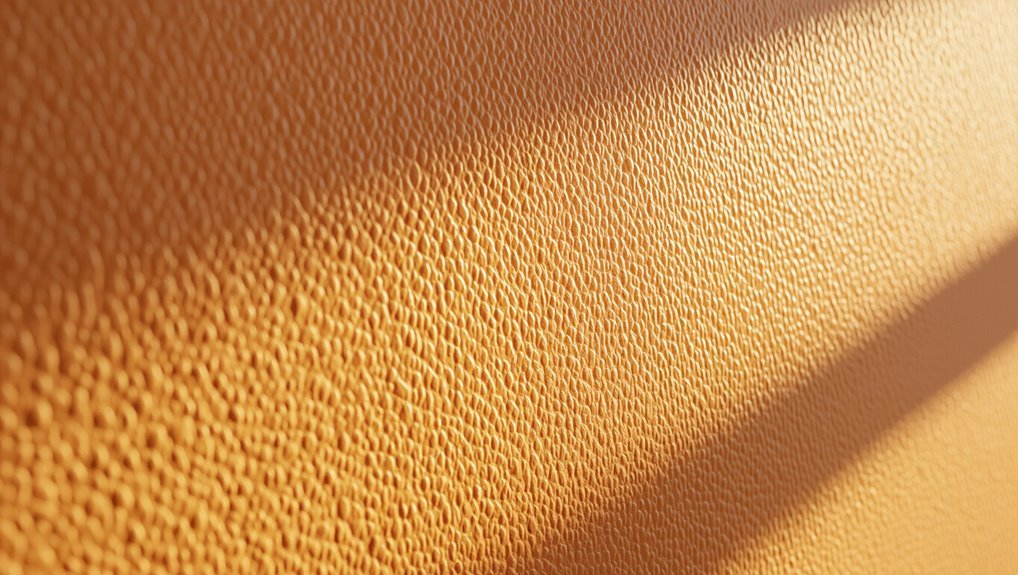
Think of orange peel as a subtle stippled finish that makes a wall look dimpled rather than smooth.
You’ll notice tiny rounded bumps and shallow craters across the surface, disrupting light reflection and creating soft shadowing. From arm’s length it reads as texture; up close it shows irregular, pebble-like patterns.
It’s uniform enough to be distinct but not sharply raised.
Causes: application, paint viscosity, spray settings, environmental factors
That dimpled look comes from how the paint gets applied and how it behaves as it dries.
You usually see orange peel when spray pressure, tip size, or technique atomize paint unevenly. Thick or improperly thinned paint won’t level, and wrong spray settings create droplets that skin over.
Temperature, humidity, and airflow also affect drying speed, locking in texture before it smooths out.
How orange peel differs from other textures (popcorn, stipple, knockdown)
While they all add texture, orange peel shows a fine, even dimpled surface that’s distinct from the chunkier bumps of popcorn, the tight speckling of stipple, or the flattened ridges of knockdown.
You’ll notice orange peel sits closer to the wall, offering subtle shadowing; popcorn is bulky, stipple is fine but uniform, and knockdown creates spread-out, flattened peaks.
Assessing the Damage: When to Patch vs Repaint
First, check the scope: are the flaws isolated, across an entire wall, or in multiple rooms?
Tap and lightly scrape suspect areas to test adhesion and soundness before you decide.
Finally, consider whether you can match the existing texture and sheen—if not, repainting the whole surface may be the cleaner choice.
How to evaluate scope: isolated spots, entire wall, multiple rooms
How badly is the texture affected — a few tiny dimples or whole swaths of orange peel?
Decide by area: patch isolated spots if damage is limited and blends easily.
If textural differences cover an entire wall or several adjoining rooms, plan a full wall or multi-room repaint to match sheen and texture.
Factor time, budget, and visibility.
Surface tests to determine adhesion and soundness (tap, scrape)
Before you decide whether to patch or repaint, test the surface to see if the existing texture and paint are sound.
Tap lightly with a knuckle; hollow sounds or flakes mean poor adhesion.
Scrape with a putty knife in several spots—loose chips or peeling indicate you should strip or prime first.
Solid, well-bonded areas can be patched without full repainting.
Matching texture and sheen considerations
One clear rule will guide your decision: if you can match both the orange-peel texture and the paint’s sheen closely, spot-patching will blend in; if not, plan to repaint the whole wall.
Test small areas with matching spray or stipple, view under different light angles, and use sample finishes—flat, eggshell, satin—to confirm.
If mismatch shows, repaint for uniform appearance.
Tools and Materials You’ll Need
Before you start fixing orange peel, gather the essential tools—sanding blocks, a drywall knife, a texture sprayer or stomp brush, and quality sandpaper.
Pick recommended products and finishes like a matching primer, flat or eggshell paint depending on the room, and a feathering compound for smooth shifts.
Don’t forget safety gear and prep materials: a respirator or dust mask, goggles, drop cloths, and painter’s tape.
Essential tools list
Gathering the right tools makes fixing orange peel paint faster and gives you a smoother result, so you’ll want a basic kit: sandpaper (80–220 grit), sanding blocks or an orbital sander, a drywall or spackle knife, joint compound or lightweight spackle, primer, matching paint, a quality roller and tray, painter’s tape, drop cloths, a tack cloth, and safety gear like goggles and a respirator.
- Sanding setup
- Filling tools
- Painting supplies
- Safety gear
Recommended products and finishes
Now that you’ve got your tool kit ready, pick products and finishes that match the scope of the repair and your wall’s existing finish.
Choose flexible spackle for small dings, light-grit sandpaper for smoothing, a thin-skim joint compound for larger orange peel areas, and a matching paint finish (eggshell, satin, flat) to blend repairs seamlessly.
- Flexible spackle
- Light-grit sandpaper
- Joint compound
- Matching paint finish
Safety gear and prep materials
You’ll want a few basic safety items and prep materials to protect yourself and make the repair go smoothly: goggles, a dust mask or respirator, nitrile gloves, and knee pads if needed.
Gather drop cloths, painter’s tape, a sanding block or fine-grit sandpaper, a vacuum with brush attachment, tack cloths, and a small putty knife.
Keep a damp rag nearby for cleanup.
Step-by-Step Spot Repair Method (No Full Repaint)
Start by prepping the spot: clean the area, mask nearby surfaces, and protect floors and furniture.
Sand and feather the damaged edges, then apply your chosen texture patch—spray or hand-applied—using the technique that matches the surrounding finish.
Once dry, sand lightly, blend the edges, spot-prime, and match the paint sheen for an invisible repair.
Step 1 Prepare the area: cleaning, masking, protecting surfaces
Clear the work area and protect everything you don’t want painted: move furniture away from the damaged wall, cover floors and nearby surfaces with drop cloths, and mask trim, outlets, and light switches with painter’s tape and plastic.
Clean the repair zone with a mild detergent, remove dust, and let it dry before proceeding.
- Remove loose debris
- Vacuum and wipe
- Tape edges carefully
- Lay drop cloths
Step 2 Sanding and feathering the edges for a smooth transition

Grab a sanding block and medium-grit sandpaper, then gently sand the raised orange-peel texture around the damaged spot until the edges blend smoothly into the surrounding wall.
Work in light, circular strokes, check progress frequently, and feather toward untouched paint to avoid sharp ridges.
Finish with fine-grit sandpaper, wipe away dust, and guarantee the surface feels uniformly smooth before patching.
Step 3 Applying texture patch (spray vs hand-applied) techniques and tips
Now you’ll add texture to match the surrounding orange-peel finish, choosing either a spray or hand-applied method based on the size of the repair and the tools you have.
For small spots, use a squeeze bottle or brush stippling to mimic bumps; for larger areas, use an aerosol texture spray or hopper gun.
Test on scrap, apply light passes, and build up to match surrounding texture.
Step 4 Drying, sanding lightly, and blending edges
Allow the texture to dry fully before touching it—you’ll know it’s ready when the bumps feel firm and the sheen matches the surrounding wall.
Lightly sand high spots with fine-grit paper, feathering edges into the existing texture.
Wipe away dust with a tack cloth, inspect under good light, and repeat minimal sanding if needed.
Keep edges subtle to blend seamlessly without disturbing surrounding paint.
Step 5 Spot priming and matching paint sheen
Step 5 focuses on sealing your repaired spot and matching the surrounding sheen so the patch disappears; apply a quality primer to the sanded area, let it cure, then compare gloss with the existing wall.
Use the same sheen level (flat, eggshell, satin) paint for touch-ups.
Test a small area, adjust sheen or sheen-matching additive, and guarantee uniform light reflection before finishing.
Step 6 Feathered touch-up painting for invisible repairs

With the primer cured and sheen matched, you’re ready to feather the paint so the repair blends invisibly into the wall.
Load a small brush or mini roller, apply thin coats from the center outward, tapering pressure to thin the edge.
Let each coat dry, inspect under good light, and repeat until texture and color disappear.
Clean edges with a damp sponge.
Alternative Methods When Spot Repair Isn’t Working
If spot repairs aren’t matching the surrounding texture, you can resurface the whole wall section with a texture sprayer for a uniform finish.
You can also skim coat the wall with joint compound to flatten or rebuild texture—I’ll explain when to use this and the basic steps.
If those options aren’t practical, consider hiding problem areas with wallcoverings or trim.
Using texture sprayers to resurface the entire wall section
When spot repairs keep standing out, consider using a texture sprayer to resurface the entire wall section so the finish looks uniform. You’ll match texture across seams, save time versus hand‑troweling, and avoid visible patches.
Prep by cleaning and masking. Adjust nozzle and pressure for the original orange‑peel pattern. Practice on scrap, then spray in overlapping passes for consistent coverage before repainting.
Skim coating the wall with joint compound when and how
Skim coating a wall with joint compound gives you a smooth, uniform surface when spot repairs or texture spraying can’t hide mismatched orange‑peel.
It’s a method you can handle yourself with a few tools and patience.
Clean and sand the wall, apply a thin, even coat with a wide drywall knife, let it dry, sand smooth, then repeat once more before priming and painting.
Applying wallcoverings or trim to hide texture problems
Although patching and skim coating are ideal, you can also hide stubborn orange‑peel by applying wallpaper, textured panels, or trim to mask uneven areas without redoing the entire wall.
Choose a heavy-duty vinyl or fabric wallpaper for durability, or install beadboard, wainscoting, or decorative molding where texture is worst.
Measure carefully, prep surfaces, and use adhesive or nails for a clean, lasting finish.
How to Match Texture and Paint Color Perfectly
To get a seamless repair, you’ll need to match both the orange peel texture and the paint color precisely.
Practice spray patterns and nozzle sizes on scrap drywall, bring samples for tinting and test blends, and adjust sheen to account for light angle differences.
Take your time with small test patches so the finished spot disappears from normal viewing positions.
Techniques for replicating orange peel texture (spray patterns, nozzle sizes)
When you’re matching orange peel texture, the spray pattern and nozzle size are your primary controls for getting a consistent, factory-like finish; choosing the right fan width and tip orifice helps you recreate the same droplet size and coverage the original applicator used.
Test different air pressures, use a 1.4–1.8mm tip for most wall paints, and adjust fan angle until the texture blends.
Color matching tips: samples, tinting, and blending
Color is easiest to match when you start with good samples—bring in several swatches and paint a few small test patches on the wall near the texture you’re matching so you can view them in the room’s light.
Compare patches at different times of day, note undertones, then get tint adjustments from the supplier.
Feather new paint into existing areas for seamless blending and test before committing.
Dealing with sheen mismatch and light angle issues
Matching swatches and tinting gets you close, but sheen and the angle of light can still betray your work.
To fix this, test small patches with the desired sheen—flat, eggshell, satin—viewing them at different times and angles.
Adjust by lightly sanding or adding a glazing medium to match reflectivity.
Blend edges feathered into existing finish to hide changes.
Common Mistakes That Make Repairs More Visible
Don’t sand too much or too little, and don’t use the wrong technique when applying texture, because both will make the repair stick out.
Also match the paint’s color and sheen exactly, and don’t rush drying or skip proper priming.
Small shortcuts in any of these steps will turn a careful repair into an obvious patch.
Over-sanding or under-sanding
Sand carefully—too much or too little will make your repair stick out like a sore thumb.
If you over-sand, you’ll create a depression that catches light differently; under-sanding leaves edges that show through the new texture.
Use progressively finer grit, feather edges, and test with primer.
Aim for a smooth, even shift so the patch blends with the surrounding orange peel.
Wrong texture application method
Once you’ve got the feathered edges right, the way you apply texture will make—or break—the repair.
Don’t use the wrong tool or inconsistent spray pressure; that creates obvious blotches.
Practice on scrap drywall, match droplet size and distance, and work in overlapping passes.
Keep texture depth uniform and blend into surrounding surface so the patch disappears, not stands out.
Poor color or sheen matching
One common reason repairs jump out is that the paint’s color or sheen doesn’t match the surrounding wall, so your patch looks like a distinct spot instead of blending in.
You’ll want to test sample swatches in the same light, use the original paint if available, and match sheen (flat, eggshell, satin).
Feather edges and apply thin coats to minimize visible changes.
Rushing drying times or inadequate priming
If you speed through priming or paint before the previous coat’s fully dry, the repair will stand out—bubbles, peeling, and visible seams are common results.
You should wait recommended dry times, use a quality primer that bonds and evens porosity, and apply thin, even coats.
Patience prevents texture mismatch and lifts; properly primed surfaces accept paint uniformly, making repairs blend.
Prevention and Best Practices to Avoid Orange Peel in Future
To avoid orange peel next time, you’ll want to control paint viscosity, set your spray gun correctly, and keep the right application distance.
Monitor humidity and temperature while you work, and pick primers and finishes that suit your wall material.
Follow those basics and future coats will lay down smooth and even.
Proper paint viscosity and thinning guidelines
When you’re spraying or rolling paint, getting the viscosity right is key to avoiding orange peel; paint that’s too thick won’t flow out smoothly, while paint that’s too thin can run and reduce coverage.
Check manufacturer thinning recommendations, use a viscosity cup or flow cup if available, and add small amounts of appropriate thinner.
Test on scrap before proceeding to guarantee proper leveling and coverage.
Correct spray gun settings and application distance
Adjust your spray gun settings and maintain the right application distance to guarantee even atomization and proper film build—both are essential for preventing orange peel.
Set air pressure and fluid flow per manufacturer specs, choose appropriate nozzle size, and test spray on cardboard.
Hold the gun 8–12 inches from the wall, overlap passes 50%, keep steady speed, and adjust settings if you see stippling.
Environmental controls: humidity and temperature
Although paint can look fine in the gun, humidity and temperature in your workspace make the biggest difference in whether it levels out or skins over—so control them before you spray.
Keep relative humidity between 40–60% and temperature within the paint manufacturer’s recommended range.
Use heaters, air conditioners, or dehumidifiers to stabilize conditions, allow proper flash times, and avoid spraying during rapid temperature shifts.
Choosing the right primer and finish for your surface
Because the right primer and finish set the foundation for smooth paint, pick products that match your wall material and the paint system you’re using.
For porous drywall use a high-quality PVA primer; for previously painted or glossy surfaces, choose a bonding primer.
Finish selection matters: satin hides imperfections better than flat but cleanability matters.
Match primer sheen compatibility and follow manufacturer dry times.
Tools, Cost, and Time Estimates
You’ll need a few basic tools—sandpaper, putty knife, primer, and paint sprayer or roller—and DIY spot repairs usually cost $10–$100 while partial or full repaints run from $100–$800 depending on materials and room size.
Expect sanding and patching a small area to take 30–60 minutes, priming 15–30 minutes plus drying, and painting 1–3 hours with additional dry time; an average room repaint typically takes a day or two from prep to finish.
Below I’ll break down specific tools, realistic cost examples, and a step-by-step time estimate so you can plan the job.
Typical cost ranges for DIY spot repair vs partial or full repaint
When you decide whether to tackle orange peel texture yourself or hire a pro, the costs and time can vary a lot depending on scope—expect a small DIY spot repair to cost under $50 and take a couple of hours, a partial repaint (one or two rooms) to run $200–$800 and take a day or two, and a full repaint of a home to range from $1,500 to $6,000+ and take several days to a week.
| Scope | Cost | Time |
|---|---|---|
| DIY spot | <$50 | Hours |
| Partial (1–2 rooms) | $200–$800 | 1–2 days |
| Full home | $1,500–$6,000+ | Several days–1 week |
Estimated time per repair step and for average room
Breaking the job into clear steps helps you plan time and tools: prepping (30–60 minutes), sanding and skim-coating (1–3 hours for a single spot, 3–6 hours for an average room), drying/curing between coats (30 minutes–4 hours per coat depending on product), priming (30–60 minutes), and final painting (1–3 hours for one coat, plus recoat time).
Gather sandpaper, joint compound, putty knife, primer, paint, rollers.
Plan breaks for drying; expect 4–12 hours total active work and up to 24–48 hours including cure times.
Before-and-After Care and Maintenance
After repairing and repainting, wait at least 24–48 hours before cleaning or moving furniture against the wall so the paint and any joint compound fully cure.
When you do clean, use a soft brush or microfiber cloth and mild soap with gentle, circular motions to avoid disturbing texture or fresh repairs.
For stubborn marks, test a small area first and avoid abrasive pads or strong solvents that can strip paint or roughen the finish.
When to wait before cleaning or moving furniture
Once the new paint feels dry to the touch, resist the urge to clean or move furniture for several days to let the finish fully cure—this prevents smudges, dents, or texture changes in orange peel surfaces.
Wait at least 72 hours for latex and up to a week for oil-based or high-humidity cures.
Move items gently, lift rather than slide, and avoid leaning against repaired areas.
Tips for cleaning textured walls without damaging repairs
When you clean textured walls, use gentle tools and mild cleaners so you don’t loosen repairs or lift paint texture.
Test cleaners on an inconspicuous spot first. Use a soft sponge or microfiber cloth, light pressure, and short strokes.
Avoid abrasive pads, strong solvents, or high-pressure washing.
Pat dry gently and recheck repaired areas; touch up only if texture or paint shifts.
FAQ
You probably have a few quick questions about fixes, like whether spackle or joint compound alone will do the job or if a roller can help blend a repair.
You’ll want to know when a skim coat is necessary versus a simple touch-up, whether pros can match texture better than you can, and if orange peel signals any safety or structural issues.
Let’s answer each of these so you can pick the right repair approach.
Can I fix orange peel with just spackle or joint compound?
Can you fix orange peel with just spackle or joint compound? Yes, for small dings and shallow texture mismatches you can.
Use thin layers, feather edges, and sand smooth between coats. Joint compound works better for larger areas; spackle suits pinpoint repairs.
After sanding, prime the patch before painting to guarantee adhesion and color match.
Don’t overload a single application.
Will a roller help blend a spot repair into the rest of the wall?
Wondering if a roller will help blend a spot repair? Yes, a roller can help match texture if you use the same nap length, paint type, and light pressure.
Practice on scrapboard to mimic the orange peel pattern, feather edges, and avoid overworking wet paint. For small repairs, a matching roller technique often conceals the patch without repainting the whole wall.
How do I know if my wall needs a skim coat instead of a touch-up?
How bad does the texture mismatch or surface damage look up close?
If you see large, uneven areas, deep gouges, or widespread peeling that a spot patch can’t mask, you’ll need a skim coat.
Choose skim when the repair covers more than a small patch, the texture won’t blend with light, or sanding and touch-up still leave visible seams.
Can professionals match orange peel texture better than DIY?
Curious whether hiring a pro will get you a closer match? Yes — pros have experience, specialized spray equipment, and access to a wider range of texture mixes, so they’re likelier to replicate existing orange peel.
If your texture is subtle or irregular, a pro can match it faster and with fewer mistakes than most DIYers, though costs and scheduling matter.
Is orange peel dangerous or a sign of structural problems?
Although orange peel texture can look uneven, it’s rarely dangerous or a sign of structural problems; it’s usually just a surface finish applied during painting or drywall finishing.
You don’t need to worry unless you see cracks, bulging, moisture stains, or soft spots. Those indicate underlying issues.
Otherwise, orange peel is cosmetic and can be smoothed, skim-coated, or matched without structural repair.
