
How to Paint a Checkerboard Wall Step by Step
You can paint a crisp checkerboard wall by planning square size, measuring and mapping a grid, and prepping and priming the surface. Clean, patch, and prime for smooth adhesion, then mark straight lines with a level and chalk. Tape every other square, seal tape edges, and apply thin coats of your first color; remove tape while tacky. Repeat for alternate squares, touch up seams, and seal with a protective topcoat. Continue for detailed tips and troubleshooting.
Quick Overview: Time, Difficulty, and Variations for a Checkerboard Wall
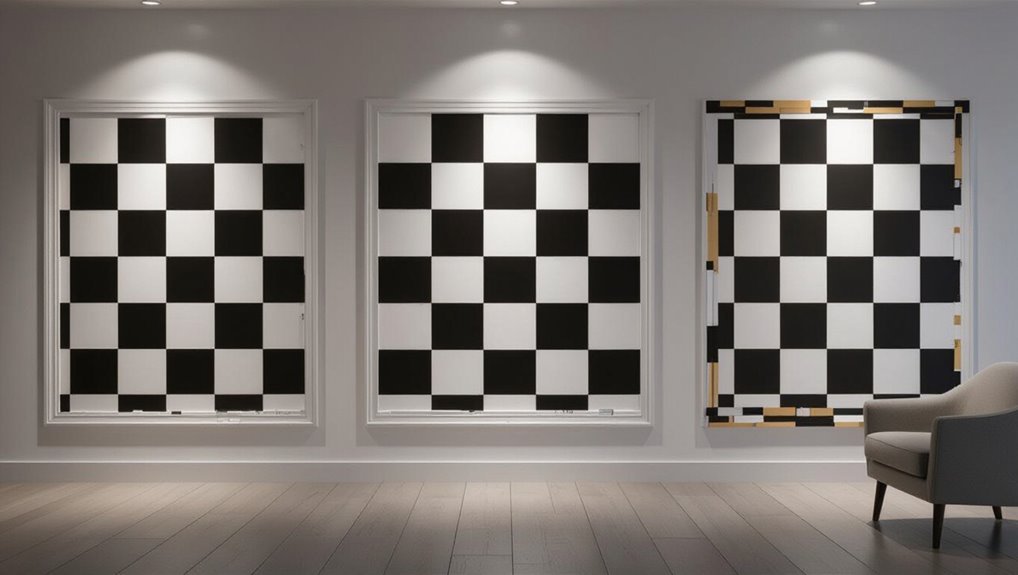
Although a checkerboard wall can look intricate, you can usually finish a single accent wall in a day or two; expect 3–6 hours of active work for taping and painting plus drying time between coats.
You’ll find checkerboard history and design inspiration in retro and modern examples.
Skill level is moderate; variations include two-tone, three-color, or staggered patterns—prep and patience matter.
Choose Square Size and Layout for Your Wall
Before you tape or mark anything, decide how big you want each square and how the grid will sit on the wall — that determines the pattern’s scale and how many partial squares you’ll need at the edges. Choose square dimensions that suit wall aesthetics and viewing distance. Consider balance, focal points, and symmetry.
| Size | Visual Impact | Use |
|---|---|---|
| Small | Detailed | Accent |
| Large | Bold | Feature |
Measure the Wall and Map a Grid on Paper
Start by measuring the height and width of your wall so you know the exact space you’re working with.
Transfer those dimensions to paper and sketch a scaled grid that reflects the square size you chose. That paper map will help you count full and partial squares and plan any adjustments before you tape or paint.
Measure Wall Dimensions
Measure the wall’s width and height with a tape measure, then draw a scaled grid on paper that matches those dimensions so you can plan square size and layout.
Next, record precise wall measurements and note outlets, switches, and baseboards.
Use reliable measuring tools and double-check corners and levelness.
These figures guide square sizing and material estimates before you start marking the wall.
Sketch Grid Layout
Now that you’ve got exact wall dimensions and noted obstacles, transfer those numbers onto graph paper to sketch the checkerboard grid.
You’ll test grid design by dividing width and height into equal squares, marking doors, outlets, and trim.
Try layout options—whole squares, partial edge adjustments, or centered patterns—so you can finalize square size and seam placement before painting.
Pick Paint Colors and Finishes for Strong Contrast
Choose high-contrast color pairings like black and white, navy and cream, or a bold color against a neutral to make your checkerboard pattern pop.
Pick matte for subtle, modern squares and gloss for striking shine that reflects light and highlights edges.
Test swatches side-by-side on the wall to see how color and finish interact in your room’s lighting.
High-Contrast Color Pairings
Strong contrast makes a checkerboard pop, so pick colors that sit far apart on the value and hue scales to get a striking effect.
You’ll favor bold color combinations like navy and lemon or charcoal and coral.
Classic contrasts — black and white, deep green and pale pink — create crisp edges and visual drama.
Test samples on the wall to confirm vibrancy before you commit.
Matte vs. Gloss Finish
While color determines the punch of your checkerboard, finish controls how that punch reads across the room; glossy squares will reflect light and sharpen edges, while matte tones absorb light and soften contrast.
Choose gloss for bold lines and maximum gloss reflectivity, but expect cleaning needs.
Pick matte for subtle contrast and improved matte durability in high-traffic areas, balancing look with maintenance.
Gather Tools and Supplies You’ll Actually Need
Before you begin, lay out the essentials you’ll actually use: paint (base and checker color), a quality angled brush and 2–3 rollers (including a small foam roller for touch-ups), painter’s tape, a level or laser, a measuring tape and pencil, drop cloths, and a small bucket for mixing.
Focus on tool selection and essential supplies. Keep these handy:
- Tape and cutting tools
- Rollers and brushes
- Measuring tools
- Mixing and cleanup items
Prepare the Wall: Clean, Patch, and Prime
Once your tools and paint are ready, make the wall ready to accept them: wipe down surfaces to remove dust, grease, and cobwebs with a mild detergent or trisodium phosphate solution, then rinse and let it dry. Use wall cleaning, patching techniques, priming methods, and surface preparation to guarantee adhesion. Follow this quick checklist:
| Task | Tool | Time |
|---|---|---|
| Clean | Sponge | 15m |
| Patch | Putty knife | 30m |
| Prime | Roller | 45m |
| Inspect | Light | 10m |
Transfer the Grid to the Wall Accurately
Measure and mark your grid carefully so each square lines up perfectly; use a tape measure, level, and pencil to plot your vertical and horizontal guidelines at equal intervals across the wall.
You’ll guarantee accurate grid placement and wall alignment by snapping reference points and checking corners.
- Measure twice
- Mark lightly
- Use reference points
- Recheck alignment
Mark Straight Lines With a Level and Chalk Line
With your grid points in place, grab a level and a chalk line to lay down crisp, straight guidelines for each row and column.
Snap lines between marked points, checking plumb and level as you go. Use reliable line tools and proven alignment techniques to guarantee intersections meet precisely.
Re-snap any faint lines so your checkerboard squares stay true before taping.
Apply Painter’s Tape for Crisp Square Edges
Now that your grid’s marked, measure and mark each square carefully so the tape lines up perfectly.
Apply painter’s tape along your marks, pressing it down firmly and smoothing out any gaps.
Run a putty knife or your fingernail along the tape edge to seal it before you paint.
Measure And Mark
Start by mapping your grid on the wall so you know exactly where each square will sit. Then use a level and a pencil to mark the key horizontal and vertical lines.
You’ll focus on accurate wall preparation and paint techniques before taping. Follow these quick steps:
- Measure total width and height
- Divide by square size
- Mark corner reference points
- Double-check level and spacing
Apply And Seal Tape
After you’ve confirmed your grid lines, lay down painter’s tape along the edges of each square to protect the unpainted areas and create sharp borders.
Press tape firmly with a plastic putty knife or your fingernail, focusing on tape application and edge sealing. Seal seams where tape meets wall to prevent bleed-through.
Remove tape while paint is tacky for the cleanest lines.
Seal Tape Edges to Prevent Paint Bleed
Because paint can creep under even the neatest tape, seal the edges to get crisp checker lines; press the tape firmly along each seam and run a putty knife or your fingernail over the edge to guarantee full contact.
Choose tape types and refine taping techniques. Then:
- Wipe edge with damp cloth
- Apply thin clear coat over tape edge
- Let it tack briefly
- Paint confidently without lifting tape
Paint the First Color: Tips for Even Coverage
Start by priming the surface so the paint sticks evenly and the color stays true.
Use thin, even coats with a roller or brush, letting each layer dry before adding the next. That approach prevents drips and blotches and gives you a crisp checkerboard finish.
Prime The Surface
Prime the surface so your checkerboard’s base color goes on smooth and true: wash and sand any grime or glossy spots, fill holes, then apply a high-quality primer suited to your wall (latex for drywall, bonding primer for slick surfaces).
Use proper surface preparation and choose primer types by substrate:
- Clean thoroughly
- Sand glossy areas
- Patch and smooth holes
- Select appropriate primer
Apply Thin Coats
When you paint the wall’s base color, apply thin, even coats so each pass dries quickly and lays down smoothly; this prevents drips, brush marks, and color pooling. Use proper color selection and steady brush technique, thin layers, and light pressure. Let each coat dry fully before the next.
| Tip | Action |
|---|---|
| Coat | Thin |
| Pressure | Light |
| Dry time | Full |
| Tool | Roller/brush |
Remove Tape, Inspect, and Apply Second Coats
1. Remove tape carefully using recommended tape removal techniques and do a quick wall inspection tips run to spot bleed or thin areas.
If issues appear, sand lightly and clean.
- Peel tape at a 45° angle
- Check seams and corners
- Touch up thin spots
- Apply second coats evenly, drying between layers
Tape and Paint Alternating Squares on a Checkerboard Wall
With the base squares checked and any touch-ups sanded, you’re ready to tape off every other square and paint the first color.
Use precise tape application along grid lines, pressing edges to prevent bleed.
Apply tape precisely along grid lines, pressing edges firmly to prevent paint bleed for clean, sharp squares.
Apply paint in thin, even coats with a consistent paint technique, working from center outward.
Let dry fully before removing tape and prepping the remaining squares for the second color.
Touch‑Ups, Caulking Seams, and Blending Edges
Address any paint flaws, seal gaps, and feather hard edges before calling the job finished.
You’ll use precise touch up techniques and caulking tips to tidy seams. Focus on edge blending and paint touch ups with small brushes and clean caulk lines.
- Use seam treatments sparingly
- Dab with minimal pressure
- Smooth caulk with a wet finger
- Practice blending methods on scrap drywall
Protect Your Checkerboard Finish: Topcoats and Maintenance
Before you call the job done, protect that checkerboard with a clear topcoat and a simple maintenance plan to keep squares crisp and colors true.
Choose topcoat types—waterbased satin for durability, polyurethane for high traffic, or a matte acrylic for subtlety.
Follow maintenance tips: dust regularly, wipe spills immediately with a soft cloth, and touch up scuffs promptly to preserve edges.
Frequently Asked Questions
Can I Paint a Checkerboard Over Wallpaper Without Removing It?
Yes — you can, but you’ll need to assess wallpaper durability first. If it’s firmly adhered and undamaged, scuff, prime with a bonding primer to improve paint adhesion, then tape and paint your checkerboard confidently.
How Do I Match Squares at Wall-To-Ceiling Corners?
You align corner squares by planning corner alignment before painting: measure from the ceiling down, use square measurement to size partial squares, mark guides on both walls, then paint to guarantee squares meet neatly around the corner.
Will Heat or Moisture Cause Painted Squares to Peel?
Yes — heat and moisture can make painted squares peel; they’re like slow storms eroding paint. You should prep surfaces, choose high-quality paint for durability, and control environmental factors like humidity and temperature to prevent failure.
Can I Use Stencils Instead of Taping for Consistent Squares?
Yes — you can use stencils instead of taping for consistent squares. Choose stencil types suited to wall texture, secure edges, and pick paint colors that contrast well; you’ll get precise, repeatable squares with less masking.
How Do I Remove Paint From Adjacent Trim or Baseboards?
Quickly and carefully: you’ll use paint removal techniques like a gentle scraper, foam sanding block, or solvent matching the paint, while contrasting precision with speed; follow trim protection tips afterward, touching up and sealing to prevent recurrence.
Conclusion
You’ve turned a plain wall into a bold checkerboard that reads like a graphic statement in your room. Take your time with measuring and taping, and don’t rush the paint—precision here is the backbone of the whole look. After removing tape, inspect seams, touch up edges, and consider a protective topcoat to keep the squares crisp. Like a stitched quilt, your careful work will hold the pattern together and stand up to daily wear.
