
What Do You Call a Picture Painted on a Wall? Mural Terms Explained
When you see a large image painted directly onto a wall, you’re usually looking at a mural — a site-specific artwork meant to engage a place, its people, and often its history. Not every wall painting is a mural; some are decorative or temporary without community intent. Techniques range from true fresco, painted into wet plaster, to acrylics and mosaics. If you keep going, you’ll find how to tell types apart, spot local murals, and hire a muralist.
Quick Answer: Mural vs. Wall Painting
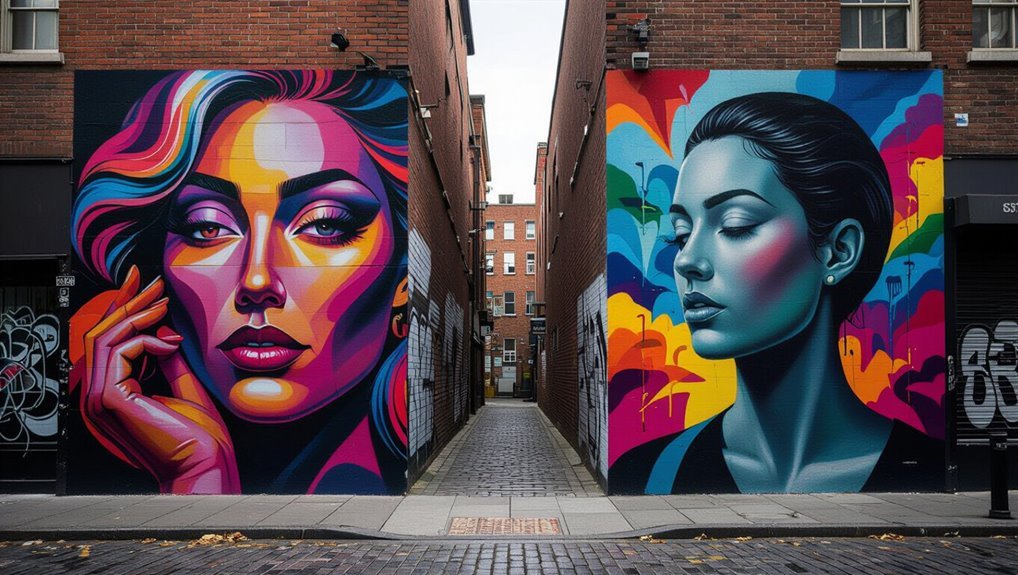
Think of a mural as a large-scale artwork created for a specific site, while a wall painting is any painted image applied to a wall without that site-specific intent.
You’ll call something a mural when its design engages site, audience, and mural history, conveying public narratives. A wall painting stays decorative or illustrative.
Consider cultural significance, context, and intent to label it correctly.
Who Searches Mural Terms: And Why
Who looks up mural terms, and what do they want to accomplish?
You seek clarity on art terminology to deepen understanding of artistic expression, cultural significance, and historical context.
You also want resources for community engagement and mural preservation.
- mural enthusiasts learning basics
- students using educational resources
- curators documenting context
- activists planning community projects
How to Tell a Mural From Other Wall Art
You can usually tell a mural from other wall art by checking who owns or controls the surface—public or commissioned work often signals a mural.
Look at permanence and scale: murals tend to be large and meant to stay, while posters or prints are smaller and temporary.
Also read the artist’s intent—community-focused or site-specific projects are more likely to be murals than decorative pieces.
Surface Ownership Matters
Ownership shapes what a piece on a wall actually is: if the property owner commissioned or sanctioned the work, it’s usually a mural, but if an artist installs a portable panel, hangs a framed piece, or affixes stickers without permission, those are other forms of wall art.
You should note surface aesthetics and mural ownership when evaluating intent.
- Commissioned mural
- Sanctioned art
- Portable panel
- Unauthorized stickers
Permanence And Scale
Having clarified how who controls a wall affects classification, let’s look at how permanence and scale help you tell a mural from other wall art. You’ll judge permanence factors and scale considerations: murals span large surfaces, aim for artistic longevity, and respond to environmental impact. Compare size, materials, and exposure to decide if a work reads as mural or transient wall art.
| Criterion | Note |
|---|---|
| Size | Large-scale |
| Materials | Durable paints |
| Exposure | Weathering risk |
| Lifespan | Designed long-term |
| Context | Public setting |
Artistic Intent Signals
When judging whether a wall piece is a mural, look for clear artistic intent: murals usually aim to communicate a narrative, provoke thought, or respond to a community, rather than just decorate or advertise.
- You’ll spot deliberate artistic expression and community relevance.
- Visual storytelling beats random decoration.
- Intent shows in research, symbols, or collaboration.
- If it educates, commemorates, or challenges, you’re likely viewing a mural.
True Fresco (Buon Fresco): How It Works
Because you’re painting into wet lime plaster, true fresco (buon fresco) bonds pigment directly into the wall as the plaster carbonates; you use precise true fresco techniques rooted in buon fresco history, working quickly in giornata sections. You’ll mix pigments with water, apply to fresh intonaco, and let chemistry fix colors permanently.
| Stage | Action | Result |
|---|---|---|
| Prep | Scratch coat | Grip |
| Intonaco | Smooth layer | Paintable |
| Pigment | Water mix | Penetrates |
| Carbonation | Drying | Bond |
| Finish | No wax | Matte |
Fresco Secco: Dry‑Plaster Painting and Uses
Contrast is key: fresco secco is painting on dry plaster, where you apply pigments bound with a binder—like egg, glue, or oil—onto an already set intonaco, so the color sits atop rather than chemically fusing with the wall.
You’ll use varied fresco techniques, appreciate historical significance, and accept tradeoffs:
- Faster touch-ups
- Richer surface detail
- Lower durability
- Easier layering
Tempera Murals: Egg Tempera on Plaster
After working with fresco secco, you’ll notice egg tempera on plaster feels more unified and immediate: artists mix pigment with egg yolk to create a fast‑drying, matte paint that bonds tightly to a prepared plaster surface. You’ll explore tempera techniques rooted in mural history, enjoy precise layering, and maintain vivid, durable color.
| Medium | Drying | Finish |
|---|---|---|
| Egg tempera | Fast | Matte |
| Surface | Bonding | Longevity |
| Plaster | Strong | Stable |
Oil Murals: Technique, Finish, and Longevity
When you paint an oil mural, you’ll need to choose application techniques that suit both the image and the wall’s texture.
Prepare the surface carefully with proper priming and sealing to prevent absorption and guarantee adhesion.
With correct technique and maintenance, oil murals offer strong durability but may require conservation to manage yellowing and varnish aging.
Oil Application Techniques
Start by understanding that oil murals demand a different touch than other media: you’ll work with slower-drying paints, layered glazing, and controlled brushwork to build depth and durable color.
- Use oil layering techniques: fat-over-lean and translucent glazes.
- Choose oil paint mediums to adjust drying, gloss, and flow.
- Work in stages: underpainting, mid-tones, glazes, highlights.
- Protect finishes with appropriate varnish after full cure.
Surface Preparation Needs
Because oil paint sits and bonds differently than water-based media, you’ll need a rigid, well-sealed support and a properly keyed ground to guarantee adhesion, prevent discoloration, and extend the mural’s life.
You should follow specific mural preparation techniques: remove loose paint, repair cracks, prime with oil-compatible grounds, and employ thorough wall cleaning methods to eliminate grease, salts, and contaminants before priming.
Durability And Conservation
Although oil murals can achieve remarkable depth and durability, you’ll need to control technique, materials, and environmental factors to guarantee longevity; proper layering, compatible varnishes, and regular maintenance all play a role in preventing cracking, yellowing, and surface degradation.
- Use stable supports and ground.
- Apply fat-over-lean layering.
- Choose reversible conservation techniques.
- Monitor humidity, light, and pollution for mural longevity.
Acrylic Murals: Why Artists Pick Acrylics
When you want color that dries fast, resists weather, and stays vivid for years, acrylics are the go-to choice for muralists; their versatility lets artists work quickly, layer transparently or opaquely, and adapt to indoor or outdoor surfaces.
You’ll choose acrylics for acrylic advantages: color vibrancy, quick drying, versatile applications, layering techniques, artist preferences, finish durability, and weather resistance that keeps murals bold.
Sgraffito & Intaglio Wall Techniques
Sgraffito and intaglio are two carving-based wall techniques that add texture and line by removing material rather than just applying paint.
You’ll find them useful when you want crisp, incised detail or subtle relief in a mural.
- Learn the sgraffito technique for layered plaster contrast.
- Use the intaglio method to engrave fine lines.
- Combine both for depth.
- Seal surfaces for durability.
Mosaic vs. Painted Mural: When to Use Tiles
If you want durability, texture, and a luminous surface that catches light differently than paint, choose tile mosaics; they’re ideal for high-traffic, moisture-prone, or outdoor sites where wear and cleaning matter.
You’ll weigh mosaic techniques, grout, and adhesive against painted mural speed and cost.
For longevity, prioritize tile selection, colorfastness, slip resistance, and professional installation over quick painted effects.
Bas‑Relief & Sculpted Wall Art vs. Painting
Although paint can suggest depth, bas-relief and sculpted wall art actually build it—adding true three-dimensional form that changes with viewing angle and light.
- You’ll explore bas relief techniques to raise imagery from flat surfaces.
- Choose sculpted materials for durability and finish.
- Dimensional design guides composition and shadow interplay.
- Artistic textures invite touch and enhance visual impact, unlike flat painting.
Trompe‑L’œil: Painted Optical Illusions
Trompe-l’œil tricks your eye by painting convincing three-dimensional scenes on flat surfaces, so viewers often reach out expecting real objects or depth.
You learn trompe l’œil techniques to master perspective, shadow, and scale, creating believable textures and architectural faux finishes.
These optical illusion murals invite interaction and challenge perception, turning plain walls into immersive, deceptive spaces that feel tangible until you touch them.
Relief Painting and Mixed‑Media Installations
Texture and depth jump off the wall in relief painting and mixed‑media installations, where you combine paint with sculptural elements to extend a mural into real space.
You choose relief techniques and mixed media approaches to shape shadow and touch, making narratives tactile and site‑specific.
- Built relief
- Applied objects
- Layered media
- Integrated lighting
Portable Mural Panels and Movable Work
Shifting from relief and mixed-media work that anchors art to a specific wall, portable mural panels let you bring that same impact into new spaces.
You’ll learn portable mural techniques—modular panels, durable substrates, and attachment systems—so you can install, transport, and reconfigure quickly.
Movable mural benefits include venue flexibility, preserved integrity, and easier storage, letting your work reach varied audiences without permanent alteration.
Temporary Murals: Wheatpaste, Posters, Adhesives
Temporary murals—wheatpaste, posters, and adhesive-based works—let you cover walls quickly, make bold statements, and remove your image when the moment has passed.
You’ll use wheatpaste techniques for fast application, consider poster longevity, and pick adhesive types suited to temporary installations.
Choose materials, surface prep, weatherproofing, and removal plans.
- Surface prep
- Material choice
- Weatherproofing
- Clean removal
Spray‑Painted Murals: Tools, Caps, Effects
When you pick up a can, the cap you choose — skinny, fat, soft, or fat‑soft — controls line width, pressure, and paint flow.
Different caps and techniques let you create hard edges, soft fades, speckled textures, or rapid fills.
Think about which caps and motions will produce the effects you want before you start spraying.
Spray Paint Caps Types
Though caps might seem like a small accessory, they change how paint comes out of the can and what you can do with it; choosing the right cap lets you control line width, texture, and spray pressure for precise outlines, fades, or wide fills.
- Skinny caps — fine lines; spray paint, cap types.
- Fat caps — wide fills; nozzle effects.
- Soft caps — subtle blends; color variations.
- Specialty caps — artists’ preferences, application techniques.
Achievable Spray Effects
Texture matters: with the right cap and technique you can make crisp outlines, soft blends, drips, halftones, and rich fills that suit your design and wall conditions.
You’ll explore spray techniques and color blending to achieve texture creation and effect layering. Your tool selection guides stroke width and edge control, letting your artistic expression translate into durable, controlled mural surfaces.
Stencil Art: Repeatable Imagery and Workflow
Stencil art gives you a fast, repeatable way to reproduce the same image across large walls or multiple sites with consistent scale and edge quality.
You’ll use stencil techniques to plan repeatable patterns, streamline artistic workflow, and guarantee design adaptability for varied surfaces.
- Trace and cut clean layers.
- Test spray spacing.
- Number assembly order.
- Pack reusable stencils.
Graffiti Basics: Tags, Pieces, and Letterforms
Graffiti starts with letters: tags are quick, personal signatures; pieces are larger, more elaborate works; and letterforms are the building blocks that tie them together.
You learn tagging techniques to develop speed and identity, study street styles to diversify form, and practice letterforms for balance and flow.
Embrace urban expression while respecting graffiti culture’s codes and community knowledge.
Street Art: Murals, Stencils, and Public Intervention
Tags and pieces teach you about lettering and speed, but street art pushes those skills into broader public conversation through murals, stencils, and other interventions.
- You explore urban expression and aesthetic diversity.
- You see social commentary and cultural significance.
- You witness artistic collaboration and community engagement.
- You consider historical context alongside legal implications.
Legal Murals vs. Illegal Graffiti: Permits and Fines
You need to know when a mural requires a permit and what documentation is typically asked for.
If you paint without permission, you can face fines, restitution, or even criminal charges depending on local laws.
Knowing permit rules and potential penalties helps you choose legal projects and avoid costly consequences.
Permit Requirements
Because murals occupy public-facing space, they often trigger permit processes that distinguish legal commissions from illegal graffiti, and you should know the difference before you start painting.
- Learn permit types and mural regulations for your area.
- Follow the application process and local ordinances.
- Engage community involvement to support approvals.
- Verify permit costs, legal requirements, and zoning laws before commissioning work.
Penalties And Fines
Consequences for unauthorized work can be severe: fines, restoration orders, and even criminal charges may apply when a mural lacks proper permits.
You must know local mural regulations to avoid penalties. If you paint without permission, you’ll face ticketing, mandated removal, or prosecution depending on severity.
Understanding permit processes reduces legal implications and protects your reputation and wallet.
Community Murals: Planning and Participation
Start by bringing neighbors, artists, and local leaders together to set clear goals, roles, and timelines for a community mural project.
You’ll foster community engagement through mural workshops and design brainstorming, recruit local artists, explore funding options, and encourage public participation to maximize community impact.
- Organize mural workshops
- Host design brainstorming
- Hire local artists
- Promote mural festivals
Political Murals: Protest, Propaganda, Meaning
When you walk past a bold political mural, you’re seeing more than paint—you’re encountering a public argument that can inspire, provoke, or persuade. You’ll read political symbolism and historical context, feel societal impact, and admire artistic expression as messages reach crowds, spark debate, and mobilize change.
| Theme | Role |
|---|---|
| Symbolism | Communicates ideas |
| Context | Roots meaning |
| Impact | Drives action |
| Art | Engages viewers |
Religious Murals: Chapels, Icons, Devotional Use
When you enter a chapel, you’ll notice how iconography on the walls directs prayer and frames sacred narratives.
Pay attention to where devotional images are placed—altar walls, side chapels, and eye-level panels each guide different types of veneration.
Those locations shape how worshippers move, focus, and connect with the images.
Chapel Wall Iconography
Stepping into a chapel, you immediately meet a layered visual language where wall icons do more than decorate: they teach, guide prayer, and mark sacred presence.
You read chapel symbolism and sacred imagery as instruction, memory, and consolation.
- Saints as models
- Biblical scenes condensed
- Symbolic motifs explained
- Liturgical calendar echoed
Devotional Imagery Placement
Placement matters: where images sit in a chapel guides how you pray, whom you notice first, and what doctrines you absorb.
You’ll find devotional symbolism near altars and entryways, directing attention and ritual movement. Positioning frames sacred narratives, highlights saints or scenes for meditation, and shapes communal memory.
Thoughtful placement lets images teach, comfort, and order devotion without words, reinforcing belief through sight.
Commercial Murals: Branding, Signs, and Murals
A commercial mural does more than decorate — it communicates your brand’s story at scale, turning building walls, storefronts, and signage into high-impact marketing assets.
- Use branding strategies and artistic branding to boost corporate identity.
- Measure mural impact and signage effectiveness on audience perception.
- Blend mural aesthetics with visual storytelling for promotional murals.
- Foster community engagement to amplify reach and local relevance.
Surface Matters: Plaster, Brick, Concrete, Wood
Surface texture dictates both your mural’s longevity and the techniques the artist will use, so choosing the right substrate matters. You’ll adapt plaster techniques to smooth walls, respect brick textures for depth, select concrete finishes for durability, and work with wood grain for warmth.
| Surface | Tip |
|---|---|
| Plaster | Smooth paints |
| Brick | Embrace texture |
Preparing a Mural Wall: Cleaning, Primer, Repairs
Before you lift a brush, clean, prime, and repair the wall so your mural sticks, looks crisp, and lasts.
You’ll handle wall preparation stepwise: assess, clean, repair, and treat surfaces. Follow these focused steps:
- Surface cleaning: remove dirt, efflorescence, and loose paint.
- Repair techniques: patch cracks, fill holes, stabilize substrate.
- Primer application: use compatible primer for adhesion.
- Wall treatment: seal and finish for durability.
Scale & Composition: Planning Large Murals
Before you start painting, measure the site carefully and note wall irregularities so your design will fit the space.
Think about typical viewing distances to prioritize scale and detail where viewers will stand or pass by.
Use grids, projections, or both to transfer your composition accurately at full size.
Site Measurement Techniques
Think of site measurement as the blueprint stage for a mural: you’ll record exact wall dimensions, note obstructions and sightlines, and map viewing distances so your composition reads correctly at scale.
Use measurement tools and thorough site analysis to plan proportions, scaffolding, and access.
- Tape and laser layout
- Grid transfer planning
- Obstruction mapping
- Access and scaffold notes
Viewing Distance Considerations
How far will people be when they see your mural? You’ll judge visual perception and distance impact to set detail levels and contrast.
Consider scale perception from sidewalks, vehicles, or balconies to boost viewer engagement and mural appreciation.
Plan composition so spatial awareness guides sightlines and focal points, ensuring your work reads clearly at designated ranges and draws viewers in.
Grid And Projection Methods
Grids and projections give you reliable ways to transfer a design from paper to wall at scale, letting you maintain composition and proportion across huge surfaces.
You’ll choose methods that suit site constraints and time, balancing grid techniques with projection accuracy.
- Measure and mark a scalable grid.
- Draw corresponding paper grid.
- Use a projector for detail.
- Check proportions continuously.
Colorfastness and Weatherproofing for Murals
Because murals face sun, rain, pollution, and time, you should choose materials and protective treatments that keep colors true and surfaces intact; prioritize pigments and binders proven for color longevity and environmental resistance.
Sealants, UV inhibitors, and breathable water repellents extend life without trapping moisture.
Test coatings on a sample, consider substrate compatibility, and plan routine inspections to catch early deterioration.
Conserving Historic Murals: Consolidation & Inpainting
Start by stabilizing fragile paint and plaster so you don’t lose original material while treating the mural.
You’ll apply consolidants carefully, then match losses with reversible inpainting using compatible materials.
Follow proven historic mural preservation and mural restoration techniques to respect authenticity.
- Test consolidation agents
- Limit intervention
- Use reversible fills
- Document materials and steps
Documenting Wall Paintings: Photography Tips
Once you’ve stabilized paint and documented treatments, photograph the mural systematically to capture condition, context, and details for future conservation.
You’ll use consistent mural photography techniques: tripod, scale bars, orthogonal and oblique views, and high-resolution overlap for mosaics.
Control lighting considerations — diffuse, even illumination, avoid harsh raking light unless documenting texture — and record camera settings and angles for reproducibility.
How to Identify Technique From a Photo: Checklist
A clear photo lets you infer painting technique by emphasizing surface texture, layer relationships, and tool marks; examine overall composition, paint edges, and color stratification to spot brush strokes, fresco intonaco joins, or painted glazes.
Use technique identification and careful photo analysis to decide next steps.
- Check surface texture
- Inspect layer edges
- Look for tool marks
- Note color stratification
Common Mislabels: When It’s Not a Mural
After you’ve checked texture, layer edges, tool marks, and color stratification, you’ll often still need to confirm whether the work is actually a mural.
You’ll spot misunderstood murals labeled as murals but actually installations, projections, wallpaper, or decals.
Check permanence, attachment method, and context: murals are painted directly on substrate.
Distinguishing true wall art prevents misclassification and respects creator intent.
How to Write Accurate Mural Captions
When you caption a mural, focus on what helps a viewer understand its origin, context, and physical characteristics: use concise mural captioning tips and craft effective mural descriptions that note artist, date, location, medium, and intent.
Provide clear, factual lines and avoid opinion.
- Artist & date
- Location & wall type
- Medium & scale
- Historical/contextual note
Keywords to Search for Different Wall Art Types
To move from caption basics to discovery, you’ll want targeted search terms that match different kinds of wall art so you can find examples, references, and conservation guidance quickly. Use concise keywords like mural styles, wall textures, fresco, graffiti, and site-specific. Scan archives, catalogs, and blogs for technique, scale, and material clues.
| Term | Use | Tip |
|---|---|---|
| Mural styles | Identify genre | Look for era |
| Wall textures | Assess surface | Note prep |
| Fresco | Technique | Check pigment |
| Graffiti | Street context | Respect sources |
| Site-specific | Placement | Document scale |
How to Talk About Street Art Respectfully
How do you speak about street art in a way that honors the artists and communities behind it?
- Acknowledge historical context and local identity, avoiding appropriation.
- Frame comments as cultural appreciation, not consumption of someone’s story.
- Highlight artistic collaboration and aesthetic value, crediting creators.
- Support community engagement to shape public perception and preserve respect.
Finding Murals Near You: Apps and Resources
Finding murals near you is easier than ever thanks to dedicated apps, community maps, and local arts organizations that catalog public works and walking routes.
Use mural discovery apps to filter by style, artist, or neighborhood, and check local art resources for events, guided tours, and volunteer projects.
You’ll navigate murals confidently, support communities, and document finds responsibly with mapped info and artist credits.
Hiring a Muralist: Questions and Contract Tips
When you hire a muralist, start by defining the scope and deliverables—size, materials, timeline, and any sketches or revisions you expect.
Be clear about payment terms, milestones, and what rights each party gets to the finished work.
Put everything in a simple written contract so you’re both protected and there’s no confusion later.
Scope And Deliverables
Start by defining exactly what you want the mural to accomplish and what the artist will deliver: specify size, materials, color palette, timeline, installation method, and any preparatory or finishing work you expect them to do.
Be clear about mural definitions and preferred artistic styles.
Include a concise scope list:
- Dimensions and layout
- Materials and coatings
- Timeline and milestones
- Site prep and cleanup
Payment And Rights
Once you’ve nailed the scope and deliverables, agree on payment and rights so both you and the muralist know who’s responsible for costs, usage, and ownership.
Specify payment structures—deposits, milestones, final retention—and outline who covers materials, permits, and repairs.
Define mural rights clearly: public display, reproductions, credit, and resale terms.
Include termination, insurance, and dispute resolution in the contract.
Budget Ranges and Timelines for Mural Types
Mural budgets typically span a wide range—from a few hundred dollars for small community pieces to tens of thousands for large commercial commissions—so you should match your expectations to the mural’s size, location, complexity, and materials.
- Small community: low cost, quick timeline estimation.
- Residential: moderate mural budgeting, days to a week.
- Commercial: higher budgets, weeks.
- Monumental: large budget, months for prep and painting.
Further Reading and References on Mural Terms
Resources will help you deepen your understanding of mural-specific terms and how they’re used in contracts, proposals, and community discussions.
You can consult glossaries, academic articles, and municipal guidelines to master mural terminology and its legal nuances.
Explore books on artistic movements, artist interviews, and case studies to see terms applied in context, helping you write clearer briefs and negotiate projects confidently.
Frequently Asked Questions
Can Murals Be Insured Against Vandalism and Weather Damage?
Yes — you can insure murals against vandalism and weather damage; you’ll need policies covering vandalism prevention measures and weather protection treatments, document the artwork, install security, and work with insurers to set appropriate coverage and deductibles.
How Do Accessibility Laws Affect Mural Placement and Content?
They’re governed by accessibility standards, so you’ll place murals where they don’t obstruct routes and provide clear sightlines; you’ll also follow design considerations like readable contrast, tactile or descriptive alternatives, and avoid content creating safety hazards.
Are There Copyright Issues With Painting Recognizable People or Logos?
Yes — you’ll need permissions; ironically, fame doesn’t make images free. You’ll face public figure rights issues and trademark considerations, so get releases or risk takedown, cease-and-desist letters, or expensive legal fights.
What Permits Are Needed for Murals on Historical Buildings?
You’ll need local building and zoning permits, often a Certificate of Appropriateness or historic commission approval, and sometimes conservation permits; you’ll also commit to mural maintenance plans to satisfy historical preservation regulations and community reviews.
How Long Does It Take to Get a Mural Removed Legally?
You’ll typically wait weeks to months for mural removal through the legal process, though emergency orders can speed it up. Don’t assume it’s instant; you’ll need permits, reviews, possible appeals, and contractor scheduling.
