
Why Are Porch Ceilings Painted Blue? Meaning and History Explained
You’ll see many porch ceilings painted a pale, greenish-blue called haint blue because it blends superstition, practicality, and style. You’ll learn it started with Gullah-Geechee traditions using blue to ward off restless spirits and honor ancestors, then gained popularity for mimicking the sky and possibly deterring insects. Historic pigments like indigo and limewash gave faded, breathable finishes. Today it brightens porches and interiors while carrying cultural meaning—keep going to uncover origins, myths, and care tips.
Quick Answer: Superstition, Practicality, and Style
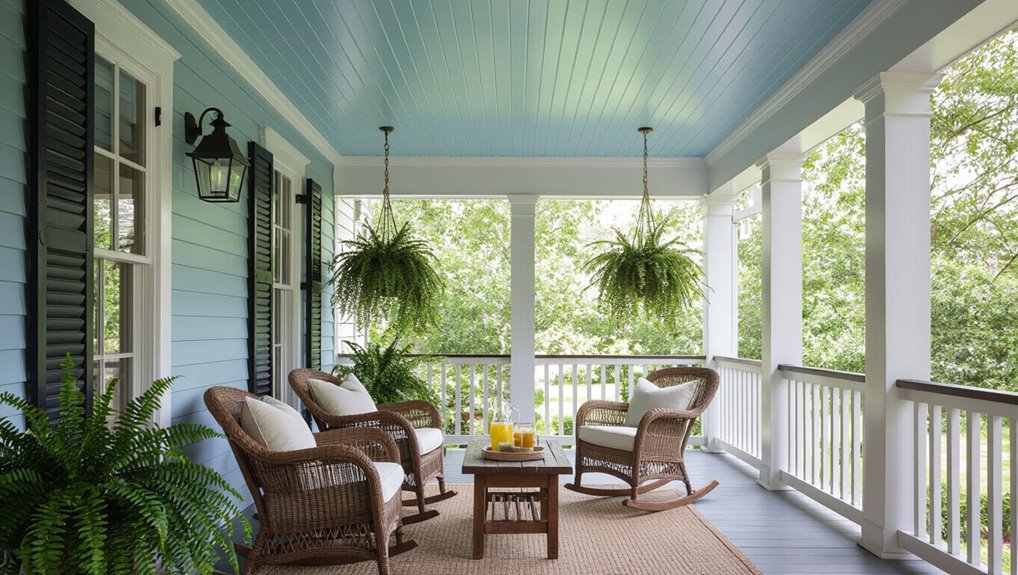
One reason people paint porch ceilings blue is that it blends folklore, function, and flair into a simple choice you can make for your home.
You’ll find porch aesthetics improved by a calming hue, practical benefits like insect deterrence in some traditions, and cultural symbolism that connects to protection and sky.
Choose blue to combine superstition, utility, and style confidently.
Why Are Porch Ceilings Often Painted Blue?
If you liked the mix of folklore, function, and flair mentioned above, you’ll see those themes play out in several clear reasons people paint porch ceilings blue.
You’ll notice porch aesthetics improve with a calming hue, insects deterred under pale shades, and color symbolism communicating tranquility or protection.
Homeowners choose blue for mood, tradition, and practical benefits that blend beauty with purpose.
What “Haint Blue” Actually Means
Haint blue is a specific shade of pale, slightly greenish-blue traditionally used on Southern porch ceilings, and it carries both a practical purpose and a cultural story.
You’ll learn that haint blue symbolism blends folk belief—warding off restless spirits—with practical uses like insect deterrence and mimicking sky.
Its cultural significance ties community identity, ancestry, and regional aesthetics into a simple painted gesture.
What Readers Are Looking For
You’re probably wondering why people care about blue porch ceilings and whether it’s folklore, style, or both.
You want clear answers to common questions like what shade to choose, how to paint, and whether it actually keeps bugs away.
Below, we’ll focus on the practical info and honest explanations readers most often look for.
Why People Care
Because a blue porch ceiling can change how a space feels, readers want to know whether the color will actually brighten, cool, or protect their porch—and how much effort and cost are involved.
You’re curious about cultural significance and aesthetic appeal, plus practical effects on mood, insect deterrence, maintenance, paint types, and budget.
You want clear, actionable guidance before deciding.
Common Reader Questions
What do readers actually want to know about blue porch ceilings? You’re seeking quick answers: origins, cultural meanings, and whether blue deters insects.
You want practical tips on paint choice, maintenance, and how color affects porch aesthetics. Reader curiosity also covers regional traditions and modern trends.
Keep explanations concise, actionable, and tied to real examples you can use on your own porch.
What They Want
Curious about blue porch ceilings? You want clear answers about porch aesthetics, color significance, regional influences, cultural heritage, and design trends. You’re looking for history, practical tips, and inspiration to apply locally.
| Question | Why it matters | Quick tip |
|---|---|---|
| Origin | Cultural heritage | Research region |
| Meaning | Color significance | Test samples |
| Style | Design trends | Match trim |
| Locale | Regional influences | Ask neighbors |
| Care | Porch aesthetics | Use durable paint |
Where the Haint Blue Tradition Began in the American South
You’ll trace the haint blue tradition back to the Gullah Geechee communities along the Sea Islands, where West African beliefs mixed with everyday life.
You’ll see how Southern folklore—stories about spirits, protection, and color symbolism—shaped the practice as it spread inland.
You’ll explore how those cultural threads turned a paint choice into a regional ritual.
Gullah Geechee Origins
Although the exact origins blend West African belief and Caribbean practice, the Haint Blue tradition took clear shape among the Gullah Geechee people along the Sea Islands and Lowcountry coasts, where enslaved Africans preserved spiritual and practical customs.
You’ll see Gullah history and Geechee traditions reflected in color symbolism, spiritual significance, cultural preservation, community storytelling, ancestral connections, and folklore origins.
- Coastal homes echo ancestral protection
- Paint as living memory and identity
- Rituals passed through oral storytelling
Southern Folklore Roots
Building on the Gullah Geechee threads of ancestral protection and oral ritual, the Haint Blue practice took on wider Southern folklore meanings as it spread across porches and eaves from the Sea Islands into coastal Georgia, South Carolina, and beyond.
You’ll see Gullah traditions reflected in spiritual symbolism, cultural preservation, southern aesthetics, ancestral connections, community practices, blue variations, regional beliefs, historical significance, and folklore stories.
West African Spiritual Roots Behind Haint Blue
When enslaved West Africans were brought to the American South, they carried beliefs and practices that blended with local customs to create what we now call haint blue.
You can still trace its roots to protective rituals and spirit-warding colors used in West African cultures.
You’ll see spiritual symbolism and enduring cultural heritage in these hues.
- Blue mimics water spirits
- Paint wards haints
- Color links to ancestry
How Gullah and Geechee Cultures Preserved the Practice
You’ll see how Gullah and Geechee communities kept haint blue alive by blending its spiritual meaning with everyday life.
They passed the color down as both protection against spirits and a practical insect deterrent, teaching each generation through homes, stories, and shared routines.
Notice how that steady transmission turned a West African tradition into a living, local practice.
Cultural Spiritual Significance
Although its roots reach back to West African cosmologies, the blue porch ceiling became a living practice among Gullah and Geechee communities by blending spiritual intent with everyday life.
You see cultural preservation and spiritual connections in how families paint, bless, and pass the custom on.
- You honor ancestors through color.
- You mark sacred household boundaries.
- You teach younger generations the meaning.
Practical Insect Deterrent
If you’ve ever spent time on a Lowcountry porch, you’ll notice the soft blue overhead isn’t just pretty—it’s practical: Gullah and Geechee folks long ago found that blue-green hues seem to confuse or repel biting insects, and they kept painting porches that color for both comfort and habit.
You’ll learn how insect behavior and simple color contrast helped preserve this smart, low‑cost deterrent.
Transmission Through Generations
When elders mixed the blue-green paint and tucked stories about porch care into everyday chores, they passed along more than a color—you inherited a practice tied to identity, environment, and community memory.
You learn the cultural significance through hands-on lessons and generational stories that teach respect for place and function.
- Oral instruction from elders
- Shared work on porches
- Ceremonial timing and meaning
The Role of Enslaved Peoples in Spreading the Tradition
Because enslaved men and women adapted their own beliefs and skills within constrained circumstances, they became key carriers of the blue porch-ceiling tradition across the American South and the Caribbean. You can see enslaved traditions, cultural transmission, spiritual practices, heritage preservation, color symbolism, community rituals, folklore influences, and ancestral connections shaping choices and teaching neighbors, ensuring this enduring vernacular art survived.
| Region | Practice | Meaning |
|---|---|---|
| South | Painted ceilings | Protection |
| Caribbean | Blue hues | Spirits |
| Plantations | Communal rites | Memory |
| Homes | Craft skills | Continuity |
European Influences on Porch Color Choices
Although often adapted to local materials and meanings, European color traditions left a clear imprint on porch palettes across the Atlantic world.
You’ll spot how European color and cultural symbolism guided aesthetic choices, architectural trends, and regional influences, revealing historical significance in porch hues.
- Coastal cottages echo maritime blues.
- Manor houses show restrained palettes.
- Folk porches blend imported and local tones.
Early Paint Tech Behind Blue Ceilings
If you look closely at historic blue porch ceilings, you’ll find their color owes as much to early paint chemistry and trade as to aesthetic preference.
You’ll notice early pigment formulations used indigo, smalt, and imported blues that were affordable and durable.
You trace historical color trends through trade routes, availability, and evolving recipes, which shaped widespread porch‑ceiling blue choices across regions.
How Limewash and Milk Paint Created Sky‑Blue Tones
You’ll see how traditional limewash techniques built translucent, breathable layers that softened the blue and let the wood grain show through.
You’ll also learn how milk paint’s mineral pigments and curd-based binder produced matte, durable sky‑blue tones that age gracefully.
Together, these methods explain why historic porches achieved that authentic, airy blue you still find charming today.
Traditional Limewash Techniques
When painters mixed limewash and milk paint on porches centuries ago, they were chasing a pale, breathable blue that felt both protective and airy.
You learn limewash application and historical techniques that favored multiple thin coats, natural pigments, and rough brushes to yield soft, weathered hues.
The method stayed simple and reparable, keeping porches cool and mildew-resistant.
- Layered thin coats
- Natural pigments
- Breathable finish
Properties Of Milk Paint
Because milk paint binds with limewash to deepen and stabilize pale blues, you’ll find porch ceilings that feel both luminous and durable. You’ll notice milk paint benefits like breathability and patina, and simple milk paint application enhances longevity. This combo yields soft sky tones that age gracefully.
| Feature | Effect |
|---|---|
| Breathability | Prevents peeling |
| Patina | Softens color |
| Ease | Simple application |
| Durability | Lasting finish |
| Tone | Sky-blue nuance |
Do Blue Ceilings Actually Deter Insects?
Curious whether a blue porch ceiling really keeps insects away? You’ll notice insect behavior can change with perceived shelter cues, and the color impact is subtle rather than magical.
You shouldn’t expect guarantees, but blue may reduce landing by mimicking sky tones.
- It may signal open sky, deterring rests
- It can alter perceived safety
- Effects vary by species and context
Scientific Tests on Insect Behavior and Blue Surfaces
Although you won’t find a single definitive study, controlled experiments and field trials have tested how insects respond to blue-painted surfaces by comparing landing rates, flight paths, and attraction to alternative colors under varying light and habitat conditions.
You’ll see mixed results: some species show reduced insect attraction to blue surfaces, others prefer blue wavelengths, and outcomes depend on species, ambient light, and nearby cues.
Color Psychology: Why Blue Feels Like Open Sky
When you look up at a blue porch ceiling, your brain reads it as open sky and relaxes—our visual system associates short-wavelength light with distance, air, and calm, so blue cues create a sense of spaciousness and tranquility.
- You notice color symbolism shaping mood.
- You feel the emotional impact of sky association.
- You sense cultural significance reinforcing comfort.
The Idea of Painted Ceilings as “Open Space” for Spirits
If you’ve ever sat under a painted porch ceiling and felt the place breathe a little easier, that response taps into a long-held folk idea: by painting ceilings sky-blue or soft tones, people signal an open path for spirits and protect the household from restless presences.
You’ll see spiritual beliefs and cultural practices merge, using visual aesthetics to honor ancestral connections while calming communal senses.
Folklore: Warding Off Ghosts Versus Welcoming Ancestors
You might see blue porch ceilings as a way to keep mischievous spirits away or as a sign that you’re honoring ancestral presence.
Different regions give the color distinct meanings, so what it signals to your neighbors can vary widely.
Consider how those cultural symbols shape whether blue feels protective or welcoming where you live.
Keep Spirits Away
Although the same pale blue can signal protection in one region and hospitality in another, most porch-ceiling lore boils down to intent: some people paint it to repel mischievous spirits by mimicking sky and water, while others see the hue as a welcome mat for ancestors returning to visit.
You use color symbolism and spiritual beliefs to deter ghosts.
- Visual barrier
- Calm deterrent
- Cultural cue
Honor Ancestral Presence
When you paint a porch ceiling blue to honor ancestors, you’re signaling more than superstition: you’re creating a gentle, living backdrop that invites remembered loved ones and marks the threshold between everyday life and ancestral presence.
You acknowledge ancestral connections, practicing cultural reverence through a quiet, visible act. That blue both comforts family memory and frames your home as a place where lineage is respectfully welcomed.
Cultural Symbolism Across Regions
Moving from honoring ancestors to broader meanings, blue porch ceilings carry different stories around the world—some communities paint them to keep restless spirits away, while others do it to welcome ancestral presence.
You’ll notice cultural variations and clear regional significance in stories, practices, and materials used.
- Southern U.S.: protective charm, folk belief
- Caribbean: ancestral welcome, ritual use
- Europe: decorative, symbolic continuity
Regional Variations: Southern Haint Blue vs. New England Blue
If you’ve noticed porch ceilings painted blue in different parts of the U.S., you’ll see two distinct traditions: the Southern “haint blue,” steeped in folklore and often leaning toward greenish-teal hues, and the New England blue, which tends toward crisp, sky or robin’s-egg shades rooted more in colonial aesthetics than superstition.
You’ll explore Haint Blue Origins, Regional Influences, Cultural Interpretations, and Architectural Styles.
Typical Shades Called Haint Blue and How They Differ
Having compared Southern haint blue and New England blue, you’ll notice that “haint blue” actually covers a range of specific shades rather than one fixed color.
You can use shades comparison and historical influences to pick tones that suit your porch, from pale sky to greenish-blue to deep robin’s egg.
- Pale sky blue
- Greenish-blue (teal hints)
- Deep robin’s egg
How Climate Influenced Porch Ceiling Color Choices
Because porch ceilings sit between sky and shelter, climate has shaped which blues people pick for them: in humid Southern summers, homeowners favored pale, cooling haint blues that reflect heat and keep insects away, while in foggy New England, deeper, grayer blues resisted mold and blended with coastal grays.
You’ll notice climate adaptation informs palette choices, and color symbolism ties mood and function together.
Architectural Styles That Commonly Use Blue Ceilings
Climate and function shape the blues you see on porches, and architectural style often determines how those hues get used.
You’ll notice blue ceilings reflect regional architectural influences and broader cultural aesthetics, guiding mood and detail choices.
Common styles include:
- Craftsman and bungalow: simple, nature-inspired blue accents.
- Colonial Revival: restrained, historical blue tones.
- Southern vernacular: bright, cooling blues.
Porch Ceiling Blue in Folk and Victorian Cottages
When you look at folk cottages, especially in Gullah Geechee communities, you’ll see blue porches tied to cultural protection and spiritual traditions.
In Victorian homes, the color was also linked to a hygienic belief that blue felt clean and calming.
Some people still cite the insect-deterrent theory—that the blue mimics sky and fools bugs—so you can weigh cultural meaning against practical ideas.
Gullah Geechee Tradition
Though rooted in West African and Caribbean beliefs, the Gullah Geechee porch ceiling blue has become a distinctive feature of Lowcountry folk and Victorian cottages.
You’ll notice it both for its soft, sky-like hue and for the cultural meanings it carries.
You’ll see Gullah heritage expressed through Geechee customs, Spiritual significance, Cultural symbols, Ancestral connections, Folklore traditions, Community practices, and Oral histories.
- Protective symbolism tied to ancestral connections
- Color as Cultural symbols in Community practices
- Oral histories preserving Folklore traditions and Geechee customs
Victorian Hygienic Belief
If you peek into Victorian and folk cottages, you’ll often find porch ceilings painted a pale blue because people once believed it kept insects and miasmas away and signaled a cleaner, healthier home.
You encounter Victorian cleanliness ideals reflected in color choice; this hue became part of Cultural practices conveying hygiene, calm, and moral order.
You recognize how domestic aesthetics expressed public health concerns.
Insect Deterrent Theory
Building on Victorian ideas about cleanliness and health, people also believed porch ceilings painted a pale blue kept insects at bay.
You’ll see this tied to observed insect behavior and perceived color influence on pests. You’ll likely try it yourself, expecting fewer bugs.
- Easier spotting of insects against blue
- Belief that sky-like color deters nesting
- Folk remedies reinforcing practice
Modern Interpretations in Craftsman and Farmhouse Styles
When you blend traditional Craftsman and farmhouse details with contemporary sensibilities, blue porch ceilings become a crisp, intentional design choice rather than a quaint relic.
You’ll use blue to highlight Craftsman details like exposed rafters and woodwork, or to soften Farmhouse charm with shiplap and muted palettes.
It frames porches, unifies materials, and feels both nostalgic and refreshed.
Best Paint Types for Blue Porch Ceilings
Now that you’ve seen how blue ceilings can refresh Craftsman and farmhouse porches, you’ll want the paint that performs as well as the look.
Choose durable, low-VOC formulas that resist mildew and hold color. Consider eco-friendly options and test color combinations in daylight.
Pick finishes suited to exposure and maintenance.
- Satin for subtle sheen
- Matte for traditional look
- Semi-gloss for easy cleaning
Exterior Latex vs. Oil‑Based Paint for Porch Ceilings
Although both exterior latex and oil‑based paints can give your porch ceiling a beautiful blue, they behave differently in real-world conditions, so pick the one that fits your priorities.
You’ll find latex easier to clean up, more breathable, and resistant to cracking, improving exterior durability.
Oil-based paints offer tougher surface wear and superior paint longevity but require solvent cleanup and longer cure times.
Best Sheen and Finish for Durability and Appearance
When choosing a blue for your porch ceiling, pick a low‑ to medium‑sheen latex—like satin or soft gloss—for an even look that still hides brush marks.
For durability, look for formulations labeled “exterior” with mildew resistance and a hard‑wear finish to handle humidity and cleaning.
If you expect heavy exposure, consider a high‑quality acrylic latex with a tougher finish rather than flat paint.
Paint Sheen Recommendations
Because porch ceilings face moisture, insects, and touch, choosing the right sheen matters: you’ll balance paint durability with aesthetic sheen selection to resist wear and hide blemishes.
Pick a finish based on exposure and cleaning needs.
- Satin for easy cleaning and moderate durability
- Eggshell for subtle sheen, fair durability
- Semi-gloss for high-traffic areas and maximum durability
Durable Finish Options
You’ve already weighed sheen choices for cleaning and wear; now focus on which specific finishes will give your porch ceiling the best long-term protection and appearance.
Choose durable materials like exterior acrylic latex or oil-modified enamel for superior weather resistance.
Consider semi-gloss for wipeability or satin for subtle sheen.
Prioritize aesthetic longevity and follow simple maintenance tips: clean annually, touch up chips, and reseal exposed wood.
How to Prepare an Old Porch Ceiling for Repainting
Start by clearing the area and evaluating the ceiling’s condition so you know exactly what repairs and prep work are needed before painting.
Begin by clearing the room and assessing the ceiling to determine necessary repairs and prep before painting.
You’ll focus on prepping surfaces, choosing tools, safety precautions and paint selection while noting ceiling textures, color trends and vintage finishes.
Consider weather considerations, maintenance tips and contractor advice.
- Remove dust and cobwebs
- Mask nearby trim
- Inspect for rot or mold
Repairing Wood, Scraping, and Priming Tips
Before you paint, check for soft spots and split boards and make basic wood repairs with epoxy or new trim so the ceiling’s structure is sound.
Then scrape away loose paint and sanding dust until you have a smooth, clean surface.
Finally, apply a quality primer that’s compatible with both the wood and your topcoat to lock in adhesion and prevent stains.
Wood Repair Basics
Wood repair is straightforward if you know what to look for: probe suspect areas for soft spots, peel away loose paint and rot, and decide whether to patch, replace, or consolidate the timber.
Use damage assessment to guide material selection, apply repair techniques that prioritize wood safety, and follow maintenance tips for rot prevention, weatherproofing methods, wood staining, finishing options, and restoration advice.
- Inspect fasteners
- Choose compatible fillers
- Prioritize sealing
Scrape And Prime
Tackle scraping and priming systematically: remove loose paint and any remaining rot until you hit sound wood, then sand feathered edges smooth so primer can bond evenly.
You’ll clean dust, fill small gouges with epoxy or wood filler, sand again, and wipe clean.
Proper ceiling preparation guarantees primer seals tannins and creates a uniform base for paint application, reducing peeling and improving adhesion.
Recommended Tools and Safety When Painting Overhead
Painting a porch ceiling overhead demands the right gear and strict attention to safety, so gather a sturdy ladder or scaffolding, drop cloths, extension poles, a roller with a 9–12″ nap, angled brushes for corners, and eye and respiratory protection.
Painting a porch ceiling requires sturdy ladders or scaffolding, extension poles, a 9–12″ nap roller, angled brushes, and eye and respiratory protection.
You’ll focus on brush selection and safety gear, secure footing, and lighting before you start.
- Check ladder stability
- Wear respirator and goggles
- Use extension pole
Painting a Porch Ceiling: Step‑By‑Step
Start by clearing the area, securing your ladder, and setting up drop cloths so you can work safely and without interruptions.
Inspect porch ceiling materials, repair cracks, and sand glossy surfaces.
Prime stained or raw wood, then paint in thin, even coats with a roller and angled brush for edges.
Follow current color trends but pick a durable exterior paint and allow proper drying between coats.
How Much Paint You’ll Need and How to Estimate Coverage
Before you buy paint, measure the porch ceiling’s length and width to calculate its square footage so you know how much coverage you’ll actually need.
Use coverage estimates from labels, factor in paint types and application techniques, and include cost analysis for budgeting.
Consider:
- Surface porosity and primer needs
- Coat count and waste allowance
- Tool choices affecting coverage and time
Color Matching: Finding Authentic Haint Blue Tones
Now that you’ve figured out how much paint you need, it’s time to match the right shade—haint blue comes in many subtle variations, and picking an authentic tone will affect how your porch reads in sunlight and shadow. You’ll compare samples in natural light, test color combinations, and note tone variations against trim and sky to guarantee the right mood.
| Sample | Light | Notes |
|---|---|---|
| Pale | AM/PM | Cool |
| Teal | Shade | Warm |
| Sky | Noon | Neutral |
| Slate | Overcast | Muted |
DIY Alternatives: Stain, Limewash, and Milk Paint Mixes
You can get a Haint Blue look without traditional latex paint by using stains, limewash, or milk paint—each gives a different depth and texture that changes how your porch ceiling reads.
- Use stain alternatives for subtle translucence and visible grain.
- Try limewash benefits for breathable, soft matte tones.
- Mix milk paint and pigments, practicing color mixing to match historic Haint Blue.
Maintenance: Cleaning and Repainting Schedules
Maintenance matters—keep your Haint Blue porch ceiling looking fresh by scheduling regular cleanings and prompt touch-ups.
Maintenance matters—schedule regular cleanings and quick touch-ups to keep your Haint Blue porch ceiling looking fresh.
You should dust and wash annually, inspect for peeling or mildew, and follow maintenance tips like gentle soap, soft brush, and rinsing.
Note repainting frequency depends on exposure: typically every 5–7 years for porches, sooner if wear appears.
Record dates and photos to track condition.
How to Combine a Blue Ceiling With Exterior Color Palettes
Think about how your blue ceiling can tie into trim and siding by echoing undertones or choosing a crisp contrast.
You can make an entry pop by matching or complementing the blue with your door and shutters.
Also consider how roof tones and stonework interact so the whole exterior reads as a cohesive palette.
Coordinating Trim And Siding
When a porch ceiling is painted blue, the trim and siding should both support and balance that cool overhead accent; choosing complementary hues and contrast levels will make the ceiling feel intentional rather than isolated.
You’ll aim for color combinations that create design harmony while defining edges and planes.
- Use crisp white trim for clean contrast
- Try muted gray siding to calm intensity
- Pick warm taupe for subtle balance
Accent Door And Shutters
If you want your blue porch ceiling to feel purposeful, tie it into the entry with an accent door and shutters that echo or complement that hue; a door in a deeper navy or a shutter pair picked from the ceiling’s undertone will create a deliberate, cohesive look.
Choose accent colors that balance warmth or coolness, and pick shutter styles—louvered, board-and-batten, or raised-panel—to match your home’s character.
Harmonizing Roof And Stone
Although a blue porch ceiling is a small detail, it can anchor the whole exterior when you deliberately coordinate roof and stone choices; pick tones that either echo the ceiling’s coolness or provide a warm counterpoint to keep the composition balanced.
You’ll use porch aesthetics and color symbolism to guide choices.
- Cool slate roof with gray stone
- Warm terracotta tiles with beige limestone
- Charcoal roof, pale blue trim
Trim, Siding, and Roof Colors That Complement Haint Blue
Because haint blue has both calming and protective associations, you’ll want trim, siding, and roof choices that highlight its coolness without washing it out.
You’ll pick trim colors and siding styles that respect blue variations, choose roof shades for color harmony, and add accent features to create architectural contrasts.
Consider porch designs, design elements, and color psychology to balance mood and curb appeal.
Using Haint Blue on Urban Balconies and Small Porches
Balconies and small porches make perfect places to use haint blue, since the hue visually expands tight outdoor spaces and brings a calm, airy feel right off your living room.
Haint blue brightens balconies and small porches, visually expanding tight outdoor spaces with a calm, airy feel.
You can adapt it to modern urban aesthetics and varied balcony designs to soften concrete and add subtle charm.
- Paint ceilings to reflect light
- Pair with potted greenery
- Use durable, weatherproof finishes
How to Honor Haint Blue’s Origins Respectfully
When you choose haint blue, acknowledge its Gullah-Geechee and Southern roots and the stories behind the color.
Support local traditions by buying from regional artisans or contributing to community preservation efforts.
Whenever possible, use authentic pigments and traditional paint techniques to honor the craft.
Acknowledge Cultural Origins
If you’re going to paint your porch ceiling haint blue, recognize it’s more than a color trend — it’s rooted in Gullah and other African American coastal traditions meant to ward off spirits and insects.
You should acknowledge cultural significance and regional differences, learn the history, and credit sources.
- Learn context
- Cite origins
- Respect meaning
Support Local Traditions
Acknowledging haint blue’s roots is only the start; you can actively support local traditions by engaging with the communities that keep them alive.
Visit cultural events, ask elders about local customs, and offer time or resources for preservation projects.
Share stories with respect, credit origins, and participate in community bonding activities so the tradition endures on its own terms without commercialization or appropriation.
Use Authentic Materials
1 simple way to honor haint blue’s origins is to choose authentic materials and methods that reflect how the tradition developed — like milk paint, lime wash, or oil-based porch paints used historically — and avoid cheap, modern substitutes that erase the craft.
You’ll preserve historical significance and material authenticity while supporting skilled artisans.
- Use milk paint
- Choose lime wash
- Seek oil-based formulas
Avoiding Appropriation: Respectful Design Choices
When you choose a porch ceiling color that references another culture, do it with intent: research the symbolism, learn from sources within that community, and avoid reducing meaningful motifs to mere decoration. You’ll apply cultural sensitivity and design ethics, credit influences, and favor collaboration over imitation.
| Step | Action | Outcome |
|---|---|---|
| 1 | Research | Informed choices |
| 2 | Consult | Community input |
| 3 | Credit | Respectful design |
Case Studies: Historic Homes That Kept Haint Blue
If you’re touring Southern towns or researching preservation projects, you’ll notice that several historic homes have deliberately kept their porch ceilings painted haint blue—both to honor local tradition and to maintain historical authenticity.
You can study preserved examples to learn about historic significance and how different architectural styles integrated the color.
- A Creole cottage in Louisiana
- A Greek Revival in Georgia
- A Victorian cottage in South Carolina
Contemporary Homes Using Haint Blue Intentionally
You’ll notice modern porches using haint blue to create a light, airy aesthetic that makes small spaces feel larger.
Some homeowners keep the color partly because of the old belief that it deters insects, while others choose it as a nod to cultural preservation.
Let’s look at how designers balance tradition and contemporary taste.
Light, Airy Aesthetic
Although rooted in Southern tradition, contemporary designers are adopting haint blue on porch ceilings to create a light, airy feel that visually lifts the space and reflects natural light.
You’ll notice improved light diffusion and an overall airy ambiance that makes porches feel larger and calmer.
- Enhances perceived ceiling height
- Softens harsh shadows
- Unifies indoor-outdoor connection
Insect-Deterrent Belief
Beyond improving light and height, haint blue has another appealing reputation: many homeowners believe it keeps insects away.
You’ll hear that certain shades mimic sky or water, confusing insect preferences and reducing landings.
Whether it truly deters bugs or simply changes your perception, the psychological impact matters: if you feel fewer pests, you use your porch more, creating a real practical benefit.
Cultural Preservation Trend
When homeowners want to honor regional roots, they’re intentionally painting porch ceilings haint blue to preserve a living piece of local history.
You’ll see this trend as a deliberate act of cultural significance tied to community practices, blending aesthetics with memory. It signals respect for ancestors and shared identity, making modern homes feel rooted.
- Heritage continuity
- Visual cohesion
- Shared rituals
Interior Uses Inspired by Porch Haint Blue
If you love the soothing, sky-like feel of haint blue on a porch, bring that same calm into your home by painting a ceiling, accent wall, or even kitchen cabinets in a similar soft blue-green.
You can use interior accents like trim, textiles, and lamps, and experiment with color pairings—soft grays, warm woods, or muted coral—to create cohesion and restful, Southern-inspired rooms.
Alternatives to Blue That Achieve Similar Effects
If you like the calming, sky-like feel of a blue porch ceiling but want options, consider pale sky shades that mimic open air, soft green tones that read as fresh and airy, or subtle grays that give the same soothing backdrop.
You can use sky-like paints to visually lift the porch, pale greens to evoke nature, or warm-grays to keep things neutral without losing depth.
Pick the one that matches your home’s palette and the mood you want to create.
Sky-Like Paint Shades
Although blue is the classic choice for a sky-like porch ceiling, you can achieve the same airy, expansive feel with several alternative hues—soft grays with cool undertones, pale lavenders, and muted aqua-greens all read as open and uplifting while offering subtle warmth or sophistication.
You’ll use sky symbolism and color associations to guide choices:
- Cool dove gray for calm
- Lavender for soft elegance
- Aqua-tinged white for brightness
Pale Green Alternatives
When you want the fresh, airy feel of a blue porch ceiling without using blue, pale greens make an excellent alternative—minty, sage, or seafoam tones keep the space light, open, and slightly earthy.
You’ll find pale green shades deliver similar sky-like openness while adding subtle warmth. They support calming aesthetics, complement natural wood and plantings, and resist showing dust or minor imperfections.
Subtle Gray Tones
Pale green shifts nicely into subtle gray tones when you want the same airy, expansive feel with a more neutral, sophisticated edge.
You’ll get a calming effect without overt color, and it pairs with many trim choices.
- Choose warm gray for cozy porches
- Pick cool gray to mimic sky openness
- Use satin finish to reflect light subtly
Cost Considerations: Budget Paint vs. Premium Pigments
If you’re weighing cost against appearance, remember that cheaper ceiling paints can save money upfront but often need more coats and touch-ups.
On the other hand, premium pigments give richer color, better coverage, and longer-lasting results so you’ll repaint less frequently.
Do a cost effectiveness analysis comparing coverage, durability, and labor.
Choose budget friendly options only if short-term savings outweigh faster maintenance needs.
How Haint Blue Appears in Photography and Home Staging
Because haint blue reads cooler on camera than it does to the eye, you’ll often see porches photographed with a slightly greener or grayer cast that softens shadows and brightens skin tones in staged shots.
Haint blue often photographs cooler—leaning green or gray—to soften shadows and flatter skin tones in staged porch shots
You’ll use photography techniques and home staging choices to emphasize calmness, balance exposure, and suggest depth.
- Calibrate white balance
- Use soft fill light
- Stage complementary textiles
Common Myths About Blue Porch Ceilings Debunked
Now that you know how haint blue reads in photos and staging, let’s clear up some persistent myths about blue porch ceilings.
You’ll learn myth busting traditions aren’t superstitions but cultural practices; blue doesn’t always repel insects or spirits.
Focus on color symbolism: it soothes and reflects sky light.
Use history and local context to decide, not folklore.
When to Skip Blue: Situations Where It’s Not Practical
Although blue ceilings can charm many porches, there are clear situations where you should skip them: you’ll want alternatives when color symbolism clashes with cultural significance or regional preferences, when design trends demand neutral palettes, or when maintenance tips warn against peeling in harsh climates.
Consider modern alternatives that suit practical applications and aesthetic choices.
- Severe climate damage risk
- Conflicting cultural cues
- Contemporary design constraints
Final Checklist for Choosing and Applying a Blue Porch Ceiling
If you’ve ruled out blue in the situations above or decided it’s a fit, use this checklist to make sure your porch ceiling looks great and holds up over time. Confirm final color choices, test samples, choose weatherproof paint, and review application techniques.
| Step | Item | Action |
|---|---|---|
| 1 | Choose hue | Sample paint |
| 2 | Prep | Clean & prime |
| 3 | Apply | Technique & tools |
| 4 | Protect | Seal & maintain |
Frequently Asked Questions
Can Painted Blue Porch Ceilings Increase My Home’s Resale Value?
Yes — a painted blue porch ceiling can boost curb appeal and porch aesthetics, and if it matches resale trends in your area, it’ll help attract buyers. You’ll see better first impressions and potentially higher offers.
Are There Cultural Appropriation Risks When Selling Haint Blue Merchandise?
Yes — you can face cultural appropriation risks selling haint blue merchandise; you should respect cultural significance, avoid commodifying traditions, and adopt transparent marketing ethics so you’re honoring origins rather than exploiting them for profit.
Do Blue Ceilings Affect Local Wildlife Beyond Insects (Birds, Bats)?
Birds of a feather flock together: you won’t drastically alter wildlife behavior by painting porch ceilings blue, but color perception can slightly influence birds’ and bats’ activity patterns, so monitor local responses and adjust if needed.
Can Interior Rooms Mimic Porch Haint Blue for Spiritual Practices?
Yes—you can mimic haint blue indoors for spiritual symbolism and calm; designers blend it into interior design with ceilings, altars, or accent walls to honor tradition, invite protection, and create a serene, reflective atmosphere for practice.
Are There Fire-Safety or Building-Code Limits on Exterior Ceiling Paint?
Yes — you’ll need to follow standards: like a lighthouse guiding ships, fire safety and building codes dictate materials, finishes, and clearances for exterior ceilings, and you’ll have to use approved paints and installation methods.
Conclusion
You’ll choose that pale blue like a secret promise—a ceiling painted skyward to ward off blues and bugs, to mark hospitality and memory. Let it be your porch’s soft punctuation: a nod to history, a practical charm against wasps, and a quiet talisman against bad luck. When you paint, you’re not just adding color; you’re cupping a small piece of sky above your doorway, inviting light, calm, and stories to settle in.
