
Why Does Paint Bubble on Concrete and How to Stop It
You’re getting paint bubbles on concrete because moisture, salts, poor prep or incompatible products are breaking the paint’s bond and forcing blisters to form. Trapped water, outgassing from new concrete, efflorescence or high humidity will lift coatings, and painting over compromised layers just hides the problem. Stop it by testing and drying the slab, removing failed paint, treating salts, and using breathable primers and proper coatings applied in ideal conditions. Keep going to learn the right fixes and prevention steps.
Quick Answer Why Paint Bubbles on Concrete and How to Stop It
If paint’s bubbling on your concrete, it’s usually because moisture, heat, or poor surface prep is trapping air beneath the film; fix it by removing the bubbles, drying and cleaning the slab, and using the right primer and paint for concrete.
You should test for dampness, strip loose coating, etch or sand as needed, then apply a breathable masonry primer and durable concrete paint to prevent recurrence.
How Paint Bubbles Form on Concrete (Basic Understanding)
You’ll see paint bubbling as raised blisters, pinholes, or flaking where the coating has lost adhesion.
It happens when chemicals or physics force vapors and solvents out of the concrete or paint—outgassing, solvent entrapment, or trapped moisture—often worsened by high humidity, temperature swings, or efflorescence from the substrate.
Using the wrong primer, old or poorly mixed paint, or incompatible products during application can trigger or amplify the problem.
What is paint bubbling (definition and visible signs)
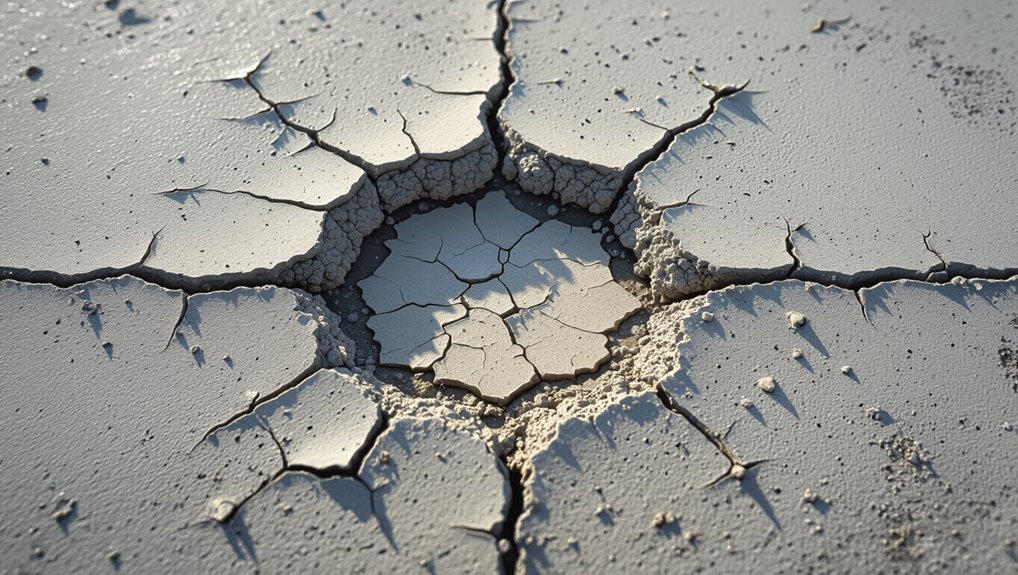
When paint bubbles on concrete, it forms raised blisters or pockets where the coating has separated from the surface, often looking like small domes, pinholes, or clusters of flaky scales.
You’ll notice loose, lifted edges, soft or hollow spots when pressed, and areas that flake or peel. Colors may appear uneven, and texture changes signal compromised adhesion.
Chemical and physical causes (outgassing, solvent entrapment, moisture)
Because concrete and paint interact chemically and physically, bubbles usually come from trapped gases or moisture trying to escape through the coating.
You’ll see outgassing when fresh concrete releases alkaline vapors or curing gases that lift paint.
Solvent entrapment occurs if paint dries too fast atop wet solvent, forming blisters.
Persistent moisture under the film also forces pockets that rupture the finish.
Environmental and substrate causes (humidity, temperature, efflorescence)
Outgassing and trapped solvents set the stage, but external conditions and the concrete itself often decide whether those pockets form or stay hidden.
You’ll see bubbles when high humidity or rapid temperature swings trap moisture under paint.
Efflorescence pushes salts and water to the surface, breaking adhesion.
Control drying conditions, reduce substrate moisture, and remove salt deposits to prevent bubbling.
Application and product causes (incompatible primers, old paint, improper mixing)
If you use the wrong primer, apply paint over old, failing coatings, or skip proper mixing, you’ll invite bubbling on concrete.
You should strip loose or chalky paint, choose a primer compatible with both concrete and your topcoat, and mix paint thoroughly to uniform consistency.
Also follow manufacturer pot life and recoat times—poor product choices or shortcuts create adhesion failures and trapped solvents that cause bubbles.
Diagnosing the Specific Cause on Your Concrete
Start by doing a visual inspection checklist to note bubble patterns, discoloration, efflorescence, and paint failures.
Then run moisture tests (plastic sheet, moisture meter, or calcium chloride), check porosity and salts, and do simple paint layer tests like adhesion, cross-hatch, or a scrape test.
Those steps will tell you whether moisture, salts, surface porosity, or coating adhesion is causing the bubbles.
Visual inspection checklist
A quick, methodical visual inspection will often tell you where paint bubbles on your concrete came from, so work from obvious to subtle signs: scan the surface for clustering, note whether bubbles sit over joints or repairs, check for efflorescence or white powder, and look for discoloration that suggests moisture or oil contamination.
- clustered blisters along a crack
- bubbles over a patched area
- powdery white deposits
- dark damp-looking stains
- oil sheen or greasy spots
Moisture testing methods (plastic sheet, moisture meter, calcium chloride)
When you suspect moisture is the culprit behind paint bubbles, run simple tests to confirm where and how much water’s moving through the slab.
Use quick, practical methods to pinpoint damp spots and measure vapor.
- Tape a plastic sheet for 24–72 hours to spot darkening
- Scan with a moisture meter for readings
- Place a calcium chloride kit to quantify vapor
- Compare indoors vs. outdoors
- Mark high-moisture zones
Porosity and salt/efflorescence testing
Because paint bubbles can come from salts or a porous surface that won’t hold coatings, you’ll want to test both porosity and efflorescence to diagnose the exact problem.
Check for powdery white deposits, salt stains, or flaky paint. Use simple tests to confirm.
- white powder on surface
- water beading vs soaking in
- salt crystallization after wetting
- dusty concrete when brushed
- uneven absorption patterns
Paint layer testing (adhesion, cross-hatch, scrape test)
Now that you’ve checked for salts and porosity, it’s time to test the paint layer itself to see how well it adheres.
Do a cross-hatch: cut a grid, apply tape, and pull to check adhesion.
Perform a scrape test with a putty knife to spot weak spots.
Record failing areas, remove loose paint, and prep properly before repainting to prevent future bubbling.
Step-by-Step Repair and Prevention
Now that you’ve diagnosed the cause, here’s a clear, step-by-step plan to fix and prevent paint bubbles on concrete.
Start by preparing and cleaning the surface, remove efflorescence, and guarantee the slab is thoroughly dry using mechanical drying, ventilation, or sealers as needed.
Then remove damaged paint, repair the substrate, apply a suitable concrete primer or bonding agent, and finish with the right paint and application technique for temperature, coats, and drying time.
Step 1 Prepare the surface: cleaning and efflorescence removal
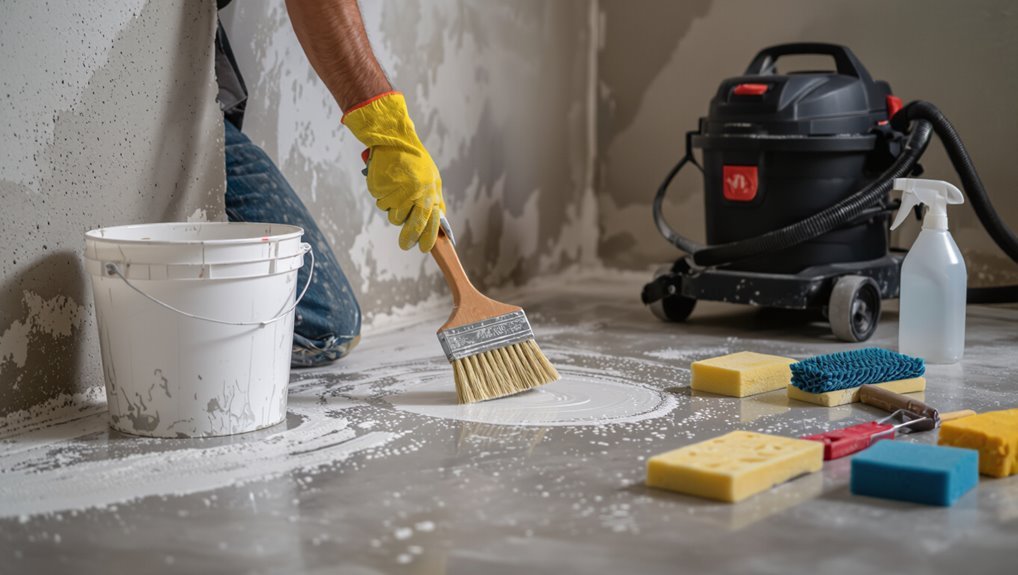
Start by giving the concrete a thorough cleaning so paint will adhere properly and any sources of bubbling are revealed.
Scrub loose dirt, rinse with a hose or pressure washer, remove salts with a stiff brush and diluted vinegar or efflorescence remover, and let the surface cool before repairs.
- Chalky white salt deposits
- Streaked, damp patches
- Crumbly surface dust
- Embedded oil stains
- Grooves and pits
Step 2 Drying and moisture control (mechanical drying, ventilation, sealers)
Because trapped moisture is the most common cause of paint bubbling, you’ll need to dry the slab thoroughly and control any ongoing vapor before you repaint.
Use dehumidifiers, fans, and heaters; test with a moisture meter; and apply compatible vapor barriers or breathable sealers to stop future migration.
- roaring dehumidifier in a garage
- oscillating fans pushing air
- infrared heater warming concrete
- moisture meter reading low
- clear silane sealer coating
Step 3 Remove damaged paint and repair substrate (scraping, grinding, patching)
With the slab dry and vapor controlled, tackle the bubbled and loose paint so new coatings can bond to sound concrete.
Scrape blisters, grind feathered edges, and remove all dust. Patch pits and cracks with compatible cementitious filler, then smooth and cure.
Inspect for delamination before recoating.
- wire brush scraping
- angle grinder dust plume
- trowel filling cracks
- feathered smooth edges
- dry, clean surface
Step 4 Primer selection and application (concrete primers, bonding agents)
Primer choice makes or breaks a lasting repair, so pick a product formulated for concrete and compatible with your topcoat.
You’ll apply a bonding primer to clean, dry concrete, sealing pores and promoting adhesion. Use thin, even coats, allow recommended cure time, and recoat only when tack-free.
- porous surface drinking primer
- brush into cracks
- roller for flats
- thin, even film
- wait full cure time
Step 5 Proper paint selection and application techniques (temperature, coats, drying time)
Although paint choice and application might seem simple, getting them right is essential to prevent bubbles and guarantee a durable finish on concrete.
You’ll pick breathable, masonry-grade paints, apply thin even coats, respect manufacturer temperature and humidity ranges, and allow full drying between coats to avoid trapped moisture.
- cool morning paint can
- thin nylon roller strokes
- crisp edge lines
- sunlight-warmed concrete
- bead-free wet film
Step 6 Post-application care and monitoring (maintenance tips)
Once the paint’s cured, you should inspect the surface regularly and tackle minor issues early to stop small blisters from turning into bigger problems.
Check quarterly for bubbles, cracks, or moisture stains. Clean gently, repair chips, and reseal joints as needed.
Address drainage or humidity sources promptly. Keep records of maintenance and recoat when adhesion weakens to prevent recurrence.
Product and Method Comparison
Now you’ll compare products and methods to stop bubbling at the source.
Pick the right primer for concrete and weigh paint options—latex, epoxy, or elastomeric—against performance and durability.
Then match moisture-mitigation strategies (vapor barrier, topical sealer, or substrate repair) to the underlying problem and budget.
Best primer types for concrete
Picking the right primer can make the difference between paint that holds and paint that bubbles on concrete, so you’ll want a product that matches the substrate and the job conditions. Use a concrete-specific alkali-blocking primer, a masonry bonding primer, or a penetrating silane/siloxane sealer for moisture control.
| Primer Type | Best Use | Key Benefit |
|---|---|---|
| Alkali-blocking | Fresh concrete | Prevents alkali burn |
| Bonding primer | Smooth surfaces | Improves adhesion |
| Silane/siloxane | Moisture-prone | Repels water |
Best paint types for concrete surfaces (latex vs epoxy vs elastomeric)
Although all three—latex, epoxy, and elastomeric—can coat concrete, they perform very differently depending on how you’ll use the surface and what problems you need to solve. You’ll pick latex for easy application and breathability, epoxy for durability on floors, and elastomeric for crack-bridging exterior protection.
| Type | Strength | Best use |
|---|---|---|
| Latex | Breathable | Interior walls |
| Epoxy | Very durable | Garage floors |
| Elastomeric | Flexible | Exterior walls |
Comparison of moisture mitigation methods (vapor barrier vs topical sealer vs substrate repair)
When you’re dealing with damp concrete, choose the moisture-mitigation approach that matches the source and severity of the problem: vapor barriers stop ground moisture before it reaches the slab, topical sealers repel surface water and salts, and substrate repair fixes structural issues like cracks and spalling that let moisture penetrate. Pick vapor barriers for new slabs, sealers for surface issues, and repairs for structural damage.
| Method | Best use | Longevity |
|---|---|---|
| Vapor barrier | New slab, high vapor | High |
| Topical sealer | Surface moisture, salts | Medium |
| Substrate repair | Cracks, spalling | High |
Common Mistakes That Cause or Recur Bubbling
You’ll often see bubbling when common mistakes stack up: painting over damp concrete, skipping primer or using the wrong one, or applying paint in poor weather.
Incompatible paint systems or re-coating too soon will also cause failures that come back.
Addressing these issues before you paint prevents most bubbling problems.
Painting over damp concrete
If you paint over damp concrete, trapped moisture will push the paint up as it tries to escape, causing bubbles and peeling soon after the job’s done.
You need to test for dampness, wait for full drying, and use dehumidifiers or heat to speed drying in cool, humid conditions.
Painting too soon guarantees failure; patience prevents costly rework.
Skipping primer or using wrong primer
Because concrete soaks up and releases moisture unevenly, skipping primer or choosing the wrong one lets paint fail to bond and encourages bubbling.
You need a masonry-specific, breathable primer that seals pores without trapping moisture. Apply primer to clean, dry concrete per manufacturer instructions.
Using a generic or oil-based primer can block vapor escape or prevent adhesion, so bubbles reappear or spread.
Applying paint in wrong weather conditions
When you paint concrete in high humidity, extreme heat, or freezing temperatures, the finish’s drying and adhesion get compromised and bubbles form or return.
You should monitor forecasts, paint within the manufacturer’s recommended temperature and humidity range, and avoid direct sun or wet surfaces.
Wait for several dry days, use fast-curing formulations if needed, and keep airflow steady to guarantee proper film formation and adhesion.
Using incompatible paint systems or re-coating too soon
Alongside weather and surface prep, the products you choose and how fast you recoat play a big role in whether bubbles appear or come back.
If you layer incompatible systems—oil over latex or vice versa—adhesion fails and trapped solvents form blisters.
Waiting too little time traps moisture and solvent vapors. Always match paint chemistry and follow manufacturer cure times to prevent recurring bubbling.
Prevention Checklist and Best Practices
Before you paint, run a quick inspection checklist to confirm surface readiness, check moisture levels, and note any drainage or grading issues.
Pick the right weather and timing—warm, dry days with low humidity—and plan long-term moisture control like proper grading, drainage, or a vapor barrier.
Finally, schedule routine maintenance to catch minor problems early and prevent bubbles from returning.
Pre-paint inspection checklist
Because bubbles usually start from surface problems you can’t see at a glance, a thorough pre-paint inspection is your best defense against paint failure; check for moisture, efflorescence, prior coatings, cracking, and loose or powdery concrete, and use simple tests (moisture meter, tape pull, and water droplet) to confirm conditions before you prime or paint.
- Damp patch under paint
- White powdery deposits
- Flaking old paint
- Hairline cracks along joints
- Chalky, dusty surface
Ideal environmental conditions and timing for painting
When conditions are right—low humidity, moderate temperature, and a dry concrete surface—you’ll give paint the best chance to adhere and cure without forming bubbles.
Paint in temperatures between 50–85°F (10–29°C), avoid direct sun and wind that speed drying, and wait at least 48–72 hours after rainfall.
Use weather forecasts; start when several dry days are predicted to guarantee proper cure.
Long-term moisture management strategies (grading, drainage, vapor barriers)
Good surface conditions are only part of the solution; long-term moisture control keeps concrete dry beneath the paint so bubbling doesn’t return.
You should slope soil away from foundations, install gutters and downspouts that discharge well, and add perimeter drains where water pools.
For slabs over soil, lay a proper vapor barrier under new concrete or retrofit interior vapor mitigation systems to block rising damp.
Routine maintenance to prevent recurrence
If you want paint bubbles to stay away for good, follow a compact routine of inspections and quick fixes:
- Walk perimeter monthly, scanning for cracks, blisters, or peeling paint.
- Check gutters and downspouts after storms; clear clogs.
- Test surface dampness before repainting.
- Reseal joints and control joints annually.
- Touch up chips and thin spots immediately to block moisture intrusion.
Cost, Timeframe, and When to Hire a Pro
You can often handle small paint bubbles yourself for a modest cost, but hiring a pro raises the price while cutting guesswork.
Expect each repair step—testing, prep, patching, and recoating—to take anywhere from a few hours to a couple of days depending on drying time.
Call a contractor if bubbles cover large areas, keep returning after fixes, or if moisture and structural issues are involved.
Typical DIY vs professional cost ranges
One quick way to decide whether to tackle paint bubbles on concrete yourself is to compare the cost and time involved with hiring a pro: You’ll often save on labor but pay for materials and rental tools; pros charge more but guarantee results. Consider scale, safety, and moisture issues before choosing.
| Option | Typical Cost | Notes |
|---|---|---|
| DIY small | $20–$150 | Patch, primer, paint |
| DIY large | $150–$500 | Rentals, sealers |
| Professional | $300–$1,200+ | Inspection, warranty |
Time required for each repair step
Having weighed cost differences and scope, let’s map out how long each repair step takes so you can plan workdays and know when calling a pro makes sense.
Prep and cleaning: 1–3 hours.
Drying: 24–48 hours.
Patch and cure: 2–8 hours plus overnight cure.
Sanding and priming: 2–4 hours.
Topcoat and recoat: 2–6 hours with 4–24 hour recoat windows.
Signs it’s time to call a contractor
When paint bubbles reappear across large areas, keep spreading, or follow deep cracks, it’s time to contemplate calling a contractor—especially if repairs would eat several afternoons, require specialty tools, or risk hidden moisture or structural problems that push costs and timelines beyond DIY scope.
You should hire a pro if quotes exceed your comfort, moisture testing or structural fixes are needed, or the timeline disrupts other projects.
Frequently Asked Questions (FAQ)
You probably have a few quick questions about bubbling paint on concrete, like whether you can paint over bubbles or how long concrete must stay dry before painting.
You’ll also want to know if sealing stops efflorescence and bubbling, whether indoor humidity can cause bubbles, and how to tell moisture-related bubbling from chemical incompatibility.
Below are clear answers to each of these common concerns.
Can I paint over bubbling paint without removing it?
Can you paint over bubbling paint without fixing it first? You shouldn’t.
Painting over bubbles traps moisture and adhesion problems, so new paint will peel quickly. Scrape loose areas, sand edges, and address underlying moisture or contamination before priming and repainting.
That guarantees a durable finish and prevents recurrence. Quick cover-ups only delay a proper repair and waste effort.
How long should concrete be dry before painting?
If you’ve just fixed bubbling paint, don’t rush to coat the surface—moisture trapped in concrete will wreck a new finish.
Wait until concrete reaches recommended dryness: typically 28 days for new pours, but check product guidelines and perform a moisture test (plastic sheet or moisture meter).
For cured slabs or previously sealed surfaces, allow at least 7–14 days of dry conditions before painting.
Will sealing concrete prevent efflorescence and bubbling?
Wondering whether sealing concrete stops efflorescence and paint bubbling? Sealing helps by blocking water and salts from migrating to the surface, reducing efflorescence and the pressure that lifts paint.
Use a breathable masonry sealer to let trapped moisture escape while preventing new moisture entry.
Prep properly—clean, dry, and repair cracks—so the sealer and paint adhere and perform effectively.
Can humidity cause bubbling indoors?
How much does indoor humidity make paint or wallpaper bubble?
High indoor humidity can trap moisture under coatings, softening adhesives and paint films so they lift or blister.
You’ll see bubbling in poorly ventilated bathrooms, basements, or after drying wet concrete without dehumidification.
Control humidity with ventilation, dehumidifiers, and prompt repairs to leaks to prevent recurring bubbles and adhesive failure.
How do I know if bubbling is from moisture or chemical incompatibility?
Curious whether those bubbles come from trapped moisture or a chemical mismatch? You can test: tape a 2-foot square plastic sheet to the concrete for 24–48 hours; fogging under the sheet means moisture.
For chemical incompatibility, check paint history and solvent types: bubbles that form immediately after repainting or after solvent exposure suggest incompatibility.
Also inspect for peeling, discoloration, or sticky residue.
