
Can Water Be Added to Latex Paint? Correct Mixing Guide
Yes — you can add small amounts of water to latex paint to improve flow and sprayability, but do it carefully: stir thoroughly, strain if needed, and add no more than about 5–10% by volume in small increments while testing on scrap. Use less for rollers and brushes (around 5%) and more only for compatible sprayers; watch drying, coverage, and VOCs. Keep good ventilation, avoid thinning specialty finishes, and keep testing — continue for tips on cleanup, storage, and safety.
Can You Add Water to Latex Paint? : Short Answer and Quick Rules
If you’re wondering whether you can add water to latex paint, the short answer is yes — but only sparingly and with care: you’ll adjust paint consistency slightly to improve flow for brushing or spraying.
Use measured mixing techniques—add small amounts, stir thoroughly, test on a scrap, and avoid over-thinning.
Keep records of ratios so coverage, adhesion, and finish stay predictable.
Why People Dilute Latex Paint: Common Reasons
Knowing how and when to thin latex paint helps explain why people do it in the first place. You dilute to adjust paint consistency for roller, brush, or sprayer and to improve flow for tricky surfaces. You might also thin to ease cleanup or stretch a can, but you’ll balance coverage and durability.
| Reason | Benefit |
|---|---|
| Flow | Better application techniques |
| Coverage | Cost-efficiency |
| Texture | Smoother finish |
| Cleanup | Easier tools maintenance |
When It’s Safe to Thin Latex Paint With Water
When you’re thinning latex paint with water, do it only for wall-and-ceiling jobs or for sprayers that specifically allow water-thinned latex.
Manufacturers design most interior and exterior latex formulas to be used as-is, but small, controlled additions of water (typically no more than 10% by volume) can improve roller and sprayer performance without hurting adhesion or durability.
You should follow safety precautions, test a small batch, and use proper mixing techniques to keep consistency uniform.
When You Should Never Add Water to Latex Paint
You can safely thin latex for specific jobs, but there are clear situations where adding water will hurt the paint’s performance. Don’t water down when the label forbids it, for high-moisture areas, or when using specialty finishes. Incorrect paint consistency ruins sheen and durability, and harms recommended application techniques.
| Situation | Risk | Action |
|---|---|---|
| Label forbids | Finish failure | Follow label |
| High moisture | Mold/delam | Use proper product |
| Specialty finish | Appearance loss | Use manufacturer thinner |
| Spray jobs | Clogging | Use correct reducer |
How Thinning Affects Coverage and Hiding
When you thin latex paint with water, you’re reducing the paint film thickness that ultimately covers the surface.
That dilution spreads the same amount of pigment over a larger area, so hiding power drops and colors can look washed out.
Expect less opacity on the first coat and plan for extra coats or stronger paint if you need full coverage.
Paint Film Thickness
You’ll notice thinner film build alters paint application and surface finish, changing drying characteristics and overall paint performance.
Adjust application techniques—fewer thin coats or slower passes—to regain hiding and durability without overthinning or compromising adhesion.
Pigment Dilution Effects
Because thinning dilutes the ratio of pigment to binder, you’ll see reduced hiding power and more transparency in each coat.
You’ll need more coats to achieve full coverage, and thinning can worsen pigment separation during application, causing streaks or uneven patches.
Stir frequently to restore color consistency, monitor viscosity, and avoid over-thinning so you don’t compromise durability or require excessive recoats.
Surface Opacity Loss
If you thin latex paint, you’ll notice a drop in surface opacity that lets underlying colors and textures show through more readily. You’ll face opacity challenges and must adapt application techniques: use extra coats, stronger pigments, or primer. Choose thicker consistency for high-hide areas and thin sparingly for glazing effects.
| Strategy | Effect |
|---|---|
| Extra coats | Restores hiding |
| Primer | Blocks bleed-through |
How Thinning Changes Viscosity and Flow
When you add water to latex paint, you lower its viscosity so it flows more easily across the surface.
That improved flow can help level brush and roller marks but also increases the risk of drips and sags on vertical surfaces.
You’ll need to balance thinning to get smooth coverage without making the paint so thin that it runs.
Effect On Paint Viscosity
Thinning latex paint with water lowers its viscosity, so the paint flows more easily and levels out brush or roller marks.
But too much thinning can make the film runny, reduce hide, and cause sagging. You’ll adjust paint consistency for specific application techniques, but add water sparingly.
Test small batches, stir thoroughly, and evaluate coverage; don’t over-thin or you’ll weaken durability.
Influence On Surface Flow
Lowering viscosity doesn’t just make paint easier to spread; it changes how the film behaves on the surface.
When you thin latex, you reduce surface tension and alter flow characteristics, so the paint levels differently and fills texture variances more readily.
You’ll notice smoother runs across flat areas, faster wet-edge blending, and altered drying behavior—so thin cautiously to keep control.
Drip And Sag Risks
Because adding water cuts a paint’s viscosity, you’ll increase the chance it runs or sags on vertical surfaces if you’re not careful.
You should thin minimally, test on scrap, and monitor flow to balance coverage with drip prevention and sag reduction.
- Thin in small increments
- Test vertical panels
- Use proper brush/roller
- Stop if runs appear
How Water Alters Drying Time
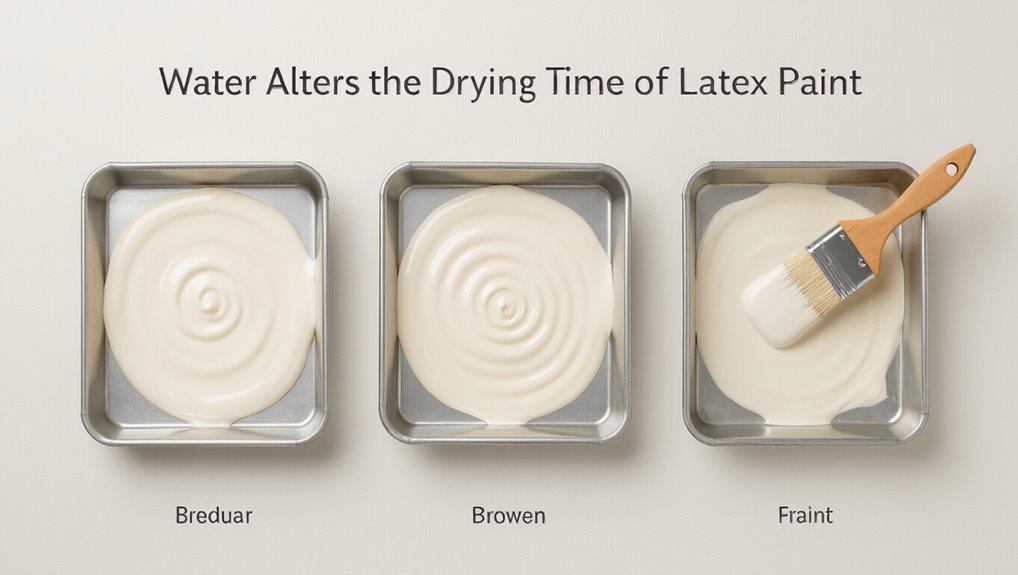
When you add water to latex paint, you change how quickly the water and resin phase separate and the film sets, so drying time usually increases. You’ll notice drying factors like thinner viscosity and humidity impact slow skin formation, extend tack time, and require longer recoat waits.
| Thin | Slow | Damp |
|---|---|---|
| Viscous | Extended | Wet |
| Fast | Normal | Dry |
Does Adding Water Weaken Paint Durability?
If you thin latex paint with too much water, you’ll reduce the binder concentration that holds pigment and resin together, and that directly lowers the cured film’s strength and adhesion.
You’ll notice reduced paint performance and altered durability factors, so you should avoid overthinning to maintain wear resistance and adhesion.
- Lower abrasion resistance
- Weaker adhesion
- Reduced hiding power
- Shorter lifespan
Standard Dilution Ratios for Latex Paint
While you can thin latex paint a little to improve flow or brushing, stick to the manufacturer’s recommended ratios—typically no more than 10% water by volume for interior/exterior latex and up to 20% only for certain primer or masonry formulations. Use proper dilution techniques and mixing methods to preserve coverage and finish.
| Ratio | Use | Feeling |
|---|---|---|
| 0% | Full strength | Confident |
| 5% | Spraying | Calm |
| 10% | Brushing | Secure |
| 15% | Special primer | Cautious |
| 20% | Masonry | Hopeful |
How to Measure Water Accurately for Mixing
When you thin latex paint, measure water by volume rather than by eye to keep the mix consistent.
Use precise measuring tools like a graduated cup or syringe for small amounts so you hit the recommended ratio.
Mark your measurements and stir thoroughly to guarantee accurate dilution.
Measure Water By Volume
Because precise volume matters more than you might think, measure water for latex paint with tools made for the job—graduated cups, measuring jugs, or a meter stick for larger batches—to keep the paint’s consistency and performance predictable.
You should use accurate measurement and consistent volume units, record amounts, and pour slowly to avoid over-thinning.
- Note exact volume
- Use marked containers
- Stir between additions
- Label mixed batches
Use Precise Measuring Tools
If you want consistent results, use properly calibrated measuring tools—graduated cups, clear measuring jugs, or a precision syringe for small amounts—so you can add water by exact volume rather than by eye.
Use measuring cups or a graduated cylinder for volume, a digital scale for weight, and measuring spoons for tiny tweaks.
Keep a paint mixer in a mixing bucket and track paint thickness with precision tools.
Tools for Thinning and Testing Latex Paint
You’ll need a few basic tools to thin and test latex paint properly: a clean stirring stick or drill-mounted mixer for blending, a calibrated measuring cup or syringe for adding water in small increments, a paint viscosity cup (or flow-cup alternative) to check consistency, and several disposable test cards or sample boards to evaluate coverage and drying.
Use mixing techniques and testing methods precisely.
- Stirrer or mixer
- Measuring cup/syringe
- Viscosity/flow cup
- Test cards/sample boards
Step-by-Step: Thinning Latex Paint for Brushing
1. Follow these steps to thin latex paint for brushing so your paint application stays smooth and your brush techniques shine.
| Step | Action |
|---|---|
| 1 | Stir paint thoroughly |
| 2 | Add 5–10% water gradually |
| 3 | Test on scrap with brush |
| 4 | Adjust until flow and coverage are ideal |
Use short strokes, avoid overloading the brush, and retest.
Step-by-Step: Thinning Latex Paint for Rolling
For rolling, thin latex paint just enough to improve nap saturation and leveling without making it runny — aim for about 5% water and adjust from there.
You’ll test small mixes, stir thoroughly, and check paint consistency before rolling. Focus on smooth application techniques to avoid splatter.
- Mix 5% water
- Stir and rest
- Test on scrap
- Adjust sparingly
Step-by-Step: Thinning Latex Paint for Spraying
Before you start spraying, you’ll want to strain and stir the paint to remove lumps and guarantee a consistent base.
Add small amounts of water and test the viscosity with the manufacturer’s flow cup or by spraying a test panel until it atomizes smoothly.
Don’t over-thin—work slowly so you only reach the sprayable consistency you need.
Prepare Paint For Spraying
Get your paint ready for the sprayer by testing and thinning it in small increments until it flows smoothly without spattering. You’ll handle sprayer setup, match paint consistency to manufacturer specs, strain debris, and keep a test panel nearby.
Follow these steps:
- Check nozzle and pressure
- Strain paint into a clean container
- Test on scrap wood or cardboard
- Adjust flow controls incrementally
Adjust Viscosity With Water
Now that you’ve tested flow and set up the sprayer, you’ll want to fine-tune viscosity so the latex atomizes evenly. You’ll perform viscosity testing, add water slowly, and use proper mixing techniques. Check spray pattern, wait between additions, and repeat until smooth. Visualize targets:
| Action | Amount | Result |
|---|---|---|
| Test | Small | Adjust |
| Add | Teaspoon | Thin |
| Spray | Trial | Evenrow |
Rolling vs. Spraying: Key Thinning Differences
When you’re choosing whether to thin latex paint for rolling or spraying, remember they demand different consistencies: rollers tolerate slightly thicker paint to maintain coverage and minimize splatter, while sprayers need a thinner, more fluid mix to atomize properly and avoid clogging.
- Consider rolling techniques: paint consistency for coverage and finish quality.
- Use spraying techniques: adjust ideal viscosity for atomization.
- Match equipment choice and application methods to surface preparation.
- Account for drying conditions during paint application.
Testing Thinned Paint: Brush, Roller, and Spray Checks
After thinning, you should test the paint with a brush to check leveling and brush marks.
Then try a small roller pass to confirm coverage and texture, and fire up a sprayer (or test on cardboard) to guarantee proper atomization and no sputtering.
If any method shows runs, poor coverage, or clogging, adjust the water ratio and retest.
Brush Application Check
Before you commit to a full coat, test the thinned latex with a brush to confirm open time, smoothness, and coverage.
You’ll check flow, tip drag, and edge control while practicing brush care and application techniques. Use a small panel, note drying, and adjust water sparingly.
- Stroke smoothness
- Edge definition
- Drying time
- Ease of cleanup
Spray And Roller Tests
Once your brush checks show acceptable flow and drying, move on to spray and roller tests to confirm how the thinned latex behaves at higher application speeds and different atomization or nap conditions. You’ll test spray techniques for atomization and adjust viscosity, then evaluate roller performance for coverage and texture. Record results and tweak water in small increments.
| Test | Result |
|---|---|
| Spray | |
| Roller | |
| Drying | |
| Coverage |
How to Restore Overly Thinned Paint
If your latex paint’s become too thin to cover properly, you can restore its body without tossing the can—start by stirring it thoroughly to reincorporate pigments and any separated binders.
Then evaluate thickness by brushing a small test patch; if it’s still weak, add a paint thickener or unthinned paint in small increments, mix well, and retest until you get the desired viscosity and hide.
Brush a small test patch, then add thickener or unthinned paint in small increments and retest.
- Use measured restoration techniques
- Add thickener sparingly
- Blend unthinned paint for paint consistency
- Test patches until satisfied
Troubleshooting: Brush Marks, Sagging, Milky Finish
After you restore overly thin paint to the right body, you’ll want to watch for common application problems that show up on the wall: visible brush marks, sagging drips, and a milky or cloudy finish.
Adjust brush techniques—use long, even strokes and proper loading. Correct paint consistency; retweak thinning if needed.
Fix sags by wiping and re-brushing; recoat when dry to eliminate cloudiness.
How Environmental Conditions Affect Thinning Choices
Because temperature, humidity, and airflow change how paint flows and dries, you should adjust thinning to match the conditions on the day you’re painting.
Adjust thinning to match the day’s temperature, humidity, and airflow so paint flows and dries properly.
Consider environmental humidity and temperature influence for drying speed and paint performance; poor air quality or seasonal factors demand different application methods and surface preparation to protect paint lifespan.
- Check outdoor conditions first
- Reduce water in high humidity
- Thin slightly in cold
- Improve airflow
Thinning High-Gloss vs. Flat Latex Paints
When deciding how much to thin latex paint, remember that high-gloss and flat finishes behave very differently: high-gloss paints are less forgiving and more sensitive to thinning because they rely on binder concentration for sheen and leveling, while flat paints tolerate a bit more dilution without showing defects.
You should thin sparingly with high gloss characteristics in mind, while using minimal dilution to preserve flat paint benefits and coverage.
Thinning Primers vs. Topcoats: What’s Different?
You’ve seen how finish type affects thinning—now shift focus to function: primers and topcoats play different roles, so they respond differently to added water.
You’ll thin sparingly because primer types vary and topcoats affect gloss and coverage. Water can harm paint adhesion or film integrity if overdone, so follow manufacturer limits and test a small area first.
Thin sparingly — primers differ and topcoats affect gloss. Stay within manufacturer limits and test a small area first.
- Primer types determine thinning tolerance
- Topcoats need consistent viscosity
- Excess water reduces paint adhesion
- Always test before full application
Thinning Pre-Mixed Primer vs. Tint-Ready Primer
If you’re working with pre-mixed primer versus a tint-ready formula, the key difference is how much adjustment they tolerate: you’ll thin pre-mixed sparingly, while tint-ready accepts more tuning for color and viscosity. Consider primer types and application techniques when deciding dilution.
| Primer | Tolerance | Best Use |
|---|---|---|
| Pre-mixed | Low | Light coats |
| Tint-ready | Medium | Custom tints |
Which Additives to Use Instead of Water
If you need to thin latex paint without using water, reach for a latex paint thinner formulated for water-based products to keep consistency and adhesion intact.
You can also add an acrylic flow improver to improve leveling and reduce brush marks.
For damp-prone areas, include a mildewcide or fungicide to protect the finish from mold and mildew.
Use Latex Paint Thinner
One smart alternative to thinning latex paint with plain water is to use purpose-made latex paint thinners and additives that preserve finish and performance.
You’ll get better control for latex paint applications and ideal thinning techniques, maintaining adhesion and sheen without over-diluting.
Choose compatible products, follow label ratios, and test a small batch first.
- Professional latex thinner
- Flow enhancer
- Water-based reducer
- Slow-dry additive
Add Acrylic Flow Improver
Consider adding an acrylic flow improver when you want smoother brush or roller marks without thinning paint with water. These additives reduce surface tension and help paint level out while preserving sheen, adhesion, and pigment stability.
You’ll gain acrylic benefits—better leveling and fewer brush marks—by following manufacturer mixing ratios, usually a few drops to a few percent per can, keeping performance intact.
Include Mildewcide Or Fungicide
When you’re worried about mold or mildew in high-humidity areas, add a mildewcide or fungicide instead of thinning latex paint with water; these biocides protect the film without compromising viscosity or adhesion.
You should follow manufacturer dosages and choose products rated for paint.
Consider mildewcide benefits and compare fungicide types.
- Broad-spectrum mildewcide
- Low-odor option
- Paint-compatible fungicide
- Eco-friendly mildewcide
Recommended Commercial Thinners for Latex Paint
If you need to thin latex paint beyond what water can safely do, reach for a commercial product designed for water-based paints—these additives maintain film integrity, improve flow, and reduce brush marks without breaking the binder.
Choose labeled commercial thinners or paint additives from reputable brands, follow recommended ratios, test compatibility on a scrap surface, and always stir thoroughly for uniform consistency before application.
When to Use Retarders or Flow Improvers
If you’re painting in hot, windy, or fast-drying conditions, you’ll want a retarder to slow drying so brush and roller marks can level out.
Use a flow improver when the paint is drying at a normal rate but isn’t leveling smoothly across edges, trim, or glossy surfaces.
Choosing the right additive depends on whether you need to slow cure time (retarder) or improve surface flow without changing drying speed (flow improver).
When To Use Retarders
Although temperature and humidity play big roles in how latex paint behaves, you’ll reach for a retarder or flow improver when the paint is drying faster than you can work or when brush and roller marks are setting up before you can smooth them out.
Use retarders for edges, large panels, hot days, and slow blending.
Know retarder types and application techniques.
- Edges and trim
- Large panels
- Hot conditions
- Wet-edge blending
When To Use Flow Improvers
Retarders slow drying to give you more open time; flow improvers handle a different problem: they reduce surface defects like brush marks, orange peel, and lap lines without changing dry time.
Use them when you need smoother flow characteristics for tricky surfaces or fast dries.
Add sparingly, match product to paint, and tweak application techniques—brush, roller, or spray—to avoid overworking the finish.
How Thinners and Retarders Change Performance
When you add thinners or retarders to latex paint, you change how the paint flows, dries, and ultimately looks on the surface.
You’ll choose thinner types for application method and retarder effects to control open time. Use them sparingly to avoid sagging or poor adhesion.
- Improved leveling
- Slower drying time
- Reduced brush marks
- Risk of runs and blistering
Brand Compatibility: Mixing and Thinning Different Latex Paints
Before you mix or thin paints from different brands, check each manufacturer’s compatibility recommendations and warnings.
Make sure the bases (waterborne vs. acrylic) and the finishes match so the blend cures and looks right.
Always do a small test mix and let it dry before committing to a full batch.
Checking Manufacturer Compatibility
Although different brands may look and feel similar, you can’t assume all latex paints are compatible; manufacturers test and formulate their products differently, so always check labels and technical data sheets for explicit guidance on mixing or thinning.
You should follow manufacturer guidelines and product specifications before combining cans. Check:
- Recommended thinners
- Maximum dilution rates
- Cross-brand warnings
- Contact technical support
Matching Base And Finish
If you’re planning to mix cans, make sure their bases and sheens match so the combined paint behaves predictably—mixing a water-based acrylic latex with a vinyl-acrylic or an oil-modified latex can change adhesion, drying time, and final sheen.
You should confirm base compatibility and match finish sheen across cans; otherwise you risk uneven texture, color shift, or poor durability when you apply the paint.
Testing Before Full Mix
Want to be sure two brands will behave together? Test small batches to confirm paint consistency and use reliable testing methods before committing.
Try mixes on primed panels, note drying, adhesion, and sheen, and compare viscosity.
- Mix 1:1 small sample
- Brush and roller trial
- Dry time check
- Adhesion/sheen inspection
Can You Mix Different Latex Paints After Thinning?
Curious whether you can mix different latex paints after thinning them? You can, but test mixing techniques and paint compatibility first. Thin small samples, stir thoroughly, and check adhesion, sheen, and color. Don’t assume brand or sheens match. Use this quick comparison table to evaluate results.
| Sample | Adhesion | Sheen |
|---|---|---|
| A+B thinned | Pass/Fail | % sheen |
| A+C thinned | Pass/Fail | % sheen |
How Thinning Affects VOCs and Indoor Air Quality
When you thin latex paint with water or solvents, you’ll change the VOC concentration and how quickly fumes are released.
That can raise indoor air pollution and affect health, especially in poorly ventilated spaces.
Follow safe thinning practices—use water when appropriate, work in well-ventilated areas, and consider low-VOC products or respirators to minimize risk.
Thinning And VOC Levels
Thinning latex paint can change how much VOCs evaporate and how those vapors behave indoors.
So you should know what to expect before you add water or solvent. You’ll balance VOC regulations, paint performance, environmental impact and health considerations while managing consistency challenges, drying effects, application techniques, user safety, product compatibility and formulation differences.
- Check product compatibility
- Limit thinning amount
- Ventilate during application
- Follow VOC regulations
Indoor Air Quality Impact
Because adding water or solvents changes paint chemistry, you’ll probably alter the way VOCs evaporate and how they affect indoor air. Thinner paint can release vapors faster, increasing short-term concentrations even if total VOC content stays the same.
You should monitor indoor pollutants, control moisture and room temperature, limit chemical exposure and paint fumes, and prioritize ventilation importance and air circulation to reduce health effects.
Safe Thinning Practices
You’ve already seen how altering paint chemistry can change VOC behavior and indoor pollutant levels; now focus on safe thinning practices that minimize those impacts.
You should use approved thinning techniques, ventilate well, limit added solvent, and test small areas.
Follow label instructions, wear a mask, and avoid over-thinning to reduce off-gassing and protect indoor air quality.
- Use measured water or manufacturer solvent
- Guarantee cross-ventilation
- Wear respirator or mask
- Test adhesion and odor before full use
How to Calculate How Much Paint You’ll Save by Thinning
When you thin latex paint, you change its volume and coverage, so you’ll want to calculate how much paint you actually save rather than guessing.
Measure original coverage per gallon, then thin a test gallon and record new coverage.
Compare areas to find paint savings percentage. Multiply by gallon cost for cost efficiency.
Adjust for extra coats needed to maintain finish.
Real Case: Thinning Exterior Latex for Warm Weather
If you’re painting outside on a hot, dry day, thinning exterior latex a bit can help it level and flow without drying too fast.
However, you’ll want a cautious, measured approach to avoid weakening the film. Use minimal water, test spray or brush, and monitor drying times.
- Start with 5–10% water
- Stir thoroughly
- Do a test patch
- Avoid overthinning in warm weather
Real Case: Thinning Interior Latex for Detailed Trim
Because trim work demands crisp edges and smooth, controllable brushstrokes, you’ll want to thin interior latex sparingly to improve flow without compromising coverage or finish.
For detailed trim, add small water increments (up to 10%), test on scrap, and adjust for brush type.
This practical application keeps opacity high, reduces brush drag, and helps you maintain clean lines without reworking or sagging.
How to Clean Brushes and Rollers After Thinned Paint Use
Start by rinsing excess thinned paint from your brush or roller under warm running water to prevent buildup and keep fibers from stiffening.
Then work soap into bristles or nap, rinse until clear, and shake or spin to remove water.
Work soap into bristles or nap, rinse until clear, then shake or spin to remove water.
For brush care and roller maintenance, follow these steps:
- Use mild detergent and warm water
- Comb bristles to realign
- Spin rollers to expel water
- Air-dry horizontally
Storage Tips for Thinned Paint and Leftovers
When you’re done, store thinned paint in airtight containers and label them with the thinning ratio and date so you’ll know what’s inside and how long it’ll last.
Keep containers cool, dry, and out of direct sunlight to preserve stability.
For paint storage and leftover management, nest smaller amounts in tightly sealed jars, avoid contaminating mixes, and rotate older batches first.
When to Dispose of Thinned Paint Safely
If you’ve thinned paint and it’s been stored beyond the labeled shelf life or shows signs of separation, foul odor, or lumpy texture, it’s time to dispose of it safely; don’t pour it down drains or into soil.
You should follow local paint disposal rules to protect environmental safety and avoid hazards.
- Use hazardous waste facilities
- Solidify with absorbent
- Seal containers tightly
- Record disposal method
Quick Checklist Before You Start Thinning Paint
After you’ve dealt with any unusable thinned paint responsibly, get ready to thin fresh batches by running a quick checklist so you don’t ruin the job.
Check label instructions, room temperature, and humidity.
Verify paint age and colour match.
Measure water slowly, test paint consistency on a scrap, and use proper mixing techniques with a stir stick or drill mixer.
Wear gloves and ventilate the area.
Frequently Asked Questions
Can Water Affect Paint Color or Sheen Long-Term?
Yes — if you over-thin paint, you’ll risk altered color consistency and reduced sheen durability; water can lighten pigments, promote uneven drying, and degrade gloss over time, so you should mix cautiously and test small areas first.
Will Thinned Paint Change Warranty Coverage From Manufacturers?
Yes — thinning paint can void warranties if it violates manufacturer guidelines; you’ll face warranty implications when you don’t follow specified dilution limits, documented procedures, or approved additives, so always check and keep records before altering.
Can Pets or Children Safely Be in the Area During Thinning?
Yes — you should keep pets and children out while thinning; fumes and spills can be risky. With proper ventilation, pet safety measures, and active child supervision, you’ll minimize exposure and accidental ingestion or contact.
Does Thinning Affect Mold or Mildew Resistance of Exterior Paint?
Yes — thinning can reduce mold prevention effectiveness and encourage mildew growth if you over-dilute exterior paint, since less binder and mildewcide lowers film integrity; keep dilution minimal and use paints labeled for mildew resistance.
Are There Legal Restrictions on Thinning Paint in Rental Properties?
Yes — you should check local paint regulations and your rental agreements before thinning paint; landlords often restrict alterations, and violations can breach leases or building codes, so get written permission and follow manufacturer guidelines to stay compliant.
Conclusion
You can cautiously cut latex paint with clean water to improve flow or make roller and brush work easier, but keep coverage consistent by limiting thinners and testing first. Remember: proper preparation preserves performance—pour patiently, pump primer-perfect proportion, and practice patch painting to prevent poor payoff. Store sealed samples, scrub soggy tools soon, and safely send spoiled leftovers to the dump. Confident, careful choices create consistent, clean coatings every time.
