
What Color Should I Paint My Garage Walls? Ideas
Pick a light neutral or mid-tone gray for main walls to brighten the space and hide dust, then add darker charcoals or navy behind tool boards to conceal grime and boost contrast. Use mid blues or greens in workshops for calm focus, or energetic accents in a home gym. Choose satin or semi-gloss, or epoxy in high-use zones for durability and easy cleaning. Keep samples up and test under garage light—learn more about matching color to use.
Best Garage Wall Colors at a Glance
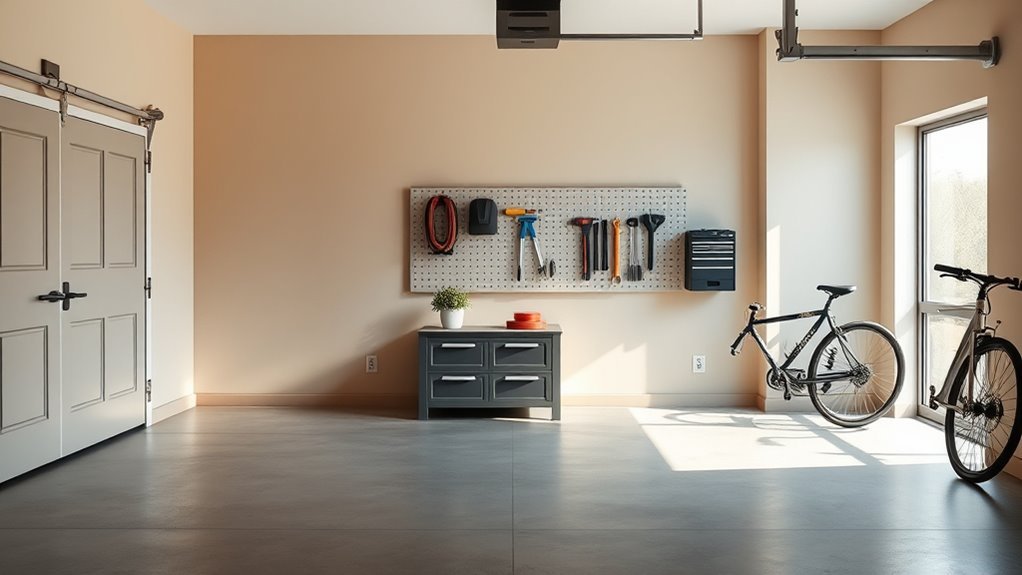
When choosing a garage wall color, pick shades that balance practicality and style—light grays and off-whites brighten the space and hide dust. Mid-tone blues and greens add calm without showing marks, and darker charcoals or navy hide stains and create contrast for tool boards.
You’ll want durable finishes and easy-to-clean paints. Consider garage color psychology: neutrals feel orderly, blues calm, greens feel restorative, and dark tones conceal wear.
Check seasonal color trends for fresh palettes, but prioritize longevity over fads. Test samples under your garage lighting, then choose a shade that supports tasks and maintenance.
Match Color to Garage Use
Now that you’ve narrowed down practical palettes, match the paint to how you actually use the garage. Think about garage functionality: if it’s a workshop, pick a color that boosts focus and hides grime; for a home gym, choose energizing hues; for storage or a laundry area, calm neutrals work best.
Use color psychology to influence mood and productivity—cool tones soothe, warm tones invigorate, and mid-tones conceal wear.
Balance aesthetics with purpose: paint zones differently for tasks, or keep one base color and add accent walls where you need energy or relaxation. Choose intentionally.
Quick Decision Framework: Light, Visibility, Durability, Budget
Because your garage serves specific needs, make decisions fast by weighing four essentials: light, visibility, durability, and budget. You’ll use color psychology to boost focus or calm, choose finishes that resist scuffs, and factor maintenance tips into long-term cost. Prioritize brighter hues for task areas, higher-contrast trims for tool zones, and durable enamel where wear’s worst. Budget dictates paint quality and prep time; invest in primer if stains or moisture exist. Use this simple matrix to match need to finish and keep plans practical.
| Need | Recommended finish |
|---|---|
| Light | Semi-gloss light hue |
| Visibility | High-contrast trim |
| Durability | Epoxy or enamel |
| Budget | Mid-range acrylic |
Why Light Neutrals Make Small Garages Feel Bigger
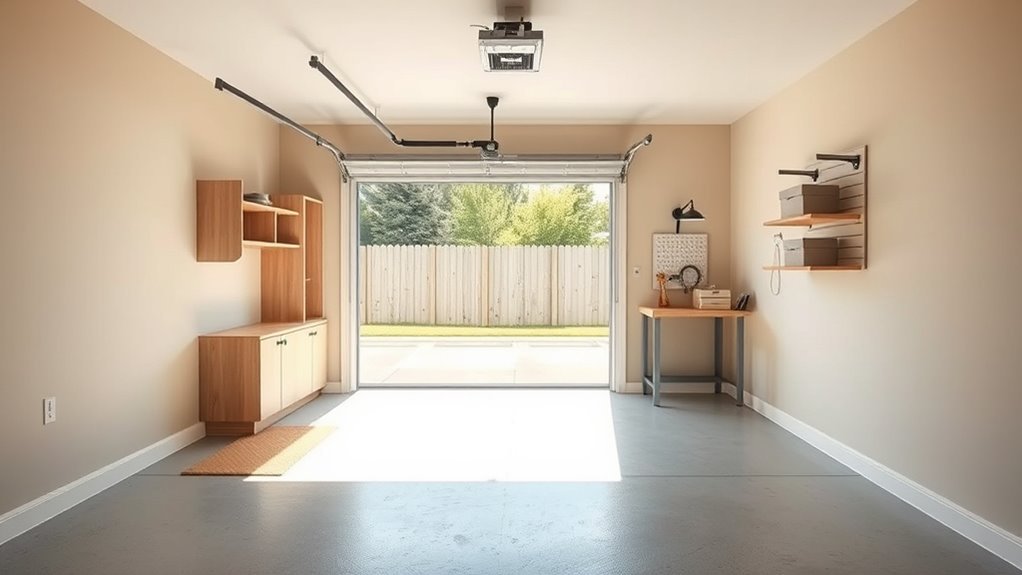
Choose light neutrals and you’ll let reflective light bounce around the room, brightening dark corners.
That increased brightness visually expands the space, making low ceilings and tight layouts feel airier.
Keeping a consistent neutral palette ties walls, trim, and storage together for seamless continuity.
Reflective Light Boost
When you paint a small garage in light neutrals, those pale walls bounce daylight and artificial light around the room instead of absorbing it, so the space instantly feels larger and more open.
You’ll notice reflective surfaces—like glossy cabinets, metal toolboxes, and polished concrete—work with those walls to amplify brightness. This lighting enhancement reduces shadows and reveals corners, making tasks easier and safer.
Choose a low-sheen paint for durability but keep some sheen on fixtures to maximize bounce. Pair light neutrals with strategic bulb placement to maintain even illumination without glare, keeping the garage functional and airy.
Visually Expands Space
If you want a small garage to feel more open, painting the walls in light neutrals makes surfaces recede and creates the illusion of extra space. You’ll tap into color psychology: pale tones reflect light and reduce visual clutter, improving spatial perception so corners feel farther away.
Choose finishes that keep surfaces subtle and matte to avoid glare. Use trim sparingly to keep lines clean.
- Pick warm or cool light neutrals based on natural light
- Keep ceilings lighter than walls to lift the room
- Limit bold accents to one area for balance
- Test samples at different times of day
Neutral Color Continuity
Because your eye reads uninterrupted pale walls as one continuous plane, sticking with light neutrals lets the room feel larger and more cohesive.
You’ll notice how soft whites, warm beiges, or pale greiges bounce light, reduce visual clutter, and create vertical flow so ceilings seem higher.
Use consistent neutral tones on walls and trim to maintain aesthetic harmony; contrast sparingly with storage or flooring for definition.
Color psychology supports calming, spacious impressions from muted hues, helping the garage feel like an intentional extension of your home.
Keep finishes matte to minimize glare and choose durable, washable paints for practical longevity.
When Mid and Dark Grays Create an Industrial Look
Though you might think gray feels cold, mid and dark grays actually give a garage a purposeful, industrial edge when paired with metal accents and exposed fixtures.
You’ll lean into industrial aesthetics by choosing gray tones that hide scuffs and emphasize structure. Use matte finishes to reduce glare and contrast them with steel shelving, conduit lighting, and concrete flooring for cohesion.
Keep trim minimal so the space reads unified and strong. Consider an accent wall in a deeper charcoal to anchor tool zones and workbenches.
- Add metal shelving
- Expose simple fixtures
- Use matte paints
- Anchor with charcoal
White and Cream Choices for Bright Workspaces
While mid and dark grays suit industrial spaces, white and cream transform a garage into a bright, functional workspace by reflecting light and making details easier to see. You’ll prefer crisp white for maximum brightness or soft cream if you want warm neutrals that still boost visibility. These tones expand sightlines, reduce shadows, and help spot small parts. Pair them with durable, washable finishes and good overhead lighting to keep the area practical. Use subtle contrast for storage without strong accents.
| Finish Type | Best Use |
|---|---|
| Gloss white | Reflects light, easy to clean |
| Off-white cream | Cozy, hides dust |
| Eggshell | Balanced sheen |
| Satin | Durable, subtle shine |
Accent-Wall Colors for Tool Walls and Workbenches
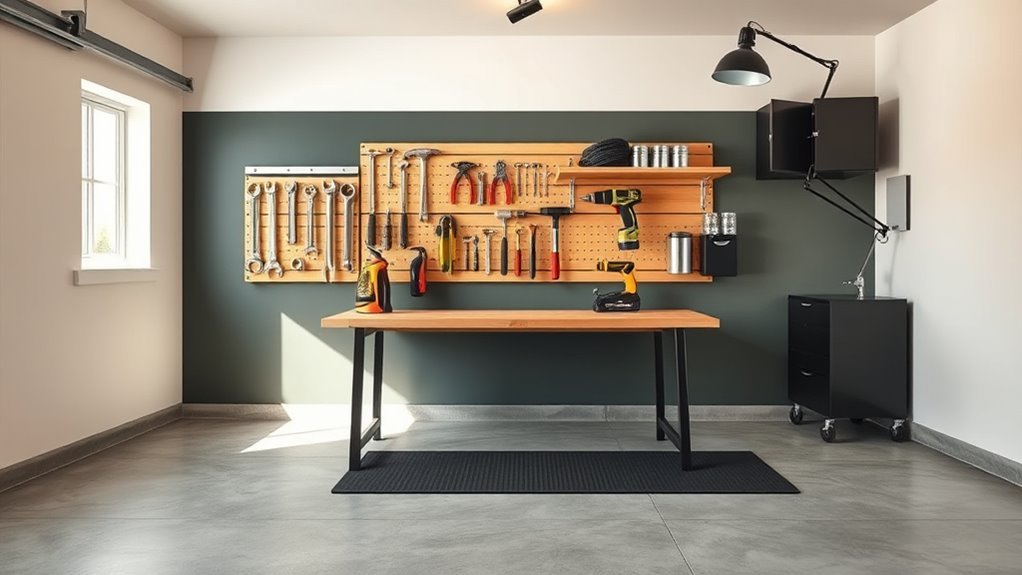
When you paint an accent wall behind your tool area, consider high-contrast striping to help tools stand out and stay organized.
A durable dark backdrop hides grime and makes hardware pop, while a bright task-focused hue over the workbench improves visibility where you need it most.
Mix and match these approaches to balance function and style.
High-Contrast Accent Striping
If you want your tool wall or workbench to stand out and stay functional, high-contrast accent striping is an efficient way to do it. You’ll use high contrast designs to define zones, improve visibility, and apply color psychology to boost focus.
Stripes guide the eye, highlight storage, and make tools pop against a neutral background.
- Use thin bright stripes to mark tool outlines and pegboard areas.
- Reserve bold bands for frequently used zones like the bench.
- Match stripe colors to tool handles for quick recognition.
- Keep widths consistent for a tidy, professional appearance.
Durable Dark Backdrop
Accent striping directs attention; a durable dark backdrop anchors it.
You’ll want a deep charcoal, navy, or matte black behind your tool wall and workbench to hide grime and emphasize hardware. The dark color benefits include camouflaging scuffs, reducing visual clutter, and creating contrast for mounted tools.
Choose tough, washable paint designed for impact zones so cleanup stays simple.
Think through maintenance considerations: dark finishes can show dust and fingerprints, so plan periodic wiping and good lighting to spot issues.
This backdrop keeps the workspace grounded and professional while highlighting your tools without distracting from function.
Bright Task-Focused Hue
Because your workbench and tool wall are where precision matters most, choose a bright, task-focused hue that boosts visibility and energy without overwhelming the space.
You’ll get better contrast for small parts, reduce eye strain, and create a task oriented ambiance that keeps you concentrated.
Bright color psychology suggests yellows and chartreuse for alertness, aqua for clarity, or a vivid gray-blue for calm focus.
Pick a washable, low-gloss finish to handle messes and light reflections.
Consider matching pegboard accents to your lighting for consistent contrast.
- Yellow for alertness and visibility
- Chartreuse for energetic contrast
- Aqua for crisp clarity
- Gray-blue for calm focus
Bold Color Ideas for Hobby Rooms and Man Caves
When you want a hobby room or man cave that energizes and defines the space, bold wall colors are the quickest way to make a statement—think deep navy for a cinematic feel, hunter green for a vintage clubhouse vibe, or a saturated charcoal to set off metallic accents.
Choose one strong hue and balance it with neutral flooring and trim so the room feels intentional. Use vibrant accents in furniture, art, and lighting to punctuate the mood.
Mix creative themes—retro racing, industrial workshop, or music studio—and keep finishes durable for spills, scuffs, and long nights of projects.
Garage Wall Colors That Coordinate With House Exteriors
If you want your garage to feel like an intentional part of the home, choose wall colors that echo or complement your exterior palette—think matching trim, a deeper shade of your siding, or a neutral that ties roof and brick together.
You’ll create color harmony between indoors and out, boosting curb appeal and cohesion. Consider how light and purpose affect tone: brighter for workspaces, softer for storage.
Exterior matching doesn’t mean identical—use contrast for interest. Test samples on boards and view them at different times of day to guarantee the selected hue reads well against your home.
- Match trim accents
- Deepen siding tones
- Neutral connectors
- Subtle contrasts
How Floor and Ceiling Colors Change Garage Wall Appearance
Although walls draw the eye, your floor and ceiling shape how those wall colors actually read—darker floors ground and deepen hues, light floors lift and brighten them, and a reflective ceiling can bounce color back onto the walls. You’ll notice wall color impact changes with finishes and contrast; a glossy floor amplifies saturation, a matte floor mutes it. Ceiling influence matters too: a warm-toned ceiling warms adjacent walls, while a cool white keeps colors true. Balance contrast to control perceived size and mood. Use samples under real light before committing.
| Floor Type | Ceiling Tone | Effect on Walls |
|---|---|---|
| Dark matte | Warm | Deepens |
| Light glossy | Cool | Brightens |
| Medium textured | White | Neutralizes |
Colors That Hide Dirt, Scuffs, and Tire Marks
Practicality matters most in a busy garage, so pick wall colors that hide common grime instead of showcasing it. You’ll want dirt resistant hues and scuff proof shades that conceal tire marks, fingerprints, and smudges without constant touch-ups.
Mid-tone neutrals and muted warm grays work well; avoid pure white and very light pastels that show every streak. Consider contrast with trim to mask lower-wall wear.
Balance aesthetics with upkeep so your space looks tidy between cleanings.
- Warm gray mid-tones
- Taupe and greige options
- Deep beige and clay
- Soft charcoal and slate
Paint Finishes: Satin, Semi-Gloss, and Epoxy Explained
Choosing the right color goes hand in hand with picking a finish, because sheen affects durability, cleanability, and how imperfections show.
You’ll find a satin finish balances subtle sheen and scuff resistance, so walls hide minor marks while staying easy to wipe.
Semi gloss gives higher reflectivity and toughness for trim or damp-prone areas, improving paint durability where you scrub often.
For floors or heavy-use walls, consider epoxy coatings; they resist chemicals, stains, and abrasion.
Focus on sheen effects when matching color, and follow maintenance tips like gentle cleaning and prompt touch-ups to extend finish life.
Use Light-Reflective Paints to Improve Garage Lighting
When you pick light-reflective paints, you’ll boost brightness with less energy because these formulas bounce more light around the room; that makes your garage feel larger and safer while reducing the need for extra fixtures.
Choosing light-reflective paint brightens your garage, makes it feel larger, and cuts lighting needs and energy use
You’ll get clear light reflective benefits: improved visibility, fewer dark corners, and easier task work. Choose high-LRV whites, soft grays, or pale neutrals for ideal lighting and match them to your fixtures.
Prep surfaces, use quality primer, and apply two coats for consistent reflection.
- Increase safety and visibility
- Reduce energy and fixture cost
- Highlight work areas effectively
- Maintain a clean, airy look
Garage Conversion Colors for Studios and Home Gyms
If you’ve brightened the space with light-reflective paints, think next about how color sets the mood for a studio or home gym.
Choose studio color schemes that support creativity: soft neutrals with an accent wall in teal or terracotta keep focus without distraction.
For home gyms, prioritize gym wall aesthetics that boost energy—muted grays paired with bold yellow or cobalt accents feel motivating and modern.
Consider durable, washable finishes and low-VOC formulas to protect air quality.
Test swatches under workout and natural light, then commit to a palette that balances functionality, vibe, and easy maintenance for daily use.
Garage Door and Trim Color Combinations That Pop
Although many homeowners focus on wall color, your garage door and trim are the focal points that define curb appeal, so pick combinations that contrast and complement the house palette.
You’ll want to evaluate garage door styles and trim materials to match architecture and weather resistance. Bold contrasts draw attention; subtle complements feel cohesive. Test swatches in daylight and photographed angles before committing.
Think about hardware finishes too.
- Deep navy door with crisp white trim for coastal or modern homes
- Charcoal door with natural wood trim for rustic charm
- Black door with stone-colored trim for high contrast elegance
- Sage door with cream trim for soft, earthy curb appeal
Pattern Ideas: Stencils, Stripes, and Color-Block Layouts
You can make a garage wall pop with a stencil accent wall that adds pattern without overwhelming the space.
Try bold striped patterns for a modern, athletic vibe that also helps visually organize the room.
Mix a stencil focal panel with a complementary stripe or color-block section for a coordinated, custom look.
Stencil Accent Walls
- Start small with a focal section.
- Test colors on scrap drywall.
- Use a roller for even coverage.
- Seal with a clear topcoat for durability.
These walls add charm without overwhelming the space.
Bold Striped Patterns
If you liked the subtle impact of stencil accents, try bold striped patterns to make a stronger statement in your garage. You can use bold color combinations to define zones—tool wall, workbench, storage—so each area reads clearly.
Vertical stripes add height; horizontal stripes widen compact spaces. Choose widths and spacing that match your tools and shelving, and test samples on scrap drywall to confirm contrast under garage lighting.
Keep shifts crisp with painter’s tape and a level. Striped designs work with utility finishes—durable epoxy lower walls, washable satin above—creating a practical, eye-catching workspace.
Test Paint Colors in Your Garage Before Painting
Before committing to a color, test several paint samples directly on different garage walls so you can see how light, shadow, and the concrete finish affect each hue; this lets you compare tones in real conditions and avoid surprises once the whole space is painted.
Apply sample paint swatches in 2–3 large patches at eye level, noting morning and evening light. Try test color combinations beside cabinetry and floor sections to guarantee harmony. Live with patches for several days before deciding.
Apply large paint patches at eye level, observe them in morning and evening light, and live with them for days.
- Place swatches near the door and workbench
- Evaluate under artificial light
- Photograph patches at different times
- Note texture interaction
Maintenance-Friendly Coatings and Stain-Resistant Options
Once you’ve lived with sample swatches and confirmed a color that works with your lighting and layout, pick a paint system that stands up to garage life: look for maintenance-friendly, stain-resistant coatings that clean easily and resist oil, grease, and scuffs.
Choose maintenance coatings formulated for high-traffic, washable surfaces—epoxy-modified or acrylic-urethane blends often perform best. For walls near workbenches, add a semi-gloss or satin finish to shed dirt.
Evaluate stain resistant options labeled for automotive fluids and household chemicals. Test-clean a small area to verify marks lift with detergent or degreaser, then proceed with full coverage.
Budget-Friendly Garage Wall Colors and Where to Save
You can cut costs by choosing the right paint and skipping an unnecessary primer when the surface is sound.
Use strategic accents on one wall or trim to get a stylish look without buying extra gallons.
Pick durable, low-cost finishes like washable satin to save long term on maintenance and touch-ups.
Paint vs. Primer Costs
Think of primer as an investment: it helps paint adhere, hides stains, and can let you use fewer topcoat layers, which often saves money in the long run.
You’ll weigh primer types and do a clear cost comparison: basic latex primer costs less upfront, stain-blocking and bonding primers cost more but cut repainting and extra coats.
For paint, higher-quality topcoats cover better, meaning fewer gallons. Balance primer choice with paint quality to minimize total spend.
- Choose primer by surface and stain level
- Compare gallons needed vs. coverage rates
- Factor labor or time saved
- Buy sample sizes first
Strategic Accent Placement
While keeping most of your garage walls in a neutral, budget-friendly shade, use small, well-placed accents to inject personality without buying extra paint, hiring pros, or committing to full-wall coverage. You’ll focus accents where they count: tool zones, shelving backs, or a single column by the door. Use accent wall techniques like bands, stencils, or framed panels to guide sightlines and apply color psychology—cool blues calm, bright yellows energize. Save by painting only focal strips and swap colors seasonally. Small, deliberate strokes deliver big impact.
| Mood | Placement | Effect |
|---|---|---|
| Calm | Behind workbench | Focus |
| Energetic | Entry strip | Wake |
| Clean | Shelving back | Order |
| Bold | Column | Statement |
Durable Low-Cost Finishes
Because your garage gets heavy use and budget matters, choose finishes that stand up to scuffs, moisture, and dirt without breaking the bank. You’ll want durable options like semi-gloss paint or epoxy coatings that resist marks and clean easily.
Focus on cost effective solutions by painting only high-traffic zones, using neutral base colors, and reserving accents for small areas. Save by prepping yourself and buying contractor-grade products.
Consider sealers for concrete to prevent moisture damage without full resurfacing.
- Semi-gloss latex for walls
- Epoxy or roll-on floor coating
- Concrete sealer on slabs
- Targeted accent painting
Quick Checklist to Pick the Right Garage Wall Color
If you want a garage wall color that looks good, lasts, and fits your needs, run through a quick checklist before buying paint: note lighting and room function, test samples under different light, choose a finish that hides imperfections, factor in temperature and humidity, and match trim and flooring tones. Use color psychology to set mood and consult trending palettes for modern choices. Keep maintenance and resale in mind. Below is a quick decision guide:
| Consideration | Action |
|---|---|
| Light level | Pick lighter tones for dim spaces |
| Function | Workshop vs storage |
| Finish | Satin hides flaws |
| Climate | Use moisture-resistant |
| Sample | Test 2–3 days |
Frequently Asked Questions
Can I Paint Garage Walls Myself or Should I Hire a Pro?
You can paint garage walls yourself if your DIY painting skills match the job; you’ll save money. If skill level, time, or finish matter, hire professional services after a cost comparison to avoid mistakes and delays.
How Long Does Garage Paint Typically Last Before Recoat?
Typically you’ll need a recoat every 5–10 years depending on paint durability; high-quality epoxy or acrylic holds longer. For maintenance tips, clean regularly, fix moisture issues, and touch up chips to extend lifespan.
Are Low-Voc Paints Safe for Poorly Ventilated Garages?
Like a soft breeze, yes—you can use low-VOC paints safely in poorly ventilated garages because low voc benefits reduce fumes; still, you’ll want ventilation solutions like fans, open doors, or temporary filters to minimize exposure and speed curing.
Do Garage Wall Colors Affect Home Resale Value?
Yes — your garage wall colors can influence resale value; you’ll want neutral, clean tones since resale trends favor subtle palettes, and color psychology shows calm, bright neutrals make spaces feel larger, safer, and more marketable.
How Do I Prep Concrete Block Walls Before Painting?
Think of it as giving the wall a fresh handshake: you’ll scrub with degreaser and stiff brush, rinse, repair cracks, then choose primer options like masonry or bonding primers; let dry thoroughly before applying paint.
Conclusion
You’ve got plenty of solid options, and you’ll pick what fits your space and budget best. Keep practical things—light, visibility, durability, and maintenance—front and center, and test swatches before committing. Light neutrals open small garages; mid or dark grays give an industrial edge. Choose stain-resistant coatings if you want low upkeep. Trust your gut, but let function lead; like a good roadmap, these tips’ll guide you to a garage that actually works for you.
